First, let me remind you: be sure to join us tomorrow night starting at 8:00 p.m. ET for our TPM’s YouTube livestream coverage of the election night results. It’ll be me, TPM Publisher Joe Ragazzo and different members of the TPM team will cycle through over the course of the evening, discussing different races, sharing color commentary, answering your questions in real time, etc.
As you’ve likely seen, a final round of NYT/Siena polls came out last night and they point to the bottom falling out for the GOP in key Senate races across the country. As Kate Riga and I have discussed in numerous TPM Show episodes, the NYT/Siena poll is a high quality poll which for a variety of not terribly good reasons (largely the Times’ megaphone, but also getting closer than others in a few key cycles) has influence and impact far greater than any other poll. I saw an apt comment from Nate Silver this morning, essentially, the polls no longer say this is close. The polls, collectively, say Democrats will win the senate. They could be wrong. But what they’re saying is no longer ambiguous or too close to call.
Here’s the most interesting datapoint out of Times’ poll analyst Nate Cohn’s discussion of these final surveys. After the 2024 election, Times/Siena re-weighted their polling methodology to more accurately capture hard-to-reach Trump supporters. Generally these are non-college, non-Hispanic whites who Trump is particularly able to bring to the polls.
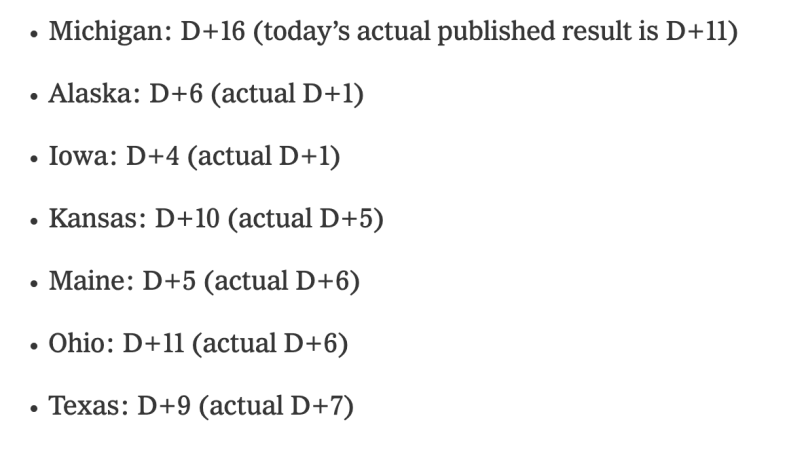
As you can see here, this change pushes these new polls significantly in the GOP direction. As Cohn puts it, it’s truly a choose your own adventure scenario.
First, a minor point. You’ll notice that the delta between the two weightings is not uniform. In Kansas and Ohio it halves a Democratic lead. In Texas it’s just two points. This reminds us that in the Trump era, Texas polls have been pretty accurate. And that’s likely because the share of non-college, non-Hispanic white voters in Texas is much smaller than in these other states.
The most important thing to remember about this re-weighting is that they did this for a reason: the very real underestimation of Republican voters in the Trump era. So we shouldn’t just be thinking, “Oh cool! Look, the real number is even better!”
That said, you can see here and more broadly, how there are very real paths through which all these polls could be systematically underestimating Democratic strength rather than the GOP underestimation everyone is focusing on.
Here’s one question I don’t have a good answer to.
We’ve previously discussed the clear difference in polls between Trump-era presidential and midterm years. They underestimate Republicans in presidentials (2016, 2020, 2024) and are pretty dead on in midterms (2018, 2022). It seems like they’ve taken a re-weighting designed to correct misses in 2024 and applied it to a midterm cycle, despite the fact that we haven’t really seen those misses in midterms. Cohn doesn’t address this in a crystal clear way. But he seems to be saying that is what they’ve done.
Here’s Cohn (emphasis added)…
What does all of this mean for 2026? Well, you can choose your own adventure. More than anything, it illustrates how hard it is to predict how the polls might err.
Maybe it implies that we’ve adopted weighting techniques that can handle the problems that caused the Times/Siena poll to overestimate Democratic strength in the past, especially in white working-class states. If so, maybe we’re dead-on.
Or perhaps one could argue that the Times/Siena polls will underestimate Democrats. Our polls were accurate in 2018 and 2022, after all, so maybe one should trust the old approach in a midterm election. If so, maybe the Democrats will do even better than our polls suggest.
As Cohn said, choose your own adventure. More broadly, polling error is fundamentally unpredictable. We’ve come to know the specific issue of non-white, non-Hispanic white voters and their characteristic reluctance resistance to participating in polls. But there are lots of potential sources of polling error. We won’t know the results until we know them.