


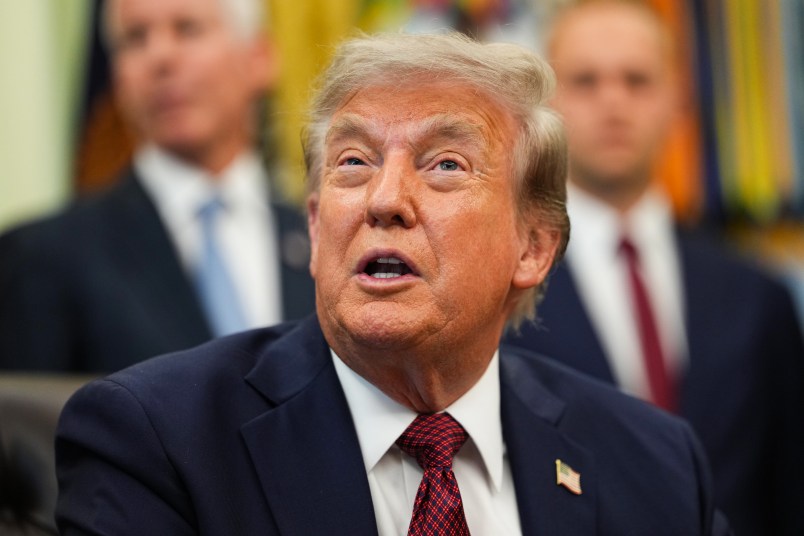
One of our great doctrines here in the Editors’ Blog is that all power is unitary. Lose or gain it in one place, and you lose or gain it in equal measure everywhere else. That’s catching up with Donald Trump. He got into the Iran War as a way to escape the emotionally crushing experience of declining popularity and power at home. But his ebbing power went with him to the Persian Gulf. And now it’s arrived in Israel, too. This was obscured for a while by the fact that the U.S. has almost unimaginable military power and a constitution which, as it has evolved if not how it was originally intended, puts almost no short-term limits on a president’s ability to wage war. But the two were always umbilically connected. It was the pain of bad news at home that spurred Trump to jump so recklessly into his Iran debacle. And it is the same unpopularity that has him so desperate to end high gas prices and inflation before the midterms. They’re all connected.
Trump has no poker face. To live in Trump’s era is not only to see his inner life but to be engulfed by it. It’s hard to think of a case in which the deciding player between warring powers has more clearly signaled his desperate desire to get out of a conflict on almost any terms. The Iranians have internet too. And they can see all of this. They have now issued a fresh set of new demands: end sanctions, leave the region, pay reparations, release frozen assets and more — in addition to make the Strait of Hormuz a permanent Iranian toll road. More or less total capitulation.
One could imagine a scenario in which there was a tacit meeting of the minds between Trump and the Iranian government. Yes, Trump wants out. But as much as Iran has gained at the United States’s expense over the course of the war, it has also sustained a vast scale of damage to its civilian industrial base. Last winter’s protests were spurred by the already bad economy. So economic revival of some sort is critical to the regime’s medium and longterm survival. So Iran still has strong reasons to want to bring the conflict to an end. And yet they’re not. Trump’s desperation is so great that they are not taking that path. They’re upping the ante again and again. They think they have Trump over a barrel and they’re right. They want to hurt Trump as much as possible. And they don’t think they’ll pay much price for driving a hard and humiliating bargain.
Meanwhile, Israeli Prime Minister Benjamin Netanyahu is now openly rejecting the proposal put together by Trump’s “Board of Peace” which envisioned a staged process of disarmament by Hamas and Israeli withdrawals from Gaza. This is a more complicated story. In large part it is also a reflection of Trump’s ebbing power. But it also intersects with Israel’s election, which takes place on October 27.
Israeli politics have been in a state of crisis since 2022. For almost a year before the Hamas massacres in southern Israel, which began the war on and reoccupation of Gaza, weekly mass protests roiled the country. Since those attacks, Netanyahu has been consistently unpopular. But he had managed to claw back some of his support because of the Israeli successes against not only Iran but its proxies in the so-called “axis of resistance,” especially Hezbollah in southern Lebanon. But in recent months, Netanyahu has felt the inevitable downside of his alliance with Trump and, on a longer time scale, his alliance with the U.S. Republican Party — a point we’ll return to in another post.
Trump has made increasingly clear in public statements that he owns Netanyahu and, for that matter, Israel itself. He decides and Netanyahu complies, according to Trump. That is a particularly toxic claim in Israeli political culture, which prizes sovereignty and independence of action in the national security sphere almost above all else. That has taken all of Netanyahu’s other sources of domestic unpopularity and added two critical new ones. The first is that Netanyahu has become Trump’s poodle, according to Trump. The second is that Netanyahu placed all of Israel’s bets on Trump and the GOP. Now that looks like a questionable bet. Trump has grown tired of Israel’s demands. They’ve become inconvenient. And anti-Israel sentiment is growing within the GOP quite apart from Trump. The New York Times had this interesting article about how Israelis now fear that the loss of U.S. support isn’t a rough patch but permanent — something that many liberal Zionists including myself have been warning about for a generation. (Again, for another post.)
It’s in this context that Netanyahu has lots of reasons to resist this new deal. He might have done so anyway. He probably would have in substance. But Netanyahu is a past master at agreeing to and slow-rolling deals he wants to kill but can’t quite do so openly. Openly rejecting this deal is a choice and one driven by very specific domestic electoral weaknesses.
Netanyahu needs to show that he doesn’t answer to Trump. He needs to buttress and intensify support within the right-wing camp in Israel to have any hope of remaining in power after the next election. (The intensification of settler violence in the West Bank can also only be understood in electoral terms.) Picking a fight with Trump is critical to both aims. But if Trump didn’t look so weak at home he wouldn’t be doing it. As with Iran, Israel’s refusal to bend to Trump’s will goes back to his own declining popularity and power at home.