


The New Republic has a new piece out by Adam Bonica and Jake Grumbach called How the Consulting Class is Eating the Democratic Party. It’s a very interesting piece and I recommend it to you. The following is a series of comments, responses, thoughts, not necessarily in any particular order. That’s in part because this is a big article and in a several different articles bundled into one, some parts of which I agree with more than others.
The basic gist is that you have a Democratic consulting industry based on profit maximization which is burning through Democratic Party patience, commitment, money rather than cultivating them for the long haul. That expresses itself through high-pressure, doomy fundraising asks and by SuperPACs, fundraising vendors, consultants, etc. who spend a huge amount of fundraising dollars on fundraising itself. Here’s one key passage from the piece …
Even averaged across all itemized donations, including the wealthy mega-donors writing checks, Democratic campaigns now spend 45 cents of every dollar on fundraising costs, a fourfold increase since 2004. Today’s campaigns like to imagine themselves as efficient machines, remade by big data and microtargeting. In reality, they are less efficient and more extractive than at any point in modern history. Most charity watchdogs will not certify an organization that spends more than 35 percent of its revenue on fundraising.
That delta between 45% and 35% is key and important and I want to come back to it. Note that when they talk about mega donors that means that the percentage is probably substantially higher when we talk about the email solicitations to ordinary people we’re really talking about.
Bonica’s and Grumbach’s global argument is that Democratic fundraising goes through two huge extractive processes. First is the fundraising one we were just describing and next is that consultant advertising one. The key there is that consultants get a cut of the ad budgets they run and thus a strong and direct incentive to spend a lot on ads. Here’s another key passage.
This media consulting structure comes from a bygone era of commercial advertising. Under the old-school commission model, a company like Coca-Cola hired an ad agency, and the agency would take home a percentage of Coca-Cola’s ad spending as a commission. This created an obvious conflict of interest: The ad agency had an incentive to encourage more ad spending, regardless of its effectiveness. For this reason, commercial advertisers abandoned the commission model decades ago in favor of flat fees and retainers. Where commissions still exist in commercial advertising, they’re tied to the impact of direct ad exposure on “conversions”—but in politics, no one can prove that an ad moved specific votes.
But political campaign ad buys never modernized. Consulting firm income rises with spending, not with success. A consultant who places $20 million in ineffective ads earns twice as much as one who places $10 million in highly effective ads. The incentive is to maximize spending, not win elections.
These are two important, global points and they point to the need for some pretty straightforward reform. But before getting to that I want to note a few points.
Bonica and Grumbach repeatedly focus on the timeframe of the last 20 years, using the benchmarks of 2004 and 2006. This jumped out to me because those years are more or less the origin points of the democratization of political giving. And though I had no direct involvement in it I was about as adjacent to it as you could be. Some of its beginnings started in the nascent advertising market on political junkie sites like TPM in 2003 and 2004. At the time it was a revelation, a veritable explosion, that campaigns — often independent ones, ones operating outside the traditional party ecosystem or even averse to it — could go directly to individuals giving small amounts of money. It was genuinely revolutionary.
Given the centrality today of fundraising emails, Act-Blue, it’s hard to remember that 25 years ago political contributions by ordinary people was all but unknown. It was always possible in theory to send a $10 or $50 or $100 check to a campaign. But in practice that was not at all how campaigns were funded. If you were really hyped up about politics in 1998 or 2002 and you wanted to put your dollars to work you mostly wouldn’t know where to send it. Campaigns were funded by a giving class of people who went to fundraisers of various sorts and people who gave in sufficient sums that they could be called and solicited. Some of this was done by mail, especially on the right. There was a whole universe of direct mail politics built up by innovators like Richard Viguerie. But that tended to be for political groups more than campaigns, and it was dominated by the right.
I want to be clear that none of this history undermines the authors’ basic arguments. If anything it strengths them. But I think it’s key to understand that this period of roughly 20 years in which they chart the rapid increase in the cost of fundraising and thus the percentage of fundraising dollars that go — not to campaigns but back into fundraising — basically lines up precisely with this era of the democratization of campaign funding, which is mostly tied to the Internet.
Another related point. The authors talk about burning out Democratic givers through the constant harassment we all know about. And yet Democratic small donor giving has become a more and more critical part of Democratic campaigns as Republicans have become increasingly and now overwhelmingly reliant on billionaires. And I have yet to see any real evidence that that source is being burned out and tapped out. We are all exhausted, harassed and hate the mails. Fundraising email rhetoric has become, essentially, self-consciously parodic and self-awarely stupid. I couldn’t agree with you more. And I think it’s a problem. But again, it keeps happening because it works. I don’t think there’s any evidence to date that that has changed.
Once again, I don’t think it defeats Bonica’s and Grumbach’s basic argument. But as they do so well in most of their analysis, I think we should maintain the distinction between what we feel and what we can quantify.
All of this builds to this chart from the authors which, as you can see, argues that of a $100 contribution by text or email solicitation $65 goes to fundraising fees, another $8 goes to various consultant cuts and then about $27 goes to the actual campaign, basically split between the costs of running an actual campaign and advertising.
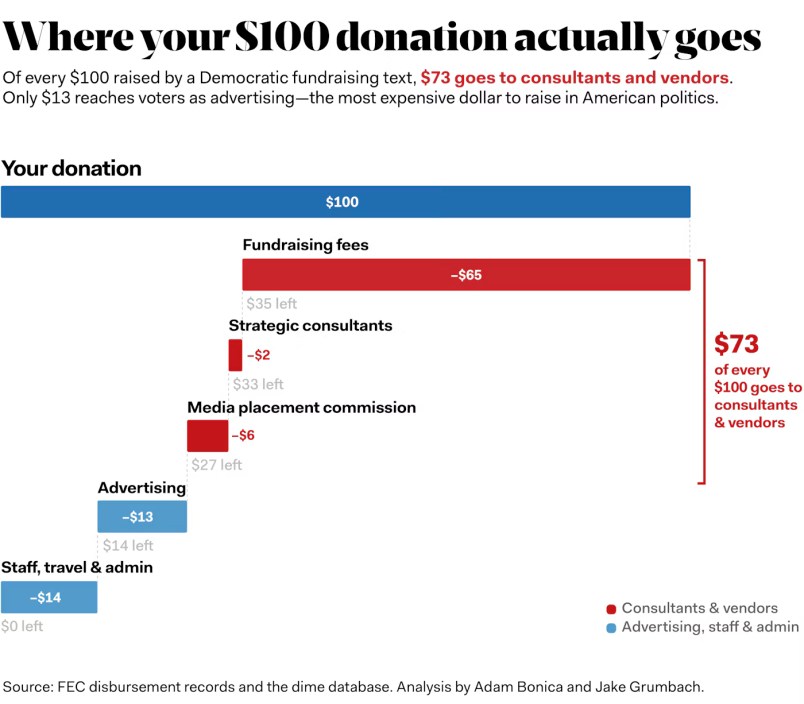
As the author’s note, this is the most expensive way to raise money. It’s much less if you go to a campaign website yourself and give directly. But obviously a huge amount of donations happen this way and I would think an even larger amount start this way, like, maybe you first give to a specific campaign from this sort of solicitation but then later you give directly, etc.
There is a whole portion of the piece that argues in essence that there’s no evidence that political advertising works, especially in general elections as opposed to primary elections. I don’t find this convincing. I think it’s much more unknowable than that. There are so many different confounding factors, and it is so inherently difficult to tie ads to the fundamental goal — vote choice — that you simply can’t answer the question in any meaningful or definitive way.
But I don’t think we need to. My own background, both as someone close to political work for years and earlier as an historian, tells me that there’s always a seamy underbelly of the world of political campaigns with a decent amount of charlatan-ing, profiteering and just things that are chaotic and weird. So I come at this from a sort of different perspective. But Bonica’s and Grumbach’s piece is a very good and helpful argument for at least two basic structural reforms that would change this picture significantly for the better. I don’t think they can or should be done by law. But there are big enough players in the Democratic ecosystem that they could be done by key players using what amounts to their market power.
The first goes back to that point about what charity watchdogs consider an acceptable amount of fundraising dollars for charities to pump back into fundraising. Political giving isn’t exactly like charitable giving. There are significantly different dynamics. So I want to hold open the possibility that the 35% threshold for some reason shouldn’t apply in political giving. I see no reason why it shouldn’t. I’m just open to hearing arguments. But I know from years of our own journalism that there are outfits that are just churn operations, basically giving almost nothing to actual candidates and mostly just funding their own churn-operations. Let’s assume the threshold should be 35%. Whether it might need to be a bit lower or higher isn’t the point. The dominant players in the space could create an entity that would monitor this and grade organizations akin to Guidestar, which could say whether players in the ecosystem are legitimate or not. By the dominant players I mean the DNC, DCCC, DSCC. Presidential campaigns could be pressed to support the number. You have your big SuperPACs but those tend to come and go. In any case, it’s doable. And it should be a priority to get it done.
It wouldn’t instantly work its way down to retirees who are vulnerable to hyper-aggressive pitches. But the brand and certification would take on a lot of weight. And the scammy operations need to use email vendors, payment processors, data list vendors, etc. and, over time, the legit operations could refuse to work with payment processors or email vendors who don’t enforce. It’s complicated but doable.
The other is that the same kind of stakeholder power and shaming needs to be used to change the advertising placement fee structure. You have a basic series of disagreements, that overlap, if imperfectly with ideological and factional party divisions, about the relative value of advertising, organizing and field operations. Like a lot of things I think the answer to which is more valuable and important is ‘it depends.’ There’s certainly a lot of reason to think that the focus on paid advertising is too high, especially over the medium and longer terms. But the best way to deal with this is to change what is certainly the perverse incentive structure, which gives advisors and outside consultants, who especially small campaigns lean on so heavily for advice, a clear financial incentive to privilege ad spending.
Since so much of the industry is based on this fee structure, there are obviously massive forces of inertial resistance against change. But reform always faces those kinds of entrenched interests. And the ultimate stakeholders are Democratic voters and those who fund the campaigns. Change is doable in just the way I described above — getting the stakeholders with the most clout and biggest budgets to insist on it. There’s no better time than in a period of internal tumult, low trust, generational turnover and reform to insist on it.
Changing the financial incentives has the key benefit of allowing us to be agnostic about just how much a given campaign should be spending on ads versus other things — something I don’t think we have much ability to really know from the outside.
It’s a good and important piece. Regardless of one’s particular points of agreement or disagreement, my take is that it points to a handful of relatively simple in concept, if not execution, reforms that most Democratic stakeholders, from big committees to individual small donors and voters, should be able to get behind.