


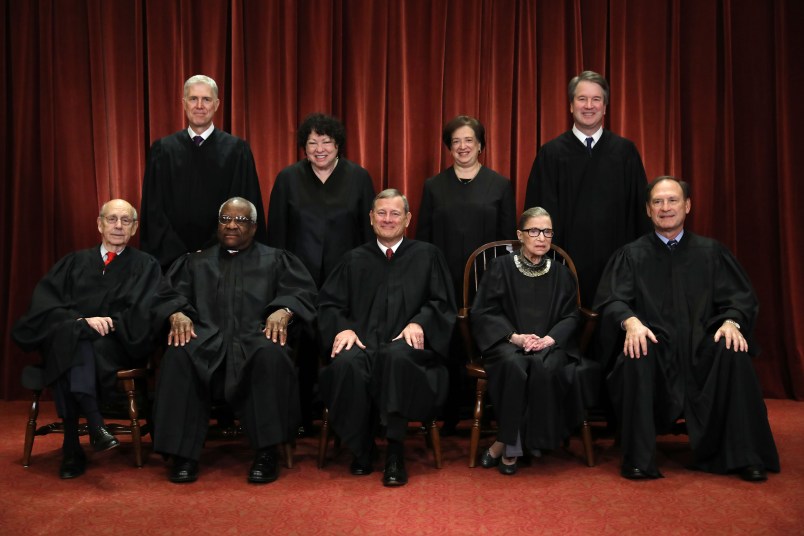
I’ve written again and again that reforming the Supreme Court — neutralizing the corruption represented by the current rogue majority — is the sine qua non of any good future for the American republic. I want to give you another example of this centrality.
Recently I was talking to someone very versed in federal employment law, the framework that undergirds the employment of the people who make the federal government run. There’s a neverending stream of proposed regulations and rules. We were discussing some new news on this front, how it might play out in the future, etc. When I have these kinds of conversations with knowledgable people, I’ll generally ask what they are hearing about groups emerging in their area for the purpose of creating Project 2029-like lists of reforms to undo the damage we are seeing today. It’s not just turning things back to the status quo ante, as we’ve discussed. We’re in an era in which it’s critical to make major structural changes when the opportunity arises and build new structures that are more durable than the ones which have fallen so quickly over the last decade and specifically the last year. So you need smart people putting time into this work during the next three years, really thinking it through and having that list of reforms ready, support built them, etc. You get the idea. We’ve discussed this before.
But I heard something I’ve heard before that goes to the heart of all of this. The person told me that yes there are discussions and groups but they’re kind of in stasis or people don’t know quite how to approach it since they realize that as long as you have the Roberts Court does the work even matter? This is the core point. You can come up with various reforms. But you have a corrupt Supreme Court, so they’ll just manufacture pseudo-constitutional arguments for why they’re not okay. It’s really as simple as that. We’re now locked into public policy which fits an aggressive version of right-wing pseudo-constitutionalism and, even more, a jurisprudence aimed at keeping federal policy in line with the electoral and political interests of the Republican Party.
You can see what’s happening here. The fact that the policy and legal worlds, and certainly the electoral political world, haven’t come around to the necessity of reforming the Court means that a lot of core policy work isn’t even happening. If it is happening, it’s wildly warped by the expected collision with the Roberts Supreme Court. You have these two tectonic plates of realization moving. First, people can see that under the current Court, only minimal Democratic government will be allowed and any public policy reforms passed by Democrats are more or less automatically unconstitutional. As of the last half dozen years, people get that these are the new rules but there’s only a very limited dawning of the idea that something has to be done about it and that something can be done about it. This isn’t like amending the constitution. It can be done. Get a trifecta, kill the filibuster and you can do it all on simple majority votes.
The point is that the corruption of the Supreme Court is actually beginning to slow, disincentivize, detour policy work. It could not be more critical that people across the Democratic world — policy, law, electoral politics — have this realization. There’s no reason to accept a situation in which democratic self-government is only allowed now for Republicans.