Gordon Wood Dies at 92

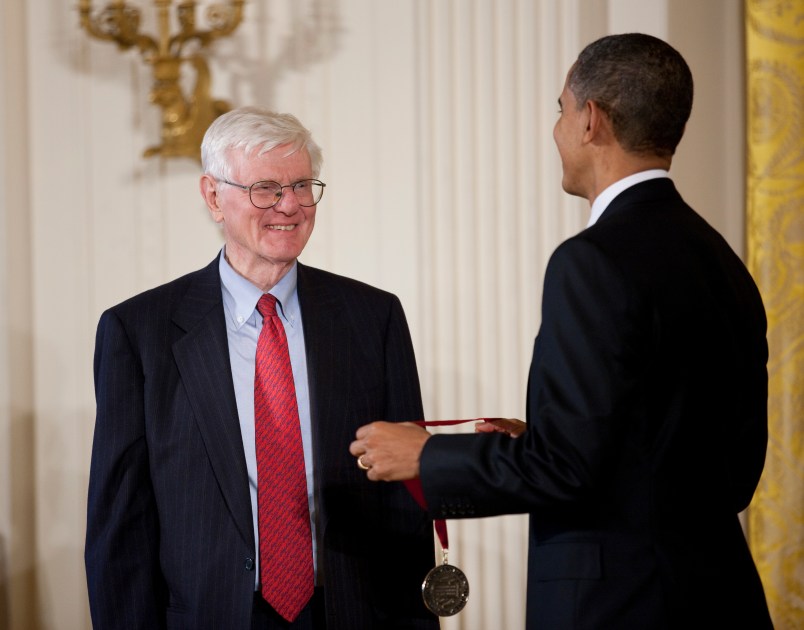
President Barack Obama presents a National Humanities Medal to author, historian and Brown University professor emeritus, Gordon Wood during a ceremony in the East Room of the White House in Washington. (Photo by Bro... President Barack Obama presents a National Humanities Medal to author, historian and Brown University professor emeritus, Gordon Wood during a ceremony in the East Room of the White House in Washington. (Photo by Brooks Kraft LLC/Corbis via Getty Images) MORE LESS

I just heard the news that Gordon Wood, a towering figure in the scholarship of Early American history, died yesterday at 92. Adding more upset to the news is the fact that he died after being struck by a car in East Providence. He died later in a Providence hospital. (One knows that people in their 90s are in the last years of their lives; a violent death like that makes it more of a gut punch.)

As I’ve mentioned a few times over the years Wood was my dissertation advisor at Brown. So he played an important role in my life. What ended up being my area of specialty, the topic of my dissertation, was pretty distant from the focus of his scholarship. He was concerned with the decades surrounding the American Revolution and the early Republic. My focus was on the middle 17th century and the interplay between economic interactions and inter-communal violence between English settlers and the Indians of Southern New England. In a way he indulged my interest in these questions that were pretty far from his. He had very little time for cant or jargon or, as he saw it, theory.

His greatest impact on me may have been as a writer. Wood was what I would call business-like as an advisor. Not long after I arrived at Brown in the Fall of 1992, I went up to talk to him after a lecture class I was taking with him and also to get back a paper I’d written. As he handed me the paper, he told me with a sort of glancing wince that I needed to learn how to write clearly, or just better. He may have just said, you don’t write very well. (I may still be trying to soften the moment in my recollection more than 30 years later.) I had not been aware this was a problem. So it was a predictably crushing thing to hear. I asked him what he suggested, as we both stood there at the front of the lecture hall, now with most of the undergraduates filed out. He told me to get a book called Style: Toward Clarity and Grace. I did that. I got it and pored over it and it ended up becoming foundational to pretty much all my understanding of how to write.

There’s a strong element of graduate education, perhaps especially in the humanities, that is a bit like confronting God. Because your advisor is basically a god. Whether they’re one generally is one thing. Among historians Wood was about as close as you get to God-status. But I mean it here in the sense that that person holds a lot of your fate in their hands. There’s a lot about graduate education that can be isolating. So that experience can be intense. You spend a lot of time thinking about your advisor’s take on you. When they come down from on high with tablets for you to study you study them for everything they contain. And maybe more than that.

Some advisors are gods of wrath, others are maybe Jesus feeding people and being warm and fuzzy, some are kind of mainline protestant: stately, business-like, not too much emotion. Wood was like that, in my experience, the mainline protestant type. He also had an infectious smile.

Another conversation in Wood’s office remains with me. After my preliminary exams, which you take after a couple years of course work before you begin on your dissertation, I began questioning whether I really wanted to be an academic. I’d managed to get a paper published in a respected academic journal that year and I’d done well on the exams and I think the relative success made me slow down and question whether this was what I really wanted to do. It was a foundational crisis of confidence about the direction of my life. I’d been sure I wanted to do this since high school. But suddenly I was very uncertain.

At some point I went to Wood’s office to discuss my doubts with him. I think I wanted him to get me back on track, say something that would quell these doubts. After we discussed the matter he said to me, “What it really comes down is that there’s an audience of maybe 300 people you’re writing for. And you have to decide whether that’s enough for you.”

The comment hung there in the air. I had the impression from him that he was expecting a yes, that this framing of the matter would lock things down for me. That was the logic of the conversation. But sitting there, I remember very clearly thinking in my head, no, it’s really not. It’s really not at all.

I didn’t say that, of course. You don’t speak to God that way. I don’t know what I said. I just remember the moment of realization because he framed the matter in a way that clarified everything for me, just not in the way I expected and, at least then, wanted.

I may write more on Wood’s scholarship. But you can read that from others and probably more expertly. I thank him for his impact on my life.