


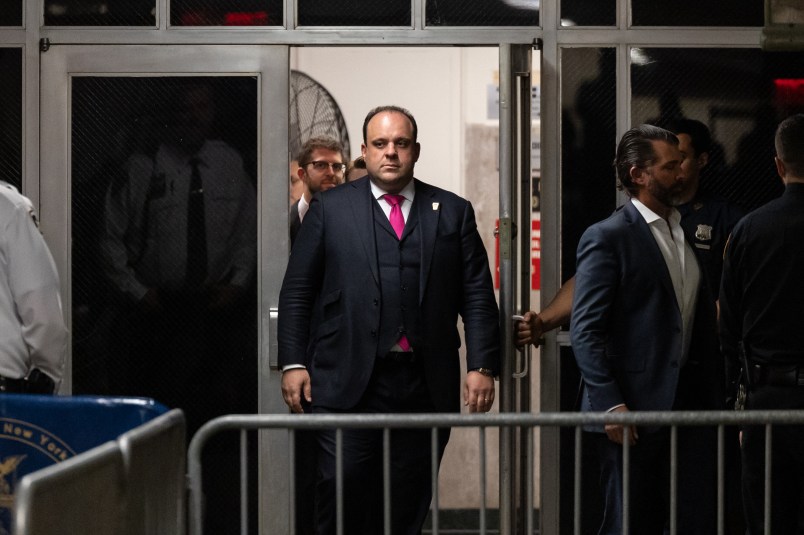
Crain’s Chicago has a piece on the law firm deals. It focuses on Chicago-based Kirkland & Ellis. The conclusion is the same. There’s no written document. It’s only the bullet-pointed text they shared internally and which Trump posted on Truth Social. When I wrote about this yesterday I realized that there was something that seems so clear that I don’t seem to have said it explicitly enough. So let’s do that: the real goal here is to gain leverage over the firms – regardless of what these notional agreements say – and stop them from taking cases that are in any way unhelpful to Trump, including but not limited to lawsuits fighting his various illegal actions. But the most interesting new information I learned yesterday I found in this article in The Wall Street Journal, which explains that the entire negotiation process is being lead by Trump lawyer and fixer Boris Epshteyn.
It’s hard to know what the ‘WTF’ metric is for Trump administration actions these days. Epshteyn does not work for the government. It’s not clear that he has any law practice at all other than working for Donald Trump. If anything makes it clear these aren’t agreements with the US government or even the current president, this is it. These are personal agreements with Donald Trump, negotiated by his personal lawyer, who doesn’t even nominally have a position in the US government, to forestall illegal actions and abuses of power which Trump threatens to take with his powers as President.
But Epshteyn isn’t just anyone. As the Journal notes, he’s been repeatedly accused of shaking down potential nominees for consulting contracts, sort of finder’s fees, as it were. Indeed, Trump’s former lead campaign lawyer and now White House Counsel David Warrington recommended that Trump cut ties with Epshtyn over precisely those kinds of activities. According to the Times, Warrington’s review found that Epshteyn pitched Scott Bessent on a $30-$40,000 per month fee to “promote” Bessent’s efforts to get the Treasury Secretary appointment — sort of get Scott over the finish line, shall we say. Bessent reportedly declined the offer and also declined an investment opportunity in a three-on-three basketball league which Epshteyn recommended to him. (Real bottom of the barrel stuff here, right?) So Bessent refused, according to the Times reporting on this investigation. But he kept the conversation with Epshteyn going, presumably not to get his nose out of joint.
There are many similar examples you can find in reporting by the Times, the AP, etc. etc. Suffice it to say that Epshteyn is a highly enterprising fellow who Trump’s own White House Counsel found had repeatedly tried to wet his own beak while tending Trump’s pond on the boss’s behalf. Epshteyn has denied all the allegations.
It’s important to note that as Politico Influence has reported, a number of these firms hired Trump-adjacent lobbying shops to help them navigate the Trump world. But none of those firms include Epshteyn. I don’t think he’s formally even a lobbyist.
I’d put the proper question this way, for the lawyers who cut these deals (the management committees and chairs), which is basically, is that your final answer?
What was involved in cutting these deals?
Apart from reported lobbying, which is regulated and allowed, was there money involved, with anyone tied to Trump? You sure?
I’ll note to conclude that the Times has now taken notice of this story. They have a piece out today about how Trump is talking more and more about use the purported “free legal services” for everything from representing coal plants, to representing Trump in investigations to simply working directly for the Justice Department. The Times is kind of coy about whether contracts of any sort, actual written things, actually exist. (They don’t.)
The Times presents the firms as now increasingly worried that Trump will in fact demand that they work on behalf of coal plants or him personally or the DOJ. And they then phrase that anxiety around whether the “agreements” allow Trump to force that or if they will be binding.
But all of that really misses the point. The agreements are not only not binding, they’re not even agreements. They are meaningless in the sense in which we think about contracts. It’s now purely what Trump chooses to demand and what the firms decide to comply with. The “agreements” themselves are irrelevant to that. The issue is that it’s at least a bit harder to say no after you’ve already said yes, and vice versa. And from the vantage point of the President, he’s already allowed the firms which are most likely to say yes to essentially self-identify. If it’s too ungenerous to label them “most likely to yes,” certainly we can say that they are the ones who feel most vulnerable to Trump’s threats. And they have already self-identified.