


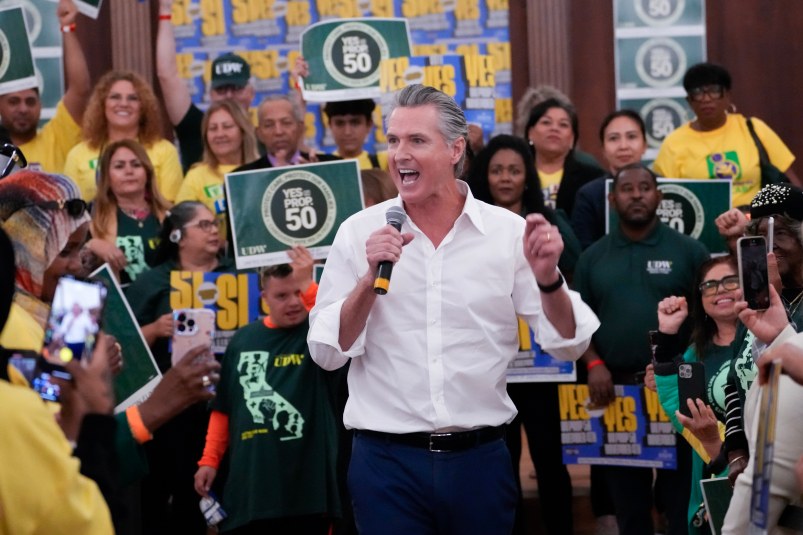
The clearest read of what happened last night is that, as far as I can tell, Democrats won every race that was in meaningful contention anywhere in the country. That’s not just high-profile races in New York, New Jersey and Virginia or the redistricting proposition in California. It goes way down into races only obsessives or local observers were watching in Pennsylvania, Georgia, Mississippi and a bunch of other places. Democrats won everywhere, and just about everywhere they won by larger margins than even optimists were expecting.
As I noted last night, some of these were surprises against low expectations which were not realistic. But Democrats did well against realistic expectations too.
Last night gives us one possible explanation to the question I raised Monday, which is how President Trump can be as extremely unpopular as he is (not an exaggeration, look at the numbers) and yet Democrats have only a modest advantage on the generic ballot. Maybe it’s the simple answer: the polls are wrong. Or “wrong” isn’t the right word. Maybe we’re over-interpreting them. The generic ballot is a good benchmark. But there is literally no “generic” ballot. There’s always a name on it and a specific political context. What’s more, as I suggested Monday, it’s hard to figure that an electorate that is so down on the president wouldn’t turn to some degree on the congressional party that makes his untrammeled rule possible.
In any case, results are results. There’s a very small caveat worth applying here. An off-year election without congressional races isn’t the same turnout or intensity as a midterm. Democrats were reminded in 2023 and 2024 that special elections, which are always very low-turnout and privilege the views of the most committed, every-time-voters, are not predictive of a general election. But these weren’t special elections. These were full elections in several states, and in the hothouse political environment of 2025 they got a lot of attention. At this moment, they point to wave election territory in 2026. A year is a long time, but there are pretty few scenarios where I think Trump will get more popular in the next 12 months.
The big immediate question is what impact this will have on the Capitol standoff. I think it changes the equation. But it’s not obvious to me what the new equation produces. One thing that caught my eye is that as the results were coming in last night, Trump hopped on Truth Social and declared that none of it was his fault. Republicans were getting hammered, he insisted, because 1) he wasn’t on the ballot and 2) the shutdown. Not my fault is typical Trump. But those other claims are … well, noteworthy.
Donald Trump won’t ever be on the ballot again. (Stop dooming.) So that’s a problem for Republicans. And he seems to be conceding that the shutdown is a disaster for Republicans. If he thinks that, you’d imagine he tries to end it as quickly as possible. There’s clearly a deal available, for better or worse, to pass a continuing resolution in exchange for restoring Obamacare subsidies — not a promised vote, but actually restoring the subsidies. Most Republicans are ideologically dead set against that. But Trump doesn’t give a crap about the policy or budgetary implications. What’s more, restoring those subsidies is at least something of a plus for Republicans in the midterms. And he cares about holding the House a lot. Who knows? I suspect at a minimum, last night’s result kills whatever reality there was behind those reports of a deal to pass a continuing resolution in exchange for a promise of a vote.
The biggest impact of last night’s result may be to collapse D.C.’s collective denial about the sheer scale of Donald Trump’s unpopularity. A mix of spectacle, aggression and speed have created this on-going pageant of Trump’s power. And he does have a lot of power. He can break things. A lot of things. Here and abroad. Like God imputed Abraham’s faith to him as righteousness, the political class has read Trump’s power, perversely, as popularity or at least political power. But that’s not how it works. These results tell a clear story: an electorate eager to send a message to Donald Trump and clip the wings of his untrammeled power.
A couple additional points.
A few days ago, Nate Silver’s Silver Bulletin ran a piece speculating on whether Republicans would hold or build on their gains with Hispanic and Black voters in New Jersey and make New Jersey into a swing state. The short answer is that Republicans gave up all the gains with Hispanic voters and a bit more. That is again at least partly a win against poorly thought out expectations. 2024 was a weird year, with an incumbent party still under the overhang of post-pandemic trauma, and lower- and middle-income voters struggling under high prices and economic dislocations, notwithstanding a good jobs environment. It’s certainly good news for Democrats that those voters appear to be shifting back. But it’s always dangerous to assume a sustained realignment on the basis of an election like 2024. It involves a lot of wishful thinking, of which there was plenty in the winter of 2024/25. The pattern has been: Republican wishful thinking/press work which is readily consumed by commentators and the political press and then becomes the conventional wisdom in which everyone operates.
I’m certainly not saying that every trend is good for Democrats right now or that every apparent bad one is fake. I’m restating the obvious, which is that the Democrats lost a very close election in 2024. The country remains broadly deadlocked in partisan terms with events (inflation, military withdrawals), overreach (Trump wilding sprees) or exogenous shocks (pandemics) creating the momentary advantage for one coalition or another.
Final point.
A number of morning-after reviews I’ve seen say that the Democrats had had a great night but still hadn’t addressed their “civil war” — the battle over whether to run “moderates” or “progressives.” Is it a future of Spanbergers or Mamdanis?
That doesn’t seem quite right to me. They have a pretty good model: find candidates suited to their constituencies and focus on cost of living issues and opposition to Donald Trump’s autocracy. Full stop. It’s not more complicated than that. That’s your opposition message. To the extent there are big operative questions, they turn on how to use political power to battle encroaching autocracy. At least in the near term that’s separate from the hot-button policy questions that ordinarily divide centrists, liberals and progressive Democrats. Are you ready to reform the Supreme Court, add D.C. and Puerto Rico as states to the union, pass a raft of post-Trump laws to put new armor plating on the weak seams of the republic? Since those are mostly 2029 questions, that simple program outlined above is more than adequate now and for the next year.