

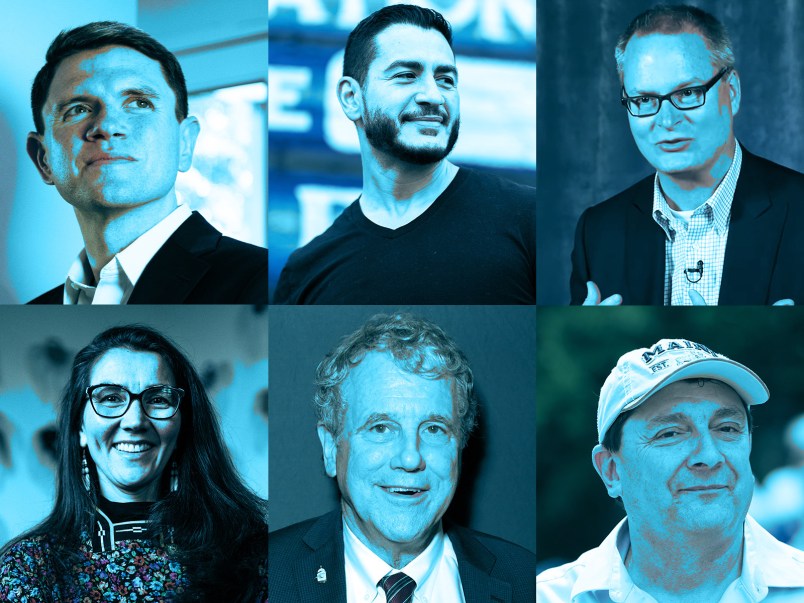
This article is part of Cafe, TPM’s home for opinion and news analysis.
Significant polling errors most often result when late-deciding voters break differently from historical patterns. That’s likely to happen this year, and not in a way that favors Republicans.
Start with the observation that the current midterm environment is utterly unlike any in recent history. The CNN average of recent polls pegs the proportion of voters who disapprove of Trump at 65 percent, and a recent You/Gov Economist poll found that of those who disapprove, 84 percent of them disapprove of him “strongly.” We’ve had no recent midterm cycle in which most American voters strongly disapprove of the president.
If we look at the distribution of Trump disapprovers, the implications for Republicans become even more ominous. Let’s say that Trump’s most loyal MAGA voters make up 30 percent of the electorate and assume, plausibly, that most of them associate largely with Americans of similar views. Since this group is largely devoid of Trump disapprovers, the upshot is that an overwhelming majority of voters not in this group — some 70 percent of the electorate — are Trump disapprovers. And since there are also almost no undecided voters among Trump loyalists, the portion of the electorate that describes itself as “undecided” also must consist almost entirely of Trump disapprovers.
To see how this may matter, consider the observation that most of us are more heavily influenced than we realize by the behavior and beliefs of peers. (This was the core premise of my 2019 book, Under the Influence: Putting Peer Pressure to Work.) As decades of careful studies have shown, peer behavior strongly influences almost everything we do and think — what we eat, how much we exercise, whether and how much we smoke and drink, how much we weigh, and which candidates we support.
Now imagine the decision facing an undecided voter. She’s almost surely not a Trump loyalist, and virtually all of her close friends and relatives are likely to disapprove of Trump, a majority of them strongly. They’re unhappy about gas prices, the cost of groceries, corruption, the war in Iran, the behavior of ICE, and more. Herself a likely Trump disapprover, she’s almost surely unhappy about many of these things as well. Late deciders in past elections often tended to break toward candidates who share their political identity. If this year’s late decider is a conservative, that would predict she’d vote Republican. But given everything we know about human behavior, casting that vote would be difficult in the current environment. It would mean bucking the views of almost everyone she knows and cares about.
How much might all this matter? A recent generic ballot poll estimated that 8 percent of likely voters remain undecided. If these voters would have split 4D-4R in a normal midterm environment, a 6D-2R split in today’s climate would hardly seem unlikely. And that four percentage point swing would almost surely be more than enough to erase any pro-R polling bias from other sources.
But there’s more. Peer influences shape not only the decision about whom to vote for but also the decision about whether to vote at all. This influence will of course cause current polling averages to further understate Democratic strength.
In a recent interview with MS NOW host Jen Psaki, former Obama adviser David Plouffe was understandably reluctant even to discuss the possibility that current polls might be understating Democratic strength. Acknowledging this possibility could of course encourage some people to slack off, thinking the prize already in hand.
But understating Democratic prospects also entails risk. As we’ve seen, Republican seats are vulnerable in many areas that earlier Democrats would never have thought to contest. There’s reason to believe that the playing field may yet warrant further expansion.




We have stories with Republicans are doing better than the polls indicate and Democrats are doing better than the polls indicate.
Ignore the polls. VOTE.
I was disappointed in the turn-out I saw for the No Kings protest on Saturday. I’m afraid people are becoming complacent.
My ballot is in. Get your ballots in as soon as possible.
Is this (tentatively) right, or do I simply wish it is? The better pollsters and stargazers have an appropriate, hard-won humility these days. It’s fascinating to watch them try to make sense of all the unknowns.
So the polls are not saying what they are saying. Therefore they are not saying what they are not saying. Therefore they are not saying what they are not saying they are not saying. Pretty much how you cut it, the polls aren’t cutting it. Therefore you must cut the polls. But you can’t, and so you must.
My understanding is that the organizations behind No Kings weren’t going for big-turnout hoopla.
Their instructions to the local organizations were, “Do what’s relevant in your community.”
I was busy with another obligation, but my wife went to the one in our downtown, where the theme was reminding people to vote, especially to vote early.