

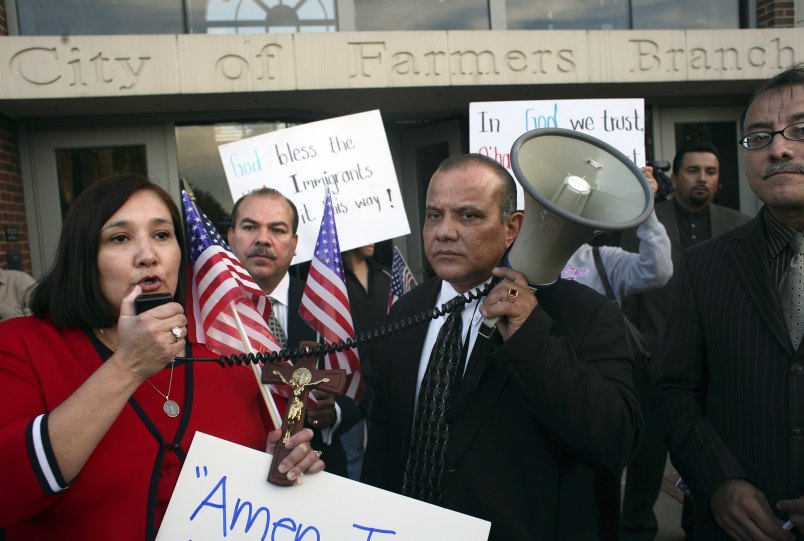
In Frisco, Texas, far-right activists are seizing upon the growing community of immigrant families from India as an example of the racist “Great Replacement” theory, with white Americans being supplanted by newcomers of color. The recent furor has a certain political logic to it that echoes events from exactly 20 years ago in the very same part of the Lone Star State. This may be the far right’s attempt to revive the spirit of 2006.
In that year, the Dallas suburb of Farmers Branch (located just 22 miles from Frisco) witnessed a somewhat parallel outbreak of xenophobia. That January, the chief of police responded to a question about the lack of Asian Americans on the police force by saying that there would be “no gooks in this department” as long as he was in charge. The subsequent outcry led to his resignation, but tension over immigration and identity re-emerged a few months later when a city councilman blamed local problems on what he described as an “influx of illegal aliens” mostly from Mexico. That fall, the Farmers Branch city council unanimously enacted a local ordinance barring landlords from renting to people without proof of legal residency. Over the following months, local voters turned out to support anti-immigrant ordinances by two-to-one margins, and the municipality would spend $470,000 defending their anti-immigrant ordinances against legal challenges.
This local controversy soon turned into a national cause célèbre that displayed GOP divisions on issues of immigration. Republicans could hardly have been more discordant on the issue at that time. The George W. Bush administration had sought to expand its electoral coalition by leading a push for immigration reform, requesting and then backing a bipartisan bill sponsored by Sen. John McCain (R-AZ) and Sen. Ted Kennedy (D-MA) that included a path to citizenship for millions of undocumented immigrants. At that point, however, the nativist wing of the party, led by talk radio figures including Rush Limbaugh, rose up in revolt against the measure, coalescing in support of a draconian House bill that redefined undocumented people as second-degree felons, threatened anyone who sheltered an undocumented immigrant with three years behind bars, and called for a feasibility study of a Canadian border fence. The bill passed the House of Representatives and gained the support of a chastened President Bush, who completely disavowed the immigration reform bill his White House had previously championed. Only the massive pro-immigrant marches of the spring of 2006 stalled the bill’s momentum in Congress long enough that the Democratic sweep of both House and Senate in the 2006 midterm elections made it a legislative dead letter.
Despite the defeat of the bill, and the fact that the Supreme Court ruled the Farmers Branch anti-immigrant ordinances unconstitutional, the episodes were clear harbingers of the Republican Party’s path to America First-style xenophobia under the leadership of Donald Trump. The GOP’s internal conflict over immigration had been settled in favor of the nativists.
Today, in cities like Frisco, far-right activists are arguing for an end to H-1B visas, which allow workers with specialized skills, many of whom are from India and other parts of South Asia, to enter the U.S. This has pitted tech executives seeking immigrant talent against white supremacists wanting to end immigration from this part of the world.As they did 20 years ago, far-right xenophobes may intend to push the GOP toward another crisis point that they hope will again be settled in their favor.
The present day, however, is a very different place and time for these activists to take their stand on immigration, for reasons both political and demographic. The most important of these is the actual location of anti-immigrant agitation. In 2006, the xenophobic mobilization was coming from inside communities from people who sought to take action against newcomers. In Farmers Branch, it was city councilmembers who spearheaded the xenophobic upsurge; and in the nearly simultaneous 2006 anti-immigrant mobilization in Hazleton, Pennsylvania, it was the mayor who led the efforts.
In Frisco, by contrast, much of the agitation is being driven by people from outside the community, mostly from outside the state. Elected officials in Frisco itself have continued to emphasize that the community continues to welcome people from India and their families, and that the newest residents of the area have been essential to its rapid population and economic growth..
The same has held true in other recent controversies. In September 2024, the town of Springfield, Ohio, drew national coverage after outsiders — soon echoed by GOP candidates including Trump and JD Vance — falsely accused immigrants of eating people’s pets. Neither they nor online white supremacists who fanned the flames noticed that Springfield had launched a public program to attract immigrants in hopes of reversing population loss. The same happened in Charleroi, Pennsylvania, cited by Trump and online xenophobes as a place of immigrant-driven despoliation, even as local officials emphasized how important the newcomers had been to revitalizing the area. And most recently, the immigration enforcement blitz in Minneapolis was propelled by a non-local right-wing blogger; the Minneapolis mayor, by contrast, pointedly said, “To ICE: get the fuck out of Minneapolis. We do not want you here.”
A second relevant variable here is the rapid realignment of public opinion regarding immigration. For many years, Americans held generally favorable public opinion on the overall benefits of immigration to the United States, including throughout the first Trump term. That opinion subsequently shifted in a notably restrictionist direction: for the first time in many years, by 2024 more Americans said they wanted immigration levels reduced; and a plurality or even a slight majority said they favored mass deportations. But in later 2025 and 2026, that trend reversed itself. As people saw what mass deportations actually involved, a majority of Americans turned against harsh immigration enforcement. Even recent Trump allies like Joe Rogan compared the tactics of ICE and the Border Patrol to the Gestapo.
Indeed, this reversion back to immigrant favorability has taken place as the nation has continued to diversify. The far right’s Great Replacement conspiracy theory has been effective in gaining support from conservative figures and White House advisors — and in inspiring racial mass murders. But its adherents have never seriously contended with the fact that demographic change in America has been fairly continuous for more than 500 years, and is essentially irreversible. Nativists fretted about immigrant Germans in the 1750s, French in the 1790s, Irish in the 1840s, Chinese in the 1880s, Catholics and Jews in the 1910s and 1920s, and so on. And as demographers have recognized for many years, national population change has already generated so much demographic momentum that even if it were possible to halt all migration to the U.S., that would only change the expected date of a majority-minority nation by a few years. This is because demographic change is now driven mainly by American citizens and other longtime residents: for example, the growth of the Latino population has been far more driven by births on American soil than by immigration for more than a quarter-century; and immigrants account for a declining share of the Asian American population, which is nearly half native-born. Notably, even the most powerful dictatorships of the twentieth century (which were also the most murderous ones) conspicuously failed to alter their nations’ ethnoracial profiles despite holding a monopoly of power.
The Trump administration’s travel bans, visa pauses, revocations or holds on immigration applications, revocation of legally-present immigrants’ protected status, and brutal internal policing have, as of early 2026, reversed net migration to the United States such that more people are now leaving than arriving. But that has only exacerbated the nation’s real population crisis, which is that our low birthrate has created a shortage of future workers and Social Security depositors and slowed job growth to a crawl, in the process driving a scarcity of everything from doctors to home builders to farm laborers to childcare workers. America’s diversification has continued, however. At the time of the struggle over identity in Farmers Branch, Texas was just transitioning into the nation’s fourth minority-majority state, joining Hawaii, New Mexico, and California; today there are nine such states.
Perhaps this fact explains the unexpected demographics of the furor in Frisco. The online xenophobes who are making the most noise about the Texas city have focused on Indian Americans, who at 1.5% of the population are hardly a credible invading army of the kind that white supremacists have long accused Latinos of being. And speaking of Latinos, there are apparently at least a few among those opposing the arrival of more recent immigrants in Frisco. Here, it is worth remembering that groups of people once classified as invading hordes have repeatedly been granted actual or honorary status as whites or at least Americans in good standing; and that this may itself be a sign of Latinos assimilation to an American culture in which yesterday’s immigrant stock are tomorrow’s nativists. This may partially account for the unprecedented Latino support for Donald Trump in 2024, though more recent elections have indicated a significant swing back toward the Democrats.
The racial politics of the conservative movement are clearly in flux: witness Latino Republicans’ dismay at the Trump administration revoking Cubans’ and Venezuelans’ protected immigration status, Ben Shapiro’s apparent shock that the far right is rife with antisemites, or JD Vance saying that people “don’t have to apologize for being white anymore” but then expressing anger at white supremacists who criticize his Indian American wife and kids.
The outcome of the current clash between immigration-dependent conservatives and domestic racists remains unknown. But would it not be a sign of these strange days if so-called “heritage Americans” next decided to take aim at their not-so-white allies for greatly replacing them in the immigration restriction movement?





As 10th generation Pennsylvanian, not too surprised that my ancestor Johann Müller likely encountered anti-German sentiment in 1776 Lehigh Valley. Another piece of history tactfully omitted from the schoolbooks.
Oh, I’m sure he did:
There’s a little local twist to this story. Richardson, which is a few miles east of Farmers Branch and south of Frisco, is home to sizable community of folks from the Indian subcontinent. (The Indian food over there is superb!)
I do not remember a single story about crime or anything unflattering about that community. But that doesn’t stop racist politicians in neighboring burbs from their kabuki fear and outrage. What they are doing is absolutely cynical and I don’t think it’s going to sell as well as they hope – at all.
Knock on wood.
Hopefully, many Americans are realizing that ICE and CBP are rounding up people we depend on to varying degrees. Fewer migrant workers means higher prices for produce at the grocery store; fewer Hispanic construction workers means higher prices and longer waits for having an addition to one’s home built, along with an assist from the tariff on Canadian lumber.
At least opposition to H-1B visas makes some sort of sense: those are used to fill desirable jobs that Americans would compete for, or could be trained for if there’s an immediate shortage. But most new immigrants take the crap jobs that nobody who’s grown up here wants: work in the chicken processing plants, stoop labor in the fields, tree surgery, roofing installation, stuff like that. I don’t want those workers sent home, and most people don’t either if they think about it for half a moment.
What Happened in Farmers Branch is that the city council and mayor decided they wanted their town to be more upscale, to not be known as a working class area. They figured the best way to do that was to drive out the “undesirables". The anti-immigrant rental ordinance was a big part of that. They also passed zoning laws to prevent affordable housing from being built, closed off existing neighborhoods to make them more exclusive, accelerated gentrification with permitting practices, etc. Sadly, it mostly worked.
I grew up in Farmers Branch, it was a great place to grow up. Obviously, that was before all this immigrant animosity from the city. No one I grew up with was like that. I never understood where all the hostility came from back when this was happening. Hopefully things are better there now. I havent been there (other to drive through it) in many years.