

This article is part of Cafe, TPM’s home for opinion and news analysis.
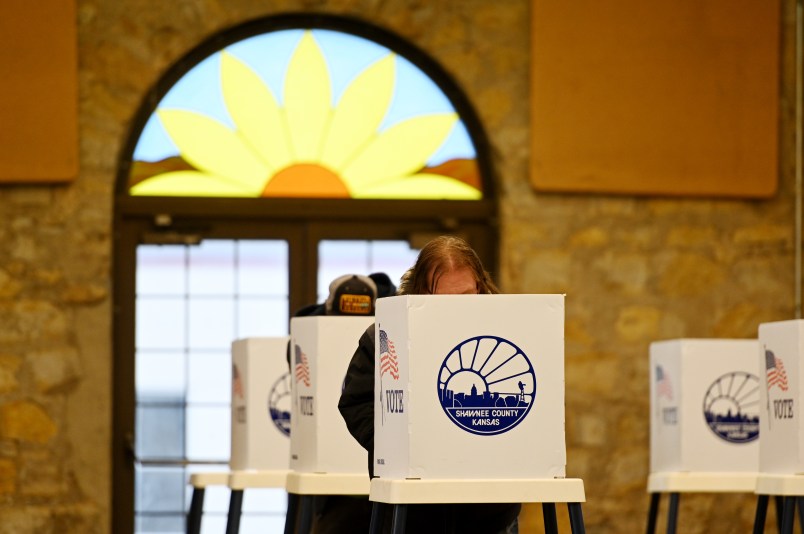
On August 4, Kansas voters will decide whether to replace the state’s longstanding merit selection system for Supreme Court justices with direct elections. Republicans want voters to believe the proposed constitutional amendment is just about transparency and giving the public more power over who sits on the state’s highest court, but the debate in Kansas is also part of a broader Republican push to inject more partisanship into state judicial elections. But the differences in where they want partisan elections and where they do not give the game away.
In states across the country — or red states anyway — Republicans have been pushing direct judicial elections as an alternative to merit selection mechanisms and nonpartisan elections, saying that voters deserve as much information as possible. The sentiment is fair enough, but if it were in good faith, one might expect it to apply just as well to district attorney and other local elections. A recent law in Georgia illustrates the actual logic behind these efforts.
In red states, partisan judicial elections tend to advantage Republican candidates by attaching the party label directly to the ballot. Merit selection can produce a more politically diverse judiciary, since judges are chosen through a process that is less directly responsive to the partisan composition of the electorate and can elevate candidates who might struggle to win a partisan election. Nonpartisan elections, particularly for lower-profile positions, can create more opportunities for crossover voting, candidate-specific campaigns, and minority party victories.
Over the last decade, Republican lawmakers in red states including North Carolina, Ohio, and Montana have advanced proposals designed to increase partisan influence over state courts, often after judges issued rulings unfavorable to conservative policy priorities. In Georgia, however, Republicans have their eyes on local elected positions like district attorney’s offices. In the blue counties around Atlanta, in order to increase their chances of unseating left-leaning officials like Fulton County’s Fani Willis, who brought a criminal case against Donald Trump, the legislature passed a law converting a series of local elections in metro Atlanta — and only metro Atlanta — from partisan to nonpartisan contests. Governor Brian Kemp signed the bill into law in May despite opposition from local officials and voting rights advocates, who argued that it selectively altered election rules in heavily Democratic jurisdictions. Even more recently, Georgia’s Republican-majority Judicial Qualifications Commission accused progressive Supreme Court candidates Jen Jordan and Miracle Rankin of violating judicial conduct rules by publicly endorsing each other and campaigning on their support for abortion rights.
The asymmetry is difficult to miss. In Kansas, Republicans are attempting to move judicial selection toward direct elections in a Republican-leaning state while in metro Atlanta, the same party has now endorsed nonpartisan elections in overwhelmingly Democratic areas where Republican candidates struggle under partisan labels.
Under the current Kansas framework, a nominating commission vets applicants and sends three finalists to the governor, who makes the appointment. Supporters of the amendment argue that the current process gives too much influence to lawyers and insufficient power to voters. The proposed amendment would abolish the nominating commission and allow voters to elect justices to six-year terms. The amendment itself does not establish partisan elections, but it would remove the current constitutional restrictions that prohibit Supreme Court justices from participating in political campaigns, while leaving the rules governing the elections to the Republican legislature.
Kansas Republicans have spent years criticizing the state judiciary, particularly after court rulings on school funding and abortion rights. In 2022, Kansas voters rejected an anti-abortion constitutional amendment by a wide margin, underscoring the extent to which the state’s electorate is more politically complicated than its Republican supermajority legislature might suggest. The judiciary has increasingly become one of the few remaining institutions capable of constraining the legislature, which helps explain the sustained campaign to restructure how judges reach the bench.
North Carolina offers perhaps the clearest precedent for where Kansas could be headed. In 2017, Republicans in the state legislature restored partisan labels to judicial elections after years of nonpartisan contests. At the time, North Carolina was becoming increasingly competitive statewide, and Republicans argued that voters needed more information about judicial candidates. The practical effect was to align judicial races more directly with nationalized party politics, tying judicial outcomes more closely to straight-ticket voting and partisan turnout patterns. After the change, state Supreme Court races became more overtly ideological, more expensive, and more dependent on partisan infrastructure. Judicial candidates increasingly ran as recognizable extensions of party coalitions rather than as relatively low-profile legal figures.
Since Republicans restored partisan labels, Republicans have also won control of the state Supreme Court, flipping it from a 4-3 Democratic majority to a 5-2 Republican majority after the 2022 elections, after which the new court reversed or narrowed several major rulings by its Democratic predecessor, including decisions on partisan gerrymandering and voter ID.
The contrast between Republican efforts in Kansas and metro Atlanta reveal that, in red states, conservatives want to replicate their success in capturing North Carolina courts through partisan elections, while they are now taking a different tack in blue areas where partisanship is a liability for them. Lawmakers are increasingly willing to tailor electoral systems to anticipated partisan outcomes.
The August 4 vote will offer a particularly revealing test of that strategy. The Kansas amendment’s supporters have framed it as a question of giving voters greater control over the courts. The experience of other states suggests that once judges enter the electoral arena, the question of who chooses them can quickly become inseparable from the question of which party has the best chance of winning.







The particular thing in Kansas that really irks Republicans is that we have a strong tendency to elect Democratic governors, particularly women, and the governor has the final say on judicial appointments from those presented by the nominating committee. That’s resulted in a relatively liberal supreme court that has both protected abortion and required the legislature to adequately fund public education. That’s intolerable to the GOP supermajority, so they’re taking another crack at it after getting shellacked in the 2022 abortion vote. Within a month of that beatdown, AG Kobach publicly promoted exactly this plan to elect judges as their best way to work around the clear will of the people.
It’s a civics-textbook principle that partisan judicial elections are associated with lower-caliber judges and with corruption.
Here in Michigan, judicial elections have been nonpartisan for almost a century.
There’s a wrinkle here, though, a single exception to the official nonpartisanship. Justices of the state supreme court are nominated by political party state conventions, and then appear on the ballot “as if” they were nonpartisan. Straight-party voting doesn’t apply to this; to vote for your party’s candidates for Supreme Court, a voter has to know their names.
(Everyone says they hate this system. In the 1990s, Michigan was rated as having the worst and most partisan state high court in the nation. Nonetheless, in recent decades, there have been zero serious efforts to change it.)
Republicans used to dominate this process. But starting in 2020, Democratic nominees have won every seriously contested Supreme Court race. That’s because, since Covid, Democrats have been far more likely to vote by absentee ballot, whereas Republicans are more likely to vote in person.
The absentee ballot is like a take-home exam; the voter can look up the answers, including which party nominated each candidate. Republicans are the ones standing in the polling place, staring at the list of names and trying to remember who they were supposed to vote for.
I still think the partisan-nominating system for Supreme Court should be changed. Ideally, we should do away with electing judges altogether. But no question, it currently benefits Democrats.