

This article is part of TPM Cafe, TPM’s home for opinion and news analysis. It was originally published at Balls and Strikes.
Months before the 2020 election, as tens of millions of people prepared to vote by mail in the midst of a deadly pandemic, President Donald Trump was already laying the groundwork for challenging the result if it did not go his way. Mail ballots, he said in April, are “very dangerous” and “fraudulent in many cases.” In July, he warned that 2020 would be “the most INACCURATE & FRAUDULENT Election in history.” In August, he told his followers that the “only way” he could possibly lose the election is if Democrats “rigged” it against him.
After the election, which Trump indeed lost in decisive fashion, his warnings only got more shrill, more dire, and more vaguely messianic. In December, he delivered a speech railing against the scourge of “corrupt forces … stuffing ballot boxes,” and blamed Biden’s victory on “fraud and abuse…on a scale never seen before.” His efforts to contest the outcome, Trump said, were “about ensuring that Americans can have faith in this election and in all future elections”—a task that he said might prove to be his “single greatest achievement.”
Unfortunately for Trump, neither his initial legal challenges nor his subsequent efforts to incite a violent coup were sufficient to get him what he wanted. But as I predicted at the time, in Republican circles, Trump did manage to mainstream the belief that states that allow mail-in voting are at least facilitating cheating, if not outright encouraging it. Today, adherence to Trump’s stolen-election conspiracy theories remains table stakes for anyone who aspires to be relevant in the Republican Party and/or the conservative legal movement.
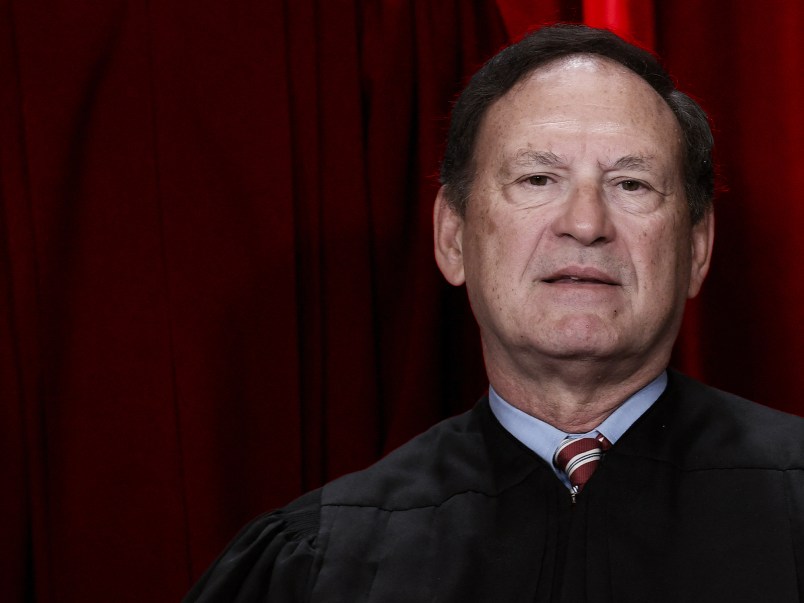
Watson v. Republican National Committee, which the Supreme Court decided on Monday, reveals just how deeply election denialism is now embedded in the conservative consciousness. In Watson, a five-justice majority of the Court rejected the GOP’s challenge to a Mississippi law that allows officials to count absentee ballots received up to five days after Election Day, as long as the ballots are postmarked by Election Day. But Justices Clarence Thomas, Samuel Alito, Neil Gorsuch, and Brett Kavanaugh dissented, and in his opinion for the foursome, Alito warned of Watson’s “lamentable consequences”: Counting post-Election Day ballots, he said, is not only “blatantly contrary” to what federal law requires, but will also “further undermine Americans’ faith in the integrity of this country’s elections.”
Given that the 2026 midterms are about four months away, it is of course good that the Court declined to issue a decision that could disenfranchise tens of millions of mail voters, who tend to cast ballots for Democratic candidates. But it is deeply unnerving to learn that four of the Court’s nine members are willing to upend the electoral processes in more than half of states in service of their demented party leader’s most demented lie. As it turns out, the line between the Court preserving the status quo and the Court plunging the country into a chaotic, anti-democracy nightmare is a single vote.
Mississippi is one of 30 states that have enacted laws like the one at issue in Watson, and the rationale is pretty straightforward: Mail takes time to deliver, and voters should not be penalized just because the Postal Service needs a day or two to route ballots to their destinations. But the Republican Party, with the Trump administration’s support, urged the Court to rule that grace periods are illegal, and that in order to count a ballot, a state must receive it by Election Day. Voters whose ballots are stuck somewhere in transit would be out of luck.
Writing for herself, Chief Justice John Roberts, and the three liberals, Justice Amy Coney Barrett had little trouble rejecting this argument. The crux of her opinion is about the meaning of the word “election,” which under both Supreme Court precedent and also ordinary English usage refers to the “act of choosing a person to fill an office.” In context, she said, that “act” is complete when a person casts a ballot, not when the state receives or records it. Existing federal statutes that govern elections “say nothing about ballot receipt,” Barrett concluded, and the Court “cannot add to the words Congress chose.”
In the first part of his dissent, Alito mostly accepts Barrett’s framing of the case as a narrow question of statutory interpretation. His argument is that federal law sets Election Day as the deadline for determining the “authoritative choice” of voters. When officials add grace-period ballots to the ballots that should, in his view, “dictate the election’s outcome,” the electorate’s “choice” is no longer determined on Election Day, and thus no longer legitimate.
In the final section, though, Alito turns to what this case, for him, is really about: the GOP’s strident efforts to undermine mail-in voting, and his longstanding commitment to using his power as a Supreme Court justice to help. The result in Watson, Alito said, “spawns a slurry of troubling election-law questions,” including about the extent to which states must accept ballots from “ballot harvesters affiliated with a political party or interest group.” This language echoes two of Trump’s favorite talking points, which are that absentee ballots empower nefarious Democratic operatives to steal, complete, and return them on behalf of unwitting citizens, and that by failing to limit mail voting, Republicans are giving their counterparts a free head start.
From there, Alito transitioned to the subject on which he and Justice Brett Kavanaugh fixated at oral argument: that grace periods create “opportunities for voter fraud” that the Court has a solemn duty to extinguish. To support his case, Alito offered an elaborate hypothetical about a tight race in which “bad actors seeking to stuff ballot boxes” manage to “flip” the apparent result. Counting ballots that “pour in” after Election Day, he said, creates a “serious risk” of undermining public confidence in “our system of self-government.”
Set aside, for today, Alito’s characterization of the administrative vote-counting process as “flipping” an election, as if winners were determined not by which candidate receives the most votes, but the order in which votes are tabulated. As is always the case when Republicans frame their antipathy for mail-in voting as motivated by a noble, good-faith concern about the perception of voter fraud, Alito omits the simple fact that his party and his president are fueling it. His rhetoric in Watson is indistinguishable from Trump’s social media rants, except that Alito’s opinion has fewer typos and does not abuse the CAPS LOCK key as much.
I am not speculating here: Shortly after the decision was published, Trump hopped on Truth Social to call Watson a “tremendous loss,” and urged Senate Republicans to “SAVE OUR COUNTRY” by passing a law that would impose a near-total ban on mail voting. The “only” reason for anyone to oppose such a bill, Trump said, is (what else?) “CHEATING.”
The Supreme Court’s six-justice conservative supermajority has been (sorry for the legal jargon) very bad in many ways: for voting rights, for reproductive rights, for the very concept of multiracial democracy, and so on. But the result in Watson underscores how much worse a Republican-dominated Court could be, and how much worse it will become if Trump gets to replace Roberts or any of the liberals with a(nother) MAGA dead-ender in 2027 or 2028. Legally speaking, mail-in voting is already on thin ice. It won’t take much more for it to break.




“and that in order to count a ballot, a state must receive it by Election Day” – I think the whining by Alito, if it had been successful, would not only toss out ballots received after election day, but would also rule out all mail-in ballots AND prohibit early voting, since those votes were not cast ON election day.
Suppose like Shrodinger’s Cat the ballot until opened exists in a superposition of states with probable outcomes for all the candidates and only the act of counting forces a collapse of the wave function? What then Alito?
The GOP’s latest, most desperate move to juice right-wing voter turnout this fall.
And …
WTF?!?!
Alito doesn’t even pretend to be anything other than a Trump regime shill; he’s old, cranky and doesn’t give a shit.