


On top of the fact that the U.S. economy lost 23,000 jobs in July, a deep dive into the jobs report published by the Bureau of Labor Statistics Friday morning revealed some jobs statistics reached their worst levels in 10 years.
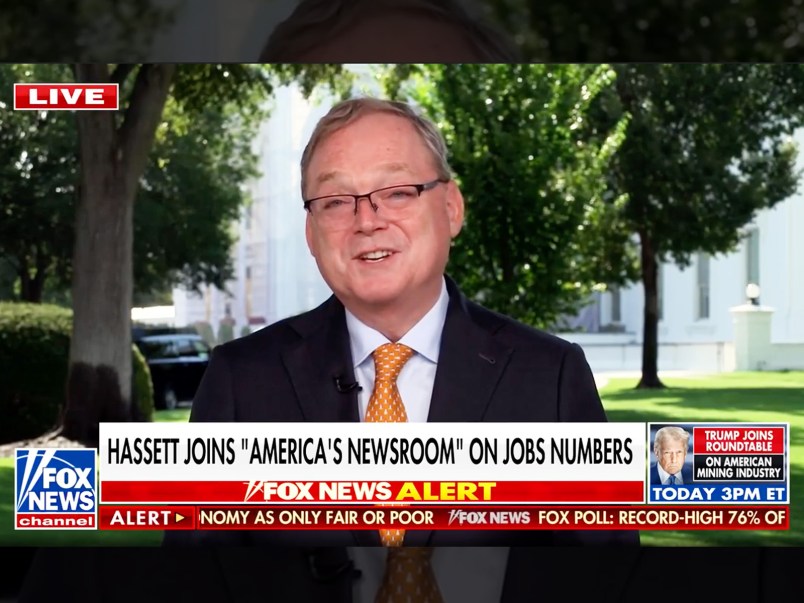
But if you ask Kevin Hassett, White House chief economist and director of the National Economic Council, everything is awesome.
In addition to the July losses, the report also came with downward revisions for the two months prior; May payroll employment was revised down by 66,000 jobs and June saw a 37,000 downward revision, for a combined total of 103,000 fewer payroll jobs than previously reported.
In an interview with Fox News responding to the dismal numbers, Hassett took the approach of turning a blind eye and plugging his ears. His take? We should throw out the sectors that lost jobs and only focus on the sectors that gained. Temporary jobs from the World Cup ended, Hassett said. Local government also shed roles.
“So if you throw out the World Cup and the government workers, we actually had a number that was about plus 100,000,” said Hassett.
Obviously, that’s not how it works.
Like Hassett, Acting Labor Secretary Keith Sonderling is ignoring job losses and focusing only on areas that gained employment
“The labor market is seeing continued growth in private sector employment, adding 30,000 jobs in July and 426,000 this year,” Sonderling said in a Friday statement. “Additionally, we are adding jobs in key sectors with gains in construction and manufacturing driven by the trillions of dollars of investments that are pouring into the United States.”
Republicans on the House Ways and Means Committee issued a similarly selective outlook in a statement Friday.
“Despite the dip in July payrolls, the employment market remains strong and will get stronger as businesses benefit from the long-term tax certainty provided to them in the One, Big, Beautiful Bill,” Rep. Jason Smith (R-MO), committee chair, said in a statement.
Local government education roles saw the biggest decline in July. But even a closer look at the manufacturing and construction industries that Hassett tried to tout shows weakness in Trump’s pet sectors.
Manufacturing jobs, seasonally adjusted, are down by 14,000 jobs compared to this time last year. Though up 5,000 from June, more granular figures suggest the tariffs Trump’s used to boost manufacturing aren’t effective. Manufacturing for computers and related products saw growth, in line with other indicators pointing to how much AI is driving the economy, while manufacturing for furniture — an industry on which Trump has levied tariffs — declined month over month and is down by more than 12,000 positions compared to last year. Subordinate workers are faring worse than the industry at large. Nonsupervisory employees have shed jobs steadily since May and lost 45,000 positions over the past year.
During his Fox interview, Hassett conceded that the percentage of people working or trying to work is down, but waved that off as due to Trump’s strict immigration policy and baby boomers aging out of the workforce.
Something called the employment-to-population ratio measures the number of people who are actually working against the total number of people who could be working, or are of working-age. Unlike the unemployment rate which only includes people actively looking for work, this number counts people who have given up on trying to find a job. At 58.9%, this ratio reached its lowest level since September 2021. And excluding the pandemic-era recession, the employment to population ratio hadn’t dipped below 59% in more than 10 years, per historical BLS data.
Algernon Austin, the director of race and economic justice at the Center for Economic and Policy Research said that ratio tends to fluctuate because of the aging U.S. population. A look at the same ratio for prime-age workers between 25 and 54 still shows a decline.
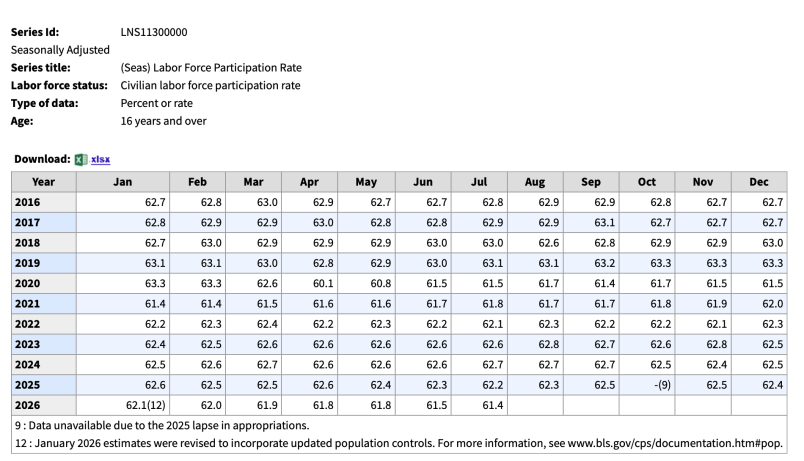
Additionally, the percentage of people working or seeking work is the lowest it’s been since February 2021.
“Today’s report shows a patchwork economy that is fraying at the seams,” said Breyon Williams, chief economist at Groundwork Collective. “Trump’s economic mismanagement has injected so much uncertainty into the economy that employers are not confident enough to add more people, but also have not initiated massive layoffs, creating a frozen job market where those with jobs are afraid to leave them and those without are stuck on the sidelines.”
Williams noted that most of the year’s job gains have been netted by the health care industry, which still added positions, but experienced a slow down in July, according to the BLS.
“On the job numbers this morning, the alarm bells on the sorry state of Trump’s economy keep ringing and ringing,” Senate Minority Leader Chuck Schumer (D-NY) said during his opening remarks on the Senate floor Friday.
“The only person who ought to lose their job right now is Donald Trump,” Schumer continued. “He’s handling the economy so poorly, with the chaos, the inconsistency, the lack of paying attention to the facts, the lying.”
Trump, for his part, had yet to speak or post on Truth Social about the job losses at the time of publishing.






I wish 2026 could leave 1984.
Whenever I see “Schumer said,” I cringe.
“You’d better stop it guys. Guys…? Guys?!?!”
Gee … there’s nothing wrong here.. Hastert has his job so s’ok.
And the reflecting pool’s ok if ya don’t think about it
The White House is gorgeous if ya ignore the ripped up Ellipse and the on going rubble filled construction where the. East Wing used to be.
This is an undersold story – and an absolute disaster for municipal services.
Schools and local agencies are shedding knowledgeable professionals like a yeti in Phoenix.