

This article is part of TPM Cafe, TPM’s home for opinion and news analysis.
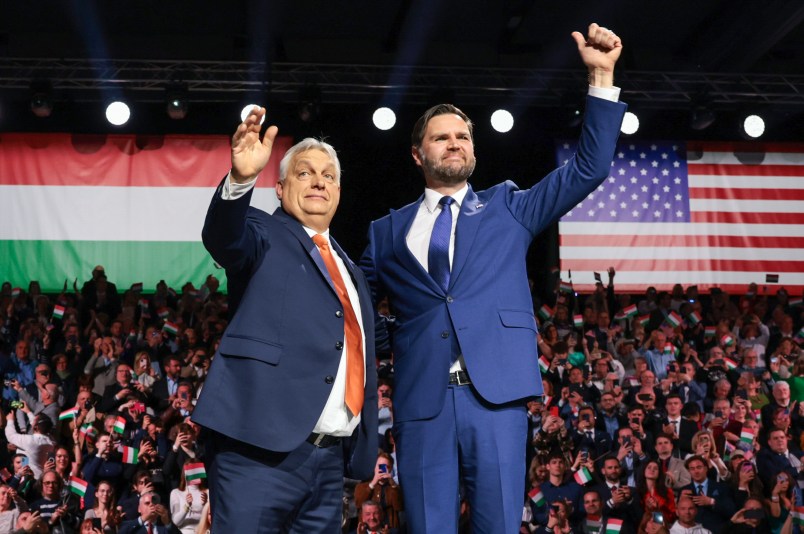
On Sunday, April 12, Hungarians will go to the polls in an election that will decide the future of their country and the illiberal state that Prime Minister Viktor Orbán — Europe’s longest-serving head of state and a role model for far-right authoritarians in Europe and America alike — has built over the past 16 years in power.
After winning a two-thirds majority in 2010, the Orbán government systematically dismantled democratic institutions and reshaped the electoral system to make future victories for the prime minister’s party, Fidesz, more likely. It rewrote the constitution with little input from society, experts, or opposition parties; packed public institutions, including the constitutional court, with loyalists; severely restricted media freedom; challenged academic freedom; and undermined minority rights, particularly LGBTQ+ rights. In addition, the Orbán government placed Fidesz loyalists in top positions across public and state companies, leading some observers to describe it as a “mafia state.” Orbán’s political allies, including aspiring authoritarians in the U.S., who see his governance as a model, paid close attention. President Donald Trump’s rapid moves during his second term to attack the administrative state, civic society and the media, including pushing for allies to control news organizations perceived as unfriendly, have drawn frequent comparisons to Orbán’s playbook.
Due to Orbán’s state capture and erosion of democratic institutins, VDEM, a prominent democracy watchdog, has classified Hungary as an electoral autocracy since its 2020 report, while the European Union in 2022 ruled that Hungary could no longer be considered a democracy. Although elections still take place and might be considered “free”, they are no longer fair. A recent investigative documentary by independent filmmakers and reporters, “The Price of a Vote,” further documents serious allegations of vote-buying, voter intimidation, and electoral fraud, raising questions about electoral integrity ahead of the April 12 vote.
And yet, against this background, Orbán faces a serious chance of losing his fifth consecutive reelection. Péter Magyar — who emerged on the political scene in early 2024 after a clemency scandal that rocked Orbán’s government and led to the resignations of both President Katalin Novak and his ex-wife, Justice Minister Judith Varga — has become a trailblazer in Hungarian politics. Himself a former Fidesz insider, Magyar has credibly attested to the Fidesz government’s corruption and clientelism, earning him a huge following. Contrary to Fidesz’s election campaign, which mostly focuses on alleged external threats, Magyar has largely campaigned on bread-and-butter issues that everyday Hungarians are concerned about, pointing to the dire state of the country’s health care and education systems and poor living standards. Promising to bring change and prosperity to Hungary, he now holds the hope of many voters.
Despite recent polls indicating a significant lead for Péter Magyar’s Tisza party, this is not an “ordinary” election. It takes place in the context of an electoral autocracy, and its outcome as well as its aftermath, including prospects of de-Orbánization, remain uncertain.
First, given the disproportionality of the electoral system Fidesz has built over the years, votes do not translate proportionally into parliamentary seats. In fact, Fidesz can still win a supermajority of parliamentary seats with less than 50% of the vote. It thus remains unclear how power will be distributed in the new parliament. Yet, the distribution of power in the new parliament is crucial as to whether the country can effectively de-Orbánize.
Many of Fidesz’s structural advantages are locked in through cardinal laws, which require a two-thirds majority to amend or abolish. In addition, Fidesz is deeply entrenched in the state, having placed party loyalists in top positions across key public institutions. A possible Tisza government will therefore first need to replace these Fidesz loyalists who were nominated to serve beyond a legislative period and could obstruct a new government’s work. This includes, for example, the fiscal council, packed with Fidesz loyalists, which can veto the new government’s budget proposal, potentially leading to snap elections.
In addition, a new government needs to at least demonstrate credible efforts and implement reforms to reinstate the rule of law in order to restore around €18 billion in EU funds that were suspended due to serious rule-of-law violations under Fidesz. Without these resources, a new Tisza government cannot fund many of its proposed policies and improve living standards as promised in its electoral program. Failure to deliver on these promises could then lead to voter dissatisfaction and frustration, potentially paving the way for Fidesz’s return in the 2030 election.
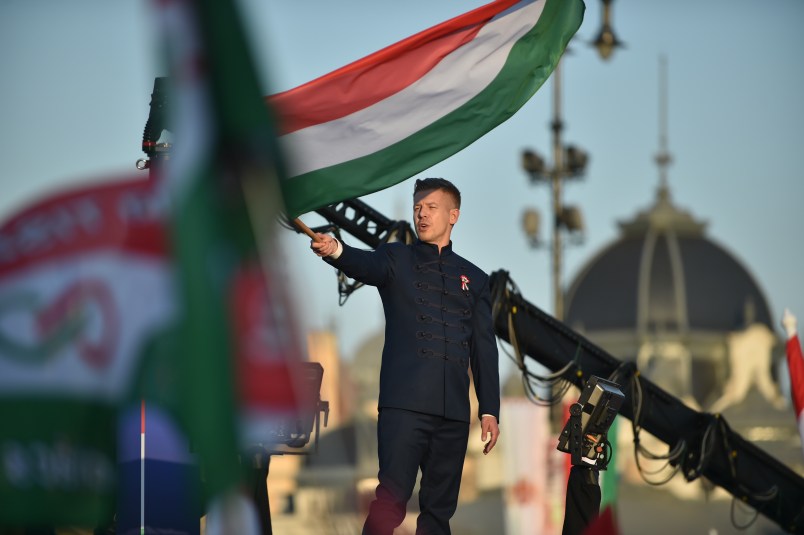
Given these political realities, if Tisza wins only a simple majority, it would be in office but out of power: unable to implement the promised and necessary reforms and facing parliamentary gridlock and obstruction from Fidesz. Instead, Magyar’s Tisza party needs a two-thirds majority in parliament to govern effectively and undo the system Fidesz has built over 16 years, which is designed to outlast the party’s electoral defeat.
Yet, even with such a constitutional majority, certain obstacles will remain: The Hungarian president, Tamás Sulyok, a Fidesz member who was elected by parliament with a two-thirds majority, will remain in office until 2029. Although mainly a ceremonial role, the president may obstruct the governing process of a future government by delaying the legislative process, for example, by sending legislation back or referring it to the constitutional courts, packed with Fidesz loyalists, for review.
As a result, not only the future balance of power in Hungary but also the prospects of de-Orbánization remain uncertain and will depend on the outcome of Sunday’s election. Knowing what it stands to lose, Fidesz has already begun sowing doubt about the integrity of the election and potential foreign interference — even though the Fidesz government itself poses the greatest threat in these regards. In case of an electoral defeat, Fidesz might double down on the “big lie.”
In the end, this election is not a question of whether Hungarians want change, as polls clearly suggest that many do. Rather, the question is whether, in a system designed to make the opposition fail, its electoral success will translate into parliamentary power — and whether the opposition can then dismantle a system built to survive it.





And yet he remained President.
No wonder Putin’s Cock-holster models himself as an Orbán wannabe.
“We need a movement, not a moment”, Al Sharpton.
One of the most important protections to keep a democracy a democracy is for the democracy to make change slow and deliberate. I mean it took Republicans 50 years to overturn Roe.
Republicans understand this. It is why they stay so loyal to their Party. The change they want, in most cases from a liberal democracy to a nation where some are more equal than others, will not happen in a single or even in several elections. Real change in a democratic society with constitutional protections takes decades.
Democrats, on the other hand, have a tendency to think because they voted once, everything they dreamed of should happen immediately or they won’t get off the couch the next time to go vote or otherwise support people who want what they want.
Or to put another way, what this article says to me is that while it took 16 years for rightwing autocrats in Hungry to pervert the fledgling democracy into an autocratic state, those who oppose the autocratic state will give up if their candidates are elected and fail to make their dreams come true in a week.
To me this sounds like not only are American Republicans like Hungary’s autocratic party, Hungary’s opposition is much like American Democrats.
J.D. Vance: Once a hillbilly, always a hillbilly. That he follows Donnie’s fascist autocratic fixation makes it even worse. Soulless. To think that if Donnie goes, Vance would assume the Presidency is beyond belief.
This new reboot of “The Honeymooners” totally blows.
(“To the moon, Olga, to the moon!”)
Alright, libtards, you go on and on and on and on about poor, humble, hard-working Orbán, while Madman Mamdani marks 100 days of carnage and you don’t even bat an eye!