


In Rough Edges, Mike Rothschild writes about fringe groups, conspiracy theories and how the Internet broke our brains. This column is part of TPM Cafe, TPM’s home for opinion and news analysis.
With a potential midterm wipeout just three months away, Republicans have been recycling past conspiracy theories to an epic extent, mining the greatest hits of a decade of paranoid plots both to please the president and to invoke memories of the “good old days.”
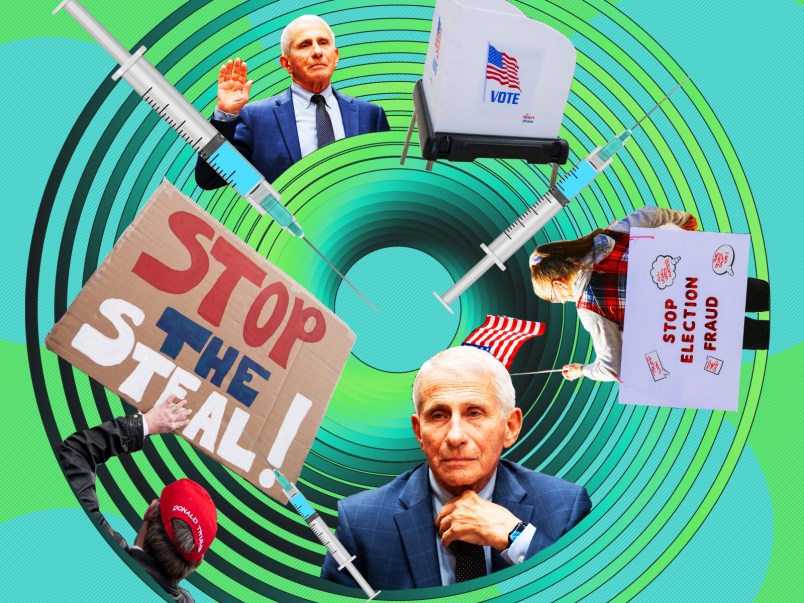
From the Senate’s contentious hearings that saw Dr. Anthony Fauci grilled with lockdown-era conspiracy theories to President Trump’s continued evocation that the 2020 election was stolen, Republicans are both replaying the past and actively rewriting it, trying to distract their voters from current crises and rally them around Trump’s brand one last time.
It’s impossible to look at the run-up to the 2026 midterms without examining the repackaging and reuse of the conspiracy theories that got us here. The midterms might be the last chance we see some of them used with any real efficacy, and nobody is missing their shot.
Trump himself has never stopped living in the frenetic period between the 2020 election and Joe Biden’s inauguration. Despite having actually conceded his defeat, both shortly after Jan.6 and in subsequent interviews, he has also continued to claim he did win the election. Trump’s relentless insistence that he won three times only to see one of them stolen (or “stollen” as he likes to misspell it) means that every single election they lose will immediately be written off as rigged by a vast conspiracy. This conspiracy, paradoxically, only seems to operate during elections when Trump is president and Republicans don’t do well.
Despite no evidence of any intentional, consequential rigging in any American election, Trump has already worked hard to cast doubt on the integrity of the upcoming midterms. Essentially, he’s calling them fraudulent before a single vote has been cast. In a July Oval Office address, Trump laid out a hopelessly complex international conspiracy theory about how the 2020 election was taken away from him — despite him being president in 2020 — and how it will happen again in 2026 without a series of harsh restrictions on mail-in voting, as well as additional voter ID regulations. His insistence that China interfered on behalf of Biden is massively overstated and repackaged from past allegations.
Trump has even claimed, with absolutely no evidence, that the 2026 California primary was rigged against Republicans. The only proof Trump has even attempted to offer was that the state took a long time counting votes, and that insurgent LA mayoral candidate Spencer Pratt lost despite being popular on social media.
Pratt’s loss was easy to forecast, and the rest of these accusations are recycled from 2020. The length of California’s vote count is a familiar complaint that holds true for every election in the state — and one that echoes the “red mirage” conspiracy theory of tranches of late-arriving Democratic votes costing Trump key swing states.
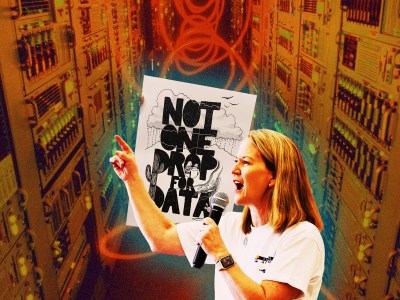
These are the latest iterations of the content created by a massive industry of election deniers and professional conspiracy theorists. Trump is seemingly fluent in all of them, and obsesses over them in public. 2020 fraud proponents continue to push debunked and outrageous ideas like satellites changing votes, shootouts between U.S. personnel over servers full of fraudulent ballots, and China somehow infusing bamboo fibers into ballots that had to be changed for Biden to win. These claims, though bizarre and unevidenced, have become gospel truth to many on the far right.
All of this was nonsense then, and it is nonsense now. But there’s a reason why Trump is able to rehash these accusations: the people who he needs to believe them still believe them. Republicans overwhelmingly still insist that 2020 was rigged and fraudulent, with a recent Economist/YouGov poll finding only 30% of Republicans saying they know for a fact the election was fair and legitimate. Likewise, the same poll found that nearly three-quarters of Republicans believe Trump has “concrete evidence” of the California primary being rigged. There is none.
Like many conspiracy theories of the Trump era, many believers — including the president himself — insist that there is one easy way to stop future attempts at fraud, but that for some reason, nobody has done it until now. Trump presents this cure-all as the SAVE America Act, an election security bill that would make it harder to vote and restrict how people are able to do it. Trump has demanded the Senate pass the bill, and claimed he would not sign new legislation until it happened, though he at one point insisted the law be loaded down with anti-trans legislation, which delayed its path through Congress and ended up mostly being stripped out anyway.
Despite its reliance on conspiracy theories that are hugely popular with Republican voters, the SAVE America Act has stalled in the Senate. Even some Republicans have pushed back at the bill, saying its provisions to stop fraudulent voting are unnecessary, overly complicated, and redundant with state laws. Many Republicans are also unwilling to remove the 60-vote filibuster threshold that is preventing it from being passed. And though nothing is final in Trumpworld, the bill appears to be dead for now.
For at least some Republicans, the SAVE America Act’s codifying of the president’s conspiracy theories about 2020 was a step too far. But this doesn’t mean that Senate Republicans don’t have their own conspiracy theories, and balancing the president’s conspiracism with the beliefs of their voters is a high-wire walk across dental floss. Many seem eager to move on from the 2020 election, but themselves are stuck in a different time in 2020 — when the world was on lockdown, and Americans turned to Fauci for guidance.
The Senate’s Homeland Security Committee hearing on the origins of COVID-19 turned into a greatest hits album of conspiracy theories about the virus and lockdown. One after another, Senate Republicans took turns hammering the 85-year-old former medical adviser to the White House with comments in the form of questions. Fauci was accused of lying repeatedly about the origins of COVID, seeking wealth and celebrity at the expense of the American people, of misleading America about its severity, and of personally funding the “gain of function” research that turned into a bioweapon that killed millions.
While he was being accused of mass murder, Fauci was simultaneously attacked for exaggerating the danger of COVID and for pushing unnecessary lockdowns and school closures, which lawmakers framed as draconian measures that took away our freedom and caused more deaths than the virus. So how could the virus be a bioweapon that killed millions of Americans, but mitigation procedures such as lockdowns be overly cautious and tyrannical? And how could Fauci be to blame for the president essentially giving governors their own latitude to enact COVID mitigation? Isn’t the president the final decider?
This is the logic of conspiracy theories. Somehow, Trump had no power over Fauci and was entirely helpless during the crisis, which was the fault of the presidents both before and after him. But this is a rewriting of history. Many Republicans have spent years blaming Biden for both COVID deaths and harsh lockdown mandates, even though almost the entire first year of COVID took place during Trump’s presidency. And Trump constantly praised his own handling of the crisis and his administration’s efforts to contain it, claiming the outbreak would have been far worse with a different president — all contrary to the idea that it was Fauci who was controlling the White House’s response.
Trump even pushed for the development of the COVID vaccine through his Operation Warp Speed venture, and gave Fauci an award for it at the end of his term — even though many of his most fervent supporters have long decried the vaccine as harmful and dictatorial. It all makes for compelling TV drama, but as a timeline of events, it’s incoherent and falsified. As always, whether it’s correct doesn’t matter to the people who need to believe it.
Ultimately, what Republicans in Congress — many of whom are facing tough re-election fights — want is not to question what the government did during COVID, but evoke memories of a hard and scary time by blaming their opponents for it. The idea of COVID being both “just a cold” and a genetically engineered murder virus doesn’t have to make sense. It just has to remind voters of the chaos and fear of 2020, and find a way to blame it on Democrats in 2026.
As the midterms get closer, we should prepare for this balance of incoherence and belief to help resurrect other popular Trump-era conspiracy theories. Each one will be used to terrify vulnerable voters, remind them of what they loved about Trump, and focus irrational anger on the reliable roster of villains dredged up every two years.
We’re already seeing this dynamic pop up on issues beyond COVID and the 2020 election. Trump’s relentless use of “Barack Hussein Obama” to refer to the former president is an invocation of nearly two decades of conspiracy theories that Obama was not born in the United States and is secretly Muslim. These are, of course, the theories that propelled Trump into political prominence in the first place. There are the usual rumblings in conservative press that George Soros is going to pour massive amounts of money into critical 2026 races, recycling the same conspiracy theories that put the 95-year-old billionaire at the center of every Democratic plot and scheme of the last quarter century. And right-wing influencers are already equating the crisis on the Spain-Morocco border with the “migrant caravan” scare that routinely appears on conservative social media in the lead-up to elections.
Even the left isn’t immune from such recycled conspiracism. Liberal conspiracy theories about Trump “cancelling” the 2026 election are becoming increasingly popular, echoing conspiracy theories from both sides about elections being canceled in 2012, 2016, and 2020. (Though it should be noted that Trump has made allegedly humorous remarks about cancelling the midterm, despite having no power to do so.)
Ultimately, conspiracy theories require no evidence or coherence, only for their believers to desire that they be true. They need Trump to have allowed himself to have the 2020 election stolen, so he can expose the fraud that allowed the 2020 election to be stolen. They need to believe Fauci talked Trump into lockdown for a virus that was harmless, but that was also deeply harmful and spread by America’s enemies. Soros is pouring money into the same elections that conservatives like Elon Musk are pouring money into, but only one of them is bad. Migrant caravans are always just about to arrive. Obama’s secret nationality and religion will finally be exposed, 20 years after they were first exposed.
Asking for it to make sense or be consistent is a waste of time. All that matters is understanding the power that paranoia holds over American voters, being able to recognize it, and knowing that all of it is meant to distract and confuse us, dampening our enthusiasm, and making us believe our votes don’t count. That’s the real conspiracy. And it’s not a theory.



Lies, racism and hatred for the left propelled these lousy traitors into the white house they are not about to stop now.
I should point out one thing to the author of this article. Unlike our opponents on the right who have no examples or proof of their conspiracy BS, their cult leader Donald John Tr#mp actually engaged in an attempt to overthrow the 2020 inauguration of President Joseph R. Biden.
Special Council John L. “Jack” Smith testified before the House Committee that:
So yeah, maybe we are being paranoid. But maybe we have a reason for doing so.
https://www.npr.org/2026/08/05/g-s1-137440/judge-dismisses-lawsuit-oath-keepers
From the article:
Yes, but he also has “no power” to tear down part of the White House, but he did it anyway.
Or fire thousands of Federal employees and shut down vast parts of the Federal Government, but he did it anyway.
And on and on, things that he has no formal power to do that were done anyway.
I don’t think that thinking he might mess with elections is paranoid behavior.
Even if Trump has no power to cancel elections run by the states, he’s making great efforts to control these elections, specifically by demanding states send him personal data on voters, by ordering the Post Office to systematically disenfranchise certain voters by denying them a ballot, by threatening to arrest election officials in liberal cities and counties. And I certainly expect him to send out the National Guard to one or more blue cities where he will pretend there is a “threat” of some kind.
Seriously. If anyone in 2010 had told me we’d be siding against Russia and threatening the sovreignity of Greenland because we were led by a pedophile who struck secret deals with the Saudis, I’d have looked at them in pity as a way out there conspiracy nut.