

This excerpt is part of TPM Cafe, TPM’s home for opinion and news analysis.
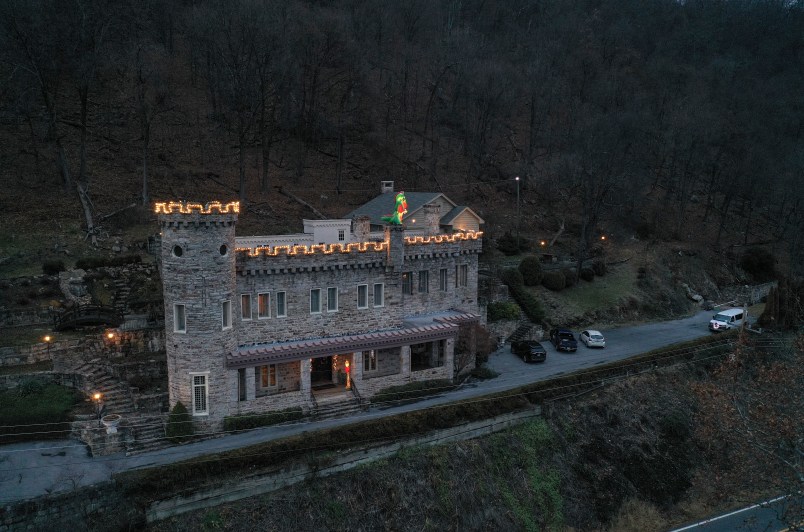
In late February 2020, residents of the small tourist town of Berkeley Springs, West Virginia, woke to learn that a mysterious right-wing group called VDARE had purchased a beautiful nineteenth-century castle overlooking their town. The castle meant everything to Berkeley Springs. Images of it appeared on town promotional materials, and the outsiders business and restaurants owners relied on for tourist revenue always noticed the gorgeous sandstone building as they drove past Berkeley Springs State Park on Route 522.
With fewer than a thousand residents, gossip reverberated quickly through Berkeley Springs, and Peter and Lydia Brimelow, the castle’s new proprietors, soon became its subject. The Brimelows had a great deal of money for Morgan County, West Virginia, as well as inscrutable benefactors and a fair share of infamy. My employer at the time, the Southern Poverty Law Center, labeled them “white nationalist[s],” and VDARE’s website wrote credulously about the “Great Replacement” conspiracy theory that mass shooters have used to justify their beliefs. There were other reasons for gossip, too, including the nearly four-decade age gap between Peter and Lydia.
My new book, Strange People on the Hill, covers a five-year period in Berkeley Springs — from the end of 2019 through the day after the 2024 election, when VDARE’s presence caused neighbors to turn on one another, taking sides across ideological divides. The following excerpt begins on the night of December 8, 2023, after my colleague Hannah Gais and I managed to gain entry to the castle for the first time. We did so by purchasing tickets to a local Christmas party. For years, I reported on the Brimelows, and they posted disparaging remarks about me and my family on their website. That night was the first — and last — time we met in person.
When Hannah and I entered the castle, a massive tree reached the high ceiling of the foyer beside it. White lights, translucent white ribbons, and a glowing angel adorned the tree. A matching wreath hung above the fireplace. Hidden speakers played Bing Crosby’s “Do You Hear What I Hear?”
I mentioned to Hannah the possibility that the Brimelows might not even show up. We grabbed champagne and appetizers from an adjoining room with a long, opulently laid table and then headed up a red carpeted staircase that split the big stone walls of the foyer.
On the next floor, we found a pristine phonograph next to a painting of green hills and a white sky. They also had a print of the Karl Ludwig Friedrich Becker painting Othello Tells His Story to Desdemona. It showed Othello in front of a row of columns, his Black skin draped in Renaissance garb, gesticulating as he speaks to an older white man and a young white woman who is demurely peering up at him.
We walked down the halls and found a few untouched bedrooms. They looked like part of a fancy hotel. Then we ducked into another room with a Christmas tree. It was empty and we hung out there for a minute to take a break. When we moved on to the next room, we found that it was a scullery.
There were no Christmas decorations in it, just framed pictures of Civil War generals. General Robert E. Lee was there. So was Stonewall Jackson. They also had a portrait of General Ulysses S. Grant. I wondered whether the Brimelows had put them up or the room came that way.
Hannah and I jumped up another small flight of stairs and stumbled into the room where VDARE held its conferences. At the center, we found the dais marked with VDARE’s circular emblem, an outline of a white doe surrounded by blackness. Behind it was an oil painting and what looked like Chinese sculptures of white, red, and black guard dogs. I found it bizarre that they had left the room accessible.
“Let me take your picture,” I said to Hannah.
Hannah posed and then took my picture next. I opened my palms in a shrug at the dais when she snapped it. From that angle, I was looking at a giant illuminated wreath and VDARE’s conference tables. There were only a couple dozen chairs.
Next to the conference area, facing west, I saw two doors. Someone had put up signs telling people not to access them, and I wondered if people lived there.
We exited through a door on the eastern side of the room, stepping into the cold. We took selfies with the illuminated battlements behind us. I looked down on the silent town from there. Traffic lights were changing colors, but there was no traffic.
When we went back inside, some other people had come into the conference room, and Hannah volunteered to take pictures of a couple who wanted a photo of themselves standing in front of the wreath. Then we walked back downstairs and got new drinks. We sat down together along a plush loveseat at the back of the foyer.
I contemplated interviewing the people milling around and then making an abrupt exit. But then the doors opened, the wind and cold air blew in, and Peter and Lydia stepped forward with their three daughters.
The bench Hannah and I were sitting on angled along the stone walls in a way that obscured our faces from most of the room. We turned our heads to the side and looked at our phones so it would be harder to notice us. The Brimelows talked about the weather when they came in, and some people walked over to be closer to them.
I was about to suggest to Hannah that we make a move back up the stairs when Peter walked directly toward me. Dressed in a brown corduroy blazer and matching pants, he came closer and closer and then marched past me. Behind my back, Peter fiddled with something and muttered to himself. Hannah and I shared a glance.
Peter returned and hovered in front of us. He looked directly at us.
“I need to turn the heat on,” he said in his gravelly British accent.
He left. Someone pulled Lydia into a conversation, occupying her, so Hannah and I got up from where we sat and moved back to the table with the hors d’oeuvres. Two of Brimelow’s daughters, the older ones, dressed in plaid and white, were thumbing through a book that had pictures in it. Hannah and I communicated only with our eyes. We saw an opening, headed back up the stairs, and found an empty space in the room with the second Christmas tree.
“I gotta talk to them,” I said.
“Once you do they’re gonna throw us out,” Hannah said.
We walked back over to the top of the stairs, near Othello Tells His Story to Desdemona and the phonograph. There were a few guests wandering around. I composed myself before approaching.
Before I could descend the stairs again, the Brimelows’ youngest daughter bounded up to them, radiating the kind of energy kids get when they’re at an adult function after bedtime. The girl said a few things to me and Hannah. She spoke like a child unfrozen from the 1840s.
“How is it living in a castle?” I heard myself asking, amid her monologue.
“Oh, it’s wonderful. And, there’s a dungeon!” she said.
The Brimelow girl detailed the time she’d visited the dungeon. My gaze hung over her shoulder, on her parents, who were chatting with someone in the center of the foyer. I decided to end the conversation and started moving down those carpeted stairs. I took no more than two steps before Lydia looked up at me.
I saw the stages of Lydia’s recognition in what felt like slow motion.
First, her eyes opened in shock. Then, her brows furrowed. Her frown sucked in to cover a row of teeth that clenched visibly beneath the curtain of her lips.
Lydia led Peter into a private conversation, presumably warning him about our infiltration. I saw Peter straining to look for where we were.
His general cluelessness was almost charming. Hannah and I went to the bar and I got another drink while the Brimelows talked. When I got my drink, I turned around to approach them. Hannah flanked me.
Lydia stared at me like she wanted to jab a stake into my heart. She closed her eyelids around her dark irises and held them that way, letting them twitch with contempt.
“Hey Peter, how are you doing?” I said.
“No pictures of the children,” Peter said quietly.
Hannah and I erupted with crisscrossing expressions of “no” and “of course not” and “we would never do that.”
“No pictures of the children,” he said again.
“You had your phone out, and if you took pictures of my kids . . . ,” Lydia said.
“I wouldn’t do that,” I said.
“You would do whatever you can,” Lydia said, raising her voice.
“I would not, I would not,” I said. “I’m not even here on behalf of SPLC.”
“What are you here on behalf of ?” Lydia asked.
“I’m writing a book,” I said, trying to project a little defiance.
“About what?”
“About the town.”
“Not about us?” Lydia asked.
“Well, you’re part of the town,” I said.
I told them they had a wonderful home, referring to the castle. I thought it was the thing to say at that moment. Lydia leaned forward, towering over her husband.
“It’s not our home,” she said. “It’s our office.”
I wanted to ask about the doors that they’d roped off adjacent to the conference room but I thought better of it.
“I mean, you’ve spent nights here, right?” I asked.
“It’s not our home,” Lydia repeated. “That is a very important distinction. We have a house with our family, which is not this house.”
I told Peter that I wanted to interview him. He told me to send an email. Then he looked at Hannah directly.
“What’s wrong with room temperature vodka?” he blurted out.
For years, Hannah and I had made watching VDARE’s holiday fundraising livestream an annual tradition. We would inevitably post screenshots and videos to Twitter and poke fun. In one of them, Hannah had mocked Peter for drinking room temperature Tito’s vodka. We laughed at Peter’s joke. At that moment, it felt like a peace offering.
“As a Slavophile, I simply think it should be cold,” Hannah said.
When I laughed about the vodka, I involuntarily put my hand onto Peter’s left shoulder, as you would do to a friend. After I realized what I had done, I drew my hand away. I watched Peter’s eyes monitor the movement of my hand as it left him. I continued to feel the corduroy of his jacket on my fingers long after touching it.
“You traveled all the way here? For this?” Peter asked, his tone shifting to one of displeasure.
Lydia leaned forward in my direction.
“As soon as you come into town, I get a string of text messages,” she said.
“Well,” I said and stopped short.
“And I get recordings of your meetings.”
I searched myself for what she might be talking about. I remembered the night with Tanya Gersh and her comments about maggots.
“Well, it was certainly nice to meet you finally—,” I started.
“These people are normies,” Peter said in a low voice, putting emphasis on the word “normies.”
His eyes flitted to either side, referring to the people there. “Normies” had a particular connotation in the movement. He meant that they were people who had no connection to radical politics. Hannah and I were not considered normies because we were perceived to be in the fight — in the “cold civil war.”
“No, we’re not—,” I said, starting to explain that I wasn’t writing about the guests.
“And unblock me on Twitter,” Peter said.
I squinted at him after he made the comment and then looked at Lydia, who continued to watch me intently. It caught me off guard because of how stupid it sounded coming from Peter’s mouth.
“I don’t want to get in any public back and forth,” I said.
“Then why do you attack?” Lydia asked.
“I don’t attack,” I said. “I never attack.”
“You’re writing a book called the Strange People on the Hill, what do you call that?”
“It’s from a quote,” I said.
“It really should be called Strange People in the Castle,” Lydia said.
Her youngest daughter arrived at her side. She looked at Hannah and me like we were her new best friends.
“That’s not bad, but again, it’s from a quote,” I said and forced a smile.
“It’s disingenuous to say that you don’t want to get into a back and forth, so you’re going to mock,” she said.
“Well—”
Peter raised his hand.
“This is enough,” he said. “Merry Christmas.”
“Merry Christmas to you,” I said.
The energy shifted from a pantomime of collegiality to something harsher, darker, and colder than the air outside. When we picked up our coats, someone who wasn’t the Brimelows followed us to make sure we left. He was an older middle-aged man wearing black fleece. As we stepped into the cold air, he looked down on us from the big doors.
“You’re not welcome here,” he said.
Hannah and I walked the long driveway to the gates. They were closed. It might not have been more than a minute but it felt like half an hour before someone opened them for us. We crossed Route 9 and hiked down the hill to the park. The only place still serving food was a bar on 522 called the Naked Olive.
“These people are normies,” I said to Hannah, imitating Peter’s voice.
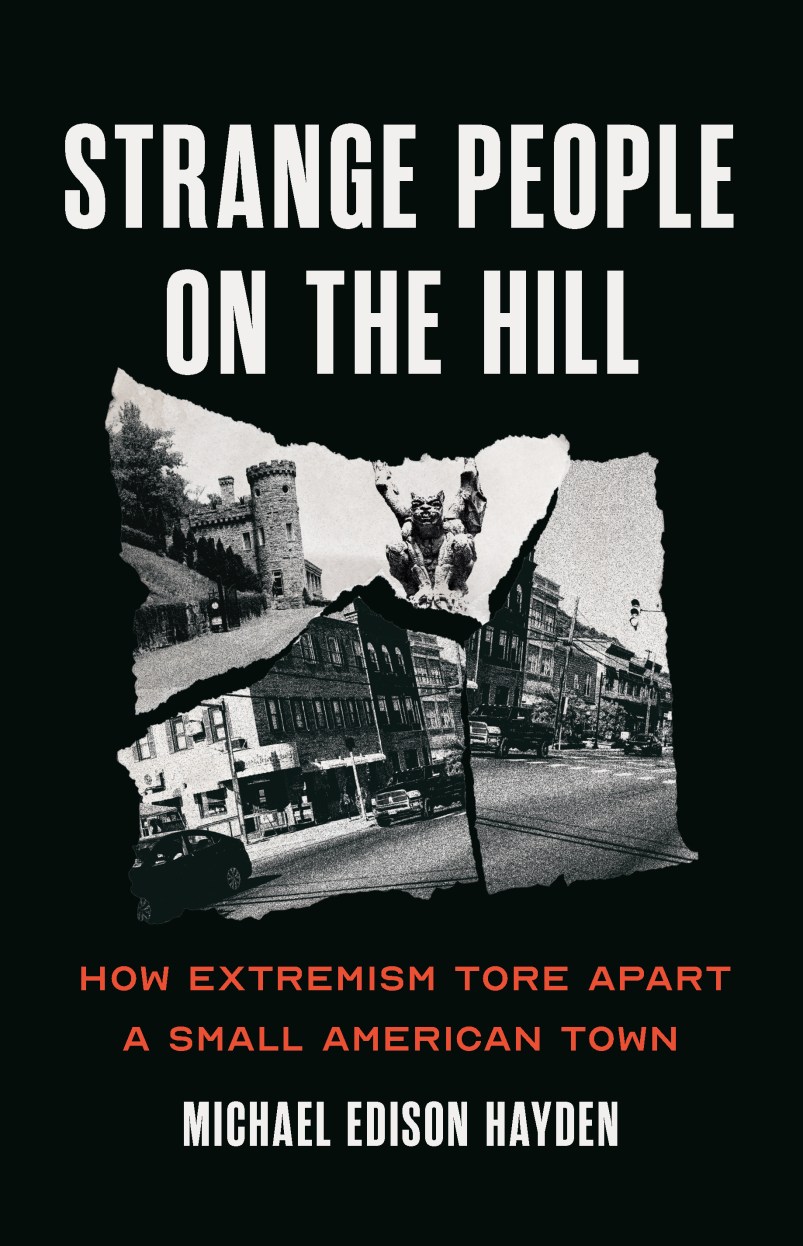
Excerpted from STRANGE PEOPLE ON THE HILL: How Extremism Tore Apart a Small American Town by Michael Edison Hayden, copyright ©2026 by Michael Edison Hayden. Used with permission of Bold Type Books, a division of Hachette Book Group, Inc.




No, they’re not “Normies”. I’d go as far as to say they’re “Creepies”.
The author is also the co-host of the great “Posting Through It” podcast, doing deep dives on the far-right movement and personalities.
Terrific story. I’m sure I have encountered Brimelow and VDARE before. Glad we imported another ignorant bigot, we don’t seem to have enough of the native variety. His wife sounds like he deserves her. Not nice people, thanks for exposing them.
The sad thing is a helluva lot of People in this schizophrenic land of the free actually believe this Great Replacement bullsh*t. They are terrified of the coming change in demographics when Whites will be majority/minority. They think the Convicted felons mass deportation scheme will stop it. Not going to happen.
My Dad would have called that a starter castle.