


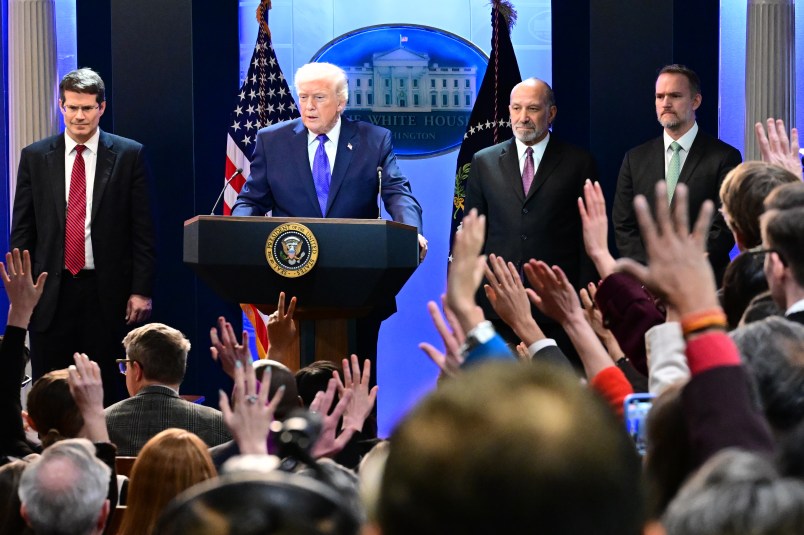
As soon as the Supreme Court struck down many of President Donald Trump’s tariffs in February, his administration imposed a new, sweeping 10% tariff on a broad swath of products and countries under a different law, called Section 122 of the Trade Act of 1974.
Now, a group of 24 states and some small businesses is challenging the legality of those replacement tariffs in court. A win for them — likely, ultimately, at the Supreme Court — would further erode a core part of the president’s economic and foreign policy agenda.
Trump initially relied on the International Emergency Economic Powers Act, or IEEPA, to hike tariffs on foreign imports for the first time in the history of the statute. The Supreme Court in February decided the tariffs were tantamount to a tax on Americans and that the Constitution grants Congress, not the executive branch, the power to tax. Before the Supreme Court, the arguments in that case became relatively straightforward: Either tariffs are taxes and the president cannot unilaterally impose them under IEEPA, or tariffs aren’t taxes and the president can.
Things are less clear cut in the Section 122 case.
Section 122 of the Trade Act of 1974 allows a president to impose “temporary import surcharges” to address “fundamental international payments problems” including “balance-of-payments deficits.” Tariffs under the statute come with strict guidelines: no more than 15% for no longer than 150 days. Trump’s current Section 122 tariffs are set to expire on July 24, 2026.
Judges at the Manhattan-based U.S. Court of International Trade spent much of a 3-hour hearing this month just trying to define and understand the meaning of “balance-of-payments-deficits,” one criteria which must exist for a president to impose tariffs. They also probed the meaning of “fundamental international payments problems” raised in Section 122. Ultimately, the panel of three judges — Chief Judge Mark Barnett, Judge Claire Kelly, both appointees of President Barack Obama, and Judge Timothy Stanceu, appointed by President George W. Bush — seemed confused about whether those criteria were met under the present conditions.
If the tariffs are blocked ahead of their 150-day deadline, the judgement would strike yet another blow to the Trump administration’s agenda, and potentially ease price increases for consumers.
Here’s what you should know.
This Statute is Obsolete in 2026, Plaintiffs’ Lawyers Argue
Counsel for states and small businesses are arguing that the U.S. is not on the same kind of currency system this statute was created to address, thus making it impossible not just for the president to use this statute today, but for the confluence of conditions necessary to trigger Section 122 tariff powers to exist at all.
The statute was established to prevent a problem that was related to a time when the U.S. dollar was pegged, and then unpegged, to gold, creating the threat of a currency crisis, argued attorney Brian Marshall.
Government attorney Brett A. Shumate opened by saying Trump invoked his new tariffs “to address large and serious trade deficits” since the courts struck down IEEPA. The assertion triggered immediate skepticism from judges, as, Chief Judge Barnett said, Section 122 is likely not intended to address trade deficits.
One Supreme Court Justice Basically Told the Administration They Could Use Section 122
In his lengthy dissent to the 6-3 SCOTUS IEEPA decision, Justice Brett Kavanaugh cited Section 122 as an alternative measure the administration could use to replace some of its unauthorized tariffs.
“[T]he Court’s decision might not prevent [p]residents from imposing most if not all of these same sorts of tariffs under other statutory authorities,” Kavanaugh wrote. “For example, Section 122 of the Trade Act of 1974 permits the [p]resident to impose a ‘temporary import surcharge’ to ‘deal with large and serious United States balance-of-payments deficits.’”
During oral arguments, attorney Neal Katyal, representing parties challenging the tariffs, also pointed to Section 122 as a potential alternative for the administration to try.
“We have no problem with the [p]resident doing that,” Katyal said at the time.
And D. John Sauer, the U.S. solicitor general, pointed to the statute as proof Congress had granted the president tariffing power in some capacity.
Section 122, however, has never been used to levy tariffs. And Trump’s own Department of Justice when arguing in favor of IEEPA tariffs last year found that Section 122 didn’t “have any obvious application’’ for addressing trade deficits, calling those deficits “conceptually distinct” from payments problems.
Major Questions Doctrine Rears Its Head as Judges Show Confusion Over Meaning of Statute
More than an hour into the hearing, Judge Claire Kelly asked the plaintiffs’ counsel to fill in the blank: “A fundamental international payments problem is,” she said, and paused. “Complete the sentence.”
That exchange exemplified the most noteworthy aspect of the hearing: confusion on all sides. Judges, and to an extent attorneys, struggled to define fundamental parts of the legislation at issue. Attorneys for both sides had limited legislative history to point to regarding balance-of-payments-deficits and fundamental international payments problems, and judges repeatedly pressed lawyers to quantify whether the problem does or does not exist today.
Jeffrey Schwab, a plaintiffs attorney from the Liberty Justice Center, suggested judges strike down Trump’s new tariffs using the major questions doctrine. That legal theory has led Supreme Court justices to block presidents’ actions with significant economic implications if those actions aren’t clearly defined by Congress.
“The Supreme Court has indicated that the major questions doctrine might be useful in this circumstance,” Schwab said. “Because here, we have a massive amount of power supposedly given to the president that obviously implicates vast economic and political significance, and in a situation where we have an old statute that’s never been used in this way before by any president.”
Judges haven’t indicated when they might rule.
Replacement Tariff Rate Just a Fraction of IEEPA Tariffs, But Households Still Pay
According to a tariff tracker from Yale Budget Lab, IEEPA tariffs represented more than 41.5% of the total effective tariff rate, which jumped from around 2% in January 2025 to more than 14% by January 2026.
Tariffs levied under IEEPA made up the biggest single share of that hiked rate throughout their duration before they were blocked by the Supreme Court.
Section 122 tariffs account for a much smaller share of the now lower effective tariff rate, accounting for about 26% of the total rate which stands just above 11% as of April 2026. So even if the new tariffs stand, the nature of the statute prohibits them from having as drastic an effect as those overturned by SCOTUS.
Prices are still on the rise for consumers, and it’s unclear whether they’ll go down if the tariffs are struck down before the 150-day period lapses. Yale Budget Lab estimates that if the tariffs are allowed to continue, they’ll cost the average household $760 to $940.
Tariff Challenges Draw Bipartisan Support
Trump’s attempt to reorder global trade through tariffs goes against the usual conservative lodestars of free trade and capitalism. As a result, the policies have put the president on the opposite side of conservative and free trade groups.
The Liberty Justice Center, a nonprofit law firm which advocates against things like diversity, equity, and inclusion programs in higher education, and against requiring government workers to pay into a union, is one such conservative group, and is representing some small businesses in this case. Most of the states who are party to the case are Democratic-led.
Advancing American Freedom, an organization that “promotes and defends policies that elevate traditional American values,” and the libertarian Cato Institute, wrote amicus briefs opposing the government.
“Section 122 was enacted to allow the President to solve a specific problem in foreign relations that no longer exists,” attorney J. Marc Wheat wrote for Advancing American Freedom. “It was not enacted to allow the President to erect barriers to international commerce on the mere assertion of a trade deficit.”
The Liberty Justice Center also represented small businesses opposing Trump’s IEEPA tariffs.


As a lawyer, I’m most confused about the inability of the plaintiffs to seek a stay of these new import taxes/tariffs. Unless I don’t understand what they are doing, I would have filed to seek a stay of the tariffs on day one. Why let them ever be collected when the Trump regime seems unwilling or unable to refund stolen tariff money from their first bunch of illegal tariffs?