


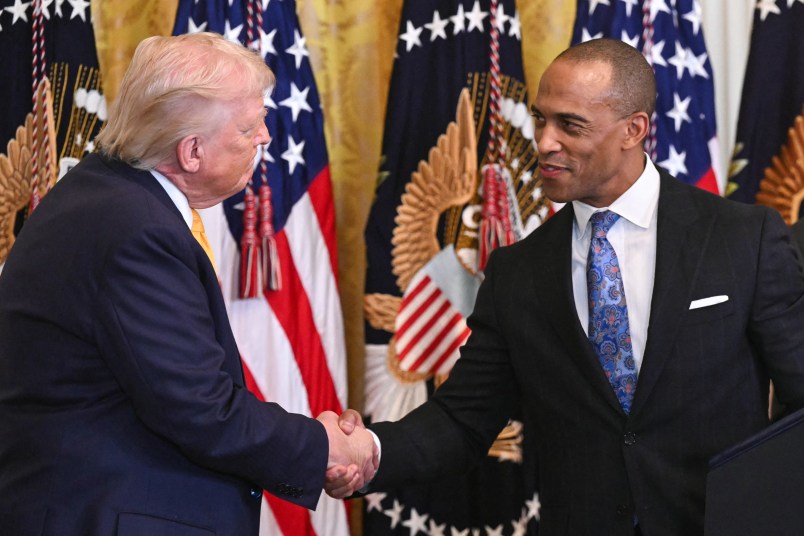
It would be unjust to say the U.S. real-estate-mogul-in-chief created today’s housing crisis.
But it is fair to say that President Donald Trump’s policies today won’t make anything better and could make everything worse.
“If you take one step forward, but you take 15 steps back, you have a very low odds of being able to achieve your objective, which is to give Americans some relief in the cost of housing today,” Mitria Wilson-Spotser, vice president and federal policy director at the Center for Responsible Lending, told TPM of White House housing policy.
The domestic housing shortage, which has been estimated at between 2.3 million to more than 7 million homes depending on the metrics, started toward the end of the last century and has been exacerbated by an amalgam of intersecting issues like restrictive local zoning, ballooning residential construction costs, and the 2008 global financial crisis.
Bipartisan leaders have tried to tackle the complex issue with little movement. Congress last passed a sweeping housing bill in 1990, creating an affordable housing strategy which relied on new grant programs to spur residential construction. A new bipartisan bill passed by the Senate on March 12 is poised to be the first major affordable housing legislation out of Washington in more than 35 years. It’s pretty uncontroversial, evidenced by an 89-10 vote, and expands on some of the 1990 bill’s initiatives but faces a potential block from the president, who’s claimed he won’t pass any legislation if Congress doesn’t pass a deeply controversial voter suppression bill.
Threatening to torpedo affordability legislation just about everyone can agree on isn’t the only thing Trump and his cabinet members are doing to compromise Americans’ access to affordable shelter.
Like this administration’s faulty approach to lowering prices generally, Trump and his officials have verbally promoted housing access as a priority, but their key policies are increasing costs and uncertainty while decreasing housing security.
In a September interview with the conservative Washington Examiner, Treasury Secretary Scott Bessent called the housing crisis the administration’s “biggest priority” and floated the idea of Trump declaring a “national housing emergency,” something that hasn’t happened.
On March 13, the president issued an executive order aimed at eliminating some federal building regulations to encourage affordable homebuilding. Minimizing red tape and federal bureaucracy has been one administrative priority housing advocates and developers lauded in conversations with TPM.
And on Tuesday Trump in a White House Instagram post falsely claimed that mortgage rates, which recently dipped just below 6%, were the lowest they’d been in five years. The post is fact-checked by a community note.
White House-Supported Proposals Fight Against Each Other
At least 16 Democratic attorneys general are suing Trump’s Department of Housing and Urban Development for threatening funding for public housing and moving to revoke a recognized certification from state and local public housing agencies who comply with certain fair housing laws. Known as the disparate impact rule, the civil rights protection codifies standards in the Fair Housing Act that protect people from housing policies that disproportionately impact certain groups including low-income people, people of color, women, and other gender minorities. Trump’s Housing and Urban Development Secretary Scott Turner celebrated the rollback of these provisions, which Turner said are now in “the ash heap of history,” according to the ACLU.
The administration has also gutted HUD’s Office of Fair Housing and Equal Opportunity, slashing staff by 45% according to Politico, and has halted HUD civil rights investigations.
The potentially unlawful rule changes are in direct contradiction to the stated goals of the administration to improve housing access.
“One of the things that’s really interesting about the policies in this administration is it continues to talk about its efforts to increase affordability, [but] at the same time it repeals and restricts housing assistance programs through HUD,” said Wilson-Spotser.
A White House staff member speaking to TPM on background denied that the administration has reduced fair housing standards and echoed anti-DEI sentiments core to Trump’s policies. The staffer said the administration’s changes to long-standing fair housing standards at HUD will provide equal access to affordable housing.
OBBBA Supports Low-Income Home Building, But Attacks Low-Income People
Trump took a stab at improving affordable home building in his One Big Beautiful Bill Act.
The OBBBA permanently expanded two low-income residential construction incentives: the Low-Income Housing Tax Credit (LIHTC) and the Opportunity Zone incentive. A report from the National Low Income Housing Coalition estimates the former provision will result in the construction of 1.22 million affordable homes over the next decade.
Jake Keating, a real estate professional who worked for The Promise Homes Company, an industry leader in single-family rental homes, applauded the administration’s Opportunity Zone expansion in an interview with TPM. Keating met with HUD Secretary Turner and called him “an incredible guy [who] clearly cares a ton about what he’s doing.” Keating said HUD has been working on an issue with Opportunity Zone designations that left some communities out of the incentive program.
“I think they have taken a lot of steps [trying to rectify] unintentional data-driven differences between opportunity zones to encourage capital development into those areas,” said Keating.
But a statement from the NLIHC said other federal provisions including cuts to federal nutrition assistance cancel out any benefit the low-income housing program expansions may have had.
“[T]he additional financial strain put on low-income households because of the other provisions of this bill means that housing will continue to be out of reach for those with the most urgent affordable housing needs,” the statement reads.
The Iran War Oil Strain Could Stretch to Residential Construction
Trump’s war in Iran and the resulting increase in gasoline prices could affect the fuel needed for airfare and other importation thus driving up the cost of a range of goods, including construction materials, Christopher Hodge, chief U.S. economist at Natixis CIB Americas, told Axios. That’s upward pressure on top of the tax from tariffs.
Some building materials like steel also take a lot of energy to produce, so higher energy prices can drive up material costs in two ways, according to a report from a construction logistics company called Linesight.
And despite the start of spring real estate season, Russell Brazil, president of the Greater Capital Area Association of Realtors which includes parts of the Washington D.C. metro area, is eyeing a drawn-out war’s impact on the market at a hyper-local level.
“In this scenario,” Brazil said in a monthly industry report, “consumers will also be met with increased pain at the gas pump. With these factors combined, some may choose to put homeownership on hold.”
Violent Deportation Campaign, Coupled with Hate, Compromises the Labor Force
“They’re just being profiled.”
That’s what construction firm owner Maurice Roming said on a February Marketplace podcast episode about how escalated violence and bigotry against his foreign-born employees was impacting his business. Some of Portland-based Roming’s employees opt to stop working rather than risk harassment or compromise their family’s security in the U.S.
“I’m losing talented people,” Roming told Marketplace.
Immigrants make up a quarter of the construction industry workforce, and nearly a third of skilled tradesmen, the National Association of Home Builders found. A November 2024 NAHB report also tracked a positive relationship between the number of new immigrants and the number of new single-family homes under construction.
Immigration raids at construction sites in Texas led Trump voter and building industry leader Mario Guerrero to issue a warning to the GOP.
“I told [lawmakers] straight up: South Texas will never be red again,” Guerrero told Politico.
Tariffs as a Construction Tax
While companies have been eating a large share of the inflationary impacts of Trump’s tariffs, data from the Bureau of Labor Statistics reveals the impact of that importation tax on domestic building.
Most of Trump’s tariffs were overturned by a February Supreme Court decision. But those that apply to some housing-related inputs remain. There’s a 25% tariff on certain furniture, for instance, and February’s BLS inflation report saw annual inflation for household furniture tracking around 4%, higher than the general inflation rate. Materials and components for construction, including raw steel and finished goods like HVAC units, had a 3.5% annual unadjusted inflation rate according to the Producer Price Index released Wednesday.
“A lot of the supplies that we use to build houses in the United States come from places like Canada,” said Wilson-Spotser, “and so that so the tariff policies of this administration have had direct impacts on…the cost to build not just single-family homes but multi-family projects.”
Trump’s White House has responded a bit to builder concerns, delaying a tariff hike on furniture, for example, for one year.
Institutional Investor Restriction Gets Mixed Reviews
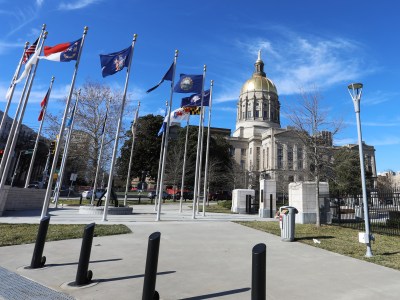
Trump’s populist-seeming proposal to restrict institutional investors from owning single-family homes has been met with bipartisan support. The proposal has been a priority of Democratic and Republican legislators in Georgia, where institutional investors own as much as 30% of single-family rental units in the Atlanta metropolitan area. There, investors routinely outbid would-be homeowners and drive up housing prices, said Xinyuan Zheng, a policy and program analyst at Georgia Advancing Communities Together, an affordable housing organization. Zheng said investors are concentrated in Atlanta-area communities of color because Georgia has weak renter protections.
Nationwide, though, institutional investors own around 3% of single-family rental homes. The issue is more nuanced than a blanket ban can address, and Zheng has heard from other states that a ban on investor-owned single-family homes could harm other local housing industries.
“They’re more worried the ban of institutional investors can affect supplies of new construction,” Zheng said. But I believe the real argument to this is those investors are buying the single-family house that’s existing and because they’re large companies, they can buy the house by cash.”
Keating, the former The Promise Homes Company executive who co-founded a real estate investment tech venture capital firm , made the ban sound dire.
“I think it’s well intended,” Keating told TPM, “but, yeah, it will pretty much single-handedly destroy that market.”



HUH… I have no clue what this means. Firstly, aren’t women the majority from a numerical standpoint; and other gender minorities is a new way of saying trans?
Also I’d like to propose we use OFFAL (One Fucking Foul Awful Law) instead of OBBA.
It would be unjust to say the U.S. real-estate-mogul-in-chief created today’s housing crisis.
But it is fair to say that President Donald Trump’s policies today won’t make anything better and could make everything worse.
That is true about everything he says and does..
ETTD. How many times does that have to be posted to get through to the MAGAts?? Asking for many, many friends…..
It’s not about Trump. It’s about taking it to the ‘libs. Republican party knows branding and keeping their base at high stress levels. Democratic party know policy and believe in educating the idiots. It’s an impossible battle. Getting the idiots to not vote in November should be the goal.
Fun Fact
Democrats controlled Congress in 1990.