


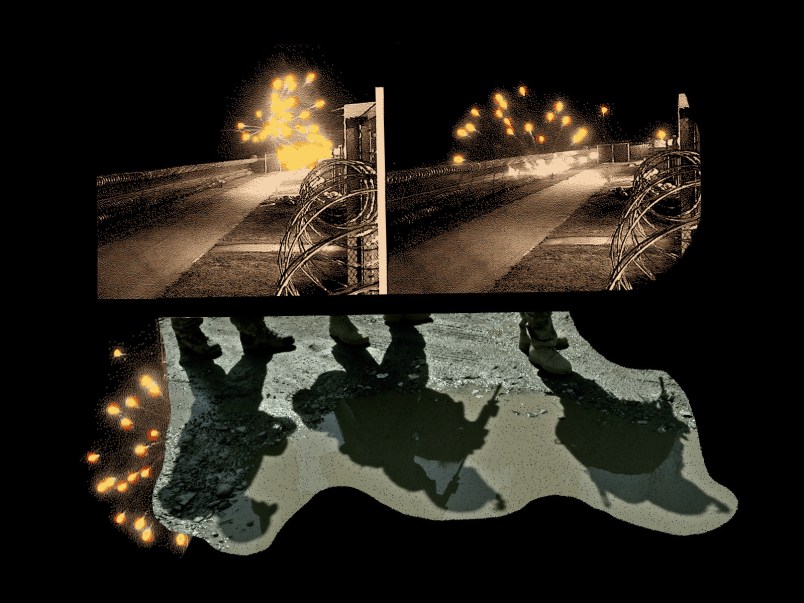
This article is part of TPM’s ongoing “Creating the Enemy Within” project, tracking the Trump administration’s efforts to crack down on dissent.
When Amber Lowrey first heard that her sister had been arrested at a protest on July 4, it didn’t alarm her.
Her sister, Savanna Batten, was a longtime animal rights activist. She’d been arrested before: nothing violent, once at an “Occupy Dallas” sit-in, once after blocking a highway during a Trump I immigration protest. Both cases were dismissed after Batten met certain conditions and checked in with the court. So when Lowrey heard that Batten had been arrested after demonstrating outside an ICE detention facility in Prairieland, Texas, that weekend, it didn’t sound like a big deal.
But as time passed, Lowrey began to understand this arrest was different. A rumor circulated the next day that a police officer had been shot at the demonstration, she told TPM; Batten’s mother saw a news story that afternoon saying that an officer had been shot and injured. For weeks, Lowrey found it to be nearly impossible to reach Batten. She had been placed in solitary confinement, Lowrey later learned, where she’d ultimately spend three months.
Batten and other defendants were initially charged on July 7 with attempted murder of a federal officer and use of a firearm. Federal prosecutors upgraded these charges after the White House directed prosecutors to embark on a sweeping crackdown on Trump’s political opponents in the wake of right-wing activist Charlie Kirk’s killing. Prosecutors were now accusing her and others present at the demonstration of belonging to an “antifa” cell. Batten was facing charges of material support of terrorism, in addition to rioting and use of an explosive over protestors’ use of fireworks at the event. The case became national news, with Department of Homeland Security and Department of Justice officials describing the incident as an “ambush” and citing it as justification for a broader crackdown on anti-administration protest activity.
The case, set to go to trial on Tuesday, Feb. 17, is the first terrorism prosecution of a supposed “antifa” group. Prosecutors have now charged 15 people involved with the demonstration and its aftermath with material support for terrorism, four of whom have pleaded guilty. The case is complex: more than one week after the demonstration, prosecutors arrested one man for shooting the cop, purportedly tracing gun purchases and DNA back to him. The alleged ties between some of the defendants and the alleged shooter seem, from what the government has revealed so far, to be tenuous; in court documents, prosecutors use wearing black clothing, protest literature, and group chats to construct a single conspiracy. Civil liberties attorneys say the approach crosses the boundary from punishing violence into punishing a political stance.
Batten, in particular, appears to have scant ties to the act of violence that prosecutors cite as the basis for the case. Like some of the other defendants, she is not accused of participating in a planning chat where bringing rifles to the protest was allegedly discussed. To establish her connection to the conspiracy, prosecutors accused her of having been part of a group that distributed what they memorably described as “insurrectionary materials called ‘zines.’” Plea agreements in the case purport to implicate some defendants who are going to trial; Batten and others in the so-called “publishers” group are not among them.
What does unite those indicted as part of the “antifa cell” is opposition to President Trump. They form a version of “antifa” that a prosecutor in the case described as an “anti-President Trump and anti-ICE movement,” but that experts warn tips dangerously toward an attempt to prosecute based on ideology.
For Lowrey, the claim that her sister is supposedly linked to antifa is deeply frustrating. Both Trump administration officials and local officials in Texas, including Attorney General Ken Paxton (R), have pinned the incident on antifa.
“You cannot just get on the internet and call people antifa,” she said.
Batten, along with seven other defendants charged with material support, has pleaded not guilty. Seven more have pleaded guilty to single counts of material support for terrorism. Another defendant, charged with concealing documents for allegedly moving a box of zines after arrests had begun in the case, has also pleaded not guilty. TPM spoke with family members, lawyers, and others close to several defendants, as well as experts in federal terrorism prosecutions and domestic extremism, to understand the case.
‘Core Chat’
Planning for the demonstration began on Signal, prosecutors said.
Some of those later charged were members of a local chapter of the Socialist Rifle Association, a left-leaning gun owners’ group. Others had attended protests against U.S. support for Israel’s war in Gaza through Food Not Bombs. One couple operated a small anarchist printing press.
There were two Signal chats that the group allegedly used to plan the demonstration: one, which the DOJ described as a “Core” chat, contained Ben Song, the alleged shooter. Five defendants were also in that chat, per an indictment.
In that chat, the group allegedly planned what to bring to the event, eventually deciding on first aid kits, fireworks, and guns, prosecutors said. Everyone would wear black, the group agreed.
Armed protest is legal in Texas. But after another chat member warned that “rifles might make the situation more hot,” Song allegedly replied, “Cops are not trained or equipped for more than one rifle so it tends to make them back off.” Song has pleaded not guilty.
That’s a line that prosecutors have returned to throughout the case, and which drew attention from national commentators. Material support for terrorism, a federal statute first deployed widely after 9/11, sets a high bar for prosecutors: they have to show that someone knew and intended to commit a crime of terrorism. In this case, those crimes could be attempting to kill a police officer, using an explosive, or damaging government property.
Jeff Breinholt, a former DOJ counterterrorism section chief who helped pioneer the use of material support statutes after 9/11, said that the Song texts strengthened the government’s case while expressing skepticism about how far that logic extends to others.
“They have to be aware that what they’re doing is being done with the knowledge and intent to promote a terrorism crime,” Breinholt said.
But the connections from Song’s message to some of the other defendants charged with material support remain tenuous and ill-defined.
When Song promoted the demonstration to another Signal group with, per the indictment, “dozens” of people, called a “Large Chat,” prosecutors said that he downplayed both his own role as an organizer and what he anticipated might take place. Members of that larger group, which included two defendants, discussed it as a “‘noise demonstration’ involving fireworks,’” prosecutors said in court documents.
Per charging documents and affidavits, the demonstration started late on July 4, and began as planned in that larger chat: with fireworks and loud noises. Some demonstrators allegedly began to graffiti cars and damaged a camera; guards called the police. Soon after a squad car pulled up, shots rang out. Prosecutors later accused Song of having shot a police officer, who survived.
‘Zines’ and ‘Black Bloc’
After the gunfire went off, demonstrators scattered. That evening, officers arrested everyone they could find.
Since then, prosecutors have cast the case as an “ambush,” describing Song in a hearing as a “cult leader” capable of inspiring enough devotion to induce several others to help hide him until his arrest more than one week after the incident.
The government, however, has so far offered less evidence to tie other defendants who weren’t in the “Core” chat to the key piece of evidence against Song: knowing that participating in the protest would involve the potential use of guns, or would help commit what prosecutors allege is a crime of terrorism.
“They went and poisoned everyone against the defendants before we ever even knew what was going on.”
Amber Lowrey, sister of a woman facing charges of material support for terrorism for her involvement in a supposed “antifa cell”
Batten had traveled to the demonstration with a couple, prosecutors said: Liz and Ines Soto. They operated a small printing press in the Fort Worth area that distributed anarchist zines. Neither Batten nor Liz Soto were listed in charging documents as having been in any of the planning chats. Ines Soto was in the “large” chat. The Sotos also face material support charges, and have both pleaded not guilty.
When an attorney for Liz Soto asked an FBI agent during a September evidentiary hearing what evidence the government had against her client apart from her “presence,” the agent replied that she came with first aid kits and an “understanding of the overall intent.”
Everyone arrested on the night of the protest was dressed in “black bloc,” prosecutors say. A federal prosecutor homed in on that in Batten’s case in September, saying that she had been wearing a “little black tank top” but had removed other items of black clothing before being detained. Some defendants who pleaded guilty agreed as part of their plea deals that dressing in black obscured their identities, which, prosecutors said, suggests the defendants provided themselves — that is, their own presence — as material support for the alleged terrorism. By appearing at the protest in black clothes, prosecutors say, they helped support the alleged act.
In post-9/11 cases, courts have ruled that material support for terrorism charges can be applied to someone who provides not just supplies or funding but their own presence, and, experts told TPM, relying on something like black clothing is not unusual for how federal prosecutors build cases that involve alleged conspiracies.
At the probable cause hearing, prosecutors went further, focusing on Batten and Liz Soto’s ideological ties. They described the group as “printers and publishers.”
The FBI seized the Sotos’ printing press, along with zines that they produced. From what prosecutors said at a September hearing, that included pamphlets called “What Does Freedom Look Like?” “Revolutionary Meditation,” “Factories Don’t Burn Down by Themselves,” and something that prosecutors characterized as going over how to attack a prison.
The question here, Rachel Moran, a professor at the University of St. Thomas School of Law who has studied protest cases, told TPM, is whether any of this was directly relevant to planning a crime.
“They need to be able to show specific language or actions on the part of the less involved people who are getting lumped into the group to show that they knew about what the others were going to do and they meant to support that,” Moran said.
“The First Amendment unequivocally does not protect violence. It does not protect damage to property,” Moran added. “But if you are going to be charged for materially contributing to someone else’s illegal actions, you need to mean to support them in those actions, not just abstractly support their belief system.”
So far, that evidence has not emerged. The Sotos and Batten are scheduled to go to trial on Tuesday, along with five other Prairieland defendants.
Lowrey, Batten’s sister, still feels blindsided.
“They went and poisoned everyone against the defendants before we ever even knew what was going on,” she told TPM.




“Are you a communist?"
“No, I am an anti-fascist”
“For a long time?”
"Since I have understood fascism.”
― Ernest Hemingway, For Whom the Bell Tolls
So, EVERY ICE agent is a material supporter for terrorism, based on the fact that they obscure their faces.
This is the road the DOJ is walking down?
Its a busy road, what with all the pedophiles, murders, and drug offenders they prostitute themselves in defending.
"Are you now, or have you ever been, a member of the
Communist partyANTIFA?1950’s we hardly knew ya.
IMPORTANT CONTEXT:
Judge Mark Pittman is a trumper through and through. He will do everything in his power to obtain convictions here.
And here we have it. These astoundingly weak and dishonest prosecutions are “trial runs” for the Trump regime to go after those seeking to vote in November for non MAGA candidates. The only thing stopping that are not guilty findings and enforced injunctions against regime paramilitary forces. I suspect Democrats are preparing, since Trump isn’t subtle.