


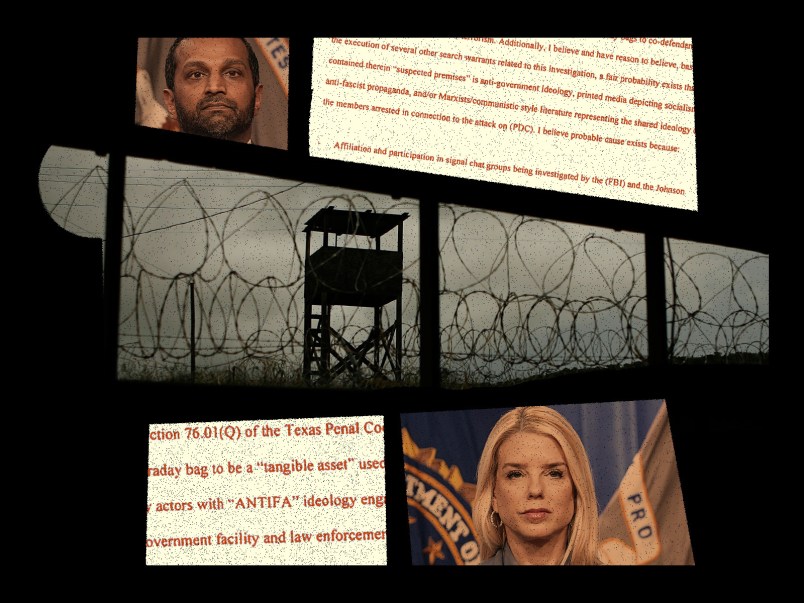
Across the country, federal prosecutors are upgrading what would have been routine prosecutions into terrorism cases when they involve people President Trump has cast as his political enemies.
It represents a dramatic departure from how the Justice Department has historically used the federal material support for terrorism statute. For decades, counterterrorism prosecutors have largely reserved the statute — 2339A — for the kinds of audacious plots that wreak real, lasting damage or whose ambition forms the stuff of movie screenplays. It’s been used in recent years to charge the leadership of Hamas over the Oct. 7 attacks, pursue men accused of assassinating the president of Haiti, and take down networks of white supremacists who allegedly conspired to blow up power plants.
But after Trump DOJ leadership issued a series of memos demanding that prosecutors target those who espouse “anti-Americanism, anti-capitalism, and anti-Christianity,” both the focus and the standards in these cases have changed. The memos direct federal law enforcement to use speech — including “extremism on migration, race, and gender” — as key criteria for who to investigate and against whom to bring the most aggressive charges possible.
They are part of the Trump administration’s broader crusade against the left, and include executive orders labeling “Antifa” a terrorist organization and directing law enforcement to pursue investigations and possible charges against left-leaning advocacy groups and their funders.
This full-bore assault on speech is now bearing fruit.
In Birmingham, Alabama, federal prosecutors in November charged a longtime local Black Lives Matter activist under the statute over an arson he allegedly committed at an area Walmart. In Texas, a July 4 demonstration outside the Prairieland ICE detention facility, at which a responding local police officer was shot and injured, has resulted in more than a dozen people facing federal terrorism charges. It also spawned a Joint Terrorism Task Force investigation into “Antifa.” The new focus on the left has yielded other cases across the country, as well.
These cases all feature some credible accusations of criminal conduct. But by casting the allegations as terrorism, the DOJ has dramatically increased the severity of the charges relative to what prosecutors allege. Legal experts say this could result in longer and harsher sentences, makes defendants likelier to lose on appeal, and risks saddling them with the label of “terrorist” for life.
The cases raise grave concerns about free speech and freedom of association. The Trump administration is using terrorism statutes to retaliate against its opponents, seemingly applying a different standard of law to people associated with left-wing causes. Those individuals are now more likely to face federal terrorism prosecutions, and their associates — even if not implicated in any wrongdoing — are more likely to face investigation and possible charges.
To Jeff Breinholt, a longtime former DOJ counterterrorism prosecutor who handled terrorism cases during the Bush, Obama, Biden, and first Trump administration, the crackdown hearkens back to the most repressive moments in the history of federal law enforcement.
“It’s suspiciously like the COINTELPRO days of the Hoover administration back in the sixties,” Breinholt said. “You’re declaring a sort of informal law enforcement war on this shadowy group.”
After the assassination of Charlie Kirk in September, senior Trump administration officials began to talk about his death as having been perpetrated by the “Radical left” or “Antifa,” which they have long portrayed as a shadowy, organized, violent organization. It was far from the first time that Antifa came up in MAGA messaging. But the White House seized on the moment to begin building the architecture for a federal law enforcement crackdown on the left. That took place in part through NSPM-7, the DOJ memo issued after Kirk’s killing that directed federal and state law enforcement to aggressively pursue domestic terrorism charges against those who espouse “anti-Americanism, anti-capitalism, and anti-Christianity.”
This spate of new cases shows how that approach is being put into practice, several former DOJ counterterrorism officials, including Breinholt, who helped pioneer the use of 2339A after 9/11, told TPM.
TPM has found:
- Federal prosecutors have recharged conduct as material support for terrorism in cases where defendants were associated with left-wing causes including Black Lives Matter or trans rights activism.
- This came after the issuance of NSPM-7, the September memo that directed prosecutors to consider those who espouse “anti-Americanism, anti-capitalism, and anti-Christianity” as targets for domestic terrorism cases.
- One charge, depredation of government property, had not been used in a material support for terrorism case for at least a decade before 2025, a TPM review found. It can apply to anything from breaking the windows of a building to spraypainting.
- In one case, prosecutors charged several people with material support while relying on coordinated dress — black bloc — as a link to an alleged terrorist plot.
- FBI Director Kash Patel, Attorney General Pam Bondi, and other Trump appointees have promoted the cases as part of a broader fight against Antifa.
- These prosecutions have ripple effects. In Texas, state prosecutors have brought “hindering the prosecution of terrorism” charges against three people who weren’t at the July 4 event at the ICE facility; a warrant in one state case included a reference to a White House Executive Order designating “Antifa” as a domestic terrorist organization in seeking probable cause. Legal experts say the order is meaningless as domestic terrorist organizations do not exist under federal law.
Earlier cases using the material support for terrorism statute required months or years of preparation, former prosecutors tell Taking Points Memo, because of the law’s severity, because of a high standard of proof embedded in its provisions, and, paradoxically, because of the relative ease with which the government can bring the charge. Under 2339A, prosecutors do not need to accuse people of belonging to or helping a specific terrorist group. As long as they show that someone knowingly intended to help commit a crime that Congress has listed as a terrorism offense, they can be prosecuted for material support.
Convictions on material support charges can come with far more draconian penalties. 2339A carries a maximum sentence of 15 years if no death is associated with the crime. Prosecutors will also be able to apply for a terrorism enhancement. Though there’s no mandatory minimum associated with that, it would set a guidelines recommendation for the sentencing judge at 17.5 years behind bars regardless of the underlying crime. Charging or even investigating crimes as terrorism also gives the government more power: terrorism defendants are far more likely to be detained before trial. Under current law, prosecutors can take more aggressive actions during a terrorism investigation, including making use of material gathered by the intelligence community. On top of that, indictment on a crime of terrorism carries reputational consequences that far outstrip most other crimes.
Congress enacted the material support for terrorism law in 1994 as part of sprawling anti-crime and anti-terrorism legislation, responding in part to the 1993 World Trade Center bombing and the Waco siege. After 9/11, Congress used the PATRIOT Act and other legislation to broaden the law’s scope. As prosecutors increasingly used it to pursue cases involving Islamic fundamentalist terrorism and, later, domestic terrorism, the DOJ evolved strict internal guardrails to prevent domestic terrorism charges from being used frivolously or for partisan reasons. Those guardrails disappeared over the past year. Now, the White House has replaced them with directives ordering prosecutors to target the administration’s perceived opponents.
Fire at a Walmart
On Aug. 22, 2025, protesters gathered at a soccer field in the Birmingham suburb of Homewood. In June, local police had fatally shot an 18-year-old Black man named Jabari Peoples. Police said he fought law enforcement; his family, after viewing body cam footage, said he was shot while running away.
Local Black Lives Matter activists staged the protest to demonstrate against a local DA’s decision not to file charges against the officer who shot Peoples. The protest began in the morning. According to police reports, a fire started at a Walmart down the street that afternoon.
Days later, police arrested a locally known Black Lives Matter activist named Mercutio Southall. They charged him in state court with arson, criminal mischief, and possession of psilocybin mushrooms, per a local news report. Southall, police said, had gone from the protest to Walmart, where he allegedly filled a shopping cart with rags, charcoal bags, and fuel. A fire later started.
Federal law enforcement followed up in October, charging him and a local woman, Lillian Colburn, with one count of federal arson each.
The next month, federal prosecutors upgraded the charges: Southall and Colburn were now each facing a count of providing material support to terrorists. “Great work,” FBI Director Kash Patel wrote in a quote tweet addressed to the local FBI field office, which appeared to misstate the date of the alleged arson.
Southall has pleaded not guilty in both the state and federal cases, which remain pending. Colburn has pleaded not guilty as well.
The case has raised eyebrows among national security lawyers in part because of the apparent mismatch between the severity of the charges and the alleged wrongdoing, and what appears to fill the gap between the two: affiliation with a Black Lives Matter protest.
“This really poses a grave risk for conduct that is otherwise criminal being recast as terrorism because of the ideology involved,” Josh Herman, a Chicago attorney who has represented defendants in material support cases, told TPM.
NSPM-7 in Action
Previous terrorism cases tended to follow a different path.
During Trump’s first term, for example, Manhattan federal prosecutors charged an Army private named Ethan Melzer with material support for terrorism over his involvement with an online neo-Nazi group called the Order of the Nine Angles.
Melzer, prosecutors said, spent weeks talking to members of the group in an online chat room. Melzer was an accelerationist: a type of extremist familiar to those who have spent too much time online, he purportedly sought to hasten the decline of Western civilization by inviting an attack on his army unit. In the chatroom, he gave away information about his unit’s upcoming deployment to Turkey, including its location, the number of soldiers, where they were to be stationed, and the “facility’s surveillance and defensive capabilities,” prosecutors said in an indictment.
Melzer eventually pleaded guilty to one count of material support, as well as counts including attempting to murder U.S. servicemembers.
Francesca LaGuardia, who studies terrorism prosecutions at Montclair State University, told TPM that the administration was now entering new territory by bringing terrorism charges in cases that involve protest and property damage.
“In the past, we would not have seen terrorism prosecutions for property damage, and that’s obviously a direction that this administration is going in,” she said. “In the past, we haven’t seen a lot of terrorism prosecutions for anything that runs the line between activity and protest. “
Former DOJ officials attributed the shift to the guidance issued by the Trump administration after Charlie Kirk’s death. In NSPM-7, the White House directed prosecutors to approach cases involving people who believe in what it described as gender extremism as well as “anti-Americanism, anti-Christianity, and anti-capitalism” as domestic terrorism.
That’s now being operationalized, said Tom Brzozowski, the former counsel for domestic terrorism at the DOJ’s counterterrorism section.
The Justice Manual, a document that lays out internal policies for prosecutors, includes a detailed section on domestic terrorism cases, he said.
When the DOJ announces a material support case, it typically says which attorneys from the National Security Division — located in D.C. — were on the case. The U.S. attorneys offices that have charged the Prairieland and Birmingham 2339A cases under Trump have not included attorneys from Main Justice in their press releases.
“In the normal run of business, that charge would be vetted and staffed all the way up through Main Justice before it was approved,” Brzozowski said. “It’s not immediately clear to me that those approval processes remain in place for domestic terrorism cases.”
“They have taken on that term and applied it pretty loosely to activity that is anti-Trump,” he added.
The DOJ did not return TPM’s request for comment. A spokesperson for the U.S. Attorney’s Office for Northern District of Alabama declined to comment. The FBI declined to comment.
Defining the Enemy Within
For Lydia Koza, the charges came as a shock.
Koza’s wife, Autumn Hill, was charged in federal court over a July 4, 2025 incident that took place outside the Prairieland ICE facility in Alvarado, Texas. More than a dozen protesters descended on the facility, which is around an hour’s drive from Dallas, for a demonstration that prosecutors have described as a “direct action.” The assembled group allegedly shot fireworks at the facility, spraypainted cars, and damaged a surveillance camera. When a local police officer responded, one protester allegedly shot him with a rifle. The officer, wounded in the neck, returned fire and survived.
Search warrants and documents from parallel state and federal cases obtained by TPM show that the regional Joint Terrorism Task Force — itself a mix of state and federal law enforcement in the greater Dallas-Fort Worth area — came down hard. The next evening, Koza recalled to TPM, FBI and state law enforcement broke down the door to the group home that Koza shared with Hill and others. Hill was detained, while FBI agents seized computers, guns, fireworks, and a booklet called “Satanic Death Cult is Real,” per a warrant and receipt reviewed by TPM.
Koza, who told TPM that she wasn’t at the Prarieland demonstration, stood outside as a mix of federal and state law enforcement searched the group house in which she and Hill were living.
“We were all kind of looking at each other like, ‘are we gonna be sleeping rough tonight?’” she said. “Like, we also don’t even have any shoes. This fucking sucks.”
The FBI conducted that search as part of an investigation into assault of a federal agent, damage to government property, and conspiracy, per a search warrant reviewed by TPM. That month, federal prosecutors charged several of those detained at Prairieland with attempted murder of a federal officer and discharging a firearm during a crime of violence.
But by October, the case had shifted. Prosecutors charged two people who were allegedly at the incident under 2339A. The next month, they filed material support charges against six others.
Federal prosecutors said that the protester who allegedly shot the police officer had sent a damning message before the demonstration in a Signal chat with five others. “Cops are not trained or equipped for more than one rifle so it tends to make them back off,” the person, Ben Song, allegedly wrote.
At a September probable cause hearing, a federal prosecutor likened Song to a “cult leader” who took a leading role in planning the incident. The prosecutor said that he shot the police officer and affixed a “binary trigger” to a rifle that he brought, allowing him to double his rate of fire. Song faces charges of attempted murder of a federal employee, use of and conspiracy to use an explosive, and using a firearm during a crime of violence. He has pleaded not guilty.
Autumn Hill, along with seven others, faces charges of material support. Hill is additionally charged with attempted murder of a federal employee, use of and conspiracy to use an explosive, and using a firearm during a crime of violence. She has pleaded not guilty. Hill, Song, and six others have pleaded not guilty to the 2339A charges.
Prosecutors have managed to secure guilty pleas from others charged in the case. Seven people pleaded guilty to single counts of material support late last year.
Of the eight people charged under 2339A, only one — Song — is directly accused of having committed any crime of violence. Three of those charged, prosecutors say, were not present on what the DOJ characterized as a “core” Signal chat that was used to plan the incident. Others are tied to the case either by involvement with what prosecutors have described as spreading “insurrectionary materials called ‘zines,’” or through clothing: everyone at the demonstration, even if not accused of having shot fireworks or vandalized property, was dressed in black.
“If you are going to be charged for materially contributing to someone else’s illegal actions, you need to mean to support them in those actions, not just abstractly support their belief system,” Rachel Moran, a professor at the University of St. Thomas Law School who has studied protest cases, told TPM.
The federal case had become a national talking point for senior Trump federal law enforcement officials; the Department of Homeland Security took to calling it an “ambush.” When federal prosecutors recharged the case as material support for terrorism, Bondi wrote: “Antifa is a left-wing terrorist organization. They will be prosecuted as such.”
For the first time, Trump officials have been forced to define what it thinks Antifa means before a judge. As one FBI agent put it when asked to define the group during a September probable cause hearing, “Antifa is a loosely organized, kind of decentralized anarchist mindset, an ideology. These individuals commonly practice anarchy and don’t believe in a normal system.”
Bondi cited the case in a December memo that called for more domestic terrorism prosecutions, calling it an “ambush” by an “anti-fascist group.” The memo directs prosecutors to make a list of groups “engaged in acts that may constitute domestic terrorism,” and to review past, closed investigations for “Antifa-related intelligence” that could be used in future charges.
To Breinholt, the former DOJ counterterrorism prosecutor, it’s all new territory.
“These are not the types of things we would normally charge in the old days as terrorism,” he remarked.



An echo from the past:
“For heaven’s sake, children, Fascism isn’t coming…it’s here.” – Dorothy Parker, 1947, commenting on HUAC
Frankly, is there anything more “anti-American” than this order? The anti-Christianity nonsense violates the First Amendment. The anti-capitalism thing is just stupidly irrelevant, and probably formulated by folks who don’t know the distinctions between a “free market” and actual “capitalism.” And what the heck is “anti-Americanism”, if not an opposition to everything in that statement?
How about these bigshot law firms that caved to Dumpy start with representing these persecuted American patriot protesters pro bono? How about courts smack this down hard and fast?
OTOH, juries may see this bullshit for exactly what it is, and find that the defendants are not terrorists after all.
“Wearing black clothing” as a means to tie you into these activities? Please, someone get a picture of one of the Mar-a-Lago black tie soirees - all those tuxes and “little black dresses” - and submit it as proof that they, too, are planning un-American activities.
Hey, wait a minute…