

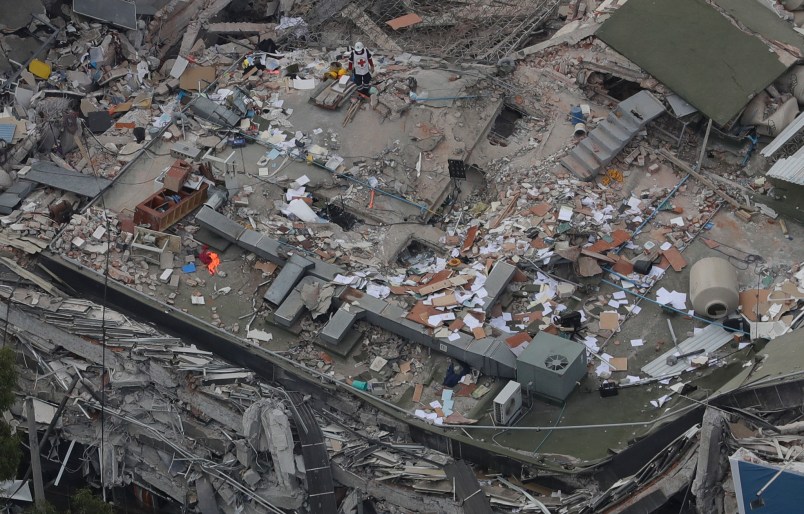
WASHINGTON (AP) — The soft soil that lines the ancient lake bed that Mexico City is built on amplified the shaking from Tuesday’s earthquake and increased its destructive force, seismologists say as they try to better understand the quake that has killed more than 200 people.
Scientists are looking at other quirks of the magnitude 7.1 earthquake, including the absence of aftershocks and if it is somehow related to a distant, even stronger, Mexican temblor that struck a dozen days earlier.
LIKE JELLY
Mexico City is built on deep, soft soil that was once the bottom of a lake. Instead of cushioning the city from earthquakes, it exaggerates their effects, said James Jackson, a professor of geophysics at the University of Cambridge in England.
The vibrations, or seismic waves, from the hard rocks below are amplified by the soil and sediments above, making the surface — and the structures built on the surface — shake longer and more intensely.
“It’s like being built on jelly on top of something that is wobbling,” Jackson said.
The soft sediments were the major cause of damage in Mexico City’s 1985 earthquake, according to Cornell University geophysicist Geoffrey Abers.
OTHER SOFT SPOTS
The same deep soft soil effect worsened the deadly 2015 Nepal earthquake because Katmandu is also built on a dry lake bed, Jackson said.
While the geology is not quite the same, Los Angeles, Seattle and the San Francisco Bay area have soft soil that can amplify seismic waves, according to U.S. Geological Survey seismologist Oliver Boyd. New Zealand has been affected by similar issues in past quakes, he said.
WHRE ARE THE AFTERSHOCKS?
Scientists have been unable to detect any aftershocks as of Wednesday afternoon, said USGS seismologist Paul Earle. Usually an area can expect an aftershock one magnitude lower, which would be in the 6.1 range, he said — even though Tuesday’s quake was a type that is usually accompanied by fewer aftershocks.
Unlike most earthquakes, it did not happen where two tectonic plates meet. Instead, Tuesday’s quake happened in the middle of the Cocos plate, the result of pressure built up as it slips under the North American plate.
This so-called “slab fault” quake usually has fewer aftershocks, like the relative quiet after a 2001 earthquake in Seattle. Tuesday’s quake was deeper than normal at 51 kilometers (32 miles) below the surface, and deeper quakes are also associated with fewer aftershocks.
TWO IN TWELVE DAYS
Tuesday’s earthquake was the second in just 12 days in Mexico. The first was a magnitude 8.1 quake that struck southern Mexico and killed at least 90 people.
Geologists say the second quake was not an aftershock because it was too far away — about 650 kilometers (400 miles) — from the first. Most aftershocks are within 100 kilometers (62 miles), Earle said.
It was also not a release of stress generated by the far-off quake, Earle said.
Still, he said, seismologists will probe further to see if there might be some kind of link between the two — or not.
“Earthquakes are random,” Earle said. “Sometimes they happen spaced out in time. Sometimes they happen at the same time.”






1989 Loma Prieta quake in San Francisco had the same effect on the Marina District, which was built on landfill scooped out of the bottom of the bay in the 1910s to prep for an international exposition. After that was over, it was torn down and homes were built.
When the Loma Prieta quake hit, dozens of blocks of the Marina District suffered liquifaction, causing buildings to slump sideways, often entire blocks of houses leaning into one another, the end houses collapsing into intersections.
Also caused the double-decker 880 Fwy to collapse, killing dozens in their cars. Same reason: solid structure, unsolid ground.