

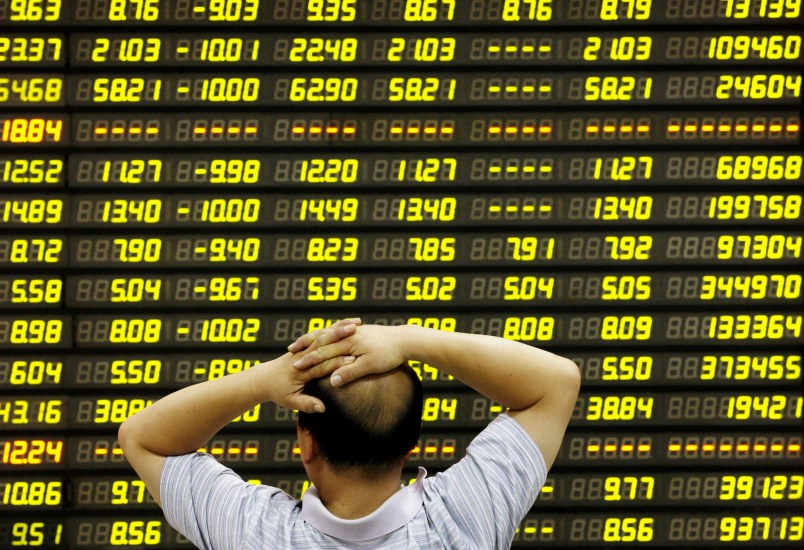
WASHINGTON (AP) — The fear that gripped financial markets this month is a stark one: That China’s economy might be slipping into a decline that could persist for years.
But the world’s second-largest economy isn’t collapsing — certainly not yet, anyway. What’s really in freefall is confidence in its leaders, once seen as wielding near-mythic power to keep their economy growing at a propulsive pace.
Global stock markets have sunk — and gyrated — as investors have wrestled with their doubts. The Dow Jones industrial average has lost nearly 1,000 points since China’s surprise move to devalue its currency Aug. 11. That step, in part an effort to align the yuan with market forces, was also seen by investors as a desperate bid to fuel exports in a faltering economy.
“The incredible faith in the Chinese policymakers has been shaken,” says Ruchir Sharma, head of Morgan Stanley’s emerging markets equity team.
For all its woes, China still outruns every other major economy. For 2015, while the nearly healthy U.S. economy will expand perhaps 2.5 percent, even most pessimistic analysts predict that China’s will grow at least 5 percent . Yet its growth has decelerated for four straight years.
And a series of bungled decisions have escalated doubts about Beijing’s economic stewardship. The skepticism is rising just as China is pursuing one of the most daunting transitions in modern economic history — from overheated growth, driven by exports and often-wasteful investment, toward slower and sturdier growth fueled by spending from an emerging middle class.
The leadership’s miscues have multiplied, starting with its handling of the stock market. To try to cushion the pain from a slower economy, the government deployed state-run media to promote stocks for inexperienced individual investors. The hope was that Chinese companies could issue shares into a rising market and use the proceeds to finance growth and shrink their heavy debt levels.
Untethered from economic reality, Chinese stocks took wing. The Shanghai Composite Index rocketed 150 percent in the year through mid-June, propelled in part by individuals who poured money in, often on borrowed funds, confident that their government wouldn’t steer them wrong.
On June 12, the bubble burst: Shanghai stocks have since tumbled 37 percent, though they remain 47 percent above where they were a year ago.
Beijing, abandoning a pledge to let market forces play a bigger role in the economy, tried futilely to stop the freefall. It suspended trading in many companies, restricted the use of borrowed money for some trades and banned big investors from selling their stakes for six months.
“The bubble pops, and they intervene and it doesn’t work,” says Derek Scissors, resident scholar at the conservative American Enterprise Institute.
Beijing suddenly looked like something less than omnipotent.
Then, on Aug. 11, China devalued the yuan. The government said the move was a nod to reality: Investors were signaling that the currency was overvalued. And the United States and the International Monetary Fund had long urged China to let market forces play a bigger role in the yuan’s exchange rate.
Yet the decision surprised investors and aroused suspicions that it was a bid to drive up exports, which tumbled more than 8 percent in July from a year earlier. (A lower-valued yuan gives Chinese goods a competitive edge overseas.) And Beijing has since sent confusing signals, sometimes intervening to keep the yuan from falling too fast.
The episode led investors to take a more skeptical look at the Chinese economy. China’s economic statistics have always been dubious. Premier Li Keqiang once acknowledged that its growth figures were “man-made” and unreliable.
The official unemployment rate is laughable: It’s remained between 4 percent and 4.25 percent — and almost always precisely 4.1 percent — every quarter for the past five years, according to Trading Economics.
Some analysts have sought alternative ways to gauge China’s economic performance — electricity consumption and freight shipments, for example. The London firm Consensus Economics asked several economists to provide alternative forecasts based on unconventional measures.
They predicted that China’s economy would grow 5.3 percent in the year ending in the fourth quarter of 2015, well below conventional forecasts near 7 percent. Morgan Stanley’s Sharma suggests that the economy is growing 5 percent “at best” this year.
Still, compared with other major economies, that’s a brisk pace. And there’s some evidence that China has managed to begin transitioning toward growth based on consumption and services. Retail sales, for example, rose 10.5 percent in July from a year earlier despite the economy’s overall deceleration. And from January through March, U.S. services exports to China rose 8 percent even as manufacturing exports fell 9 percent.
China’s authorities, though, are pursuing a transition on a magnitude never seen before. And their recent stumbles have prompted a more critical appraisal of the policymakers’ earlier decisions. After the global financial crisis in 2008, for instance, they enacted a stimulus program — spending on roads and other infrastructure and ordering state-owned banks to lend freely.
Yet the stimulus came at the cost of a surge in debt: McKinsey & Co. says China’s public and private debt quadrupled to $28 trillion in 2014 from $7 trillion in 2007.
Sharma, who studied other countries with big debt run-ups, found that all later suffered severe slowdowns. The reason: When banks lend at a frenzied pace, they make many bad loans, leading eventually to a growth-killing credit crunch.
The only good thing about the recent financial market tumult, Sharma says, is that it leaves the world with a more realistic view of Chinese leaders.
“The blind faith that they could achieve whatever growth rate they wanted to — it’s amazing so many smart people thought that,” he says.
Copyright 2015 The Associated Press. All rights reserved. This material may not be published, broadcast, rewritten or redistributed.





maybe currency manipulation isn’t the way to go?
China is devaluing their currency so that the cheap shit that they already sell to us by the boatloads will be even cheaper. This is a gamble like the gamble that the big banks of America took and nearly crashed the world.
The Chinese Gov’t seems more intent on saving face and pretending to be the world leader even in the face of real decline. That is because the people making the decisions are never actually negatively affected by their decisions. Just the peons.
Republicans have thrown all of America’s economic wealth and potential wealth into the Chinese cookie jar. We are now dependent on Chinese fortune cookies for our stability despite the fact that they are as contrived as they are unreliable.
This is why we need trade agreements that don’t include China or at least don’t hand China equal say in the deal.
Agree, Leftflank, and I’m just wondering if our administration hasn’t been working on some response.
They say every crisis contains an opportunity, and I wonder if President Obama and his people aren’t pivoting toward some “patriotic” stimulus program.
The continuing slump in the Chinese economy and stock market is creating ripples here, and a news report this week said Obama might be considering some economic sanctions in response to Chinese cyberhacking.
There might be an opening here for Obama to convince Republican leaders to agree to some tax reform bill that will incentivize the return of foreign and expatriate American capital back here. The US is already the prime destination of foreign investment, and investor uncertainty over China could create political pressure to create additional incentives to park foreign money in the US. And a stimulus program funded by this newly reshored capital could be presented as a patriotic nation-building program that does not rely on foreign interests, and might even be crucial to national security.
Randy, while the end result may be the desired result, it sure is shitty that we have to resort to these sorts of games with our own people and have the opportunity to benefit the US come from the fact that other places are crashing so America doesn’t look so bad anymore. If you can understand how I mean that.
China is sort of a false crash just as it was sort of a false bubble. They manufactured their economy by over-stimulating growth through a savings and loan type operation that is now biting them. But, the crash isn’t all that as their economy is still expected to grow in the 5% range even after the fall.
China is not easily understandable as they create their own numbers and don’t share info and other things with the rest of the world. I don’t believe that any of their numbers are all that accurate and in times of trouble they manipulate their plusses and minuses even more.
A nation like that can not be dealt with on an honest and even scale and therefore are untrustworthy. China certainly can not be written off but can be excluded and diminished.by us and by collectives.
I think that Barack is rightly going around them and not just throwing America’s riches at them as had been the case. Listen to Trump, he’s all China this and China that but he’s almost a decade behind regarding this and much worse in other things.
The stock market players have backed off a bit and are either taking profits or in a sort of wait and see mode. I think it is still a bull market and doesn’t have the real negatives that the Bush recession turned depression had. The general mood of the world is still upbeat and not defeatist but rightly cautious.
Personally, I’m buying and if you haven’t yet, you ought to be too.
Well said, Leftflank. Agree.