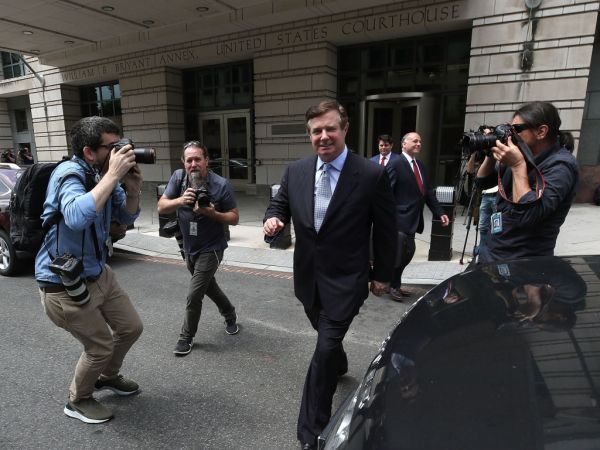


Hard not to notice that within the last 48 hours the President appears to be making a final break with Paul Manafort, now claiming the FBI should have warned him that Manafort was dirty and maybe in league with Russia or pro-Russian forces in Ukraine. (He’s hinted at similar logics before but never been quite this explicit about it.) He is also aggressively claiming an absolute right to pardon himself. Not only are these not the actions of an innocent man. They aren’t the actions of anyone who isn’t seeing their legal jeopardy rapidly increasing. It will be fascinating – in the future – to understand what developments were occurring in the background that made sense of these actions.
President Trump is up this morning with the audacious claim that he has an absolute power to pardon himself and that all legal scholars agree this is so. Needless to say there’s zero consensus on this point. It’s more of a conceptual black box. It’s not immediately clear what specific constitutional or historical fact would preclude a self-pardon. But I think I’m on safe ground asserting that most legal scholars would agree that this is clearly not the intended use of the power. Indeed, it puts the entire constitutional framework on its head. Below I note a column by Douglas Kmiec in which he notes that the same DOJ opinion which says a sitting President shouldn’t be indicted notes that a self-pardon is similarly a contradiction in terms.) But set that aside, because it’s preposterous that such a thing would even be considered. More salient is the question of whether a sitting President can even be indicted – which precedes the question of a pardon. Read More