

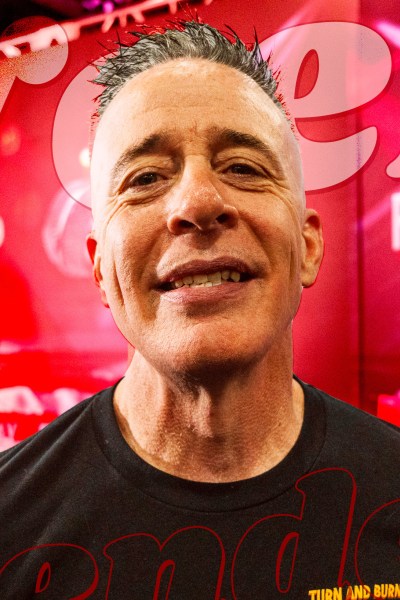


Former Border Patrol official Greg Bovino can’t keep away from the limelight.
After the operation he oversaw in Minneapolis — one of several he conducted with a position out of the chain of command — saw two protestors killed by federal agents, he left the government. That hasn’t kept him away from becoming a fascist influencer.
In a lengthy interview this week with a program called “Died Suddenly” — a spinoff program from the creators of the 2022 anti-vax film by the same name, produced by far-right figure Stew Peters, who runs an extremist media empire — hosts Lauren Witzke and Edward Szall asked Bovino about the “Renee Good types” and “what were the American protestors like?”
“Cannon fodder,” Bovino replied.
Bovino first called protestors “cannonfodder” in an X post after the killing of Renee Good, but before the killing of Alex Pretti, telling protestors not to become “cannonfodder” for someone else’s agenda. To Witzke and Szall, Bovino was more direct: they’re “cannon fodder.”
Witzke and Szall are a telling choice of interviewers. Witzke is a self-described Christian nationalist who told TPM in 2023 that she spent 10 years smoking “rat poison and gasoline.” She’s frequently accused of bigotry. Last year, she posted a video of a polluted river in India, labelling it, “The Ohio river, circa 2028 under Governor Vivek Ramaswamy.” Szall, for his part, was White House correspondent for Mike Lindell. Szall, TPM reported in 2024, was involved in a project with Laura Loomer that briefly appeared to involve Neo-Nazi Nick Fuentes.
Bovino is on X now, and posts regularly. Just this week he wrote that the government should “deport all Muslims illegal aliens and denaturalize those incompatible with American values.” Sen. Rand Paul (R-KY), a Republican who was vocally uncomfortable with the killing of Alex Pretti, wasn’t “keen on mass deportations in Minnesota,” Bovino wrote.
The interview with Witzke and Szall took place next to a small stream, with what appeared to be a security fence abutting them on the other side. A structure resembling a guard tower looms behind Bovino.
At one point, they asked Bovino to name his least favorite minority to deal with during operations in major American cities. Before saying what he had to — “there are individuals from all nationalities that can be really bad apples” — Bovino answered that it was “Somalians in Minneapolis.”
“These folks were not anywhere sympathetic to anything American,” he said.
Per a lawsuit from the ACLU and widespread accounts, federal immigration officials under Bovino’s command in Minneapolis targeted people who appeared Somali — many of them U.S. citizens — for questioning and detention.
Bovino expressed no remorse for federal agents’ killings of Alex Pretti and Renee Good. Though he and the interviewers mentioned Good by name several times, Pretti did not come up. Instead, Bovino said that Minneapolis got off easy, blaming the disaster in the city on murky conspiracy theories.
“Minneapolis, we didn’t hit them hard. And when you don’t hit them hard, guess what? That empowers…those funding streams, those individuals, those leaders of those organizations. It empowers them. That’s what happened in Minneapolis,” he said. “If you want to know the ground truth and the secret to Minneapolis is, we didn’t treat Minneapolis like we did the other cities that we were in. That softer approach started creeping in in Minneapolis. And that’s definitely not the way you treat an anarchist or a rioter.”
Bovino also blamed higher-ups for sabotaging him, but left one person out: President Trump.
“I felt that we had President Trump. Notice I didn’t say any of his other team, there,” Bovino said, adding that Kristi Noem and Corey Lewandowski would pass on messages that Trump believed he was “doing a good job.”
— Josh Kovensky
Callais Spits in the Face of Congress
For years, the Supreme Court has been creating tools to inure itself to the decisions of Congress: the major questions “doctrine” and nondelegation “theory” are homespun excuses the right-wing justices can lean on when they want to ignore congressional intent.
The Court’s decision in Louisiana v. Callais was no different. In 1982, Congress passed amendments to clarify that maps with discriminatory effects violated the Voting Rights Act, freeing plaintiffs up from having to prove that the legislators passed them with an intent to discriminate, which was nearly impossible. On Wednesday, Justice Samuel Alito undid those amendments, reinstating the intents test and rendering the law dead letter.
The correct response to this trend is not, as legal commentator Steve Vladeck suggested, to create a more robust Congress that could actually threaten the Supreme Court with legislative responses to bad court decisions. Such a Congress, even devoid of institutional barriers like the filibuster, is incapable of responding to major rulings absent a decisive Democratic trifecta. And does anyone actually think the Court would respect legislative fixes from an administration and Congress they’d oppose?
Additionally, the 1982 VRA amendments were passed by a Republican Senate and signed by President Ronald Reagan. That did not protect those laws from getting unraveled by the Supreme Court.
The Supreme Court does not respect Congress, and it does not respect lower courts. It is a rogue and completely unchecked actor.
The only answer is reform, likely expansion. The Supreme Court, as it is currently constituted, operates as a veto on Democratic presidents and Democratic Congresses. As Democrats are the only party interested in restoring minority voting rights, it is impossible to imagine a future where the Court allows any attempt to restore the protections of the VRA to stand, even if it circumvents the particular pieces this Court has found unconstitutional.
— Kate Riga
Kemp Won’t Draw New Maps Before Midterms — But He’s Eager to Redraw for 2028
Despite mounting pressure from fellow Republicans to call a special session on redistricting to redraw maps in the aftermath of the Supreme Court’s decision in Louisiana v. Callais, Georgia GOP Gov. Brian Kemp said he will not redraw new maps ahead of the fall midterm election.
Kemp, like most Republicans, celebrated Thursday’s SCOTUS decision, which dealt a devastating blow to the Voting Rights Act. In a recent interview with The Atlanta Journal-Constitution he described the ruling as one that restores “fairness to our redistricting process and allows states to pass electoral maps that reflect the will of the voters, not the will of federal judges.”
He added, however, that it’s too late in the game to adopt new maps before the midterms, despite mounting pressure from Republicans to get him to do so.
“Voting is already underway for the 2026 elections,” he told The Atlanta Journal-Constitution. “But it’s clear that Callais requires Georgia to adopt new electoral maps before the 2028 election cycle.”
Kemp has faced a tremendous amount of pressure, though, following Louisiana GOP Gov. Jeff Landry’s announcement Thursday to suspend an already-active congressional primary election to allow lawmakers to redraw congressional maps.
“The last thing that Republicans need to do is be weak-kneed at this moment,” GOP state Sen. Greg Dolezal, who is running for lieutenant governor, said, per The Atlanta Journal-Constitution. “This is a time to be bold. This is a time to be aggressive.”
Rick Jackson and Lt. Gov. Burt Jones, both GOP candidates for governor, have both similarly called for the drawing of new maps.
This is not the first time Kemp has been in the position of having to maintain the integrity of elections and election administration in Georgia, despite pressure from Trump and his allies. In the aftermath of the 2020 election, Georgia became a hotbed of election conspiracies. Kemp refused to aid Trump in his efforts to overturn the election results in Georgia.
— Khaya Himmelman
Words of Wisdom
“Well no other country has ever done it … As you know, most people consider it totally unconstitutional. Also we had a ceasefire so that gives you additional time — but no other country’s done it. We’re in the midst of a big victory…”
That’s President Donald Trump responding to a question on if he will seek congressional authorization for the Iran war since it’s officially the 60-day legal deadline for the conflict.
As we’ve laid out this week, the War Powers Resolution of 1973 mandates the president must either get congressional authorization or withdraw from a conflict 60 days after notifying Congress. Neither of those things have happened.
The president is instead pulling out an old reliable: claiming that a law he doesn’t like and does not want to follow because it does not fit his agenda is “unconstitutional.”
Meanwhile, some in the administration — as Trump hints at in his remarks — have been claiming that the 60-day clock is frozen because the Iran war is in a state of ceasefire. Experts have called that stance “absurd” in conversation with TPM, saying the White House is still using the military for the purposes of the law through their naval blockade.
The White House also sent a letter to Congress, which was obtained by TPM, to that effect on Friday, claiming that as far as it was concerned the war had been “terminated” by a ceasefire.
— Emine Yücel


Please - make it stop! The awfulness of this timeline is exhausting.
Ten years smoking gasoline and rat poison. That explains a lot.
trump lies to Congress
My ol kitty Ferrous never shared his box with our other two kitties
“Exhausting” doesn’t begin to describe it.