

This article is part of Cafe, TPM’s home for opinion and news analysis.
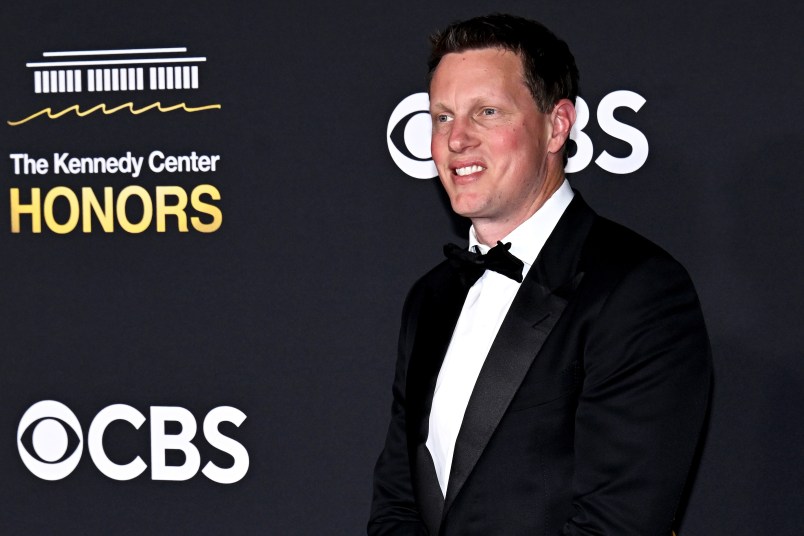
In “Raiders of the Lost Ark,” when Indiana Jones is asked how he intends to single-handedly stop a Nazi caravan he mutters, “I’m making this up as I go.” That improvisational approach by a signature Paramount hero appears to mirror that of the company’s current CEO David Ellison, as he stumbles through a conservative media takeover that feels more like the product of expediency than ideology.
The latest odd wrinkle in Ellison’s serialized pursuit of becoming one of media’s most influential figures — acquiring Paramount through Skydance Media, then engineering a pending $111 billion merger with a much larger studio, Warner Bros. Discovery — emerged this week. Frustrated by the thus-far effective efforts of state attorneys general, led by California’s Rob Bonta, to delay or even derail the deal, Paramount officials privately floated the prospect of abandoning California if Ellison doesn’t get his way, administering a blow to the state’s economy.
Bonta quickly labeled the not-so-subtle threat “blackmail,” but like many of Ellison’s actions, there’s a sense nobody fully thought the logistics through in terms of relocating and how that would practically work. Since the Skydance deal closed a year ago, Paramount has been defined by chaos, potentially destroying traditional media outlets while cozying up to the Trump administration to secure its regulatory blessing.
For many, the assumption is that’s all part of a nefarious plot, given Donald Trump’s ties to Oracle founder Larry Ellison, David’s billionaire father, who has already wheedled a stake in TikTok’s U.S. joint venture out of the relationship. But while the trade press tends to assume the strategic acumen of tech and media moguls, the explanation might arguably be worse — that the Ellison scion’s posturing about leaving California is more a temper tantrum than a master plan, which is a plausible way to decipher Paramount’s stumble toward conservatism.
Broadly speaking, none of this bodes well for Hollywood or the media/information ecosystem. The billionaire class, faced with Trump’s assault on institutions, has repeatedly chosen self-interest over principle. Concessions have ranged from Google, Disney and CBS paying millions to settle frivolous Trump lawsuits to Amazon ponying up an inflated $75 million to acquire and support the Melania Trump vanity documentary “Melania.”
Of course, the possibility that Ellison is in over his head — joining a long list of “Succession”-like media heirs born on third base — doesn’t offset the ramifications of how that ripples through our media and politics. But based on his public statements and New York magazine’s lengthy Vulture profile, Ellison, 43, sure looks like a guy who wanted to become a movie mogul and inherited the baggage that comes with complicated assets like CBS News and now potentially CNN, while, yes, making it up as he goes along.
So far, Paramount has spent $150 million to acquire The Free Press and put its anti-“woke” co-founder, Bari Weiss, in charge of CBS News — a move that has primarily yielded dividends to media reporters and newsletters painstakingly documenting all the rakes upon which she’s stepped while trying to overhaul the venerable news division and its crown jewel, “60 Minutes.”
Ellison’s stated defense has mostly consisted of platitudes, laid out in a New York Times oped this month. Seeking to quell rumbling about putting a thumb on the scale for Trump, Ellison wrote that news should be “straight down the middle,” reflecting “the whole world, not one side of it.” He also cited diminishing trust in news as a sign of the work that must be done, ignoring a decades-long campaign, dating back to radio trailblazer Rush Limbaugh, intended to undermine traditional media while serving right-wing content to growing armies of “ditto-heads.”
Marc Elias, the progressive voting-rights attorney and founder of Democracy Docket, punctured that bubble, writing in an open letter that despite Ellison’s protestations he comes across as “just another in a line of powerful men who will do anything to gain Trump’s approval.”
Recognizing fears of CNN, which is owned by Warner Bros., being sacrificed on the Trump altar should the merger go through, allies have also floated the idea of a committee to safeguard the network’s editorial independence; still, as Richard J. Tofel observed in his Second Rough Draft newsletter, such a move would provide “false comfort,” citing what happened when another billionaire, Rupert Murdoch, bought Dow Jones and the Wall Street Journal.
Notably, Ellison’s improv act hasn’t stopped with news or real estate. Addressing fears about a shrinking film pipeline if two studios consolidate, he pledged that Paramount and Warner Bros. will release a combined 30 movies a year — a promise that few believe, based on mergers past. Disney, for example, dramatically pared back Fox’s output after acquiring those entertainment assets, and between them, Paramount and WB released just 39 movies in 2024 and 2025 combined.
As Hollywood historian and author Mark Harris posted on Bluesky, Ellison’s 30-movie promise sounds like “absurd fiction.” But it’s further evidence Paramount will say what’s necessary to try winning over theater chains, talent guilds, journalism critics, and Trump, who Ellison feted with a private dinner before the first stab at the White House Correspondents Association dinner in April, while awaiting regulatory approval.
Some of this might be dismissed as an academic exercise if the stakes weren’t so high, due to the rightward shift in media and, on a more human level, the thousands of lives and careers impacted as Paramount careens from one crisis to the next.
Indeed, the whole point of the WBD acquisition, as Paramount has spun it, is that neither is positioned to survive in an evolving media landscape, which makes one wonder why Skydance didn’t first go after Warner Bros., a studio with roughly six times Paramount’s market cap.
For Trump, anything that wounds or weakens the mainstream media he calls “the enemy of the people” is surely welcome, and his administration’s Justice Dept. approved the deal in June, which, the Wall Street Journal reported, surprised staff lawyers still weighing an antitrust challenge. The coalition of state AGs sued to block the deal in mid-July, arguing, among other things, that it would “extinguish competition.”
Ellison, however, must consider other constituencies. As the Vulture profile outlined, after flirting with acting, Ellison found a measure of success as a producer through Skydance, knowing his father’s wealth was there as a backstop. The portrait that emerges is of someone who yearned to make movies, before detouring into moguldom and the assorted challenges that go with that.
Paramount has already inflicted significant damage on institutions like CBS News and shed thousands of employees, with more likely to follow. Should the merger come to fruition, the extensive overlap between the two studios’ operations creates plenty of what corporate bean counters like to call “redundancies.”
Despite his stated concern about dwindling faith in mainstream media, Ellison has essentially been mouthing another line associated with the artifact-chasing Dr. Jones — namely, “Trust me.” But whatever the merger’s fate and wherever Paramount winds up calling home, his real legacy might simply be the wreckage that the studio’s wild ride leaves in its wake.




We note with interest that Ellison’s “straight down the middle” opinion essay was completely silent about the component of foreign ownership that rightfully bothers people about the mega-purchase. How hard-hitting will any movie, news feature, 60Mins spot be when Foreign County Investor X commits some heinous act? Where will the corruption stories about Trump, Kushner, et alia be covered? ANSWER: They will be ignored by the Ellison Empire.
It’s probably easy to release 30 movies a year if half of them are AI-generated Christo-Fascist pandering which looks like Neil Breen brought a Chick Tract to life.
Are there still movie theaters? It seems like studios now like to do smaller theater runs and get on streaming services faster.
Oracle is the company most likely to collapse when the AI bubble pops. It is exceptionally vulnerable to OpenAI, Anthropic, and their feeder fish businesses (eg, Coreweave) defaulting on their commitments to data center buildout. It’s not clear how badly David Ellison would suffer if his father went bankrupt, but my sense is the failson is rather reliant upon daddy’s money.
I trust Nepo Boy as far as I could pick him up and throw him. I’d love the chance, anyhow.