


Trump’s Elections Order Will Be Back Before the Supreme Court Before Long
A ruling yesterday evening by the Supreme Court suggests we’re going to be spending the next few months watching litigation around Donald Trump’s March 2026 executive order on elections unfold. The order is one of Trump’s most sweeping efforts to mess with elections, and one that still poses a live risk to the midterms. It directs the federal government to create lists of eligible voters, and requires the United States Postal Service to implement new measures around mail ballots and refuse to mail ballots for states that don’t cooperate with the administration.
Yesterday evening, the Supreme Court’s conservative majority found that a district court order blocking the executive action was issued too early, finding that the states who had challenged it brought their case when the harms were still hypothetical, before the administration had written rules putting the order into effect.
Importantly, Monday’s Supreme Court ruling did not engage with the merits of what the administration is trying to do — it only took a position on whether the time was right for states to sue. Its possible the conservative justices don’t have consensus among themselves on the merits.
Another district court injunction against the order remains in place, so it will not go into effect for now.
Meanwhile, events have already moved past the Supreme Court’s ruling, which appears to have been written last week. As I noted yesterday, the U.S. Postal Service released a rule Friday that will be formally published this week outlining how it will implement the executive order.
Voting rights groups in one case challenging the order asked Massachusetts U.S. District Court Judge Indira Talwani to enforce an earlier preliminary injunction that they say should block the USPS from promulgating this rule. Talwani told DOJ to respond to the voting rights groups’ request by today.
The issue will be back before the justices soon. It’s possible none of this gets decided before the midterms. It’s also possible it does. The worst-case scenario I’ve seen was outlined by law professor and Supreme Court expert Steve Vladeck yesterday, who envisioned a situation in which the Court allows the order to move forward, and then, at a later date, decides it is now too close to the election to block it.
Seventh, the shadow looming over all of this is the “Purcell principle,” the idea that, as election day draws nigh, federal courts should stay their hand rather than issue coercive orders changing the rules for when and how people vote. Purcell is the source of significant controversy and criticism, almost all of it deserved. Among the charges are that (some of) the justices are ruthlessly inconsistent in when they do and don’t apply Purcell—leading to the worry that an injunction against the USPS Final Rule might be deemed “too close to the election,” and stayed under Purcell. That’s a genuine concern, and given the Court’s own repeated transgressions of the Purcell principle earlier this term in Texas, Louisiana, and Alabama, to hide behind it to allow the USPS Final Rule to go into effect would be as indefensible and anti-democratic a ruling as the Court has handed down in a very long time.
Darline Graham Faces a Single Challenger
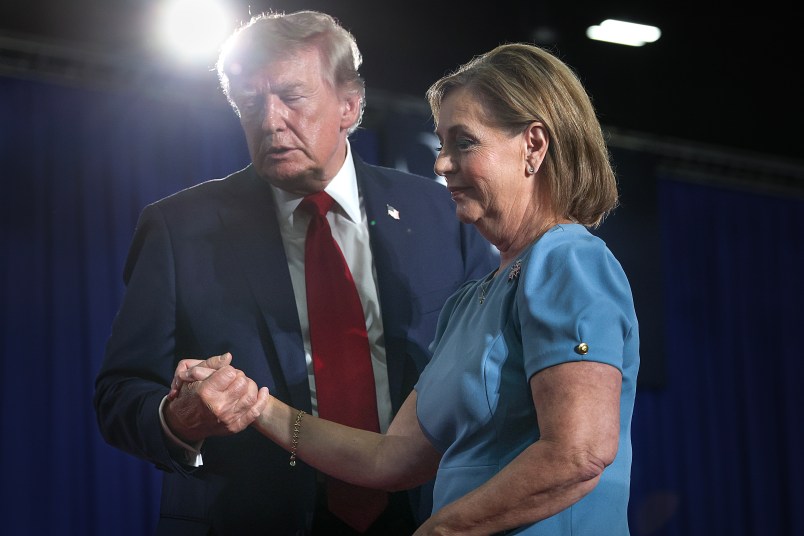
An odd spectacle is unfolding in South Carolina, where, as sometimes happens, Donald Trump is going all in to back one loyal ally over another.
- The state will hold a runoff today to replace Lindsey Graham, who died earlier this year, as its Republican Senate nominee. The candidates are his sister, who is also currently in the role in an interim capacity, and Ralph Norman, a far-right congressman and member of the House Freedom Caucus who came in second place during a very crowded primary earlier this month.
- Norman holds a special place for TPM. In our 2022 series on a trove of text messages former White House chief of staff Mark Meadows had handed over to Jan. 6 investigators, Norman played a notable role, going as far as anyone to press the chief of staff to overturn the election, even after Jan. 6. “Our LAST HOPE is invoking Marshall Law!! PLEASE URGE TO PRESIDENT TO DO SO!!” a Meadows correspondent identified as Norman wrote on Jan. 17. Later asked about the message, he expressed regret over his spelling error.
- Despite his extremism in 2021, Norman endorsed Nikki Haley ahead of the 2024 election, a sin that has continued to loom over him in the MAGA universe. Darline Graham has Trump’s backing in today’s contest, in part, it seems, because she has never defied him: she is a blank slate who can serve as a rubber stamp for the president. She has suggested as much, including when she professed that she was “not that informed on national security.” Norman’s allies piled on. National security knowledge is “not something you inherit,” Haley, who is backing Norman in this race, wrote.
- Looking both to support Graham and to avoid seeing one of his endorsees lose, Trump’s been campaigning hard for her. An aligned super PAC is spending nearly a million dollars to do get-out-the-vote, the Wall Street Journal reports.
Tabs
- The Trump administration is preparing to revoke up to 200,000 visas of people in the U.S. who have applied for refugee status, perhaps the largest such action in history.
- The White House has become deeply involved with the process of selecting the next secretary general of the United Nations, the Washington Post reports.
Man of the Hour
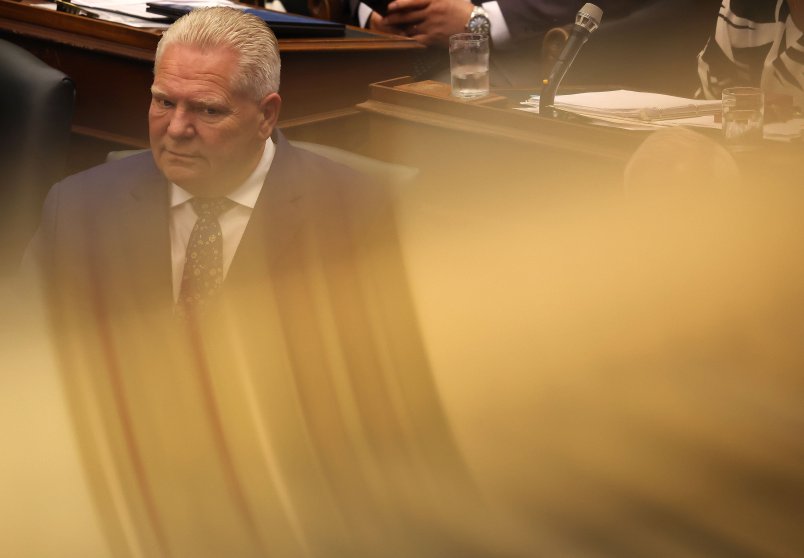
It’s Doug Ford, the premier of Ontario and, as Donald Trump put it, the “overall unimpressive brother of the late, great, Rob Ford.” Trump and Doug Ford spent yesterday trading attacks on one another amid Trump’s new trade war with Canada. Josh Marshall took the occasion to review some TPM history relating to both Rob and Doug Ford.
Are We at War?
Yes, both shooting and economic wars — and both bad news for those who want low oil prices.




“The order is one of Trump’s most sweeping efforts to mess with elections, and one that still poses a live risk to the midterms. It directs the federal government to create lists of eligible voters, and requires the United States Postal Service to implement new measures around mail ballots and refuse to mail ballots for states that don’t cooperate with the administration.”
… … … … … … …
If a letter or package is properly addressed to who it should be delivered to …along with who is sending it and that it carries adequate postage then the post office should do it’s job and deliver the mail. It should never be the job of the post office to decide who does and who does not get a ballot mailed to them. They deliver mail. They are not immigration experts.
“Today, I would like to demonstrate that my capacity for being provocative is limited by the depth of my ignorance and corresponding lack of imagination. Thanks you for your attention to this matter.”
(@emptywheel.bsky.social on Bluesky )
“Also, I would like to add that I’ve regressed to a 12-year old’s idea of negotiating with other kids at a playground when talking to world leaders.”
SMH. The newsreader on my radio news this morning calmly observed: “It should be noted that Lake Ontario is jointly owned by Canada and the United States with the border running down the middle of the lake.”
I would also note the same applies to Lake Superior, Lake Huron and Lake Erie. Stupid, pointless debate for the day: We know that no one (and therefore anyone) has rights to name or rename an international body of water, like, say, the Gulf of Mexico. (a) What’s the rule about an inland lake? (b) Why would anyone care? and (c) What is Trump trying to distract from today?