



I want to share with you this note from TPM Reader PP. But context is important. I received it on November 7th — two days after the election. So you need to understand it in that moment. But it’s been rattling around my head ever since. I’d actually intended to publish it at the time. I just didn’t find the right moment. What he says doesn’t mean the conversations about new ecosystems are wrong. They’re not at all. That’s not my takeaway. But if you’re serious about building up alternative media that isn’t dominated by right-wing voices and politics-adjacent channels dominated by right-wing ideas, I don’t think you can succeed or even have a plan to succeed without starting with the premises PP is articulating.
Read MoreI have read TPM for just more than half my life, and the entirety of a 20-year career in political campaigns and consulting that I decided to wind down earlier this year to pursue a very different and unrelated career.
I’m writing now somewhat in response to the broader conversation about Democrats/men/algorithms/media and somewhat in direct response to TPM’s recent article about Democrats adapting to the “new media landscape.”

As the clock winds down on the Biden presidency, Democrats and the Democrat-adjacent are hashing out, often awkwardly and painedly, what stance to take toward the second Trump presidency. I’ve already discussed this issue in the piece I wrote back on November 14th: “The Most Pernicious Anticipatory Obedience Hides in Plain Sight.” As I wrote in that post, there’s a species of Democrat who imagines there’s “some power or badassery or even a species of courage in” declaring constantly that Trump is all-powerful and everyone is powerless before him. Today this is playing out over Trump’s threat to jail the members of the Jan. 6th committee after pardoning the insurrectionists themselves.
For myself, I’m with former Rep. Adam Kinzinger, whose response to Trump was “bring it on.” This isn’t just about the personal and aesthetic importance of standing or going down fighting rather than cowering. (And yes, obviously it means much less coming from me than Kinzinger.) There’s also the deeper issue I discussed in that November post, which is how much fuel anyone should give Trump, how large a penumbra of fear and shock we should allow Trump to cast with boasts he probably lacks the courage to make good on and would probably struggle to make good on if he were up to trying. This isn’t the same as ignoring these crazed and degenerate threats. And it doesn’t mean these threats couldn’t come to pass. Managing that balance is at the heart of this period we are living through.
Read More
One of the central features of Trumpism is that Trump never wants to deal in pain. Not for people who might vote for him. Or at least, no pain to anyone who might vote for him … that they would blame on him. That’s why, at least in concept, he’s always said he’d never support cuts to Social Security or Medicare. That’s in concept of course. What happens down in the fine print of administrative decisions or omnibus tax bills is another matter. But the position in concept is still important and fairly consistent. But over the last couple weeks things have gone sideways in a pretty big way. And key players in his administration-in-the-making are now proposing massive cuts to Social Security and Medicare.
Read More
It seems all but certain that Pete Hesgeth’s nomination to lead the Pentagon is doomed. Yesterday he was reduced to promising not to drink on the job if he’s confirmed for Defense Secretary. You may not like him, but don’t deny him this: he’s going to have the best story ever when he introduces himself at his first meeting and explains what brought him to AA. It’s probably best to refer to Hegseth on Thursday afternoon as one of the “post-nominated.” Trump is already sounding out Ron DeSantis for the job. But he’s happy to let Hesgeth twist in the wind a bit longer. And in a paradoxical kind of way I appreciate his doing that. This of course will be Trump’s second top-tier nominee to go down in flames, and the third overall.
Has this gone well for Hesgeth? I don’t mean in terms of getting the job. I mean in the general sense of reputation, dignity, etc. I’d say it’s gone … well, pretty badly? Kind of the fate of everyone and everything who locks up with Trump.
DeSantis is much like Marco Rubio, a generally clownish figure, if somewhat more malevolent, but in the overall ballpark of the kinds of people who get these jobs. He’s served in Congress. He’s been governor of the one the country’s most populous states. Given the type of people Trump often hires for these jobs, the country could do so much worse.
So does it matter that Hesgeth goes down the tubes?
Read More
This column, by Alexander Burns, the head of news at Politico, is a rich example of the DC logic that only Democrats have agency and it’s only to Democrats that standards, norms, rules or whatever else apply. “Joe Biden’s Parting Insult: The president delivered a vote of no confidence in a justice system preparing for siege.”
It is a rich gift to those who want to blow up the justice system as we know it, and who claim the government is a self-dealing club for hypocritical elites. It is a promise-breaking act that subjects Biden’s allies to yet another humiliation in a year packed with Biden-inflicted injuries.
Republicans are like the weather. Destructive and unpredictable, perhaps capricious and sometimes dangerous. But who shouts at the rain? Those are the deeply carved grooves into which our elite media narratives all turn. How else do you explain the vastly bigger press uproar over Biden’s pardon than a notorious charlatan who’s promised to abuse his power at every opportunity being on a fast track to take over federal law enforcement?
Read More
People are scared and upset about Kash Patel becoming FBI director. There’s good reason to be. But the language illustrates problems we should have learned about during the election. I hear that he’s an “extremist,” that’s he’s a “norm-busting” pick, that he’s inexperienced, that he’s a “hardcore MAGA loyalist.” This all sounds like yada, yada, yada to me. In one ear and out the other.
What I want to hear Democrats saying is that Patel has literally promised to abuse his power as soon as he’s sworn into office. He’s said that repeatedly over the last year. I want to hear Democrats saying they don’t want an FBI director who has promised to abuse the powers of his office as soon as he’s sworn in. To me, that’s not complicated. That’s pretty straightforward. Everyone can understand it.
Read More
Over the past couple weeks, the thought of President Biden pardoning his son entered my head a few times. I tossed it around: good or bad idea? I could see it both ways. I still can. But I am fine with his decision. I’m glad he did it. Biden learned the right lesson: no one gives a fuck about norms. It’s unquestionably true that Hunter Biden wouldn’t be in this position if not for his dad. That’s basically the justification Biden gave. And he’s right. It may sound angry or cynical to say “no one gives a fuck.” But I mean it both in a general way and in this particular way: the reason for Biden not to do this was to allow his son to remain collateral damage of the GOP war against his presidency and to leave him in the hands of the Trump DOJ for at least the next four years all to make a point of principle about being better, different, more righteous, more norm-honoring than Donald Trump.
Truly. No one gives a fuck. If anything, that logic I just laid out sounds like one of those fastidious, hyper-process-oriented and baroque bits of reasoning that have of late left Democrats mesmerized while the real world is passing them by.
Either you know the difference or you don’t. This doesn’t shift the balance in anyone’s head.
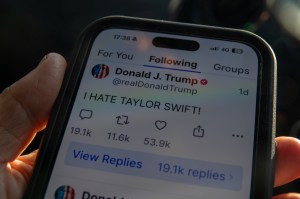
Ever since Elon Musk bought Twitter two years ago, those who despise his evolving mix of predatory trolling, stunted emotional development and right-wing extremism have been hoping for an alternative. There was “Post”; Meta got into the act with “Threads”; another entity of at first uncertain origins actually got its start with one of Twitter’s former CEOs, Jack Dorsey. That was Bluesky. There was also Mastodon, a sort of Linux of social media networks. Part of the problem there was that you may not be familiar enough with Linux to understand the analogy. And if you do, you’re part of a potential community not nearly big enough to sustain a mass adoption social media platform. Each in succession thoroughly failed to dislodge or even make much of a dent in Twitter’s disordered and Frankensteinian dominance. It’s the power of network effects. Everyone can want to leave (or at least a big chunk of users can want that) and yet everyone is simultaneously trapped. It’s a collective action problem.
Read More
A perennial feature of Trumpism is that Trump is constantly launching threats and shiny objects of all sorts. Some of those he’ll follow through on; most he won’t. They all put opponents back on their heels. And that is, of course, the point. Trump lets it all ride and acts on what seems to serve his interests in the moment. Or maybe he doesn’t. That’s also the point. He’s the actor; his opponents are the reactors.
That spurs a knock-on feature of Trumpism. His opponents are among the biggest proponents of the seriousness of his threats. We’ll come back to that.
Polls have come out in the days since the election showing clear majorities favoring Trump’s “mass deportation” plans. Or at least they seem to. One I saw over the weekend asked if respondents supported Trump’s plan start “a national program to find and deport all immigrants who are in the U.S. illegally.” 57% of respondents to a CBS/YouGov poll said they supported that. But let’s note that this is already U.S. government policy. There is a question of what’s prioritized, just what lengths the government goes to to find people. But the question in the poll described what is actually current policy. When asked how he plans to start “mass deportation,” incoming “Border Czar” Tom Homan says they’ll focus first on criminals and terrorist undocumented immigrants. Well, that is especially current U.S. policy.
Read More
We’ve been discussing a lot of plans and ingenious new strategies for a Democratic comeback which are variously half-baked, hyperbolic, histrionic or merely silly. Here’s one that I believe is not. It’s not even a strategy. It’s simply identifying a real challenge, or a knot Democrats need to untangle.
A key reason that many people are Democrats today is that they’re attached to a cluster of ideas like the rule of law, respect for and the employment of science and expertise, a free press and the protection of the range of institutions that guard civic life, quality of life and more. On the other side, say we have adherents of a revanchist, authoritarian politics which seeks break all those things and rule from the wreckage that destruction leaves in its path. So Democrats constantly find themselves defending institutions, or “the establishment,” or simply the status quo. Yet we live in an age of pervasive public distrust — distrust of institutions, leaders, expertise. And not all of this distrust is misplaced. Many institutions, professions, and power centers have failed to live up to their sides of the social contract.
In short, Democrats are by and large institutionalists in an age of mistrust. And that is challenging place to be.
Read More