

House Speaker Nancy Pelosi’s (D-CA) husband, Paul Pelosi, is in the hospital after being attacked in their San Francisco home early Friday morning.
Continue reading “Pelosi’s Husband In Hospital After Assault At California Home”Election Pollsters Face A Big Test In 2022 After Recent Polling Errors
This article is part of TPM Cafe, TPM’s home for opinion and news analysis. It was originally published at The Conversation.
When it became clear his poll had erred in the 2021 New Jersey governor’s race, Patrick Murray, director of the Monmouth University Polling Institute, acknowledged:
“I blew it.”
The campaign’s final Monmouth poll estimated Gov. Phil Murphy’s lead over Republican foe Jack Ciattarelli at 11 percentage points — a margin that “did not provide an accurate picture of the state of the governor’s race,” Murray later said in a newspaper commentary. Murphy won by 3.2 points.
It was a refreshingly candid acknowledgment by an election pollster.
More broadly, the error was one of several in the recent past and looms among the disquieting omens confronting pollsters in the 2022 midterm elections. Will they be embarrassed again? Will their polls in high-profile U.S. Senate and gubernatorial races produce misleading indications of election outcomes?
Such questions are hardly far-fetched or irrelevant, given election polling’s tattered recent record. A few prominent survey organizations in recent years have given up on election polling, with no signs of returning.
Treat polls warily
It is important to keep in mind that polls are not always in error, a point noted in my 2020 book, “Lost in a Gallup: Polling Failure in U.S. Presidential Elections.” But polls have been wrong often enough over the years that they deserve to be treated warily and with skepticism.
For a reminder, one need look no further than New Jersey in 2021 or, more expansively, to the 2020 presidential election. The polls pointed to Democrat Joe Biden’s winning the presidency but underestimated popular support for President Donald Trump by nearly 4 percentage points overall.
That made for polling’s worst collective performance in a presidential campaign in 40 years, and post-election analyses were at a loss to explain the misfire. One theory was that Trump’s hostility to election surveys dissuaded supporters from answering pollsters’ questions.
In any case, polling troubles in 2020 were not confined to the presidential race: In several Senate and gubernatorial campaigns, polls also overstated support for Democratic candidates. Among the notable flubs was the U.S. Senate race in Maine, where polls signaled defeat for the Republican incumbent, Susan Collins. Not one survey in the weeks before the election placed Collins in the lead.
She won reelection by nearly 9 points.
Recalling the shock of 2016
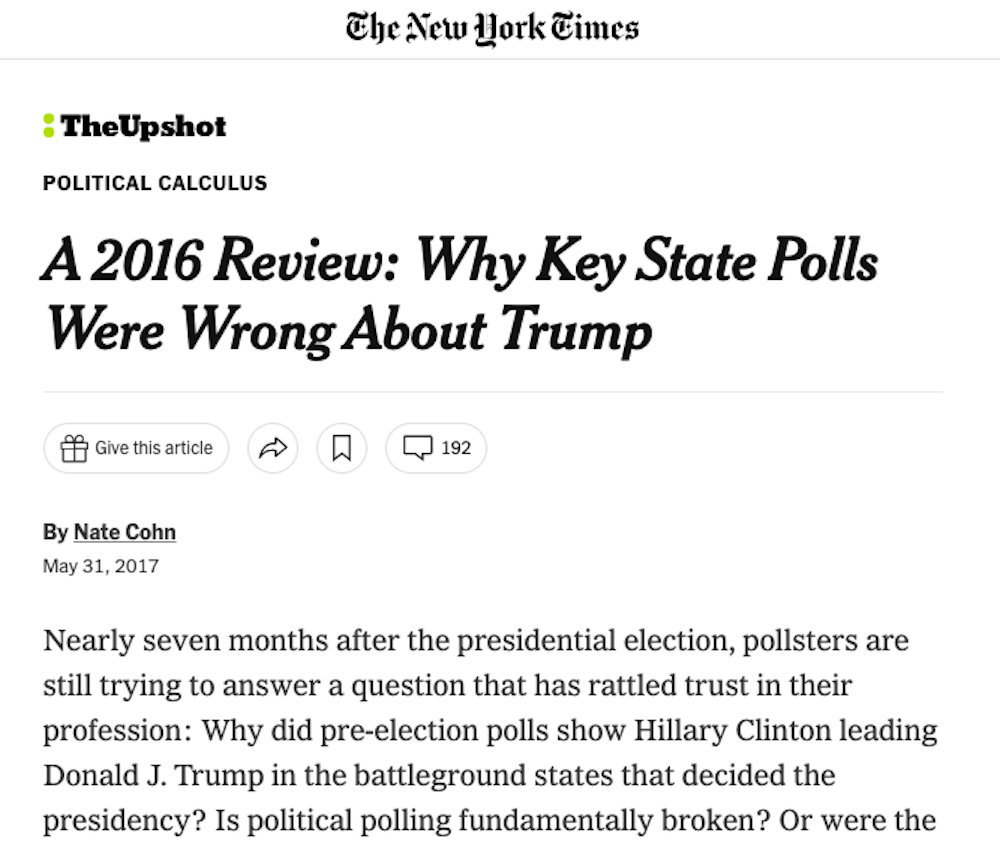
The embarrassing outcomes of 2020 followed a stunning failure in 2016, when off-target polls in key Great Lakes states confounded expectations of Hillary Clinton’s election to the presidency. They largely failed to detect late-campaign shifts in support to Trump, who won a clear Electoral College victory despite losing the national popular vote.
Past performance is not always prologue in election surveys; polling failures are seldom alike. Even so, qualms about a misfire akin to those of the recent past have emerged during this campaign.
In September 2022, Nate Cohn, chief political analyst for The New York Times, cited the possibility of misleading polls in key races, writing that “the warning sign is flashing again: Democratic Senate candidates are outrunning expectations in the same places where the polls overestimated Mr. Biden in 2020 and Mrs. Clinton in 2016.”
There has been some shifting in Senate polls since then, and surely there will be more before Nov. 8. In Wisconsin, for example, recent surveys suggest Republican incumbent Ron Johnson has opened a lead over Democratic challenger Mandela Barnes. Johnson’s advantage was estimated at 6 percentage points not long ago in a Marquette Law School Poll.
The spotlight on polling this election season is unsurprising, given that key Senate races — including those featuring flawed candidates in Pennsylvania and Georgia — will determine partisan control of the upper house of Congress.
Worth doing?
Polling is neither easy nor cheap if done well, and the field’s persistent troubles have even prompted the question whether election surveys are worth the bother.
Monmouth’s Murray spoke to that sentiment, stating: “If we cannot be certain that these polling misses are anomalies then we have a responsibility to consider whether releasing horse race numbers in close proximity to an election is making a positive or negative contribution to the political discourse.”
He noted that prominent survey organizations such as Pew Research and Gallup quit election polls several years ago to focus on issue-oriented survey research. “Perhaps,” Murray wrote, “that is a wise move.”
Questions about the value of election polling run through the history of survey research and never have been fully settled. Early pollsters such as George Gallup and Elmo Roper were at odds about such matters.
Gallup used to argue that election polls were acid tests, proxies for measuring the effectiveness of surveys of all types. Roper equated election polling to stunts like “tearing a telephone book in two” — impressive, but not all that consequential.
Who is and isn’t responding
Experimentation, meanwhile, has swept the field, as contemporary pollsters seek new ways of reaching participants and gathering data.
Placing calls to landlines and cellphones — once polling’s gold standard methodology — is expensive and not always effective, as completion rates in such polls tend to hover in the low single digits. Many people ignore calls from numbers they do not recognize, or decline to participate when they do answer.
Some polling organizations have adopted a blend of survey techniques, an approach known as “methodological diversity.” CNN announced in 2021, for example, that it would include online interviews with phone-based samples in polls that it commissions. A blended approach, the cable network said, should allow “the researchers behind the CNN poll to have a better understanding of who is and who is not responding.”
During an online discussion last year, Scott Keeter of Pew Research said “methodological diversity is absolutely critical” for pollsters at a time when “cooperation is going down [and] distrust of institutions is going up. We need to figure out lots of ways to get at our subjects and to gather information from them.”
So what lies immediately ahead for election polling and the 2022 midterms?
Some polls of prominent races may well misfire. Such errors could even be eye-catching.
But will the news media continue to report frequently on polls in election cycles ahead?
Undoubtedly.
After all, leading media outlets, both national and regional, have been survey contributors for years, conducting or commissioning — and publicizing — election polls of their own.
This article is republished from The Conversation under a Creative Commons license. Read the original article.

Hassan Slams Bolduc For Repeatedly Boosting Big Lie
A lot of things happened. Here are some of the things. This is TPM’s Morning Memo.
Yeah, He Wasn’t Gonna Get Away With This One
During their debate last night, Sen. Maggie Hassan (D-NH) accused GOP rival and election denier Don Bolduc of fueling Trump’s election lies–and it’s unclear why he apparently thought he could avoid that charge after declaring in August that he stood by his claim that Trump won the 2020 election and that the GOP nominee was “not switching horses, baby.”
- Bolduc “has traveled around this state for over a year now, stoking the Big Lie that 2020 was stolen,” Hassan said.
- The Republican nominee still tried to sow doubt about election integrity via the ironclad “many-people-are-saying” argument during the debate, claiming that Granite Staters he’d met on the campaign trail told him they “can’t trust” the mail-in voting system and believe same-day voter registration “causes fraud” (it doesn’t).
- Bolduc also claimed without evidence that there were “school buses loaded with people” being taken to poll sites, a thing that he knows is happening because “that is what Granite Staters tell me.”
Murkowski Faces Off With Alaska GOP-Backed Rival
Sen. Lisa Murkowski (R-AK) had a debate with MAGA challenger Kelly Tshibaka, who’s been endorsed by the Alaska Republican Party and Trump, and Democrat Pat Chesbro on Thursday night. Check out these highlights:
- The Associated Press: “Murkowski faces Tshibaka and Chesbro in Alaska Senate debate”
- The Hill: “Five takeaways from the Alaska Senate debate”
Gosar Attempting To Hold Peace Talks With Zelensky And Putin
Rep. Paul Gosar (R-AZ) sent a letter to the Ukrainian and Russian embassies in D.C. on Wednesday inviting Ukrainian President Volodymyr Zelensky and Russian leader Vladimir Putin to Phoenix, Arizona to “engage in peace talks.”
- The Arizona Republican demanded “administrative and other support” from the U.N. to help him with his diplomat cosplay.
- Gosar also called himself a “non-combatant peace activist” in the letter. Last year, he posted an animated video of himself killing Rep. Alexandria Ocasio-Cortez (D-NY).
Putin Says He’s Not Planning On Using Nuclear Weapons In Ukraine
In spite of the veiled threats the Kremlin’s made about potential nuclear strikes in its Ukraine invasion, Putin said during a conference in Moscow on Thursday that there’s “no point” politically nor militarily in using nuclear weapons.
- But Putin also warned that the world is facing “the most dangerous” decade since the end of World War II.
- And Putin kept pushing his baseless claim that Ukraine was plotting a false flag operation to blow up a radioactive “dirty bomb” on its own soil and blame it on Russia.
NY Post Blames Rogue Staffer For Racist, Violent Posts
Several hours after the New York Post’s Twitter account and website were suddenly flooded with horrific headlines and tweets on Thursday morning, the tabloid put out a statement saying an unnamed “employee” was responsible for the posts and has since been fired.
- The Post initially claimed it had been “hacked” and was “investigating the cause.” That claim is still up, for some reason.
- This is what got posted:
Elon Musk Now Officially Owns Twitter
Tesla CEO Elon Musk closed his $44 billion deal to buy Twitter on Thursday and immediately fired at least four of the social media giant’s top executives.
Must Read
“Kanye West Destroys Himself” – The Atlantic
“Hatred destroys the hater.” When it comes to anti-Semitism, the questionable cliché is sometimes literally true. That’s because societies that spend their time pursuing and persecuting Jewish bogeymen fail to address the real roots of their concerns, whether they are political, economic, or personal. In practice, this means that those who embrace the conspiratorial currents of anti-Semitism are frequently the authors of their own demise, flailing against phantoms instead of overcoming their challenges.
Do you like Morning Memo? Let us know!
Listen To This: TV Candidates
A new episode of The Josh Marshall Podcast is live! This week, Josh and Kate discuss recent debates, the importance of candidate quality, and the idea that demographics is destiny.
You can listen to the new episode of The Josh Marshall Podcast here.
Ex-Trump Official Tries To Scare Employers Out Of Paying For Abortion Travel
Much like Herschel Walker and his prop police badge, some in the right-wing universe can’t help flaunting power they don’t actually have.
Continue reading “Ex-Trump Official Tries To Scare Employers Out Of Paying For Abortion Travel”Cheney Officially Backs Rep. Slotkin In First Dem Endorsement
House Jan. 6 Committee vice chair Liz Cheney (R-WY) endorsed Rep. Elissa Slotkin’s (D-MI) reelection bid on Thursday, marking the Republican’s first endorsement of a lawmaker on the other side of the aisle in her push against Trumpism in her own party.
Continue reading “Cheney Officially Backs Rep. Slotkin In First Dem Endorsement”How to See the Ukraine Letter Imbroglio
I want to return to this issue of the Ukraine letter that the Congressional Progressive Caucus released and then hastily disavowed. This can seem like an insider story with a mix of staff-member disagreements, endangered leadership ambitions and just some old-fashioned whodunnit. We’re not at all above covering those stories. But there are some really important issues at play beneath the superficial controversies.
One close to dominant view of this is that the letter itself wasn’t very controversial. It was just ill-timed (right before the election, after on-going Ukrainian battlefield successes), poorly managed and the Washington Post article that broke the story portrayed it as a break with administration policy when it really wasn’t. (Here’s one good overview of the whole controversy.)
There’s a bit of truth to this. But I think it’s basically wrong. The overview I linked to above says it’s an example of how constricted the current policy debate about Ukraine is. Again, I think that’s wrong. We’ll come back to that in a moment.
Continue reading “How to See the Ukraine Letter Imbroglio”Bolduc Plans To ‘Just Completely Avoid’ Hassan Labeling Him An Election Denier At Debate
Retired Army Brigadier General Don Bolduc, the Republican challenger for Sen. Maggie Hassan’s seat (D-NH), candidly shared some of his strategy ahead of Thursday’s debate.
Continue reading “Bolduc Plans To ‘Just Completely Avoid’ Hassan Labeling Him An Election Denier At Debate”GOP Candidate Nukes Twitter Account That ‘Liked’ And Replied To Porn Tweets
A Republican running for auditor in Franklin County, Ohio has deleted his Twitter account after people noticed that the account had been “liking” and even responding to porn tweets.
Continue reading “GOP Candidate Nukes Twitter Account That ‘Liked’ And Replied To Porn Tweets”Rubio’s Backwards B Moment Starts to Crumble
We are now cast into that antic final period before an election where a raft of strange and outlandish stories suddenly spring up and mostly drop like a stone amidst the ongoing carnival of news. One of those stories popped up earlier this week in Florida when Marco Rubio announced on Twitter that a canvasser for his campaign was viciously beaten by anti-Republican street toughs who told him that Republicans weren’t welcome in their neighborhood. “Last night one of our canvassers wearing my T-shirt and a Desantis hat,” tweeted Rubio, “was brutally attacked by 4 animals who told him Republicans weren’t allowed in their neighborhood in #Hialeah #Florida.”
It sounded pretty bad — a canvasser for Rubio’s campaign was beaten badly enough that he had to be taken to a local hospital. But the story has played out a bit differently than might have been expected.
Continue reading “Rubio’s Backwards B Moment Starts to Crumble”