A big question we turn to now is who will be the next Speaker of the House. This should not be a question. The leader of the Republican opposition for the last four years should obviously become speaker. But, as we know, it’s not that simple.
Tonight we heard for the first time that McCarthy has agreed to allow motions to vacate as part of his quest to get the votes to become speaker. This is a technical parliamentary tool but an extremely important one. It allows any member at any time to force a vote on firing McCarthy as speaker. There are various potential versions of this and it has to do with what is called a “privileged motion.” The latest reports suggest McCarthy has finally agreed to this, something he has insisted he would never agree to.
ProPublica is a Pulitzer Prize-winning investigative newsroom. Sign up for The Big Story newsletter to receive stories like this one in your inbox.
The deal to pay off the treasurer of Detroit was forged in a booth at a strip club named Bouzouki.
“You’re basically paying all these other guys. … You should be paying me,” the city’s treasurer told local business owner Robert Shumake that day in 2007 during a conversation that Shumake would later recount to federal prosecutors.
Shumake, a self-described community organizer and philanthropist, agreed to make payments to several officials who ran the city’s pension funds. The money was used, among other things, to cover gambling expenses, airline tickets and a day cruise to the Bahamas.
In return, Shumake received a lucrative reward: Detroit steered millions of pension dollars to his investment company and paid him $1.2 million in fees. Prosecutors would later say it was “the worst possible deal for the pension systems.”
A series of city officials and businessmen were convicted in the sweeping scandal, but Shumake struck a deal in exchange for his testimony in 2011 and avoided prosecution.
Soon after, he landed another fortunate break. The southern African country of Botswana nominated him as an honorary consul in the United States, a diplomatic position that came with legal protections, travel benefits and political connections unavailable to most Americans.
The State Department approved the appointment, granting Shumake entry into the privileged world of international diplomacy. Honorary consuls, though not as prominent as ambassadors and other career diplomats, have for centuries worked from their home countries to represent foreign nations.
The department did not respond to questions about what steps, if any, it took to review Shumake’s background. Had officials done even a cursory internet search, they would have discovered that Shumake’s real estate broker’s license was suspended in 2002 and that he settled a bank fraud case in 2008, agreeing to pay hundreds of thousands of dollars.
Reports of exploitation, scandal and criminal behavior by the little-known volunteer diplomats have surfaced for years. But the vast majority of governments have failed to strengthen oversight or press to reform the international law that protects thousands of honorary consuls worldwide, a new review found.
All told, the “Shadow Diplomats” investigation identified criminal or controversial consuls connected to at least 168 governments, including Russia, which has leveraged the system to install dozens of pro-Kremlin advocates on foreign soil as a soft-power strategy.
In the wake of the reporting, Paraguay, Finland, Brazil and other countries announced investigations of consuls and the system that empowers them. In some cases, government officials acknowledged not knowing how many consuls they had appointed or whether any had been convicted of crimes.
Experts in international diplomacy and national security say that more governments must demand change, examine nominees before they are approved and track their activities once they become consuls.
ProPublica and ICIJ identified more than 150 current and former consuls accused or convicted of tax evasion, fraud, bribery, corruption or money laundering. Nearly 60 were tied to drug or weapons offenses, at least 20 others to violent crimes and 10 to environmental abuses. Thirty honorary consuls have been sanctioned by the United States and other governments; nine have been linked to terrorist groups by law enforcement and governments. Once accused, dozens of consuls have invoked their status to avoid prosecution, police inquiries or fines.
“No one is checking them out,” said Bob Jarvis, an international law and constitutional law professor at Florida’s Nova Southeastern University who first examined the honorary consul system in the 1980s. “What are we doing? Who are these people?”
The United States does not appoint its own honorary consuls overseas but has for decades allowed foreign countries to appoint U.S. citizens as consuls in America. An estimated 1,100 were in place this year.
The State Department, responsible for approving consul nominations, noted years ago that the United States was “not in a position” to conduct background checks or analyze the qualifications or suitability of nominees on U.S. soil and instead entrusted foreign countries to review credentials.
Unlike some other countries, the United States has no code of conduct for honorary consuls. The State Department previously fought an effort by Congress to review whether diplomatic pouches, protected from searches under international law, had been used to move contraband. The department at the time said the measure would impact U.S. diplomats overseas.
In 2020, the department reached out to foreign embassies with a simple request: an updated list of their honorary consuls in the United States. The last time the department inquired was five years earlier, records show.
“You’re looking at a pretty large universe, so to engage in a detailed review for every nominee would be rather difficult,” Lawrence Dunham, former assistant chief of protocol at the State Department, said in an interview.
The State Department did not respond to specific questions about its oversight of consuls. In a statement, Cliff Seagroves, principal deputy director of the Office of Foreign Missions, said the department works to “protect the U.S. public from abuse of diplomatic privileges and immunities. This oversight includes the accreditation of honorary consuls and their performance of official duties in the United States. The Department has zero tolerance for evidence of inappropriate activity by any member of a foreign mission, including honorary consuls.”
The department did not respond to questions about the appointment of Shumake.
Shumake did not respond to questions about his activities before becoming consul. He has previously said he cooperated with the government in the pension case; Detroit’s former treasurer was sentenced in 2015 to 11 years in prison.
Shumake has also said he never sought to misrepresent his professional background. He has denied wrongdoing in the bank fraud probe.
Outside the United States, a small number of governments faced with scandals have adopted more stringent protocols for appointing and accepting honorary consuls.
Three years ago, the Canadian government launched a review after Syrian refugees in Montreal discovered newly approved honorary consul Waseem Ramli in a red Hummer fitted with an image of the Syrian flag and a picture of President Bashar al-Assad, whose regime has killed tens of thousands of civilians through airstrikes and chemical weapons.
“To us, that is not the Syrian flag. It represents horrors for us. It represents evil,” said Farouq Habib, a Syrian father of two who was granted asylum in Canada. “It was shocking for me to see it on the streets of Canada. How can Canada adopt someone … without any due diligence or vetting? It undermines the credibility of the system itself.”
The Canadian government dismissed Ramli before his term began and reported that consuls appointed by 15 countries warranted closer scrutiny.
Ramli could not be reached for comment. At the time of his nomination, he said he would represent Syrians regardless of their political views.
“I need some [information] on what happened to let this one pass,” a Canadian official wrote at the time, according to emails released by the government. “Where did we ‘fail?’”
“The Honor System”
The honorary consul system was created with great promise centuries ago, when governments began to promote their cultural and economic interests in foreign countries by appointing prominent private citizens to serve as liaisons from their home countries. Under international law, when a foreign government nominates a consul, local governments must in turn approve the appointment.
Many consuls are diligent advocates, forging country-to-country alliances in the arts, industry, science and academia while drawing far less attention than ambassadors and other career diplomats.
But the perks of diplomacy have long attracted some dubious appointees. Honorary consuls receive legal immunity in matters involving their work. Their correspondence cannot be seized, and their offices and consular bags are protected from searches. Their status provides access to leaders of politics and industry.
In the United States, an honorary consul for Malaysia tried to use his diplomatic status to get out of a $10 traffic ticket in Portland, Oregon, taking a lawsuit to the state’s Court of Appeals in 1979 before he lost, court records show.
In Los Angeles in the 1990s, honorary consul Latchezar “Lucky” Christov conspired with lawyers, a firefighter, a police officer and a rabbi, among others, to help move tens of millions of dollars for a Colombian drug cartel.
To avoid unwanted attention, Christov planned to pick up drug money in a car with a diplomatic license plate, records show. He also held cash in his office on Wilshire Boulevard, where the sign over the door read: Consul Bulgaria.
Christov, whose exploits were later described in a report to Congress, pleaded guilty to laundering drug money. He died in 2015.
In 2005, an honorary consul representing the Czech Republic in Michigan and Ohio tried to avoid paying property taxes on a 16,000-square-foot home near Detroit with a six-car garage and elevator. He argued the property had been transferred to the Czech government.
“Does the embassy pay property taxes? Of course not! Does the consulate in New York pay property taxes? Of course not!” Thomas Prose was quoted as saying at the time. Local officials denied a tax exemption, and Prose resigned as honorary consul. Prose could not be reached for comment; he previously said he paid the taxes “out of goodwill.”
One of the more high-profile honorary consuls in the United States was Jill Kelley, who gained notoriety in 2012 for triggering an FBI investigation that ultimately exposed an extramarital affair between then-CIA Director David H. Petraeus and his biographer.
During the media coverage, Kelley reportedly called 911 to complain about trespassers. “I’m an honorary consul general … so they should not be able to cross my property,” she said.
Kelley, appointed consul by South Korea, lost her consul post that year. At the time, a New York businessman said she had sought millions of dollars to help him win a gas contract in South Korea.
“It’s not suitable to the status of honorary consul that (she) sought to be involved in commercial projects and peddle influence,” South Korea’s deputy foreign minister told the Seoul-based news agency Yonhap.
Kelley denied wrongdoing, telling ProPublica and ICIJ that she did not monetize her role as honorary consul. “I never made a dollar or capitalized from my work,” she said.
In response to questions, Kelley shared a copy of a 2013 civil lawsuit that she and her husband filed against the U.S. government, alleging their privacy was violated by the disclosure of “personal, private and confidential information” during the Petraeus scandal. The loss of her consulship deprived Kelley of “years of significant public service, social and financial opportunities,” according to the lawsuit, which she later dropped. Kelley declined to elaborate.
In recent years, more than 100 countries, including Russia, Guatemala, Liberia and Malta, have had consuls in the United States, State Department records show. France had the most: 53 as of March.
The State Department has several requirements, including that a consul is 21 or older, a U.S. citizen or permanent resident and holds no government position with duties that could conflict with the post.
A State Department memo to foreign embassies in 2003 noted that the U.S. government “trusts” foreign countries to completely review the credentials of nominees. Once consuls are in place, the memo said, they would remain accountable to the governments they represent.
“It’s on the honor system,” Dunham said.
He added that the United States can always refuse to accept honorary consul nominees or, later, remove them from their posts.
Efforts to strengthen oversight of diplomatic privilege over the years have been sporadic. In the 1980s, the State Department enacted a one-year moratorium on the appointments of new honorary consuls in response to concerns from Congress about the number of people in the U.S. with diplomatic protection.
Around the same time, a bipartisan group of U.S. lawmakers sought to review whether diplomats were exploiting protections that allowed them to receive bags, boxes and containers in the United States without inspection. Under international law, diplomatic pouches are protected from scrutiny, even by X-ray.
The measure would have required the government to adopt safeguards to ensure bags were not used to smuggle drugs, explosives, weapons or any other materials used to advance terrorism.
“We are concerned that terrorists could, and we have every reason to believe, have shipped under the protection of diplomatic immunity pouches carrying such items as small armed weapons and explosives to be used against law enforcement officers,” Dennis Martin, then-president of the American Federation of Police, testified at a congressional hearing.
The State Department opposed the measure, arguing that the United States was the largest sender of diplomatic pouches. “The beneficiary of diplomatic immunity fundamentally is the United States government because our personnel abroad could not function without it,” the department’s head of protocol said.
The measure died in Congress.
Last year, the department requested that states stop issuing special license plates to honorary consuls, saying they “may imply privileges and immunities to which honorary consular officers are not entitled.”
Some states, however, are still issuing the plates, including Oregon, Arizona and Georgia, ProPublica and ICIJ found. Texas has issued or renewed more than 3,900 plates to honorary consuls since 1994, records show.
One financial crime expert pointed to another vulnerability.
Some foreign governments have chosen to classify honorary consuls as “politically exposed persons” who present a higher risk of financial crime and are more closely scrutinized by financial institutions.
The United States has not done so, leaving that determination to financial institutions.
“An honorary consul can be used much like a gatekeeper,” said Sarah Beth Felix, a former banking compliance executive. “It’s a great way to run dirty money because honorary consuls are typically not tagged as higher risk in a monitoring system and they get the benefit of not being subjected to law enforcement searches.”
The Treasury Department said that U.S. regulations do not define politically exposed persons. “Whether honorary consuls are PEPs depends on the facts and circumstances surrounding the consul’s appointment and role,” said Jayna Desai, spokesperson for the department’s Financial Crimes Enforcement Network.
Worldwide Warning Signs
For years, government investigations around the world have chronicled lawlessness and abuse among consuls that appear to eclipse incidents in the United States.
Twenty-five years ago, Bolivia announced a review of the honorary consul system there after high-profile scandals, including one in which the country’s consul in Haiti was dismissed after police reportedly found an arsenal of weapons inside the consul’s home, including rifles, pistols and a grenade launcher. Authorities suspected that the consul was linked to paramilitary groups fighting against the Haitian government, local media reported.
“It is well worth reviewing completely this outdated custom of honorary consuls,” local newspaper La Razón wrote after the arrest in an editorial titled “The Chronic Problem of Honorary Consuls.”
“It is a thousand times preferable not to have anyone to represent us in a nation than to go through undignified situations,” the newspaper wrote.
In 2003, Hungary overhauled its system after a stockbroker wanted for fraud and embezzlement fled the country in an honorary consul’s Mercedes. The stockbroker also held an ID card from another honorary consulate, according to media reports.
After the incident, the Hungarian government announced a review of the honorary consul system and stopped issuing identity cards to employees of honorary consulates. The stockbroker was convicted and jailed for five years; the consuls were not charged.
In 2007, Liberia dismissed nearly all of its consuls overseas after reports from Europe, Asia and the Middle East of drug smugglers and money launderers holding honorary consul passports, according to a U.S. State Department cable at the time.
In 2019, Canada became one of the largest governments to review the system, initiating the probe after reports about Ramli, nominated by Syria, surfaced in Montreal.
“I cried at the time. How come this person was appointed?” said Muzna Dureid, a Syrian refugee. “Even in Canada, we don’t feel safe.”
The government investigation found that “time constraints and lack of information management expertise” limited an initial review of Ramli, who went on to say in an interview with Maclean’s magazine that a prominent Syrian volunteer rescue group was a “terrorist organization.”
Canada introduced a new process to examine and appoint honorary consuls, adding a code of conduct.
A Family of Consuls
Despite the findings by governments, most countries have not called for widespread reforms. That includes Spain, where authorities are currently investigating three honorary consuls accused of helping to launder money for Simón Montero Jodorovich, an accused drug dealer.
In a 2,000-page report, police wrote in 2019 that the consuls representing Mali, Croatia and Albania allegedly called Jodorovich “big boss.”
Honorary consuls, the police reported, work without pay for the countries they represent. “What is obtained,” police wrote, “is compensation in terms of prestige, privileges and social relations, not to mention the coveted diplomatic bag … that crosses borders without any control.”
The consuls, who have not been criminally charged, have denied wrongdoing. An attorney for Jodorovich said his client is innocent and “has never manipulated any consul,” adding that Jodorovich’s relationship with them was transactional.
In Central America, the government of Honduras has previously reviewed its honorary consuls overseas, but consuls within the country have received less attention.
The powerful Kafie family has counted eight honorary consuls among its members, representing an eclectic group of countries that include Finland, Latvia and Panama.
In 2015, Schucry Kafie, a prominent businessman who has served for years as honorary consul for Jordan, was arrested in a Honduran corruption scandal, accused with others of overcharging the government for medical supplies.
Others implicated in the scandal were detained, but Kafie was released by a judge, who noted that his status as consul required him to sometimes leave the country, court records show.
The charges against Kafie were ultimately dismissed.
In a written statement, Kafie said that the government’s case was politically motivated and that the company did not overcharge for equipment. He added that the court allowed him to leave the country for health reasons and not because of his job as honorary consul.
In Panama, the Kafie family has a power plant that has for years drawn complaints from nearby residents, who say they fear it emits toxic gas.
Martin Ibáñez, 66, said his skin itches and his eyes burn from the smoke. He has written to the Panamanian government and others, hoping someone will determine whether the plant is operating safely.
“It’s like they dropped an atomic bomb,” he said this year. “I will die one of these days, but I want to go down fighting.”
Kafie said the plant did not cause health problems.
“Harm and Abuse”
In 2020, the United Nations Institute for Training and Research offered a course for honorary consuls that explored diplomatic law and ethics.
“Without a strong governance and reporting process, honorary consuls can become isolated and remote and their activities can be contrary to the interests of the sending state,” the institute noted at the time.
The course was offered only once. An institute official told ProPublica and ICIJ that there were not enough participants.
Diplomatic law experts said governments should require training and also make public the names and locations of honorary consuls. Of more than 180 countries that appoint and receive honorary consuls, only 42 publish up-to-date information, including names of consuls. Dozens of countries report no information at all, ProPublica and ICIJ found. Governments could also introduce an honorary consul code of conduct, evaluate the records of those currently holding the posts and start investigating new nominees, experts said.
“The harm and abuse,” said Jarvis, the law professor from Florida, “far outweighs whatever benefit the system is providing.”
In Michigan, Shumake’s honorary consul post for Botswana ended in 2015. He had also been appointed honorary consul by the government of Tanzania; that post ended in 2015 as well.
While consul, he won a contract to build a rail line in Tanzania in a deal that opponents criticized as improper and opaque. Shumake defended the project; the rail line was never built.
The Botswana Ministry of Foreign Affairs told ProPublica and ICIJ that Shumake’s tenure was terminated after the U.S. State Department disclosed that he had been accused of misconduct. The ministry did not elaborate. The government of Tanzania did not respond to requests for comment.
One year after the consul posts ended, U.S. authorities seized more than $250,000 in cash at the Charlotte Douglas International Airport in North Carolina from one of Shumake’s associates. The money was stashed in a carry-on bag, which later tested positive for traces of cocaine, according to documents from a subsequent civil forfeiture case.
The courier referred authorities to Shumake, who said he had raised the money to support communities in Africa and the Caribbean and that as “an ambassador” of an international commission, he had diplomatic immunity in transporting it, according to court documents. Authorities seized the cash.
Shumake declined to respond to detailed questions from ProPublica and ICIJ, but he said the U.S. returned the money. Court records show the government agreed to return half the money to the international commission.
In an unrelated case in 2017, Shumake pleaded guilty to misdemeanor violations in a Michigan court after his mortgage auditing company was accused of improperly taking fees from distressed homeowners.
“You preyed on people at their lowest possible moment,” a county judge told Shumake at his sentencing hearing.
Last year, the U.S. Securities and Exchange Commission alleged that Shumake and others had set up a fraudulent crowdfunding scheme that promised investors profits from the cannabis industry. The SEC filed a lawsuit, which is ongoing. Shumake has denied wrongdoing.
In May, seven years after his honorary consul positions ended, he posted a video online titled “Robert Shumake Holds the Titles of Honorary Consul.” The video includes an image of two men shaking hands — while exchanging wads of cash.
This story first appeared at ProPublica. ProPublica is a Pulitzer Prize-winning investigative newsroom. Sign up for The Big Story newsletter to receive stories like this one in your inbox.
On a crisp day this fall I drove southeast from Grand Junction, Colorado, into the Uncompahgre Valley, a rich basin of row crops and hayfields. A snow line hung like a bowl cut around the upper cliffs of the Grand Mesa, while in the valley some farmers were taking their last deliveries of water, sowing winter wheat and onions. I turned south at the farm town of Delta onto Route 348, a shoulder-less two-lane road lined with irrigation ditches and dent corn still hanging crisp on their browned stalks. The road crossed the Uncompahgre River, and it was thin, nearly dry.
The Uncompahgre Valley, stretching 34 miles from Delta through the town of Montrose, is, and always has been, an arid place. Most of the water comes from the Gunnison River, a major tributary of the Colorado, which courses out of the peaks of the Elk Range through the cavernous and sun-starved depths of the Black Canyon, one rocky and inaccessible valley to the east. In 1903, the federal government backed a plan hatched by Uncompahgre farmers to breach the ridge with an enormous tunnel and then in the 1960s to build one of Colorado’s largest reservoirs above the Black Canyon called Blue Mesa. Now that tunnel feeds a neural system of water: 782 miles worth of successively smaller canals and then dirt ditches, laterals and drains that turn 83,000 Western Colorado acres into farmland. Today, the farm association in this valley is one of the largest single users of Colorado River water outside of California.
I came to this place because the Colorado River system is in a state of collapse. It is a collapse hastened by climate change but also a crisis of management. In 1922, the seven states in the river basin signed a compact splitting the Colorado equally between its upper and lower halves; later, they promised additional water to Mexico, too. Near the middle, they put Lake Powell, a reserve for the northern states, and Lake Mead, a storage node for the south. Over time, as an overheating environment has collided with overuse, the lower half — primarily Arizona and California — has taken its water as if everything were normal, straining both the logic and the legal interpretations of the compact. They have also drawn extra releases from Lake Powell, effectively borrowing straight out of whatever meager reserves the Upper Basin has managed to save there.
This much has become a matter of great, vitriolic dispute. What is undeniable is that the river flows as a much-diminished version of its historical might. When the original compact gave each half the rights to 7.5 million acre-feet of water, the river is estimated to have flowed with as much as 18 million acre-feet each year. Over the 20th century, it averaged closer to 15. Over the past two decades, the flow has dropped to a little more than 12. In recent years, it has trickled at times with as little as 8.5. All the while the Lower Basin deliveries have remained roughly the same. And those reservoirs? They are fast becoming obsolete. Now the states must finally face the consequential question of which regions will make their sacrifice first. There are few places that reveal how difficult it will be to arrive at an answer than the Western Slope of Colorado.
In Montrose, I found the manager of the Uncompahgre Valley Water Users Association, Steve Pope, in his office atop the squeaky stairs of the same Foursquare that the group had built at the turn of the last century. Pope, bald, with a trimmed white beard, sat amid stacks of plat maps and paper diagrams of the canals, surrounded by LCD screens with spreadsheets marking volumes of water and their destinations. On the wall, a historic map showed the farms, wedged between the Uncompahgre River and where it joins the Gunnison in Delta, before descending to their confluence with the Colorado in Grand Junction. “I’m sorry for the mess,” he said, plowing loose papers aside.
What Pope wanted to impress upon me most despite the enormousness of the infrastructure all around the valley was that in the Upper Basin of the Colorado River system, there are no mammoth dams that can simply be opened to meter out a steady release of water. Here, only natural precipitation and temperature dictate how much is available. Conservation isn’t a management decision, he said. It was forced upon them by the hydrological conditions of the moment. The average amount of water flowing in the system has dropped by nearly 20%. The snowpack melts and evaporates faster than it used to, and the rainfall is unpredictable. In fact, the Colorado River District, an influential water conservancy for the western part of the state, had described its negotiating position with the Lower Basin states by claiming Colorado has already conserved about 28% of its water by making do with the recent conditions brought by drought.
You get what you get, Pope tells me, and for 15 of the past 20 years, unlike the farmers in California and Arizona, the people in this valley have gotten less than what they are due. “We don’t have that luxury of just making a phone call and having water show up,” he said, not veiling his contempt for the Lower Basin states’ reliance on lakes Mead and Powell. “We’ve not been insulated from this climate change by having a big reservoir above our heads.”
He didn’t have to point further back than the previous winter. In 2021, the rain and snow fell heavily across the Rocky Mountains and the plateau of the Grand Mesa, almost as if it were normal times. Precipitation was 80% of average — not bad in the midst of an epochal drought. But little made it into the Colorado River. Instead, soils parched by the lack of rain and rising temperatures soaked up every ounce of moisture. By the time water reached the rivers around Montrose and then the gauges above Lake Powell, the flow was less than 30% of normal. The Upper Basin states used just 3.5 million acre-feet last year, less than half their legal right under the 1922 compact. The Lower Basin states took nearly their full amount, 7 million acre-feet.
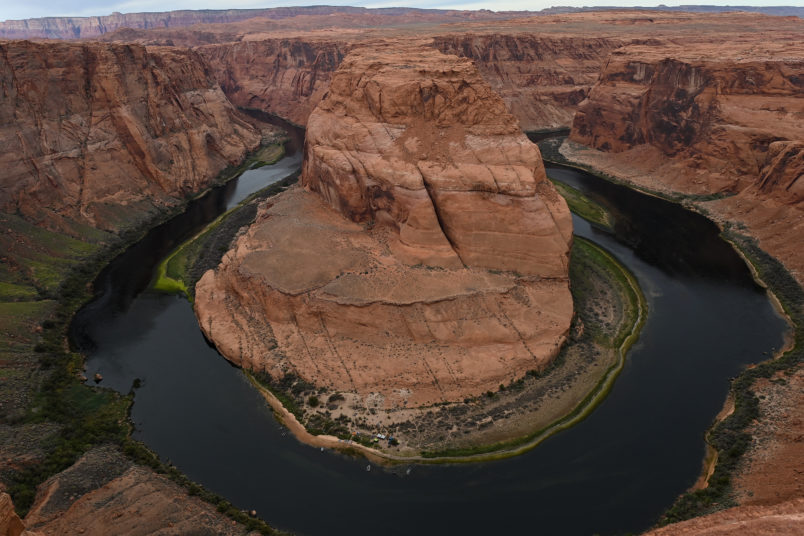
PAGE, AZ – OCTOBER 16: Boats are parked at the bottom of Horseshoe Bend along the Colorado River on October 16, 2022 in Page, Arizona. The water in Lake Powell and the Colorado River has been receding due to recent droughts leaving parts of the lake and river parched. The federal government are moving forward with plans to reduce water allocations from the Colorado River Basin to Arizona and is asking millions of residents to reduce their water consumption as the drought get worse. (Photo by Joshua Lott/The Washington Post via Getty Images)
All of this matters now not just because the river, an unwieldy network of human-controlled plumbing, is approaching a threshold where it could become inoperable, but because much of the recent legal basis for the system is about to dissolve. In 2026, the Interim Guidelines the states rely on, a Drought Contingency Plan and agreements with Mexico will all expire. At the very least, this will require new agreements. It also demands a new way of thinking that matches the reality of the heating climate and the scale of human need. But before that can happen, the states will need to restore something that has become even more scarce than the water: trust.
The northern states see California and Arizona reveling in profligate use, made possible by the anachronistic rules of the compact that effectively promise them water when others have none. It’s enabled by the mechanistic controls at the Hoover Dam, which releases the same steady flow no matter how little snow falls across the Rocky Mountains. California flood-irrigates alfalfa crops destined for cattle markets in the Middle East, while Arizona takes water it does not need and pumps it underground to build up its own reserves. In 2018, an Arizona water agency admitted it was gaming the timing of its orders to avoid rations from the river (though it characterized the moves as smart use of the rules). In 2021, in a sign of the growing wariness, at least one Colorado water official alleged California was repeating the scheme. California water officials say this is a misunderstanding. Yet to this day, because California holds the most senior legal rights on the river, the state has avoided having a single gallon of reductions imposed on it.
By this spring, Lake Powell shrank to 24% of its capacity, its lowest levels since the reservoir filled in the 1960s. Cathedral-like sandstone canyons were resurrected, and sunlight reached the silt-clogged floors for the first time in generations. The Glen Canyon Dam itself towered more than 150 feet above the waterline. The water was just a few dozen feet above the last intake pipe that feeds the hydropower generators. If it dropped much lower, the system would no longer be able to produce the power it distributes across six states. After that, it would approach the point where no water at all could flow into the Grand Canyon and further downstream. All the savings that the Upper Basin states had banked there were as good as gone.
In Western Colorado, meanwhile, people have been suffering. South of the Uncompahgre Valley, the Ute Mountain Ute tribe subsists off agriculture, but over the past 12 months it has seen its water deliveries cut by 90%; the tribe laid off half of its farmworkers. McPhee Reservoir, near the town of Cortez, has teetered on failure, and other communities in Southwestern Colorado that also depend on it have been rationed to 10% of their normal water.
Across the Upper Basin, the small reservoirs that provide the region’s only buffer against bad years are also emptying out. Flaming Gorge, on the Wyoming-Utah border, is the largest, and it is 68% full. The second largest, Navajo Reservoir in New Mexico, is at 50% of its capacity. Blue Mesa Reservoir, on the Gunnison, is just 34% full. Each represents savings accounts that have been slowly pilfered to supplement Lake Powell as it declines, preserving the federal government’s ability to generate power there and obscuring the scope of the losses. Last summer, facing the latest emergency at the Glen Canyon Dam, the Department of Interior ordered huge releases from Flaming Gorge, Blue Mesa and other Upper Basin reservoirs. At Blue Mesa, the water levels dropped 8 feet in a matter of days, and boaters there were given a little more than a week to get their equipment off the water. Soon after, the reservoir’s marinas, which are vital to that part of Colorado’s summer economy, closed. They did not reopen in 2022.
As the Blue Mesa Reservoir was being emptied last fall, Steve Pope kept the Gunnison Tunnel open at its full capacity, diverting as much water as he possibly could. He says this was legal, well within his water rights and normal practice, and the state’s chief engineer agrees. Pope’s water is accounted for out of another reservoir higher in the system. But in the twin takings, it’s hard not to see the bare-knuckled competition between urgent needs. Over the past few years, as water has become scarcer and conservation more important, Uncompahgre Valley water diversions from the Gunnison River have remained steady and at times even increased. The growing season has gotten longer and the alternative sources, including the Uncompahgre River, less reliable. And Pope leans more than ever on the Gunnison to maintain his 3,500 shareholders’ supply. “Oh, we are taking it,” he told me, “and there’s still just not enough.”
On June 14, Camille Touton, the commissioner of the U.S. Bureau of Reclamation, the Department of Interior division that runs Western water infrastructure, testified before the Senate Committee on Energy and Natural Resources and delivered a stunning ultimatum: Western states had 60 days to figure out how to conserve as much as 4 million acre-feet of “additional” water from the Colorado River or the federal government would, acting unilaterally, do it for them. The West’s system of water rights, which guarantees the greatest amount of water to the settlers who arrived in the West and claimed it first, has been a sacrosanct pillar of law and states’ rights both — and so her statement came as a shock.
Would the department impose restrictions “without regard to river priority?” Mark Kelly,, the Democratic senator from Arizona, asked her.
“Yes,” Touton responded.
For Colorado, this was tantamount to a declaration of war. “The feds have no ability to restrict our state decree and privately owned ditches,” the general manager of the Colorado River District, Andy Mueller, told me. “They can’t go after that.” Mueller watches over much of the state.Pope faces different stakes. His system depends on the tunnel, a federal project, and his water rights are technically leased from the Bureau of Reclamation, too. Touton’s threat raised the possibility that she could shut the Uncompahgre Valley’s water off. Even if it was legal, the demands seemed fundamentally unfair to Pope. “The first steps need to come in the Lower Basin,” he insisted.
Each state retreated to its corners, where they remain. The 60-day deadline came and went, with no commitments toward any specific reductions in water use and no consequences. The Bureau of Reclamation has since set a new deadline: Jan. 31. Touton, who has publicly said little since her testimony to Congress, declined to be interviewed for this story. In October, California finally offered a plan to surrender roughly 9% of the water it used, albeit with expensive conditions. Some Colorado officials dismissed the gesture as a non-starter. Ever since, Colorado has become more defiant, enacting policies that seem aimed at defending the water the state already has — perhaps even its right to use more.
For one, Colorado has long had to contend with the inefficiencies that come with a “use it or lose it” culture. State water law threatens to confiscate water rights that don’t get utilized, so landowners have long maximized the water they put on their fields just to prove up their long-term standing in the system. This same reflexive instinct is now evident among policymakers and water managers across the state, as they seek to establish the baseline for where negotiated cuts might begin. Would cuts be imposed by the federal government based on Pope’s full allocation of water or on the lesser amount with which he’s been forced to make do? Would the proportion be adjusted down in a year with no snow? “We don’t have a starting point,” he told me. And so the higher the use now, the more affordable the conservation later.
Colorado and other Upper Basin states have also long hid behind the complexity of accurately accounting for their water among infinite tributaries and interconnected soils. The state’s ranchers like to say their water is recycled five times over, because water poured over fields in one place invariably seeps underground down to the next. In the Uncompahgre Valley, it can take months for the land at its tail to dry out after ditches that flood the head of the valley are turned off. The measure of what’s been consumed and what has transpired from plants or been absorbed by soils is frustratingly elusive. That, too, leaves the final number open to argument and interpretation.
All the while, the Upper Basin states are all attempting to store more water within their boundaries. Colorado has at least 10 new dams and reservoirs either being built or planned. Across the Upper Basin, an additional 15 projects are being considered, including Utah’s audacious $2.4 billion plan to run a new pipeline from Lake Powell, which would allow it to transport something closer to its full legal right to Colorado River water to its growing southern cities. Some of these projects are aimed at securing existing water and making its timing more predictable. But they are also part of the Upper Colorado River Commission’s vision to expand the Upper Basin states’ Colorado River usage to 5.4 million acre-feet a year by 2060.
It is fair to say few people in the state are trying hard to send more of their water downstream. In our conversation, Mueller would not offer any specific conservation savings Colorado might make. The state’s chief engineer and director of its Division of Water Resources, Kevin Rein, who oversees water rights, made a similar sentiment clear to the Colorado River District board last July. “There’s nothing telling me that I should encourage people to conserve,” Rein said. “It’s a public resource. It’s a property right. It’s part of our economy.”
In November, Democratic Gov. Jared Polis proposed the creation of a new state task force that would help him capture every drop of water it can before it crosses the state line. It would direct money and staff to make Colorado’s water governance more sophisticated, defensive and influential.
I called Polis’ chief water confidante, Rebecca Mitchell, who is also the director of the Colorado Water Conservation Board and the state’s representative on the Upper Colorado River Commission. If the mood was set by the idea that California was taking too much from the river, Mitchell thought that it had shifted now to a more personal grievance — they are taking from us.
Last month, Mitchell flew to California for a tour of its large irrigation districts. She stood beside a wide canal brimming with more water than ever flows through the Uncompahgre River, and the executive of the farming company beside her explained that he uses whatever he wants because he holds the highest priority rights to the water. She thought about the Ute Mountain Ute communities and the ranchers of Cortez: “It was like: ‘Wouldn’t we love to be able to count on something? Wouldn’t we love to be feel so entitled that no matter what, we get what we get?’” she told me.
What if Touton followed through, curtailing Colorado’s water? I asked. Mitchell’s voice steadied, and then she essentially leveled a threat. “We would be very responsive. I’m not saying that in a positive way,” she said. “I think everybody that’s about to go through pain wants others to feel pain also.”
Here’s the terrible truth: There is no such thing as a return to normal on the Colorado River, or to anything that resembles the volumes of water its users are accustomed to taking from it. With each degree Celsius of warming to come, modelers estimate that the river’s flow will decrease further, by an additional 9%. At current rates of global warming, the basin is likely to sustain at least an additional 18% drop in its water supplies over the next several decades, if not far more. Pain, as Mitchell puts it, is inevitable.
The thing about 4 million acre-feet of cuts is that it’s merely the amount already gone, an adjustment that should have been made 20 years ago. Colorado’s argument makes sense on paper and perhaps through the lens of fairness. But the motivation behind the decades of delay was to protect against the very argument that is unfolding now — that the reductions should be split equally, and that they may one day be imposed against the Upper Basin’s will. It was to preserve the northern states’ inalienable birthright to growth, the promise made to them 100 years ago. At some point, though, circumstances change, and a century-old promise, unfulfilled, might no longer be worth much at all. Meanwhile, the politics of holding out are colliding with climate change in a terrifying crash, because while the parties fight, the supply continues to dwindle.
Recently, Brad Udall, a leading and longtime analyst of the Colorado River and now a senior water and climate scientist at Colorado State University, teamed with colleagues to game out what they thought it would take to bring the river and the twin reservoirs of Mead and Powell into balance. Their findings, published in July in the journal Science, show that stability could be within reach but will require sacrifice.
If the Upper Basin states limited their claim to 4 million acre-feet, or 53% of their due under the original compact, and the Lower Basin states and Mexico increased their maximum emergency cuts by an additional 45%, the two big reservoirs will stay at roughly their current levels for the next several decades. If the basins could commit to massive reductions below even 2021 levels for the Upper Basin and to more than doubling the most ambitious conservation goals for the south, the reservoirs could once again begin to grow, providing the emergency buffer and the promise of economic stability for 40 million Americans that was originally intended. Still, by 2060, they would only be approximately 45% full.
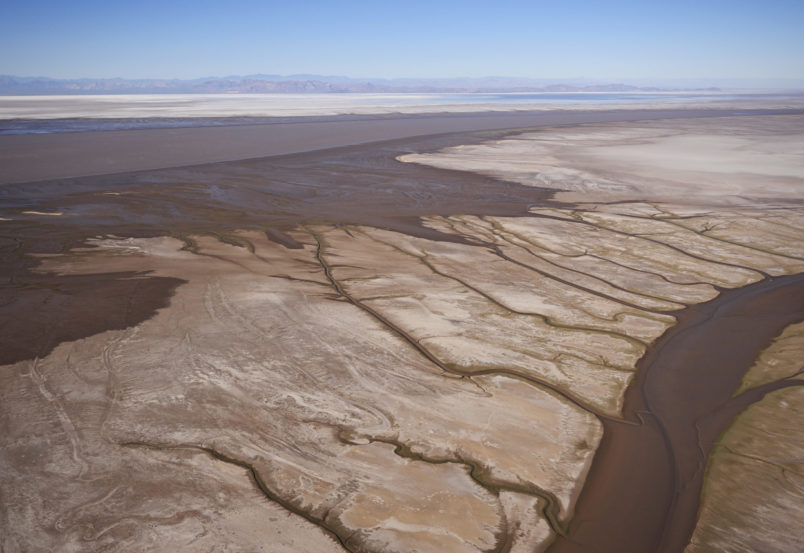
COLORADO RIVER DELTA, BAJA CALIFORNIA – OCTOBER 24: Drought, overconsumption, and climate change, are main factors dissipating the amount of Colorado River water that will reach the Sea of Cortez on its journey through the Colorado River Delta on October 24, 2022 in Baja California, Mexico. The flight for aerial photography was provided by LightHawk. (Photo by RJ Sangosti/MediaNews Group/The Denver Post via Getty Images)
Any of the scenarios involve cuts that would slice to the bone. Plus, there’s still the enormous challenge of how to incorporate Native tribes, which also hold huge water rights but continue to be largely left out of negotiations. What to do next? Israel provides one compelling example. After decades of fighting over the meager trickles of the Jordan River and the oversubscription of a pipeline from the Sea of Galilee, Israel went back to the drawing board on its irrigated crops. It made drip irrigation standard, built desalination plants to supply water for its industry and cities, and reused that water again and again; today, 86% of the country’s municipal wastewater is recycled, and Israel and its farmers have an adequate supply. That would cost a lot across the scale and reach of a region like the Western United States. But to save the infrastructure and culture that produces 80% of this country’s winter vegetables and is a hub of the nation’s food system for 333 million people? It might be worth it.
A different course was charted by Australia, which recoiled against a devastating millennium drought that ended 13 years ago. It jettisoned its coveted system of water rights, breaking free of history and prior appropriation similar to the system of first-come-first-served the American West relies on. That left it with a large pool of free water and political room to invent a new method of allocating it that better matched the needs in a modern, more populous and more urban Australia and better matched the reality of the environment.
In America, too, prior appropriation, as legally and culturally revered as it is, may have become more cumbersome and obstructive than it needs to be. Western water rights, according to Newsha Ajami, a leading expert at Lawrence Berkeley National Laboratory and the former director of the urban water policy program at Stanford University, were set up by people measuring with sticks and buckets, long before anyone had ever even considered climate change. Today, they largely serve powerful legacy interests and, because they must be used to be maintained, tend to dissuade conservation. “It’s kind of very archaic,” she said. “The water rights system would be the first thing I would just dismantle or revisit in a very different way.”
This is probably not going to happen, Ajami said. “It could be seen as political suicide.” But that doesn’t make it the wrong solution. In fact, what’s best for the Colorado, for the Western United States, for the whole country might be a combination of what Israel and Australia mapped out. Deploy the full extent of the technology that is available to eliminate waste and maximize efficiency. Prioritize which crops and uses are “beneficial” in a way that attaches the true value of the resource to the societal benefit produced from using it. Grow California and Arizona’s crops in the wintertime but not in the summer heat. And rewrite the system of water allocation as equitably as possible so that it ensures the modern population of the West has the resources it needs while the nation’s growers produce what they can.
What would that look like in Colorado? It might turn the system upside down. Lawsuits could fly. The biggest, wealthiest ranches with the oldest water rights stand to lose a lot. The Lower and Upper Basin states, though, could all divide the water in the river proportionately, each taking a percentage of what flowed. The users would, if not benefit, at least equally and predictably share the misery. Pope’s irrigation district and the smallholder farmers who depend on it would likely get something closer to what they need and, combined with new irrigation equipment subsidized by the government, could produce what they want. It wouldn’t be pretty. But something there would survive.
The alternative is worse. The water goes away or gets bought up or both. The land of Western Colorado dries up, and the economies around it shrivel. Montrose, with little left to offer, boards up its windows, consolidates its schools as people move away, and the few who remain have less. Until one day, there is nothing left at all.
The competition was fierce. Voter comments got messy. Some of our winners only eked out a victory by a few percentage points. But after a free and fair election, and more than 12,000 votes cast, we’re ready to announce 2022’s greatest losers.
What better way to round out the year than by toasting the scoundrels who did the worst the best? It’s TPM tradition, after all. Ever since Duke Cunningham — in all of his shameless glory, complete with bribe menu, lava lamp, and yacht party — brought us into a new era of public corruption, reveling in the moments when public figures reveal their true, often corrupt and comically grimy colors is what we do best.
Without further ado, join us in our celebration of this years winners — one of the most cartoonishly dishonorable cast of characters we’ve raised a toast to yet.
This article is part of TPM Cafe, TPM’s home for opinion and news analysis. It was originally published at The Conversation.
The year 2022 was a tough one for the growing number of people living in food insecurity and energy poverty around the world, and the beginning of 2023 is looking bleak.
Trump lawyer Cleta Mitchell had a series of terse exchanges with Jan. 6 committee investigators as she fielded questions about the legal theories that drove the Trump team’s scheme to overturn the 2020 election results, newly released transcripts from the committee illustrate.
Many Jan. 6 committee members jumped into Ginni Thomas’ questioning by their investigators, particularly to probe her belief that the 2020 election was infused with fraud, according to a transcript released Friday.