

The newly Republican-dominated North Carolina Supreme Court will rehear a major redistricting case at the heart of one of the biggest Supreme Court decisions expected this year.
Continue reading “Supreme Court Case May Be Moot As North Carolina Court To Rehear Major Election Suit”Koch Network Has A New Plan For 2024: Any (Republican) Candidate But Trump
Americans for Prosperity — the fundraising network that forms a key part of the conservative billionaire Charles Koch’s political influence operation — is suggesting that it won’t be supporting former President Donald Trump in the 2024 Republican presidential primaries, saying it will throw its weight behind a candidate “who can lead our country forward, and who can win.”
Continue reading “Koch Network Has A New Plan For 2024: Any (Republican) Candidate But Trump”‘Democrats Worry’ Is The New ‘Democrats In Disarray’
A lot of things happened. Here are some of the things. This is TPM’s Morning Memo.
Do Better!
“Democrats in disarray” became such a staple of political journalism for a while that it eventually became a meme and enough of a source of ridicule that reporters began to become self-conscious about trotting out the stale plot device.
But “Democrats worry …” remains unfazed by the ridicule. The angsty, always fretting, pearl-clutching Democrats are a staple of vague political reporting that tries to capture a political dynamic but usually falls short of any real insights.
These Democrats, featured prominently but rarely named, may or may not actually exist, but they form the narrative glue for everything from too-early campaign stories that lack much substance to Hill stories that lack any scoops on legislative wrangling to White House stories where actual access was limited.
This weekend’s gem was from Bloomberg (emphasis mine): “But the prospect of facing upstart Florida Republican Governor Ron DeSantis is prompting whispers of angst within Democratic circles.”
Just this year (it’s early February, yall), Democrats have worried A LOT:
WaPo: Some Democrats are worried about Harris’s political prospects
The Hill: Democrats worry Biden controversy will be Clinton emails repeat
The Hill, again: Democrats worry over potential of retirements in Senate
Politico: Dems fret policing talks will be tangled with Tim Scott’s presidential hopes
If you go farther back, into the fall, the crutch is used with even more hilarious/alarming frequency, peaking around the election.
Enough!
Sorry, I Have No Opinion On The Balloon
If you came here for balloon coverage, I’m sorry to disappoint.
Did Republicans go bonkers over the weekend trying to use it to damage Biden politically? Of course, they did. Was it comical watching them trying to outdo one another in their denunciations? 100%.
That’s all I have for now.
Trump To Pay $450,000 To Settle Campaign NDA Case
The former president wanted to keep secret the size of the financial settlement in a case that sought to invalidate the nondisclosure agreement Trump made his 2016 campaign workers sign. But the judge in the case refused to keep the settlement amount secret: It was $450,000.
Trump Defamation Cases Against WaPo Tossed Out
A federal judge has dismissed the former president’s defamation lawsuit against the Washington Post for a piece on the Mueller probe and for one on his 2020 campaign strategy. The claim against the first piece (by TPM alum Greg Sargent) was dismissed for failure to allege actual malice, the second because the piece was unactionable opinion.
Such A Weird Situation
As Manhattan DA Alvin Bragg seems to be reversing course and reinvigorating his office’s investigations of Donald Trump (for the Stormy Daniels hush money payments, among other things), a prosecutor who resigned over Braggs’ putting the probes on ice is a coming out next week with a new book.
Mark Pomerantz’s “People vs. Donald Trump: An Inside Account” gets a sharp review by former Mueller prosecutor Andrew Weissmann in the WaPo. Weissmann, who himself tends to run hot, seems taken aback by Pomerantz’s own hot-headedness.
Must Read
TPM’s Kate Riga: “The Years Of Vitriolic Misogyny At The Heart Of The Paul Pelosi Attack“
TPM On TV
TPM’s Josh Kovensky joined Chris Hayes to talk about the bizarro secret recording we obtained from inside the congressional office of Rep. George Santos (R-NY):
Deep Dive On Santos’ Purported Pet Charity
NYT: George Santos Raised Money for Dogs. It’s Unclear Where It All Went.
Make A Note Of This
CNN has a new report out this morning on the FBI’s reaction to the arrest of one of its own: Charles McGonigal. But for our purposes, the shock of his former colleagues is less interesting than what CNN reports is the investigators’ emerging sense of his motivation for the alleged crimes:
- “Sources briefed on the matter tell CNN that, at least for now, FBI officials view McGonigal not as a spy, but more as a corrupt former official looking to make a buck on his way out the door.”
- “After conducting assessments of the possible damage done to intelligence information, as well as sources and methods that McGonigal possessed, the FBI came to view him as a case of simple corruption, according to people briefed on the matter.”
- “There is no suggestion in the public indictment, either, that McGonigal committed espionage. Current and former FBI officials familiar with McGonigal and his work say they believe McGonigal – a former accountant – simply got ‘greedy.’”
This puts down a marker for the early coverage. More as it becomes available.
The Week Ahead
Morning Memo is no fan of the State of the Union address. It’s only one day of the year, but it generates a week’s worth of blather. Alas, it is upon us again.
Speaking of blather, the House GOP cranks up its bogus investigation Wurlitzer this week. Because of the way these messaging hearings get covered as if they’re legitimate, they’ll form a steady background noise all week. So even if you’re not a permanently enraged Fox News viewer, they’re going to seep into your news diet.
Tuesday, 10 a.m. ET: A House GOP messaging hearing – “On The Front Lines of the Border Crisis: A Hearing with Chief Patrol Agents” – kicks off in front of the House oversight committee.
Tuesday, 9 p.m. ET: President Biden gives the State of the Union address to a joint session of Congress.
Wednesday, 10 a.m. ET: A top-tier House GOP nonsense hearing – “Twitter’s Role in Suppressing the Biden Laptop Story” – gets underway in front of the House oversight committee.
Thursday, noon ET: Judiciary Chair Jim Jordan’s deeply corrupting “Select Subcommittee on the Weaponization of the Federal Government” holds its first public hearing.
Trump Launches New War Against Transgender Adults
Dave Weigel digs in on Trump’s new attack on transgender adults, which takes things to a level beyond “protecting” kids and women’s sports:
But to both LGBT advocates and social conservatives, Trump’s policy rollout was a watershed moment, one that signaled a hard right turn from debates focused on transitioning youth to a broader attack on the very concept of transgender identity itself.
Seeking Accommodation On Classified Docs
Administration officials are trying to head off a confrontation with Congress while protecting their investigations into the mishandling of classified documents by Presidents Trump and Biden. Look for bids to find a compromise like this one.
Hundreds Dead Across The Region After Turkish Quake
The middle-of-the-night 7.8 magnitude earthquake in southern Turkey was felt across the Middle East, but particularly devastated parts of Turkey and Syria. The latest death toll is more than 1,600 with thousands more injured, trapped, and missing.
A powerful aftershock with a magnitude of 7.5 struck the same area later in the day Monday.
The images from the disaster zone are deeply distressing:
Do you like Morning Memo? Share it with your friends and family … and let us know!
‘I Cannot Put His Name in the Past Tense’
This article first appeared at ProPublica. ProPublica is a Pulitzer Prize-winning investigative newsroom. Sign up for The Big Story newsletter to receive stories like this one in your inbox.
On Wednesday, RowVaughn Wells joined the grim sorority of Black mothers who have buried their children after deadly police encounters and then pleaded for those deaths to spur reform. Parents of other victims were in attendance at the funeral — along with Vice President Kamala Harris and the Rev. Al Sharpton.
Tyre Nichols, 29, was blocks away from Wells’ home when five Memphis, Tennessee, police officers pummeled him after a short foot chase in early January. He died three days later in the hospital, his face a mash of swollen flesh. The officers have been fired and charged with second-degree murder.
The scene, captured on body camera and security video, was similar in many ways to the other encounters that Americans have seen for years — from Rodney King to George Floyd — before taking to the streets in protest. The situation had escalated from a traffic stop. The responding officers shouted conflicting commands that Nichols, an unarmed Black man, tried to obey. They tased and pepper sprayed him repeatedly before laying into him with their fists, feet and a metal baton. Most of this wasn’t mentioned in the initial report.
As he lay on the ground, trying to shield his face from the blows, Nichols called out for his mom. Floyd had begged for his mom too.
“No mother, no mother, no mother, should go through what I’m going through right now,” Wells told reporters during a press conference the day after Nichols died. She said she believed her son was sent from God to marshal police reform. Her attorney called on lawmakers to once again try to pass sweeping police reform laws like the George Floyd Justice in Policing Act, which stalled in the Senate two years ago.
Wells now finds herself addressing the country in a gantlet of interviews and public appearances that could go on for months or even years. In other cases, parents in her position have learned, their time with the microphone can be fleeting.
Mona Hardin, whose son Ronald Greene died after a police chase outside Monroe, Louisiana, in 2019, is a veteran in the ranks of mothers who have calcified themselves and turned to activism, lobbying and media appearances.
For two years, Louisiana State Police leaders told Hardin that her son had died in a car crash. Then, in 2021, The Associated Press published videos showing troopers beating and dragging Greene across the ground. “I’m sorry,” he pleaded, blood splashed on his skin and clothes. “I beat the ever-living fuck out of him,” one officer said. Greene stopped breathing soon after.
I first met Hardin, a diminutive woman with a nonetheless commanding presence, while reporting on whistleblower retaliation in Louisiana law enforcement. Hardin was marching alongside another mother, whose son had also died in police custody, during a protest in downtown Baton Rouge. Hardin refers to their families as casualties in a “national genocide.”
On Tuesday, Hardin and I spoke on the phone about what’s happened since then, the ethics of watching police brutality videos and why some cases garner breathless media coverage while others — including Greene’s — seem to fade from the public eye. Our conversation has been edited for length and clarity.
Tell me about the meetings you’ve been having after you heard about the Nichols case. Who are you talking to?
These are the other families, and their kids were also killed by police. We call and check on each other. These meetings are for all the families to get together and we talk about individual cases. It’s basically how we help each other heal. There are a lot of families still looking for help. They have yet to have anyone looking at their situations. People are pissed and everyone’s trying to keep it under control.
We let each other know there’s no right or wrong way to grieve. Each family has been thrown into this. We give each other suggestions for emotional healing, where to go to — programs that help. We help them dig for help, wherever they’re at.
This sounds like a full-time job. Do you think you have a responsibility to be in these conversations?
It’s a must. I went back and forth with my own therapist. A lot of times you come out of these situations shallow on the other end. With the families, we all know: There’s no describing the pain. We can finish each other’s sentences. The connection is there because of the grief that we share identically, the sorrow, the heartaches, the sleepless nights. Our families, what our families go through. It’s not just the mothers and fathers. It’s the sisters and brothers too.
Did you watch the videos from Memphis?
Yes I did. I had to stop at one point. But out of respect for him — and for what they did to him — I had to go back and see it and finish it. I’m still struggling with a lot of others.
It’s just like with Ronnie: The lawyers told us we don’t have to see the video. While we were there, down the hallway, we could hear Ronnie’s screams on the tape. We were just in the other room. After more than an hour, a lawyer came in and said, “Do you want to?” I told my daughter that we have to. And I’m glad I did.
Why are you glad you did?
I had to see him take his final breaths. I was literally in a trance, when I think of it. My eyes get wide. I’m staring at the walls right now just to focus. It was horrific. He didn’t stand a chance. He did not stand a chance.
On the video in Memphis, one of the officers can be heard saying something like, “He was going for your gun.” That kind of thing seems common. The initial press release was also very similar to the one after George Floyd was killed. [At the funeral, Nichols’ stepfather called it “lies, deceit, trying to cover it up.”]
That stands out. They’re all repetitive. When you look at all the cases, you just skim over the press releases and police statements because you already know what you’re going to read. Instantly you know if this is a cover-up. They’re trying to justify what they have done and what they’re about to do.
I can say for Ronnie it would have just stayed that way. [Louisiana State Police initially said he had died in a car crash.] If it wasn’t for the videos and the whistleblowers, my God, I would have gone to my grave grief-stricken thinking that Ronnie crashed into a tree and died. That’s what I would have thought if they were successful.
Nichols’ family has invoked Emmett Till, a case that became infamous because of the open casket picture. What do you think of the idea that there is a responsibility — The New York Times called it a civic duty — to watch these videos?
It’s suggested that those who are emotionally drained should not burden themselves more. Do what your body tells you. We have families that have to heal.
But for me, oh hell yeah. The outside public needs to see this; what’s happening with state-condoned killings; how people vote; how they see the officers; how everything unfolds. Without the videos, testimony from whistleblowers, it will stay buried.
When we first met, you chose your words carefully. Now, I’ve noticed, a little less so. Is there a person that you feel like you’re supposed to be? How do you navigate that role as it’s changing?
They told us we had checks and balances with the law firms that represent us. But with all this public relations, my question is, where’s Ronnie’s case? I saw slowly that the PR was not really for him — the one who was beat up and killed. I think the corruption is all over with a lot of other entities I never saw coming.
What do you mean by that?
They keep saying, “We’re right here.” Then another year passes. Then it’s, “Now’s not the time.” Another year passes. “Now’s not the time.” And another year passes. All I can tell you is that the anger and the anxiety when you last saw me, I’m 1,000 times beyond that now.
Yesterday I had a call with Troy Carter [Democratic congressman from Louisiana] and he invited me to the White House to meet with Biden.
What do you think about that invitation?
It’s another photo-op. But you have to take every opportunity that comes up. Biden called Tyre’s family and invited them. I’m not impressed with anybody until changes are made. I’m not impressed by the suits you wear or positions you hold. I’m pretty beat up and sickened by it. Everybody has a job but nobody takes their job seriously. Other than the reporters and whistleblowers and families and activists. Those are the only minds of determination I see. The resistance is from all those above.
Have you grown kind of cynical? I was with you in Washington when you met with the congressional committee right after the original Floyd bill failed. What’s happened since then?
I wouldn’t use the word cynical. I have to grab every grain I can. At the indictments, they were acting like it was a big deal. [In December, a grand jury indicted five officers involved in Greene’s death, with charges ranging from negligent homicide to malfeasance in office and obstruction of justice.] This shouldn’t be a big deal. This should have been done a while ago. I was so pissed I couldn’t even talk when the indictments came. It’s a murder and you end up with these piss-poor charges.
We still can’t trust no one. We’re not represented. Nobody is taking the death of my son seriously. This May will be four years since his death. And to still not know what will happen. The FBI investigations? Will they bring out all these top brass that were allowed to retire or promoted?
You mentioned that you watched RowVaughn Wells speak at the press conference the other day. What did you make of her statements?
When you see that mom up there, that’s us. Over and damn over again. She’s repeating what all of us have said. It’s so hurtful and heartbreaking. It’s another family that’s been added to the list. I’m glad that it got national attention — I am so glad — like they all should have been.
One thing she said that I identified with was: The only way I can move forward is knowing that God taking Tyre might make a difference in the world. That’s how she has to accept it. I feel that because the only way I can get past my anger was to know that God has Ronnie. God had to take you for a reason and maybe changes will happen behind this.
I had to put myself there, in that way of thinking, in order not to focus on the fact that my family has become a statistic. I can’t even think of my son as my son. Mentally I’ll shut down. It’s the same reason I cannot put his name in the past tense.
There is a sense of numbness in the communities to where this is what’s expected. It’s sickening that it takes another killing of a young black man to push the hands of fairness across the board and say OK this needs to stop. This mass genocide in communites of color. It takes another killing. How many more before we actually move the needle and make those changes?
Are you worried about becoming desensitized by going through the motions so often with these other families?
I don’t think desensitized is the word. In order to be focused, the numbness sets in. As me and the kids talk, we say, “Damn, I can’t believe we got through this.” We have to literally lean on each other. When one shuts down the other picks up. Desensitized might be a good word actually. But we always resurface.
I have to say, where are the officials at the White House? They’re the ones desensitized. Why doesn’t this bear enough meaning to make legislative changes. How can you uphold any part of the Constitution when this is going on? How can you address what’s wrong in other countries when this is happening here?
We’re waiting for change but change doesn’t come. I pray that Tyre Nichols will be the last and change comes from that.
Do you believe that it will?
I have to. I was hoping that the minute Ronnie hit the news. But it dropped to silence. Every time it was on the news and then not, my heart sank. There was no assistance. Absolutely nothing. And you know what, we still have absolutely nothing. We have a legal team but we are still left alone. We have absolutely nothing. No guidance. No reassurance. I hate that.
I’m just happy the Nichols family does. This is how it should happen; how she’s been received; how it went public immediately. Nothing should be under secrecy. If only we could have had that recognition.
So you see how the Memphis case was handed as a step forward for transparency?
Oh my gosh, yes. When people gather and stage protests, if that’s what you have to do, then do it, damn it. I agree with Tyre’s mom, though. We don’t want craziness. That’s not how we do things. Hell yeah we’re mad. We’re mad as hell.
When you meet Tyre’s mother in Washington, have you thought about what you might say to her?
I’m glad you brought that up. In the past, when we met each other, we just hug and hold and sort of just melt into each other. That’s how it was when I met with Katrina Mateen. [Mateen’s 15-year-old son was shot and killed by police in Gulfport, Mississippi, last October.] There are no words other than “I love you. I’m so sorry.”
How can you take it past that when it’s so indescribable, the pain? We identify. There’s a lot of hurt in that young mother to where you have to be careful. You have to be very, very gentle with that. I know I’ll hug her. I know I have to. That’s what we all do.
A Theory Emerges
The Post has an article up that provides a bit more detail on earlier Chinese balloon incursions. The gist seems to be that they’ve skirted U.S. territory a number of times and crossed into U.S. airspace but not as extensively as what happened in this case. The “briefly” in that earlier reference was the key. In a nice bit of additional detail, Florida and Texas were earlier targets.
Continue reading “A Theory Emerges”A Bit Deeper on the Great Balloon of Doom
David Ignatius is a consistently good and informative read. This column is not really an exception. But it’s notable that Ignatius feels the need to kick off with a classic “to be sure” sentence — “an embarrassment for the Biden administration, to be sure” — before going on to explain that shooting the balloon down over the ocean was the most logical course of action and that it will likely yield more intelligence for the United States than for China.
What an embarrassment!
But with so much attention to it I thought it made sense to put together what we actually know and where the story is at.
Continue reading “A Bit Deeper on the Great Balloon of Doom”Of Men and Balloons
We officially have an absurd debate over Chinese surveillance balloon toughness. Yes, this is now a thing. A slew of Republicans today lashed out at President Biden for not shooting down the balloon just as the Pentagon carried out his orders to do so. The balloon was shot down by an F-22 firing a sidewinder missile just off the coast of South Carolina.
This was followed by new claims that President Trump never would have allowed a Chinese balloon into U.S. airspace at all. Rep. Joe Wilson, a notorious goober who represents a district in South Carolina, declared: “The catastrophic Chinese Spy Balloon spectacle clearly threatened American families from Alaska to my home community in South Carolina and confirms President Biden and Vice President Harris should resign.”
But according to a Pentagon press release out this afternoon, Chinese surveillance balloons entered U.S. airspace at least three times during Trump’s presidency. He not only didn’t shoot them down, he also, it would seem, kept it a secret.
Watch: Josh Kovensky Discusses Santos’ Staffing Chaos With Chris Hayes
This week, we obtained leaked audio that gave us a peek at the chaotic way decisions are made inside fabulist Rep. George Santos’ office, and published an in-depth profile of his attention-grabbing chief of operations, Vish Burra. TPM’s Josh Kovensky discusses both pieces on All In with Chris Hayes.
Watch below.
Continue reading “Watch: Josh Kovensky Discusses Santos’ Staffing Chaos With Chris Hayes”How A Tourist Attraction Displaying The Open Graves Of Native Americans Became A State-Run Museum
This article was originally published at ProPublica, a Pulitzer Prize-winning investigative newsroom.
When William Dickson moved to Fulton County, Illinois, from Kentucky in 1833, he purchased a beautiful piece of land overlooking the confluence of the Spoon and Illinois rivers. The federal Indian Removal Act of 1830 had exiled most Native American tribes from the state under the threat of genocide, and Illinois would soon have no tribally held land.
The people of Fulton County, as described an 1879 history of the area, were proud of what they saw as accomplishments of the “Anglo Saxon” race:
“They transformed the wigwams into cities; dotted the knolls with school-houses and churches; replaced the buffalo, deer, elk, and wolf, which had been driven further westward, with domestic animals; erected factories, built railroads, and reared a refined, enlightened and cultured people.”
Still buried throughout much of Fulton County, according to archaeologists’ estimates, were at least 3,000 grave mounds and remnants of villages that belonged to Indigenous people and their ancestors.
So when Dickson prepared his property to plant an orchard in the 1860s, he inadvertently unearthed human remains. His grandson, Thomas, later unearthed more human remains and objects while building his house nearby. Years later, in 1927, Thomas’ son, Don, turned the burial mounds into a public spectacle — and his livelihood.
“I grew up with this knowledge,” Don F. Dickson told an audience of Illinois State Academy of Science members in May 1947. “The burials were in my backyard. I liked those people.”
Dickson, a chiropractor, and his family excavated at least 234 burials and opened the site to the public. While most amateurs, archaeologists and anthropologists of the time fully disinterred and disarticulated human remains during excavations, Dickson chose to leave the burials as he found them in the ground. The novelty of seeing the dead in situ helped make the site a popular Illinois tourist attraction billed as Dickson’s Mound Builders Tomb, or what’s known today as Dickson Mounds Museum.
Inside a canvas tent lay the remains of what Dickson and newspaper reporters believed was an extinct race of people. A 1927 article from one local paper promoted the exhibit under the headline “Excavations in Illinois Reveal Race That Lived and Died Before Indians.” Dickson benefited from the promotion; tens of thousands of people visited the private museum in the late 1920s. By charging 50 cents for admission, the Dickson family made their living.
What visitors learned from the “museum” was the story that the Dicksons wanted to tell. In the remains of two adults placed side by side, their faces turned to face a baby that lay between them, Don Dickson saw a primitive, but loving, family. He speculated about relationships, social hierarchies and the purposes of various possessions. He and his family members served as the tour guides and public interpreters of the site. He rearranged objects to make the burials more dramatic; he removed the mandibles of some people to display them alongside the mandibles of various animals. Many bones and belongings were broken; some were stolen.
The state of Illinois purchased the site from Dickson in 1945 and then hired the Dicksons to run it; Don Dickson continued to interpret the site for the public until his death in 1964.
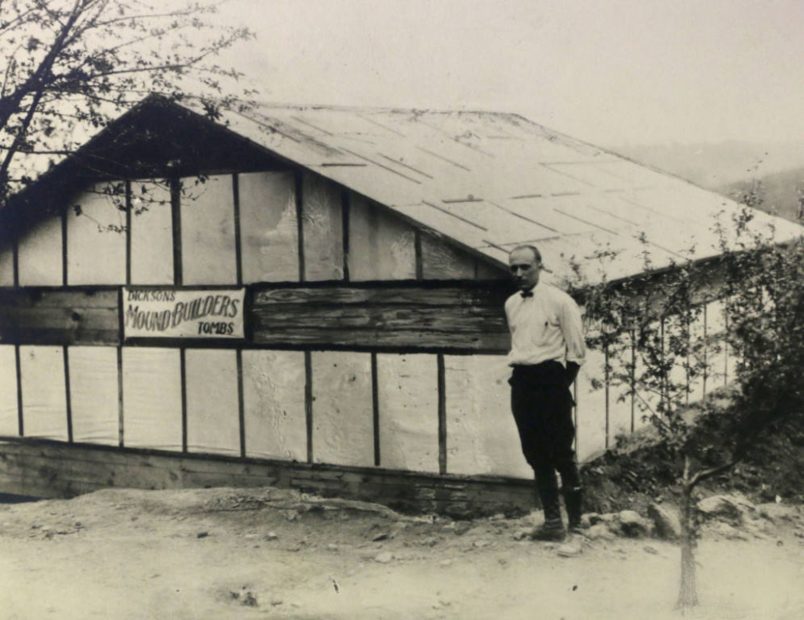
A few years later, the state built a large, new museum and adopted Dickson’s open-air exhibit as a permanent wing of the facility. Over the years, the burial exhibit saw various interpretations by museum staff, including the addition of audio and multicolored spotlights. Viewmaster reels and postcards were sold in the gift shop.
I learned of the exhibit when I started investigating why the state museum held so many human remains, and I quickly realized that memories of it are not uncommon among a generation of Illinoisans slightly older than I am. An archivist assisting me with research in the Illinois State Archives told me that he was among many Illinois students in the 1970s who had visited the museum on field trips, and he remembered it, simply, as “spooky.”
In 1990, a long movement for Native American rights led to the passage of the Native American Graves Protection and Repatriation Act, a federal law intended to enable tribal nations to reclaim their ancestors, funerary objects and sacred items from institutions.
Staff at the Dickson Mounds Museum and its parent institution, the Illinois State Museum, had been monitoring the bill and others like it for years and had anticipated changes in public sentiment around the display of open graves.
To try to head off controversy, museum leaders decided to close the burial exhibit. Illinois Gov. James R. Thompson had agreed with the museum’s decision. But when news of the exhibit’s planned closure broke, the public outcry and political pressure that ensued forced Thompson to reconsider his decision. At the heart of his dilemma was the question of whether the exhibit was educational or entertainment, and whether the offense it caused to Native Americans outweighed the potential benefits of public education and tourism. Ultimately, Thompson reversed course.
“This never has been treated as a carnival sideshow,” Thompson said. “It is an educational exhibit that respects the lives of people who made a civilization here hundreds of years ago. It will remain so.”
Among Thompson’s most vocal opponents was Michael Haney, an activist of Seminole and Sioux heritage. Haney had helped gather crowds of protestors at the museum and had responded to the governor’s decision to keep the exhibit open by calling it racist. But in addition to making many pointed public comments, which included referring to Fulton County residents as “country bumpkins,” he expressed the deep hurt caused by the Dicksons and those who supported keeping the exhibit open in a way that continues to resonate:
“If you want to know about Indians, ask living Indians,” Haney said at a public hearing in 1990. “Don’t desecrate our graves.”
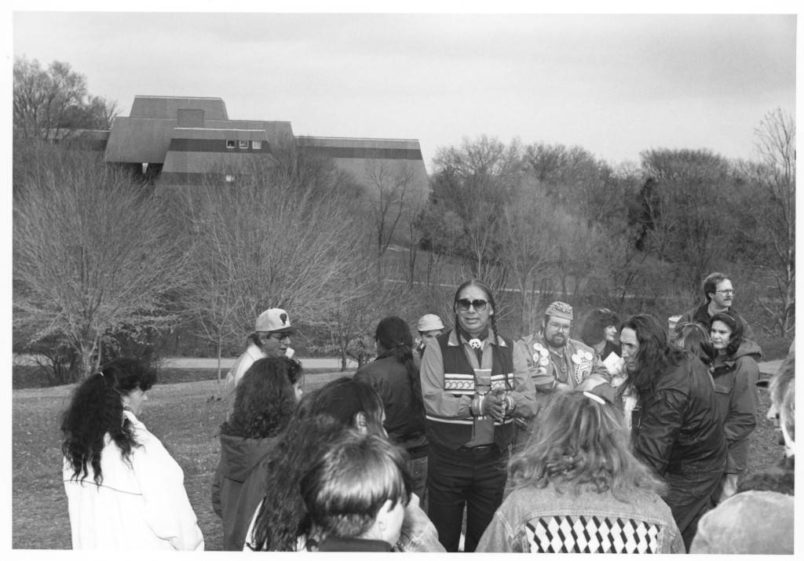
For perhaps the first time, some local residents and others paying attention to the issue were forced to confront the notion that, by advocating to keep the exhibit open, they were complicit in the erasure of Indigenous people from the story the museum was telling about them.
The controversy lasted for more than two years.
The exhibit eventually closed in 1992. Contractors installed cedar flooring over the open graves to shield them from public view. Museum officials today say that no one has seen the graves in 30 years.
At ProPublica, my colleagues and I have spent the last 18 months trying to understand why so many of the nation’s top museums and universities still have thousands of human remains in their collections even though the law to push for repatriation passed more than 30 years ago. The Illinois State Museum and Dickson Mounds Museum, for example, together hold the remains of more than 7,000 Native Americans.
But a new generation of museum leadership sees an opportunity to rewrite the story the Dicksons wanted visitors to learn, and returning remains to tribal nations is part of that. Dickson Mounds Museum is now led by a citizen of the Peoria Tribe of Indians of Oklahoma, whose members are descendents of more than a dozen tribes that were forcibly removed from the state in the 1700s and 1800s.
“My ancestors put me here,” said Logan Pappenfort, interim director of Dickson Mounds Museum. “They came from Illinois, and it’s my responsibility to do everything I can to get them where they’re supposed to be again.”
The Years Of Vitriolic Misogyny At The Heart Of The Paul Pelosi Attack
The video of the brutal attack on Paul Pelosi released last week brought a story back into the headlines that, somehow, had faded just days after David DePape broke into the home of the third most powerful person in the country, intending to hurt or kill her.
Continue reading “The Years Of Vitriolic Misogyny At The Heart Of The Paul Pelosi Attack”