War In Ukraine Becomes Latest Chapter In The Rise Of The Killer Robots

This article is part of TPM Cafe, TPM’s home for opinion and news analysis. It was originally published at The Conversation.

The U.S. military is intensifying its commitment to the development and use of autonomous weapons, as confirmed by an update to a Department of Defense directive. The update, released Jan. 25, 2023, is the first in a decade to focus on artificial intelligence autonomous weapons. It follows a related implementation plan released by NATO on Oct. 13, 2022, that is aimed at preserving the alliance’s “technological edge” in what are sometimes called “killer robots.”

Both announcements reflect a crucial lesson militaries around the world have learned from recent combat operations in Ukraine and Nagorno-Karabakh: Weaponized artificial intelligence is the future of warfare.

“We know that commanders are seeing a military value in loitering munitions in Ukraine,” Richard Moyes, director of Article 36, a humanitarian organization focused on reducing harm from weapons, told me in an interview. These weapons, which are a cross between a bomb and a drone, can hover for extended periods while waiting for a target. For now, such semi-autonomous missiles are generally being operated with significant human control over key decisions, he said.

Pressure of war

But as casualties mount in Ukraine, so does the pressure to achieve decisive battlefield advantages with fully autonomous weapons – robots that can choose, hunt down and attack their targets all on their own, without needing any human supervision.

This month, a key Russian manufacturer announced plans to develop a new combat version of its Marker reconnaissance robot, an uncrewed ground vehicle, to augment existing forces in Ukraine. Fully autonomous drones are already being used to defend Ukrainian energy facilities from other drones. Wahid Nawabi, CEO of the U.S. defense contractor that manufactures the semi-autonomous Switchblade drone, said the technology is already within reach to convert these weapons to become fully autonomous.

Mykhailo Fedorov, Ukraine’s digital transformation minister, has argued that fully autonomous weapons are the war’s “logical and inevitable next step” and recently said that soldiers might see them on the battlefield in the next six months.

Proponents of fully autonomous weapons systems argue that the technology will keep soldiers out of harm’s way by keeping them off the battlefield. They will also allow for military decisions to be made at superhuman speed, allowing for radically improved defensive capabilities.

Currently, semi-autonomous weapons, like loitering munitions that track and detonate themselves on targets, require a “human in the loop.” They can recommend actions but require their operators to initiate them.

By contrast, fully autonomous drones, like the so-called “drone hunters” now deployed in Ukraine, can track and disable incoming unmanned aerial vehicles day and night, with no need for operator intervention and faster than human-controlled weapons systems.

Calling for a timeout

Critics like The Campaign to Stop Killer Robots have been advocating for more than a decade to ban research and development of autonomous weapons systems. They point to a future where autonomous weapons systems are designed specifically to target humans, not just vehicles, infrastructure and other weapons. They argue that wartime decisions over life and death must remain in human hands. Turning them over to an algorithm amounts to the ultimate form of digital dehumanization.

Together with Human Rights Watch, The Campaign to Stop Killer Robots argues that autonomous weapons systems lack the human judgment necessary to distinguish between civilians and legitimate military targets. They also lower the threshold to war by reducing the perceived risks, and they erode meaningful human control over what happens on the battlefield.

a soldier crouches on the ground peering into a black box as to small projectiles with wings are launched from tubes on either side of him
This composite image shows a ‘Switchblade’ loitering munition drone launching from a tube and extending its folded wings. U.S. Army AMRDEC Public Affairs

The organizations argue that the militaries investing most heavily in autonomous weapons systems, including the U.S., Russia, China, South Korea and the European Union, are launching the world into a costly and destabilizing new arms race. One consequence could be this dangerous new technology falling into the hands of terrorists and others outside of government control.

The updated Department of Defense directive tries to address some of the key concerns. It declares that the U.S. will use autonomous weapons systems with “appropriate levels of human judgment over the use of force.” Human Rights Watch issued a statement saying that the new directive fails to make clear what the phrase “appropriate level” means and doesn’t establish guidelines for who should determine it.

But as Gregory Allen, an expert from the national defense and international relations think tank Center for Strategic and International Studies, argues, this language establishes a lower threshold than the “meaningful human control” demanded by critics. The Defense Department’s wording, he points out, allows for the possibility that in certain cases, such as with surveillance aircraft, the level of human control considered appropriate “may be little to none.”

The updated directive also includes language promising ethical use of autonomous weapons systems, specifically by establishing a system of oversight for developing and employing the technology, and by insisting that the weapons will be used in accordance with existing international laws of war. But Article 36’s Moyes noted that international law currently does not provide an adequate framework for understanding, much less regulating, the concept of weapon autonomy.

The current legal framework does not make it clear, for instance, that commanders are responsible for understanding what will trigger the systems that they use, or that they must limit the area and time over which those systems will operate. “The danger is that there is not a bright line between where we are now and where we have accepted the unacceptable,” said Moyes.

Impossible balance?

The Pentagon’s update demonstrates a simultaneous commitment to deploying autonomous weapons systems and to complying with international humanitarian law. How the U.S. will balance these commitments, and if such a balance is even possible, remains to be seen.

The International Committee of the Red Cross, the custodian of international humanitarian law, insists that the legal obligations of commanders and operators “cannot be transferred to a machine, algorithm or weapon system.” Right now, human beings are held responsible for protecting civilians and limiting combat damage by making sure the use of force is proportional to military objectives.

If and when artificially intelligent weapons are deployed on the battlefield, who should be held responsible when needless civilian deaths occur? There isn’t a clear answer to that very important question.

This article is republished from The Conversation under a Creative Commons license. Read the original article.


The Conversation

The New, New Right Wing Thing: Maybe the Ukraine War is Fake?

Since I spend time, for better or worse, swimming in the swill of right wing influencers and Trumpists, I’m often able to see things before they go fully mainstream — or rather before their existence gets picked up in mainstream media. Just over the last few days there’s been a burst of claims that something is not quite right about the Ukaine War, that the whole thing might be made up. Perhaps it’s a potemkin war. Maybe the Ukrainians are just crisis actors, as we sometimes hear claimed about the victims of mass shootings in the United States. The “questions” are characteristically vague and open-ended, designed to sow doubt without stipulating to any clearly disprovable claim.

The particular claim or question is, where are the pictures? Why isn’t there more war reporting as we’ve seen with every other war. How is it world leader after world leader is able to visit Kyiv in relative safety?

Continue reading “The New, New Right Wing Thing: Maybe the Ukraine War is Fake?”

In Rural America, Right-To-Repair Laws Are The Leading Edge Of Pushback Against Growing Corporate Power

This article is part of TPM Cafe, TPM’s home for opinion and news analysis. It was originally published at The Conversation.

As tractors became more sophisticated over the past two decades, the big manufacturers allowed farmers fewer options for repairs. Rather than hiring independent repair shops, farmers have increasingly had to wait for company-authorized dealers to arrive. Getting repairs could take days, often leading to lost time and high costs.

A new memorandum of understanding between the country’s largest farm equipment maker, John Deere Corp., and the American Farm Bureau Federation is now raising hopes that U.S. farmers will finally regain the right to repair more of their own equipment.

However, supporters of right-to-repair laws suspect a more sinister purpose: to slow the momentum of efforts to secure right-to-repair laws around the country.

Under the agreement, John Deere promises to give farmers and independent repair shops access to manuals, diagnostics and parts. But there’s a catch – the agreement isn’t legally binding, and, as part of the deal, the influential Farm Bureau promised not to support any federal or state right-to-repair legislation.

The right-to-repair movement has become the leading edge of a pushback against growing corporate power. Intellectual property protections, whether patents on farm equipment, crops, computers or cellphones, have become more intense in recent decades and cover more territory, giving companies more control over what farmers and other consumers can do with the products they buy.

For farmers, few examples of those corporate constraints are more frustrating than repair restrictions and patent rights that prevent them from saving seeds from their own crops for future planting.

How a few companies became so powerful

The United States’ market economy requires competition to function properly, which is why U.S. antitrust policies were strictly enforced in the post-World War II era.

During the 1970s and 1980s, however, political leaders began following the advice of a group of economists at the University of Chicago and relaxed enforcement of federal antitrust policies. That led to a concentration of economic power in many sectors.

This concentration has become especially pronounced in agriculture, with a few companies consolidating market share in numerous areas, including seeds, pesticides and machinery, as well as commodity processing and meatpacking. One study in 2014 estimated that Monsanto, now owned by Bayer, was responsible for approximately 80% of the corn and 90% of the soybeans grown in the U.S. In farm machinery, John Deere and Kubota account for about a third of the market.

A tractor with several computer screens in the cab on the floor of a convention, with several people in the background.
New tractors are increasingly high-tech, with GPS, 360-degree camera and smartphone controls. Patrick T. Fallon/AFP via Getty Images

Market power often translates into political power, which means that those large companies can influence regulatory oversight, legal decisions, and legislation that furthers their economic interests – including securing more expansive and stricter intellectual property policies.

The right-to-repair movement

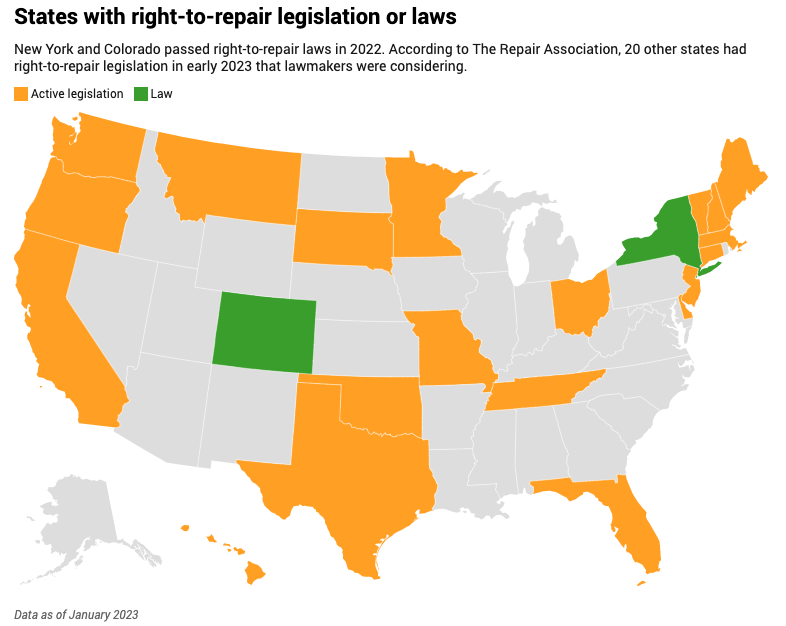
At its most basic level, right-to-repair legislation seeks to protect the end users of a product from anti-competitive activities by large companies. New York passed the first broad right-to-repair law, in 2022, and nearly two dozen states have active legislation – about half of them targeting farm equipment.

Whether the product is an automobile, smartphone or seed, companies can extract more profits if they can force consumers to purchase the company’s replacement parts or use the company’s exclusive dealership to repair the product.

Map: The Conversation/CC-BY-ND  Source: The Repair Association 

One of the first cases that challenged the right to repair equipment was in 1939, when a company that was reselling refurbished spark plugs was sued by the Champion Spark Plug Co. for violating its patent rights. The Supreme Court agreed that Champion’s trademark had been violated, but it allowed resale of the refurbished spark plugs if “used” or “repaired” was stamped on the product.

Although courts have often sided with the end users in right-to-repair cases, large companies have vast legal and lobbying resources to argue for stricter patent protections. Consumer advocates contend that these protections prevent people from repairing and modifying the products they rightfully purchased.

The ostensible justification for patents, whether for equipment or seeds, is that they provide an incentive for companies to invest time and money in developing products because they know that they will have exclusive rights to sell their inventions once patented.

However, some scholars claim that recent legal and legislative changes to patents are instead limiting innovation and social benefits.

The problem with seed patents

The extension of utility patents to agricultural seeds illustrates how intellectual property policies have expanded and become more restrictive.

Patents have been around since the founding of the U.S., but agricultural crops were initially considered natural processes that couldn’t be patented. That changed in 1980 with the U.S. Supreme Court decision Diamond v. Chakrabarty. The case involved genetically engineered bacteria that could break down crude oil. The court’s ruling allowed inventors to secure patents on living organisms.

Half a decade later, the U.S. Patent Office extended patents to agricultural crops generated through transgenic breeding techniques, which inserts a gene from one species into the genome of another. One prominent example is the insertion of a gene into corn and cotton that enables the plant to produce its own pesticide. In 2001, the Supreme Court included conventionally bred crops in the category eligible for patenting.

Seeds grow in segmented compartments of petri dishes. The dishes have writing in marker on the top.
Genetically modified seeds, and even conventionally bred crops, can be patented. Sean Gallup/Getty Images

Historically, farmers would save seeds that their crops generated and replant them the following season. They could also sell those seeds to other farmers. They lost the right to sell their seeds in 1970, when Congress passed the Plant Variety Protection Act. Utility patents, which grant an inventor exclusive right to produce a new or improved product, are even more restrictive.

Under a utility patent, farmers can no longer save seed for replanting on their own farms. University scientists even face restrictions on the kind of research they can perform on patented crops.

Because of the clear changes in intellectual property protections on agricultural crops over the years, researchers are able to evaluate whether those changes correlate with crop innovations – the primary justification used for patents. The short answer is that they do not.

One study revealed that companies have used intellectual property to enhance their market power more than to enhance innovations. In fact, some vegetable crops with few patent protections had more varietal innovations than crops with more patent protections.

How much does this cost farmers?

It can be difficult to estimate how much patented crops cost farmers. For example, farmers might pay more for the seeds but save money on pesticides or labor, and they might have higher yields. If market prices for the crop are high one year, the farmer might come out ahead, but if prices are low, the farmer might lose money. Crop breeders, meanwhile, envision substantial profits.

Similarly, it is difficult to calculate the costs farmers face from not having a right to repair their machinery. A machine breakdown that takes weeks to repair during harvest time could be catastrophic.

The nonprofit U.S. Public Interest Research Group calculated that U.S. consumers could save $40 billion per year if they could repair electronics and appliances – about $330 per family.

The memorandum of understanding between John Deere and the Farm Bureau may be a step in the right direction, but it is not a substitute for right-to-repair legislation or the enforcement of antitrust policies.

This article is republished from The Conversation under a Creative Commons license. Read the original article.
The Conversation

Alaskan Who Sued To Boot Oath Keeper From Office: We Tried To ‘Not Give Him A Platform For This Kind Of Stuff’

Many may have learned who Alaska state Rep. David Eastman (R) was for the first time this week, when he made national headlines over his befuddling remarks about the economic benefits of dead abused children. 

But not 75-year-old Alaska resident Randall Kowalke. 

Continue reading “Alaskan Who Sued To Boot Oath Keeper From Office: We Tried To ‘Not Give Him A Platform For This Kind Of Stuff’”

DeSantis’s Latest Stunt Bill Exploits the Limits of Academic Freedom, Experts Say

The Florida statehouse launched another strike in Gov. Ron DeSantis’s “anti-woke” war with a new bill this week aiming to hand more control of school administration over to the governor and his political appointees.

Continue reading “DeSantis’s Latest Stunt Bill Exploits the Limits of Academic Freedom, Experts Say”

Does It Matter What AI ‘Knows’?

I haven’t published so many reader replies in a while. But I’m doing so in this case because I find them very interesting and think some of you will too. But there’s a bit more than that. These discussions help me understand with more clarity some basic discussions we’re having as a society about artificial intelligence. They also help me line these discussions up with my own thoughts about the nature and utility of knowledge, the validation of theories by their ability to predict experimental results, and so on.

Continue reading “Does It Matter What AI ‘Knows’?”

Report: Every Extremist Mass Killing In The US In 2022 Was Tied To The Far-Right 

In 2022, right-wing extremists committed every ideologically driven mass killing identified in the U.S., according to a new report from the Anti-Defamation League’s Center on Extremism.

Continue reading “Report: Every Extremist Mass Killing In The US In 2022 Was Tied To The Far-Right “

More on AI

From TPM Reader FP

I’ve worked for decades on language models, as a researcher in academia and industry, and as a research manager whose teams have brought language models into products several years before the current excitement. I’m enjoying your commentaries on the topic, so I’m writing with a bit of historical perspective and connections that might be helpful.

The connection between language models and games goes back a long way, arguably to Turing and Shannon. Consider a reader who is shown the words (or letters, the difference is not significant) one by one, from the books in a library, and has to bet on the next still unseen word. If the reader is sufficiently educated in English language and culture, they have an almost sure bet in continuing “… to be or not … ” However, if the text was “… classical concert goers prefer Beethoven to … ” there are several possible continuations, but there’s still some predictability: the following word is more likely to be “Stockhausen” than to be “Cheetos”: text from the library tends to have some thematic coherence, in this case musical preferences, rather than mixing music and snacks. 

Continue reading “More on AI”

Tennessee Lobbyists Oppose New Lifesaving Exceptions In Abortion Ban

This story first appeared at ProPublica. ProPublica is a Pulitzer Prize-winning investigative newsroom. Sign up for The Big Story newsletter to receive stories like this one in your inbox.

In Tennessee, Republican lawmakers are considering whether patients should be forced to continue dangerous pregnancies, even while miscarrying, under the state’s abortion ban — and how close to risking death such patients need to be before a doctor can legally intervene.

At a legislative hearing last week, a lobbyist who played a dominant role in crafting the state’s abortion legislation made his preference clear: A pregnant patient should be in the process of an urgent emergency, such as bleeding out, before they can receive abortion care.

Some pregnancy complications “work themselves out,” Will Brewer, who represents the local affiliate of the anti-abortion organization National Right to Life, told a majority-male panel of lawmakers Feb. 14. When faced with a patient’s high-risk condition, doctors should be required to “pause and wait this out and see how it goes.”

Top Republicans like Gov. Bill Lee have defended the state’s abortion law, one of the strictest in the country, as providing “maximum protection possible for both mother and child.” But currently, the ban has no explicit exceptions, not even for the pregnant patient’s health.

It only includes an “affirmative defense” for emergencies, a rare legal mechanism that means the burden is on the doctor to prove abortion care was necessary because the patient risked death or irreversible impairment to a major bodily function.

The penalties for getting it wrong are three to 10 years in prison and up to $15,000 in fines. Doctors could expect to lose their medical license just for being charged. Concern over how the unprecedented law will be interpreted by prosecutors and the courts has already resulted in patients with high-risk conditions having to rush across state lines for care.

Some Republicans are proposing a modest change. An amendment to the law introduced in the House Population Health Subcommittee last week would remove the affirmative defense and clarify that it is not a crime to terminate a pregnancy to prevent an emergency that threatens the pregnant patient’s life or health, among other provisions.

“No one wants to tell their spouse, child or loved one that their life is not important in a medical emergency as you watch them die when they could have been saved,” said Republican Rep. Esther Helton-Haynes, a nurse and the bill’s sponsor.

But the word “prevent” is a sticking point for the anti-abortion groups who wrote the law.

“That would mean that the emergency hasn’t even occurred yet,” Brewer told the committee. He made a distinction between immediate, urgent emergencies — “A patient comes into the ER bleeding out” — and what he calls “quasi-elective” abortions.

Brewer, who has no medical experience, defined those as “abortions that aren’t necessary to be done in the moment but are still performed in an effort to prevent a future medical emergency.” He called for an “objective” standard.

When reached for comment, Brewer said his statements as summarized by ProPublica had been mischaracterized but did not provide additional details. “Ending the life of the baby should not be used as treatment for non-life-threatening conditions or to prevent some unknown possibility in the future,” he said. He did not respond to follow-up questions seeking clarification.

The American College of Obstetricians and Gynecologists said laws that try to limit or define medical exceptions are dangerous because they interfere with a doctor’s ability to assess fast-moving health indicators in unpredictable situations and don’t account for people’s different thresholds for risk.

Kim Fortner, a maternal-fetal medicine specialist practicing in Tennessee for more than 20 years, testified to the committee and pushed back on Brewer’s characterizations. She described a patient she saw recently whose water broke too early — the fetus still had a heartbeat, but there was virtually no chance it would survive and a very high risk the patient would get an infection.

But because of the law, the woman was sent home without the option of abortion care. She came back with emergency bleeding and sepsis, a life-threatening infection.

“It is not always so clear, and things don’t always just work themselves out,” Fortner said. “It is a significant, in my mind, misuse of resources, if she did not need to have six units of blood that could have gone to the trauma victim or the gunshot wound. Blood is a limited resource. Just because she can wait and come back in and she still lives to talk about it today — one, that won’t always happen, and two, it also is a significant misuse of an ICU bed. It is a preventable occurrence.”

Andy Farmer, a Republican state representative, agreed with her.

“These things need to be addressed early on,” he said, adding that he didn’t want doctors to feel they needed to consult a lawyer before offering care that could stop a condition from progressing into an emergency.

Brewer, however, said he believed giving doctors that kind of power would be too subjective. “Once one doctor is let off the hook in a criminal trial, it would be open season for other doctors who wanted to perform bad faith terminations,” he said.

Brewer’s position appears to be out of step with public opinion on abortion, even in a deeply red state. A recent poll found about 75% of Tennesseans support abortion exceptions, including for pregnancies caused by rape and incest.

Yet his organization exerts outsize influence on Republican state politics. Tennessee Right to Life issues an annual scorecard rating lawmakers on their fealty to “pro-life” positions and plows money into primary campaigns to unseat candidates viewed as insufficiently loyal. Already, they retracted the endorsement of one Republican lawmaker who publicly advocated for clear medical exceptions.

Signs of frustration emerged over the course of the hearing as lawmakers grilled Brewer on how his preferred positions may harm pregnant patients and accused him of trying to intimidate legislators.

“You’ve made a statement that you are fine with the current trigger law as it is, and nothing more needs to be done,” said Republican state Rep. Sabi Kumar, a retired surgeon, referring to the state’s abortion ban. “Did you believe that?”

Brewer responded: “That is our most preferential position, although we would accept an objective standard.”

Kumar said he was surprised Brewer did not appear to be taking into account other changes the bill addresses that are not in the current law, such as exceptions for cases of fatal fetal anomalies, where a baby is not expected to survive, and ectopic pregnancies, which implant outside the uterine cavity, are non-viable and can lead to rupture and death.

“Those things need to be corrected,” he said. “In the face of that, it is difficult for you to say that that is your preferential thing.”

Kumar also asked Brewer to consider the plight of doctors. Physicians carry malpractice insurance, but Kumar noted it doesn’t cover costs associated with criminal charges, which can be financially ruinous. Kumar didn’t think they should be threatened with prison time for acting to avoid an emergency.

“I would have liked to see you, as a friend, be as concerned about a physician who was under that degree of emotional stress and pressure, trying to save the life of a baby and worried about being prosecuted,” he said. “I would have liked you to be gushing with sympathy for that.”

He and others pointed out that the bill’s changes would not affect the vast majority of pregnancies, where abortion would continue to be outlawed. The bill explicitly states abortions are prohibited for mental health reasons, such as a patient threatening suicide, and it has no provisions allowing abortion for pregnancies due to rape or incest.

But Brewer suggested that lawmakers who vote in support of the bill might stand to lose the endorsement of Tennessee Right to Life.

“I would not consider this a pro-life law,” Brewer said. “And in discussions with our [political action committee], they have informed me that they would score this negatively for those members that wish to vote for it.”

Brewer’s invocation of the anti-abortion group’s scorecard provoked a strong response. As the hearing wrapped up, Tennessee’s House speaker, Cameron Sexton, appeared in the chamber.

“Something happened that I’ve never experienced in my time down here, which was somebody on a committee testifying tried to intimidate our members by telling them they’re gonna score them a vote,” he said. “You can have those conversations in your room, you can have those conversations in email. But to do it in the committee — to try to intimidate this committee to go a certain direction — is uncalled for.”

The rare public rebuke of an anti-abortion activist by a top Republican lawmaker may be a sign of growing GOP support for the modest amendments to the law. However, the bill’s path is not guaranteed. It will need to pass in three more committees before reaching final votes in the state’s House and Senate.

Republican state Rep. Bryan Terry’s reaction provided a preview of potential challenges ahead. He was the only member of the committee to vote against the amendment, and he leads the House Health Subcommittee, where the bill is headed next week.

In an email to ProPublica, Terry said that he does want to see changes to the law, but that the word “prevent” would need to be removed or redefined in the measure before he could consider voting for it.

“There are a multitude of medical emergencies that can occur during a pregnancy, but they usually never materialize,” Terry, who is an anesthesiologist, said. “A concern with the current amendment language is that an abortion could be performed in an instance when it wasn’t ‘medically necessary treatment.’”

ProPublica followed up to ask if he would consider conditions such as premature rupture of membranes, preeclampsia, cancer or heart conditions “medically necessary” reasons for abortions. He did not respond.

Three days after the hearing, Tennessee Right to Life sent a “legislative alert” obtained by ProPublica to its members, calling on them to oppose the bill at the next hearing.

The email described changes in the bill as “loopholes” making the current law “unenforceable.”

“Tragically, some pro-life legislators are currently supporting this bill,” the email read. Below, it listed the nine lawmakers who voted in favor of it.