We reported earlier this month about a number of shootings at the homes and offices of Democratic lawmakers in the Albuquerque region over the course of December and early January. Now Albuquerque Police Department has arrested Solomon Pena, a unsuccessful state house candidate in 2022, for the shootings.
Over the last couple days I’ve read a dozen or more articles and newsletter briefs which describe the purported political disaster that is the Biden classified documents issue, then explain how it bears no comparison to the ongoing Mar-a-Lago scandal and then note that the difference and lack of comparison actually don’t matter because that’s how it is. Punchbowl runs through a list of Democratic lawmakers who are barely willing to make the distinction in public, let alone defend the President from the adverse comparisons. The headline of this Dan Balz column perhaps sums it up most nicely: Biden, Trump cases aren’t alike. The political system doesn’t care.
A bizarre new George Santos fabrication has been highlighted by New York magazine.
The fabulist member of Congress from New York has become known for his wild claims, including many that could be easily debunked. But even by his own standards — and by those of the elaborate Trumpworld election-theft mythology — this one is odd.
“They did to me what they did to Donald J. Trump — they stole my election,” Santos said, speaking at a Trump rally on the Ellipse one day before the insurrection.
The political dynamics of the abortion landscape were, for decades, calcified.
The well-organized and well-practiced anti-abortion lobby used the promise of abortion restrictions — and threat of broad access to the procedure — to drive like-minded voters to turn out. Republican politicians, increasingly exclusively, signed their names to both substantive and messaging bills alike, often able to fly the flag without dealing with the consequences while Roe was still the law of the land.
This article is part of TPM Cafe, TPM’s home for opinion and news analysis.
Americans watching events unfold in Brazil last Sunday could be forgiven for experiencing an unsettling feeling of déjà vu. We’ve recently seen supporters of an electorally defeated president violently storm government buildings while demanding that legitimate election results be overturned. The events of January 8, 2023 in Brasília had so many parallels to the events of January 6, 2021 in Washington, D.C. that the comparison was practically cliché before the rioters had even been cleared out by law enforcement.
This article is part of TPM Cafe, TPM’s home for opinion and news analysis. It was originally published at The Conversation.
Rep. Chip Roy of Texas is just the latest conservative lawmaker to misuse the words of the Rev. Martin Luther King Jr. to judge a person on character and not race.
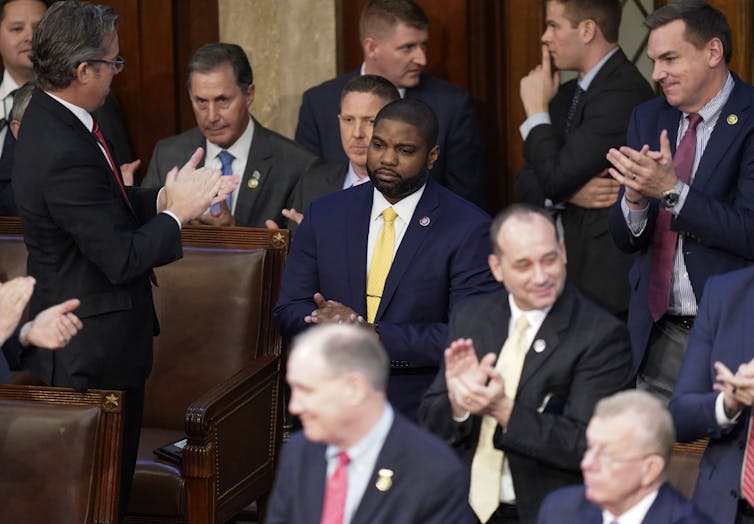
In the protracted battle to elect Rep. Kevin McCarthy as speaker of the House, Roy, a Republican, nominated a Black man, Byron Donalds, a two-term representative from Florida who had little chance of winning the seat. Considered a rising star in the GOP, Donalds has opposed the very things that King fought for and ultimately was assassinated for — nonviolent demonstrations and voting rights protections.
Calling Donalds a “dear friend,” Roy noted the selection by Democrats of another Black man, Hakeem Jeffries of New York, and invoked King’s words.
“For the first time in history, there have been two Black Americans placed into nomination for speaker of the House,” Roy said. “However, we do not seek to judge people by the color of their skin, but rather, the content of their character.”
As a scholar who researches social movements, racial politics and democracy, I have seen the consequences of the misuse of King’s words play out everywhere from the halls of Congress to corporate diversity training sessions to local school board meetings.
In Roy’s case, the invocation of King’s legacy was an attempt to hide Donalds’ outspoken right-wing political views, including his vote with 146 others to overturn the 2020 presidential election results. Roy’s speech also omits Donalds’ support for voting reform laws in Florida that many Black civil rights leaders understood as efforts to disenfranchise minority voters.
As scholars, civil rights activists and King’s own children have long pointed out, uses of King’s words, especially by right-wing conservatives, are too often attempts to weaponize his memory against the multicultural democracy of which King could only dream.
A sanitized MLK
As every Martin Luther King Jr. Day nears on the third Monday in January, politicians across the political spectrum — including those who opposed establishing the national holiday in 1983 — issue their heartfelt dedications to King or quote him in their own speeches.
Yet January is also a month that commemorates a darker, more recent memory of the Jan. 6, 2021, attack on the U.S. Capitol by right-wing extremists.
The two issues — misuses of King’s memory and the Jan. 6 attacks – may seem like unrelated phenomena.
Yet in my book, “The Struggle for the People’s King: How Politics Transforms the Memory of the Civil Rights Movement,” I show how there is a direct line from distortions of King’s words and legacy to right-wing attacks on multicultural democracy and contemporary politics.
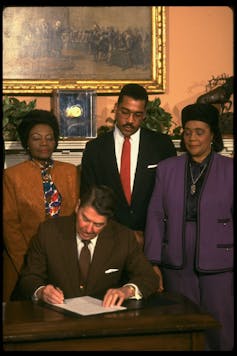
U.S. President Ronald Reagan signing Martin Luther King Jr. Day holiday proclamation with, from left, King’s widow Coretta Scott King, son Dexter and sister Christine Farris on Jan. 12, 1983. Diana Walker/Getty Images
The misuses of King are not accidental.
In the late 1970s and early 1980s, a sanitized version of King was part of a conservative political strategy for swaying white moderates to support President Ronald Reagan’s reelection by making King’s birthday a national holiday.
Even after Reagan finally signed the King holiday into law in 1983, he would write letters of assurance to angry political allies that only a selective version of King would be commemorated.
That version was free of not only the racial politics that shaped the civil rights movement but also of the vision of systemic change that King envisioned. In addition, Reagan’s version left out the views that King held against the Vietnam War.
Instead, the GOP’s sanitized version only comprises King’s vision of a colorblind society — at the expense of the deep, systemic change that King believed was needed to achieve a society in which character was more important than race.
Weaponizing America’s racist past
This interpretation of King’s memory would become a powerful political tool.
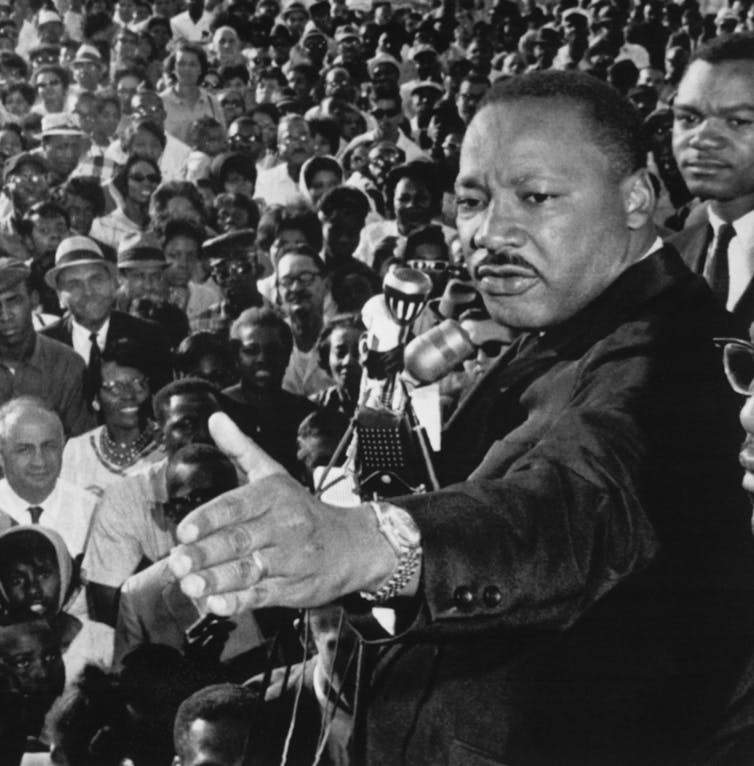
The Rev. Martin Luther King Jr. addresses a cheering crowd in Cleveland, Ohio, on July 27, 1965. Bettmann/Getty Images
Increasingly through the 1980s, right-wing social movements — from the gun rights and family values coalitions to nativists and white supremacists — deployed King’s memory to claim they were the new minorities fighting for their own rights.
These groups claimed that white Christians were the real victims of multicultural democracy and in fact were “the new Blacks.”
This false version of social reality eventually evolved into the “great replacement theory,” the far-right conspiracy theory, espoused by public figures like Tucker Carlson on Fox News, that white people are being demographically and culturally replaced with nonwhite peoples and that white existence is under threat.
In these distortions, gun rights activists called themselves the new Rosa Parks, anti-abortion activists declared themselves freedom riders and anti-gay groups claimed themselves protectors of King’s Christian vision.
These distortions of the past were not just rhetorical.
Over time, these political strategies had powerful effects and generated what appears in my view as an alternative social reality that, for many white Americans, began to feel like the only reality.
Misinformation threatens democracy
Through the making of these alternative histories, right-wing strategists such as Steve Bannon could stir up white right-wing voters to “reclaim” and “take back” America.
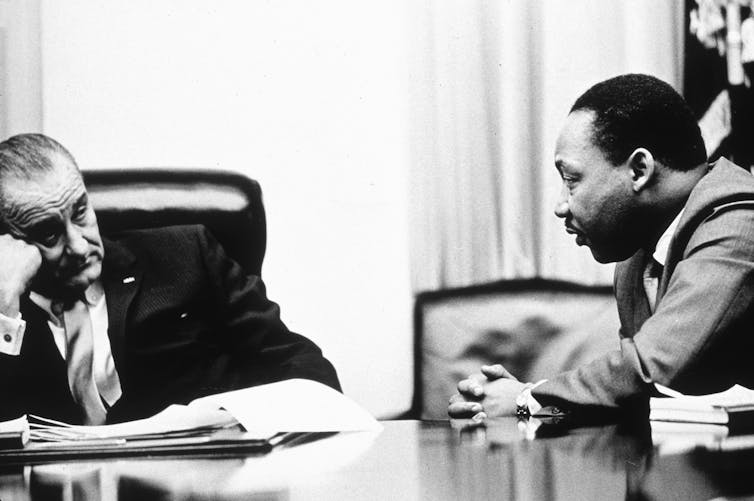
In this 1965 photo, President Lyndon B. Johnson discusses the Voting Rights Act with Martin Luther King Jr. Hulton Archive/Getty Images
Such was the politics that led to Donald Trump’s 2016 election and shaped a presidential administration that rolled back civil rights, emboldened white supremacists and banned anti-racism training.
Through the misrepresentation of the racial past, this alternate social reality hardened.
Ultimately, these revisionist narratives have fractured the collective understanding of who we are, how we got here and where we go next. In my view, moving forward means honestly confronting the often ugly past and the deep roots of white supremacy that shaped it then and now.
It is only by facing, rather than ignoring, the complexity of America’s history that the “beloved community” that King once envisioned can be realized.
It is on our radar. But since we haven’t been able to discuss it with readers yet I thought I’d share with you this email from TPM Reader EL …
If it’s not on your radar already I wanted to point you to the recent aggressive moves against higher ed by DeSantis in Florida.
Following a detailed request to all state colleges and universities to prepare a report on any use of state funds for diversity, equity, and inclusion measures including academic offerings (example information) and his language about ‘woke’ and ‘trendy’ ideologies in his inaugural address, on Jan 6 he announced what amounted to a take over of the Board of Trustees at New College of Florida, including the provocateur Christopher Rufo (who has fanned the ‘CRT” flames among other things @realchrisrufo).
We’ve been waiting to hear what secret agreements now-Speaker Kevin McCarthy had to make with the Freedom Caucus to become speaker. Yesterday we learned one key condition. McCarthy agreed to pursue something called “prioritization” as part of their plan to push debt default later this year. On its face, prioritization is a scheme by which the U.S. government will simply stop doing various functions — food and safety, Medicaid, roads, school lunches, air traffic control, border security — to prioritize only debt interest payments and likely Social Security and the military. In other words, there’s no need to default on the debt, the argument goes. You basically just default on the U.S. government.