A new episode of The Josh Marshall Podcast is live! This week, Josh and Kate discuss Donald Trump’s Waco speech, Kevin McCarthy’s debt ceiling nonsense and how Democrats should respond in the face of never-ending mass shootings.
You can listen to the new episode of The Josh Marshall Podcast here.
Delegates to Utah’s Emery County Republican Party Convention are planning to censure Sen. Mitt Romney (R-UT) for providing “aid and comfort” — the language the Constitution uses to define treason — to Democrats.
You may remember that as one of Ron DeSantis’s culture war gambits he punished Disney’s position on gay rights in the state by abolishing the special government jurisdiction which essentially allowed Disney to run Disney World as its own town or governmental district. That was the Reedy Creek Improvement District. DeSantis had the state legislature replace Reedy Creek with the Central Florida Tourism Oversight District. Now the political appointees DeSantis put on the Oversight District board to lord it over Disney are crying foul, saying Disney pulled a fast one on them and essentially cut them out of any effective power for decades into the future.
A lot of things happened. Here are some of the things. This is TPM’s Morning Memo.
New Dominion Materials
The legal proceedings surrounding Dominion Voting Systems’ defamation suit against Fox News continue to deliver a treasure trove of information about internal comms at Fox News that affirm what has become increasingly clear in the last year, but has been known about the news network for decades: feeding your relatives lies and half-truths that make them angry is just a business model.
Barack Obama articulated it rather well the other day, speaking about Rupert Murdoch’s role in the polarization of society. I flagged part of his quote in yesterday’s Morning Memo, but this part is relevant to the latest Dominion drop:
“You no longer have a joint conversation and a shared story,” Obama said from Australia as he spoke about Rupert Murdoch’s business model of dividing people for profit. “And the economics of the media, the clicks, are now based on how do I attract your attention? Well, the easiest way to attract attention without having to have a lot of imagination, thought, or interesting things to say, is just to make people angry and resentful and to make them feel as if somebody’s trying to mess with them and take what’s rightfully theirs.
“And if you throw in some good old-fashioned racism and xenophobia and sexism and homophobia, all of that, because now we’re in the realm of identity politics. And it’s very difficult to compromise around identity politics.”
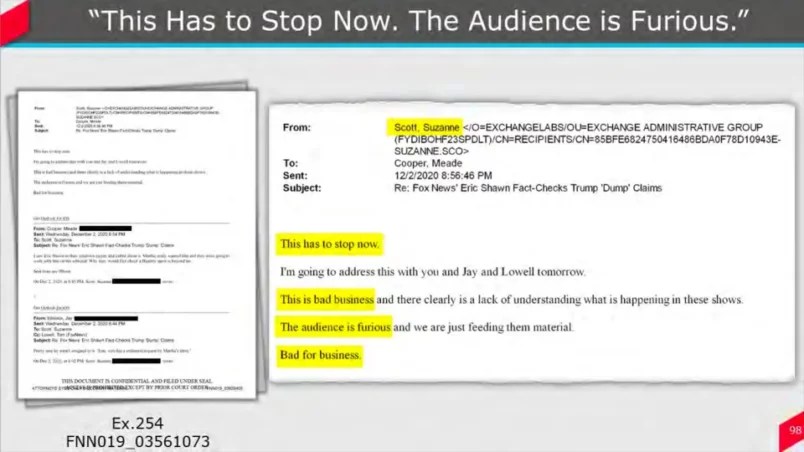
The criticism ties in rather nicely with what’s been revealed in this most recent dump of internal communications at Fox News that were previously redacted and made public on Wednesday. In one of the emails, Fox News CEO Suzanne Scott is seen alerting her colleagues to the reality that fact-checking Donald Trump and his allies’ lies about a stolen election was financially bad for the company.
In one of the emails, Scott tells Meade Cooper, who is the executive VP of prime time programming, that she was frustrated with reporter Eric Shawn who had recently appeared on Martha MacCallum’s show and fact-checked someone who is a regular guest on Sean Hannity’s show
“This has to stop now,” Scott said in a Dec. 2, 2020, message. “This is bad for business and there is a lack of understanding what is happening in these shows. The audience is furious and we are just feeding them material. Bad for business.”
Fox News has responded to the latest drop of documents, arguing specifically in this instance that Scott was not upset about the fact-checking, but rather bothered by “one host calling out another.”
Dominion Voting Systems
Scott is certainly right about the “feeding” of material for the audience to be “furious” about, but something tells me that is not the point Scott was trying to make.
Breaking This Morning
Russia has detained a Wall Street Journal reporter. Per WSJ:
Russia’s main security agency said it had detained a Wall Street Journal reporter for what it described as espionage.
The Federal Security Service said Thursday it had detained Evan Gershkovich, a U.S. citizen, in the eastern city of Yekaterinburg.
The FSB said in a statement that Mr. Gershkovich, “acting on the instructions of the American side, collected information constituting a state secret about the activities of one of the enterprises of the Russian military-industrial complex.”
“The Wall Street Journal vehemently denies the allegations from the FSB and seeks the immediate release of our trusted and dedicated reporter, Evan Gershkovich,” the Journal said. “We stand in solidarity with Evan and his family.”
When Will It Be The Time, Though?
Tennessee Gov. Bill Lee is telling the public that now is not the time to talk about legislation, as America attempts to grapple with yet another horrific school shooting tragedy that left six people dead, including three nine-year-old children. The shooter obtained at least two of their weapons legally.
“There will be a time to talk about the legislation and budget proposals we’ve brought forward this year,” he said “And clearly there’s more work to do.”
Tennessee has been a permitless carry state for handguns since 2021.
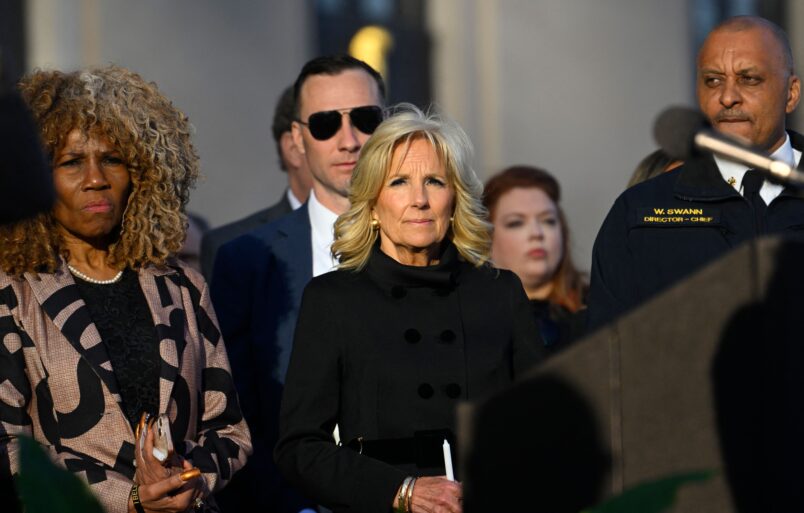
First Lady Jill Biden attended the candlelight vigil in Nashville Wednesday night, honoring the lives of those murdered on Monday.
First Lady Jill Biden attends a public vigil to honor victims and survivors of a shooting at The Covenant School in Nashville, Tennessee, March 29, 2023. (Photo by John Amis / AFP) (Photo by JOHN AMIS/AFP via Getty Images)
Fetterman Returns
Sen. John Fetterman (D-PA) will return to the Senate the week of April 17. He has been receiving treatment for depression at Walter Reed National Military Medical Center since mid-February.
Matt Gaetz Staffer Is A War Criminal
Derrick Miller, who serves as Gaetz legislative assistant on military policy, is a former Army National Guard sergeant who spent eight years in prison for murdering a civilian in Afghanistan in 2010. The Intercept has the shocking details:
While on a combat mission in Afghanistan’s Laghman province on September 26, 2010, Miller shot 27-year-old Atta Mohammed in the head during an interrogation. Miller has maintained that he was acting in self-defense, alleging that Mohammed, who had walked through a defensive perimeter established by Miller’s unit, could be a threat to his unit and that he had tried to grab Miller’s weapon during the interrogation. But another National Guard member testified he heard Miller threaten to kill Mohammed if he did not tell the truth; and then sat on top of him — Mohammed was lying prone — before shooting him in the head, killing him. According to the prosecutor, Miller then said, “I shot him. He was a liar.”
Mohammed’s body was left in a latrine, in violation of military standards.
Miller covers armed forces and national security, international affairs, and veterans affairs for Gaetz, according to the Congress-tracking website LegiStorm. Gaetz serves on the House Armed Services Committee.
The Indictment Watch Has Ended
For now. The Manhattan grand jury that we’ve been watching closely for signs of a Trump indictment over the last two weeks is scheduled to take a break in April. Reports Wednesday indicated that this break is part of some sort of pre-scheduled hiatus, but the news throws buckets of cold water on the anticipated indictment and any potential vote to charge Trump likely won’t come until late April.
Americans 57 to 38 percent think criminal charges should disqualify former President Donald Trump from running for president again, if charges are filed against him as a result of multiple state and federal criminal investigations, according to a Quinnipiac University national poll released today.
Pence Hints He May Not Appeal
Just a day after a federal judge in D.C. ruled that former Vice President Mike Pence must comply with a grand jury subpoena and testify about his communications with Trump leading up to the insurrection, Pence fielded a question from a supporter in Iowa about whether he planned to testify against Trump.
“I am limited in what I can say about the grand jury’s proceedings but I am pleased that the judge recognized that the Constitution’s speech and protection clause applies to my work as Vice President when I was serving as President of the Senate on January 6,” Pence said. “We are currently talking to our council about the balance of that decision and determining a way forward but I have nothing to hide. I have written and spoken extensively about that day and the days leading up to it.”
Pence also told the crowd gathered to meet him in Urbandale, Iowa that he would make a decision about 2024 next spring.
Pope Hospitalized
Scheduled medical check-ups of #PopeFrancis at a hospital in #Rome have revealed that he has a respiratory infection which requires a couple of days of treatment. (File Image: Pope Francis) pic.twitter.com/SL4lYOINLv
Today Utah’s Emery County Republican Party will vote at its convention on whether to censure Sen. Mitt Romney (R-UT), who they are still mad at for voting to impeach Trump two times. The county Republicans claim that in voting to convict Trump in the first impeachment, the Utah Republican gave “aid and comfort to the Democratic party,” citing the Constitution’s definition of treason.
They’re also mad that Romney “lent his support to a false liberal narrative” when he voted to impeach Trump for inciting an insurrection, according to the Salt Lake Tribune.
About Damn Time???
The FDA will meet in May to talk about whether the agency should approve one type of birth control pill to be sold over-the-counter. The pill is called Opill and is currently only available via prescription. If approved it’ll be the first birth control pill available over the counter in the country.
Of Course Mike Lindell Is Involved
Earlier this month we reported on a county in California that had voted to drop its contract with Dominion Voting Systems after some far-right members of the community who campaigned on election lies were elected to the county election board. Those county officials had been in touch with none other than the MyPillow Guy, who not only encouraged the county board vote but offered to cover any legal expenses the county may incur for ditching the machines (even though he claims he is going broke over his Big Lying).
This week Shasta County officials voted that instead of replacing the digital machines with another company’s voting equipment, the county is going to attempt to conduct its elections via hand count, a move that could be legally dubious and expensive.
I hope you get a chance to read this article by Josh Kovensky. The same Ukrainian nationals, working for Russian intelligence, who were feeding the anti-Biden “dirt” to Rudy Giuliani in 2019/2020 were later (in 2021/2022) tasked with prepping the ground for Russia’s invasion in February 2022.
In the days after the 2020 election, as Donald Trump refused to concede, his allies began scrambling for evidence that the election was invalid. Some busied themselves challenging local election laws and trying to disqualify ballots in Democratic areas based on technicalities. Others were already rushing toward fringier conspiracy theories.
One particular conspiracy theory took hold early: “Hammer and scorecard.”
Many of those who worked to interfere in American politics also played key roles in Russia’s assault on Ukraine — a fact that is becoming increasingly clear as the war moves into its second year and new intelligence becomes public.
Election officials in a Republican-leaning California county on Tuesday voted to dump their Dominion voting machines and attempt to hand-count elections moving forward after being influenced by right-wing conspiracy theories about the security of the Dominion systems.
And of course MyPillow CEO Mike Lindell is involved.
We’ve already discussed some of the broader issues involved in the ongoing Israeli political crisis. I wanted to expand on one of the more specific ones: precisely what the judicial “reform” package is about and why there’s such resistance to it.
Decades ago, American Democrats and liberals loved the U.S. Supreme Court. That love affair waned over many years before collapsing during the Trump presidency. So from an American context, it can seem a bit odd to Democrats to see Israelis making a big stand on behalf of the Israeli Supreme Court. What’s more, from an American perspective, how the Israeli Supreme Court functions and how its members are chosen can seem pretty weird.
The Israeli Supreme Court is partly a self-perpetuating creature of the judiciary and the legal profession. A board made up of members of the current Court, members of the current government, members of the Knesset (the parliament) and members of the bar association come up with selections which are then chosen by the largely ceremonial president.