Sen. Bill Cassidy (R-LA) said on Sunday that he thinks former President Donald Trump should drop out of the 2024 GOP presidential race.
“I think so,” Cassidy told CNN’s “State of the Union” when asked whether he thinks Trump should withdraw. “But obviously, that’s up to him. I mean, you’re just asking my opinion, but he will lose to Joe Biden if you look at the current polls.”
Back in the Spring I wrote that I expected Ron DeSantis’s hopeless campaign to eventually be replaced by another GOP candidate memestock, and perhaps a succession of them. By this I mean another non-Trump candidate who gets hosed down with high-roller dollars, gets a lot of media attention and sugar-high narrative buzz like DeSantis did, and then inevitably crashes and burns because GOP voters actually want Donald Trump. The only surprise to me is that there hasn’t been any coalescence behind a new guy, even as DeSantis’s campaign has become little more than a running joke. The inevitable conclusion we can draw from that dog not barking is that the couple dozen or so billionaires who play a dominant role funding GOP campaigns have reconciled themselves to getting back on the Trump Train.
This article is part of TPM Cafe, TPM’s home for opinion and news analysis. It was originally published at The Conversation.
After three indictments of former President Donald Trump, the fourth one in Georgia came not as a surprise but as a powerful exposition of the scope of Trump’s efforts to remain in power despite losing the 2020 presidential election.
New conservative legal scholarship spells out how and why those actions – which were observed by the public over many months – disqualify Trump from serving in the presidency ever again. And our read of the Georgia indictment, as longtimelawyers ourselves, shows why and how that disqualification can be put into effect.
The key to all of this is the 14th Amendment to the Constitution, which states that “No person shall … hold any office, under the United States … who, having previously taken an oath … to support the Constitution of the United States, shall have engaged in insurrection or rebellion against the same, or given aid or comfort to the enemies thereof.” Trump took that oath at his inauguration on Jan. 20, 2017.
Both Trump’s Georgia indictment, and his federal indictment in Washington, D.C., cite largely public information – and some newly unearthed material – to spell out exactly how he engaged in efforts to rebel against the Constitution, and sought and gave aid and comfort to others who also did so.
We believe the Georgia indictment provides even more detail than the earlier federal one about how Trump’s actions have already disqualified him from office, and shows a way to keep him off the ballot in 2024.
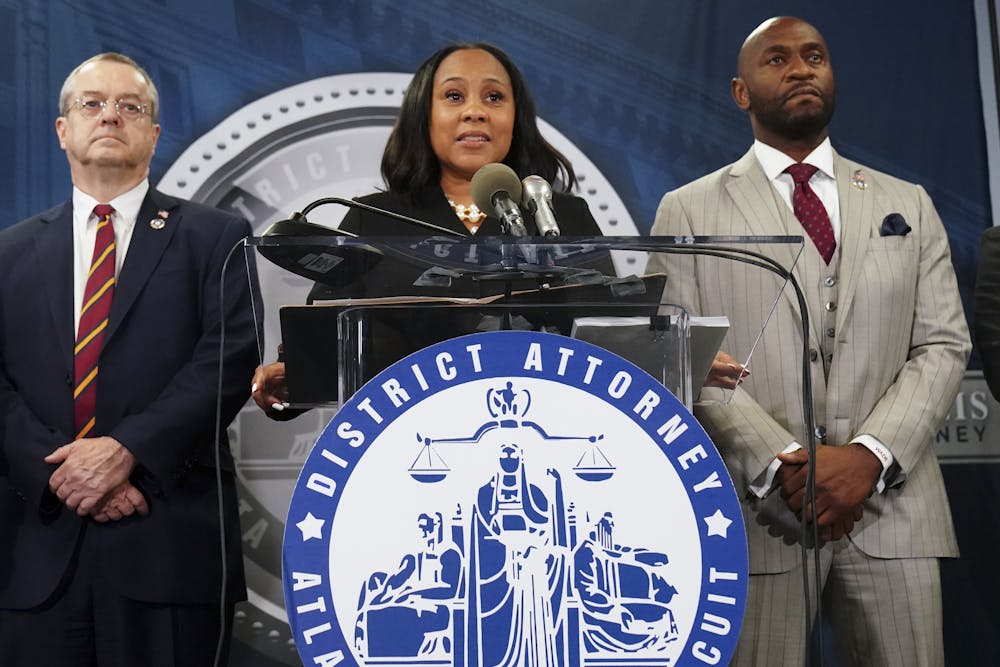
Fulton County District Attorney Fani Willis, center, during a news conference, Aug. 14, 2023, in Atlanta, after the release of her indictment of former President Donald Trump and 18 others. AP Photo/John Bazemore
Disqualification is automatic
Trump’s supporters might argue that disqualifying him would be unfair without a trial and conviction on the Jan. 6 indictment, and perhaps the Georgia charges.
But Baude and Paulsen, using originalist interpretation – the interpretive theory of choice of the powerful Federalist Society and Trump’s conservative court appointees, which gives full meaning to the actual, original text of the Constitution – demonstrate that no legal proceeding is required. They say disqualification is automatic, or what’s known in the legal world as “self-executing.”
Recent public comments from liberal constitutional scholar Laurence Tribe and conservative jurist and former federal judge Michael Luttig – who has characterized the events before, during and since Jan. 6 as Trump’s “declared war on American democracy” – suggest an emerging bipartisan consensus supporting Baude and Paulsen.
But even though they had no relevant convictions, former Confederates were in fact barred from office in the U.S.
In December 1865, several who had neither been convicted nor been pardoned tried to claim seats in the U.S. House of Representatives. But the House clerk refused to swear them in. It took an act of Congress – the 1872 Amnesty Act – to later restore their office-holding rights.
There is no requirement in the Constitution that the disqualification be imposed by any specific process – only that it applies to people who take certain actions against the Constitution.
A path through the states
For the U.S. in 2023, we believe the most realistic avenue to enforce the 14th Amendment’s ban on a second Trump presidency is through state election authorities. That’s where the Georgia indictment comes in.
State election officials could themselves, or in response to a petition of a citizen of that state, refuse Trump a place on the 2024 ballot because of the automatic 14th Amendment disqualification.
The Georgia indictment against Trump and allies exhaustively details extensive acts of lying, manipulation and threats against Georgia officials, as well as a fraudulent fake elector scheme to illegally subvert the legitimate 2020 Georgia presidential vote tally and resulting elector certification.
Trump’s failure to accomplish what is tantamount to a coup in Georgia and other swing states set the stage for the violent insurrectionof Jan. 6, 2021, that sought to achieve the same result – Trump’s fraudulent installation to a second term.
Baude and Paulsen acknowledge that “insurrection and rebellion” are traditionally associated with forced or violent opposition. But we see the broader set of actions by Trump and his allies to subvert the Constitution – the Georgia vote count and fake elector scheme included – as part of a political coup d’etat. It was a rebellion.
Georgia as a bellwether
So what makes the Georgia scheme and indictment compelling for purposes of disqualifying Trump from the 2024 Georgia ballot?
There are minimally six aspects revealed in the latest indictment that we believe justify Georgia – under Section 3 of the post-Civil War Fourteenth Amendment – keeping Trump off the ballot:
The racketeering scheme was a multifaceted attempt to subvert Georgia’s own part of the 2020 electoral process;
The officials on the receiving end of the unsuccessful racketeering scheme were elected and appointed Georgia officials. …
… whose actions to reject election subversion vindicated their own oaths to uphold the Constitution and laws of the United States as well as Georgia’s;
These officials’ testimony, and related evidence, is at the heart of the proof of the Georgia racketeering case against Trump.
In other words, the evidence to convict Trump in the Georgia racketeering case is the same evidence, coming from the same Georgia officials, who will be involved in determining whether, under the 14th Amendment, Trump is qualified to be on the 2024 presidential ballot – or not.
Little if any additional evidence or proceedings are needed. The Georgia officials already hold that evidence, because much of it comes from them. They don’t need a trial to establish what they already know.
How could Trump avoid this happening? A quick trial date in Atlanta with an acquittal on all counts might do it, but this runs counter to his strategy to delay all the pending criminal cases until after the 2024 election.
With no preelection trial, there will likely be no Trump on the 2024 Georgia ballot, and no chance for him to win Georgia’s 2024 electoral college votes.
Once Georgia bars him, other states may follow. That would leave Trump with no way to credibly appear on the ballot in all 50 states, giving him no chance to win the electoral votes required to claim the White House.
Donald Trump’s fourth indictment out of Georgia distinguishes itself from the federal felony indictments in certain ways: its scope is broader, with 19 people indicted. Trump can’t just pardon himself if he’s reelected.
And, the subsequent trial will likely be televised.
One of Democrats’ pet peeves is that President Biden has not only overseen a robust economy with almost unprecedentedly low levels of unemployment, his policies actually have some decent claim to responsibility for that record. And yet he gets no credit for it. Not only has Biden been mired in low-40s approval for the last two years, his ratings on the economy are some of his weakest.
This is definitely annoying and certainly unfair (what isn’t?). But it shouldn’t seem new or unexpected. If you’ve been following politics closely for a few decades you’ll remember that Presidents Reagan, Clinton and Obama faced a very similar issue. All three presidents had a significant interval when the economy was demonstrably doing well and yet got zero credit for it or even any clear public recognition that the economy was in good shape.
Along with a business empire, the “My Pillow” entrepreneur has been one of the primary promoters of false conspiracy theories surrounding the 2020 election. And, nearly three years after those votes were cast, Lindell has not given up on the idea that the man he calls “our great, real president Donald Trump” was robbed. Lindell has formed a constellation of activist groups and other enterprises dedicated to the cause of Trump dead-ender election denialism and, for months, he has been working on a project, the unveiling of which he vowed would be one of the “most important” moments in our nation’s history.
Former President Donald Trump announced on social media Thursday evening that he will no longer hold a press conference or release his so-called extensive report that he claimed would refute the Fulton County indictment allegations against him.
Aside from all the legal commentary on how preposterously late an April 2026 trial date is, I can offer you some piquant examples from Trump’s filing that show how petulant and not-serious it is. Don’t get me wrong, he’s dead serious about delaying all of the criminal proceedings for as long as possible, but his logic is comically strained:
I should get as much time to investigate the case as the government had! Trump counts the time from the Jan. 6, 2021 Capitol attack until his August 2023 indictment (31 months) and asks for a trial date 32 months from the indictment (emphasis mine): “This more reasonable schedule—equal to the government’s time spent investigating—will allow this case to proceed in an orderly fashion, with both parties having a fair opportunity to review all material information, advance appropriate motions, and apprise the Court of relevant legal issues. (Narrator: This is a hilarious premise on its own, but the fact that it ignores all the Trump-caused delays in the investigation, such as his frivolous and unsuccessful assertions of privilege, is extra special.)
I should get as much trial time as the government! In another blunt, ham-handed calculation, Trump declares it’s impossible at this early stage to estimate how long it will take to put on his defense at trial, so he just grabs ahold of the government’s estimate for its own case-in-chief and makes it his own: “President Trump will adopt the same calculation as the government—4 to 6 weeks for the defense case.” (Narrator: Trump will mount a vigorous pre-trial defense, but it’s unlikely he will mount much of a defense at trial; he might not even call any witnesses.)
I need all of 2025 to get ready! Trump’s proposed trial schedule devotes all of 2025 to … three (3!) discovery status conferences/motions hearings. (Narrator: Come on, man.)
Having now encountered U.S. District Judge Tanya Chutkan, Trump has run back to U.S. District Judge Aileen Cannon in Florida to complain about all the nasty things Special Counsel Jack Smith is doing to him in DC.
In a weird little filing in the Mar-a-Lago case, Trump’s obsequiousness toward Cannon results in the use of “Your Honor” nine (9!) times in a four-page document.
Trump’s complaint is that the special counsel is proposing dates for the Jan. 6 case that conflict with dates already set in the Mar-a-Lago case – and he wants Cannon to haul prosecutors into court and force them to explain themselves.
LOL
Trump has already cancelled his self-ballyhooed ‘big’ reveal of why the Georgia 2020 election really was rigged after all:
Trump says, on the advice of his lawyers, his “irrefutable” Georgia election fraud report will be put with a future legal filing, so he’s canceling the news conference he had planned at Bedminster on Monday to unveil it. Allies & attorneys had been uneasy about this event pic.twitter.com/a0Cgu5BBcr
Sheriff Investigating Threats Against Georgia Grand Jurors
The Fulton County sheriff is investigating online threats against the grand jurors who indicted former President Trump and 18 others in the sprawling RICO case for alleged 2020 election interference.
BREAKING …
CNN: Kenneth Chesebro, alleged architect of fake electors’ plot, followed Alex Jones around Capitol grounds on January 6th
CNN exclusive reporting about pro-Trump lawyer Kenneth Chesebro and his whereabouts at the U.S. Capitol on Jan. 6. He was the alleged architect behind the plan to submit a fraudulent alternate slate of electors. @ShimonPro has the details. pic.twitter.com/8t6E7GGB2l
Journal-Constitution: Meet the 34-year-old judge who will oversee Trump prosecution in Georgia
The Messenger: What We Know About All of the Fake Trump Elector Investigations
CNN: Trump DOJ official Jeffrey Clark urges judge to reject March 2024 trial date in Georgia case
NBC News: Former Trump DOJ official Jeffrey Clark seeks to pause disciplinary case due to Georgia indictment
DOJ Seeks STIFF Sentences For Proud Boys
Ryan Reilly: “Federal prosecutors are seeking sentences of 27 to 33 years in federal prison in the cases of four Proud Boys found guilty of seditious conspiracy for their actions during the Jan. 6 attack on the U.S. Capitol, as well as 20 years for a fifth Proud Boy found guilty on other charges.”
Kyle Cheney: “The proposed jail sentences would nearly double the lengthiest Jan. 6 sentence handed down to date — 18 years for Oath Keepers leader Stewart Rhodes — a decision prosecutors say reflects the pivotal role that Proud Boys leaders played in stoking and exacerbating the violence at the Capitol that day.”
Alan Feuer: “In seeking to severely punish the two Proud Boys, Enrique Tarrio, the former chairman of the group, and Joseph Biggs, one of Mr. Tarrio’s top lieutenants, prosecutors asked the judge in the case to increase their sentences with what is known as a terrorism enhancement.”
Marcy Wheeler: “[T]he document as a whole is a testament to how the asymmetrical treatment of terrorism in the United States makes it much harder to hold men like Enrique Tarrio and Joe Biggs accountable for attacking the Capitol that it would be if they were Islamic terrorists, rather than right wing Trump supporters.”
I Have Questions
A quickly deleted tweet from Project Veritas:
Quite an update from conservative undercover group Project Veritas’s official account. Hannah Giles is PV’s CEO, hired after James O’Keefe was pushed out earlier this year and was the other half of O’Keefe’s ACORN pimp sting. pic.twitter.com/tlyv9oxP7i
Donald Trump still has not indicated one way or the other whether he plans to attend the first Republican primary debate next week, put on by the RNC and Fox News. The event will almost certainly be entirely about him whether he’s there or not.
As he leads in the primary field by a not-even-close margin, his opponents are reportedly planning to use his legal woes as debate fodder, NBC News reported. Both Mike Pence and Ron DeSantis are already using his latest indictment in Georgia this week to bolster their own campaigns — seizing on Trump’s ongoing hysterics about the election being stolen in Georgia in 2020 as an opportunity to draw a contrast, presenting themselves as the Reasonable Guys who believe the election was legit.
A new episode of The Josh Marshall Podcast is live! This week, Josh and Kate are joined by TPM investigative reporter Josh Kovensky to talk all things Georgia indictment.
You can listen to the new episode of The Josh Marshall Podcast here.