

Not that it matters. But needless to say there’s no such thing as expunging an impeachment.
Kevin McCarthy Promised To Expunge Trump’s Two Impeachments???
A lot of things happened. Here are some of the things. This is TPM’s Morning Memo. Sign up for the email version.
This Takes The Cake
As we await the imminent indictment of Donald Trump for attempting to overturn the 2020 election, Speaker Kevin McCarthy (R-CA) has secretly promised Trump that the House will vote before the August recess to expunge his two impeachments – including the one for the Jan. 6 attack, Politico is reporting.
It all arises from McCarthy’s effort to stay neutral in the GOP presidential primary and hold off on making an endorsement, which has incensed Trump:
To calm Trump, McCarthy made him a promise, according to a source close to Trump and familiar with the conversation: The House would vote to expunge the two impeachments against the former president. And — as McCarthy would communicate through aides later that same day — they would do so before August recess.
McCarthy, for his part, kinda sorta maybe denies making such a promise:
The speaker has denied that he made such a promise to Trump at all, according to one Hill aide. From McCarthy’s point of view, he merely indicated that he would discuss the matter with his members — putting him and Trump on a collision course.
The whole story is revealing window into the internal divisions and psychology of the House GOP conference. Worth a read while you await Trump’s new indictment.
Indictment Watch
Some corrective reporting over the last 24 hours about what was actually in the target letter Trump received from Special Counsel Jack Smith. As I mentioned briefly in yesterday’s Morning Memo, Rolling Stone and ABC News offered similar accounts of which federal criminal statutes were cited in the target letter. Neither outlet had seen the letter, and they each relied on source(s) who had.
Subsequent reporting by the NYT and Guardian about the target letter reported one notable difference. This gets weedy quick, but I’ll keep it high level. The initial reporting said the target letter cited 18 U.S.C. 242: Deprivation of Rights Under Color of Law. The later reporting said, no, it was 18 U.S.C. 241: Conspiracy Against Rights.
The NYT has the best rundown on the elements of that crime:
Congress enacted that statute after the Civil War to provide a tool for federal agents to go after Southern whites, including Ku Klux Klan members, who engaged in terrorism to prevent formerly enslaved African Americans from voting. But in the modern era, it has been used more broadly, including in cases of voting fraud conspiracies.
There is a historical resonance to a Section 241 charge, since the effort to overturn the 2020 election and the attack on the Capitol were inextricably bound up with racism and white supremacy. But I don’t want to get too far ahead of ourselves yet.
The indictment will speak for itself. You’ll recall that the Trump World leaks about the Mar-a-Lago indictment suggested it contained only seven counts, not the 30+ counts the grand jury actually indicted on. So be patient.
Trump Quietly Adds New Attorney In Jan. 6 Probe
John Lauro, a former federal prosecutor in Brooklyn who is now a criminal defense attorney in Florida and New York, CNN reports:
Lauro will be solely focused on special counsel Jack Smith’s investigation into the aftermath of the 2020 election and was part of the team attempting to find out whether others in Trump’s orbit received target letters after Trump did Sunday night.
It appears that Todd Blanche remains Trump’s lead lawyer on the Jan. 6 case.
Counterpoint
Yesterday’s Morning Memo was a paean to the vindication of the rule of law that a Jan. 6 indictment of Trump would represent.
Charles Blow is not so moved: Why Trump’s Indictments Don’t Feel Like Part of the Finale.
Cannon Shoots Down DOJ In MAL Case
Not a huge deal yet, but U.S. District Judge Aileen Cannon did reject the Justice Department’s request for a protective order under CIPA for classified information in the Mar-a-Lago case. She cited a failure to confer with Trump’s defense team about the protective order. You’ll recall that prosecutors said they tried to confer but were rebuffed. Cannon said that after conferring with Trump’s team, prosecutor can reapply for a protective order.
Still No Trial Date From Cannon
Judge Cannon promised to promptly issue an order setting a trial date for the Mar-a-Lago case. I thought she’d rule within 36 hours hours. Nada so far. Stay tuned.
ICYMI
Anna Bower reports on what it was like inside Tuesday’s Mar-a-Lago hearing.
Get Ready
AJC: Atlanta law enforcement readies for a possible Trump indictment
No Dice, Trump
A federal judge has rejected Donald Trump’s effort to remove the Manhattan DA Alvin Bragg’s hush money prosecution to federal court.
E. Jean Carroll Just Keeps Winning
A federal judge rejected Donald Trump’s bid for a new trial in the E. Jean Carroll II case.
MAGA!
A New Jersey Ponzi schemer who was freed from prison by then-President Trump in one of last official acts in the White House has been charged by federal prosecutors in a new unrelated scheme.
There’s an emerging pattern here.
Former Rand Paul aide Jesse Benton was pardoned by Trump and then was later indicted on new unrelated charges and sentenced to a prison term.
Trump Agrees To Return Israeli Antiquities
The WSJ has the story of how Israeli national treasures ended up marooned at Mar-a-Lago.
The Professional Clarence Thomas Stans
WaPo: Influential activist Leonard Leo helped fund media campaign lionizing Clarence Thomas
Oh No …
Rep. Marjorie Taylor Greene (R-GA) went nuts even by our low standards for her, displaying graphic images of a Hunter Biden sex tape during a House hearing.
Maybe MTG Was Still Smarting From This
Like Morning Memo? Let us know!
While Defending Supreme Court, Graham Can’t Help But Admit Justices Need ‘To Get Their House In Order’
Sen. Lindsey Graham (R-SC), the Republican ranking member on the Senate Judiciary Committee, on Wednesday noted that the Supreme Court justices need “to get their house in order,” all the while insisting that Congress needs “to stay out of the Court’s business.”
Continue reading “While Defending Supreme Court, Graham Can’t Help But Admit Justices Need ‘To Get Their House In Order’”House GOP Strips Funding From LGBTQ+ Related Earmarks In Latest ‘Wokeness’ Witch Hunt
Republicans on the House Appropriations committee stripped funding from three projects aimed at providing services to the LGBTQ+ community during Tuesday’s fiscal Department of Transportation and Housing and Urban Development appropriations markup, turning an ordinarily uneventful process into a tense and antagonizing meeting.
Continue reading “House GOP Strips Funding From LGBTQ+ Related Earmarks In Latest ‘Wokeness’ Witch Hunt”The Crypto Market Crash Is Not Stopping Melania Trump From Selling NFTs
Former First Lady Melania Trump is hoping to go, as they say in the crypto community, to the moon. Despite crashes that have hit the crypto and NFT market hard in recent months, Melania Trump announced the launch of a new “limited-edition digital collectible” on Tuesday. Her new NFT, “Man on the Moon,” is being marketed as a celebration of the moon landing, which occurred 54 years ago this week.
Continue reading “The Crypto Market Crash Is Not Stopping Melania Trump From Selling NFTs”Cluster Bombs: What The US Debate Looks Like From Ukraine
The Biden administration’s decision to provide Ukraine with cluster munitions earlier this month set off a furious debate, with many Democrats and a few MAGA Republicans trying to move a measure through Congress which would block the U.S. from transferring the bombs.
Continue reading “Cluster Bombs: What The US Debate Looks Like From Ukraine”Programming Note
We’ll be recording and posting this week’s episode of The Josh Marshall Podcast later this week.
Even The Bigs
Yesterday I noted that January 6th remains radioactive for the GOP in a way that Trump’s other crimes simply don’t. It keeps coming up again because they’ve never dealt with what happened. And they haven’t because that would mean dealing with Donald Trump. And, let’s be honest, they haven’t because a substantial minority (or more?) of their supporters are in fact insurrectionists and unreconstructed ones.
The preference at all times is to ignore January 6th. The next line of defense is to offer general condemnation but say it’s time to move forward. If that doesn’t work the defense moves to “politicization” and general arguments that the Justice Department should never bring charges against the man the incumbent defeated or the one he’ll face in the next election. But defending Trump’s actions on and around January 6th remains basically impossible for all but the most authoritarian and criminally minded Republicans. Because January 6th is simply indefensible. What I wanted to note today is that the insider sheets, the ones generally inclined to say that in fact this is good news for Trump or, more seriously, that Republicans have a plan for this, are generally saying the same thing. This Axios update from last night is a good example. January 6th is different. There’s no denying it.
Continue reading “Even The Bigs”Donald Trump’s Long Overdue Reckoning Is Finally At Hand
This is a special edition of TPM’s Morning Memo focused on the imminent indictment of former President Donald Trump for conspiring to overturn the 2020 election.
It’s All Happening, Y’all
To recap a momentous day in our national history:
- Former President Donald Trump announced that he had received a target letter from Special Counsel Jack Smith in connection with the effort to overturn the 2020 election that culminated in the Jan. 6 attack on the Capitol.
- State criminal charges were filed in Michigan against the slate of fake Trump electors that were part of the larger scheme to reverse the election results in key states.
- In the Mar-a-Lago prosecution, U.S. District Judge Aileen Cannon presided over a nearly two-hour hearing centered on whether the trial should be set before the 2024 election in which Trump is the likely GOP nominee.
More than two years after the Republic was shaken to its core, the rule of law is slowly but surely being vindicated. Still a long way to go, but look how far we’ve come.
A Long Time Coming
Let’s not rush past the day’s most important development: Donald Trump is on the verge of being indicted by a federal grand jury in DC for his leading role in the far-ranging, multi-pronged conspiracy to subvert the 2020 election and seize extra-constitutional powers.
After losing re-election, Donald Trump tried to claim the power unto himself to ignore the law, the Constitution, and will of the people and to remain in the White House beyond the end of his term. Now at long last he is facing criminal charges for trying to usurp the constitutional order.
It was never clear – even as late as this time yesterday – that criminal charges against Trump for Jan. 6 and everything that led to it were a sure thing. Yes, the chances of a Trump indictment had been steadily rising in recent months, as the contours of Special Counsel Jack Smith’s investigation slowly emerged. But think about where we were in early 2021 compared to now.
I keep going back to one of the stories I’m most proud of having published during my time at TPM, The Capitol Mob Was Only The Finale Of Trump’s Conspiracy To Overturn The Election:
That day in January was preceded by a series of increasingly destructive schemes launched by President Trump and his allies aiming to reverse Joe Biden’s win. Some occurred out in the open and were documented in real time … Others took place behind closed doors …
But the conspiracy started many months before, when Trump convinced his followers that only fraud could explain any election that didn’t result in his victory. As it became clear that he had lost, and not even that narrowly, Trump used that lie to propel a previously unthinkable attack on democracy. With the help of close aides, faraway operatives and admirers who needed to look no further than the President’s Twitter feed to understand what he wanted them to do, Trump tested every vulnerability in the democratic process — every weak point in the electoral system where, perhaps, someone could be convinced or bullied to ignore the will of the people.
When we hit publish on that story on Jan. 25, 2021, less than three weeks after the Capitol attack, the broad political consensus was – wrongly – that Jan. 6 was a discrete event, the real crime, the game-changer that deserved criminal investigation, public opprobrium, and a deep national self-reflection. It was being treated as sui generis, a protest that got out of hand, a political rally that unexpectedly turned into an out-of-control mob. Yes, the President may have instigated it, did nothing to stop it, and in fact praised it, but Jan. 6 was like Sept. 11 – a thunderclap under otherwise blue skies.
We, and other close observers, knew otherwise. Jan. 6 was in fact the culmination of a months-long, labyrinthian conspiracy run out of the White House and directed by the President to ensure that he would retain power no matter the results of the election. The violence of Jan. 6 – the searing images of the Capitol swathed in smoke, American flagpoles being used as weapons, and national legislators running for the their lives from a mob unleashed by the President – had a catalyzing effect. But for a time it seemed like the focus on the violence – by mainstream media outlets, Republicans, and others who had either ignored or misunderstood what led to that point – would overwhelm and marginalize the larger reckoning that was due.
As late as the summer of 2021, it was unclear whether the House select committee created by Speaker Nancy Pelosi in the aftermath of Jan. 6 would do more than simply focus on the Capitol attack. That July, just before the Jan. 6 committee’s first public hearing, we ran a story story titled “Does The Jan. 6 Committee Have What It Takes To Investigate The Big Lie?:
[A]s it digs into the effort to overturn the election, the Select Committee to Investigate the January 6th Attack on the United States Capitol risks being limited by too literal an interpretation of its name.
The attack didn’t start on Jan. 6, and the crime scene extends far beyond the Capitol.
Congressional observers stressed to TPM that unless the committee takes a broad view of the conspiracy to undermine democracy in 2020 and beyond, Congress may be unintentionally laying the groundwork for more violence.
As we now know, the Jan. 6 committee eventually came through in a big way, conceiving of its role broadly and serving as not just an important public accounting of the vast Trump-led conspiracy but a crucial force in shaping public impressions of Trump’s unlawful conduct and developing a stunningly detailed factual record that supported and reinforced the criminal investigation.
When the history of this era is written, there’s a very real risk that it will collapse the past two years into something that will be unrecognizable to those of us who lived through it: It will make Trump’s reckoning look like an inevitability. It was most certainly not inevitable. The path from the Jan. 6 attack to the present was neither straight nor narrow. It was fraught, full of risk, dependent on a myriad of decisions both large and small by a vast array of characters who had to do the right thing on their own.
In truth, American democracy has been more at risk in the two years since the attack than it was during the period of Trump’s active conspiring to overthrow the election. What we do about it having happened is more important than the fact that it happened in the first place. The outcome – true accountability under the law – was never certain. But it has now arrived.
Risks do remain. Criminal trials must proceed before the next election. A Trump-stacked judiciary may stand in the way of that. Political violence remains an unprecedented threat. But the rule of law has stood up to be vindicated loudly and publicly. It’s worth celebrating and feeling a smidge of relief.
What Charges Will Trump Face?
Rolling Stone and ABC News each had Trump’s target letter read to them by people who had seen it. It reportedly refers to violations of the following federal statutes:
- conspiracy to commit offense or to defraud the United States;
- deprivation of rights under color of law
- tampering with a witness, victim or an informant
Waiting On Aileen Cannon
After yesterday’s much-anticipated hearing – which was supplanted a bit by the Trup targt letter in the Jan. 6 case – the judge in the Mar-a-Lago case looks unlikely to grant the Justice Department a December 2023 trial date, but also unlikely not to set a trial date at all, as Trump requested. She said she would set a trial date “promptly” via a written order. Stay tuned.
BREAKING …
Special Counsel Jack Smith’s team has subpoenaed “any and all security video or security footage, or any other video of any kind, depicting or taken at or near” State Farm Arena in Atlanta, the site of vote counting in Fulton County in 2020, the Atlanta Journal-Constitution is reporting this morning based on a public records request it made.
The grand jury subpoena was dated May 31, 2023.
State Farm Arena became a focal point of the Trump team’s baseless election fraud claims, Fueled by Rudy Giuliani, the bogus conspiracy theory targeted election workers Ruby Freeman and her daughter Shaye Moss.
The Pentagon Is No Longer The World’s Largest Office Building
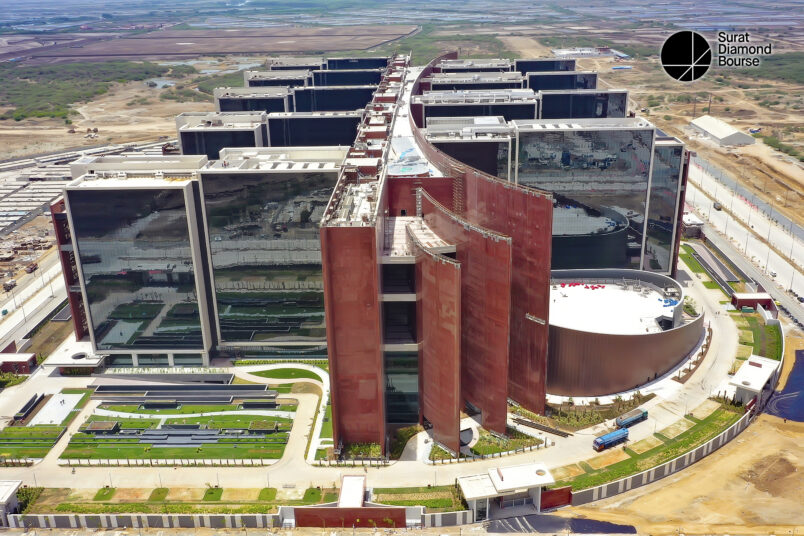
The newly-opened Diamond Bourse in Surat, India has supplanted the Pentagon as the world’s largest office building after an 80-year run.
Like Morning Memo? Let us know!
‘Zombie Fires’ In The Arctic: Canada’s Extreme Wildfire Season Offers A Glimpse Of New Risks In A Warmer, Drier Future
This article is part of TPM Cafe, TPM’s home for opinion and news analysis. It was originally published at The Conversation.
The blanket of wildfire smoke that spread across large parts of the U.S. and Canada in 2023 was a wake-up call, showing what climate change could feel like in the near future for millions of people.
Apocalyptic orange skies and air pollution levels that force people indoors only tell part of the story, though.
As global temperatures rise, fires are also spreading farther north and into the Arctic. These fires aren’t just burning in trees and grasses. New research on the exceptional Arctic fire seasons of 2019 and 2020 points to fires moving into the ground as well.
These underground fires are known as “zombie fires,” and there are a number of reasons to worry about the trend.
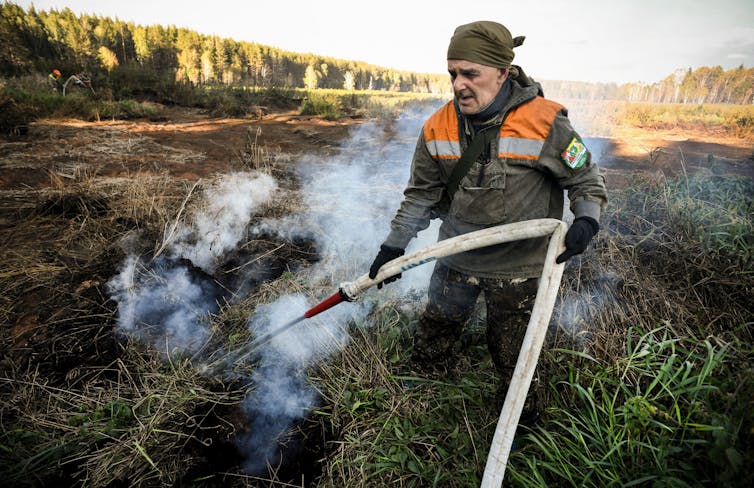
First, as the organic-rich Arctic soils dry up because of changing climate conditions, they can burn slowly and release vast amounts of smoke into the atmosphere.
Second, soil fires that spread underground are harder for firefighters to tame and extinguish, thus demanding more resources for longer periods of time. Firefighters in Alberta, Canada, where carbon-rich peatlands are common, have been dealing with fires smoldering to depths dozens of feet underground in 2023. Because peat fires can make the ground unstable, using heavy equipment to excavate the fire areas also becomes risky.
Finally, these soil fires don’t die easily. Recent research finds that Arctic soil fires can smolder through the winter and reignite during early spring when temperatures rise, hence the nickname “zombie fires.”
The Arctic is increasingly flammable
Wildfires have been a natural part of northern forest and tundra ecosystems for thousand of years. However, the severity, frequency and types of wildfires in northern and Arctic regions have changed in recent decades.
One major culprit is the rising temperature: The Arctic is warming nearly four times faster than the rest of the world, a phenomenon known as Arctic amplification.
While governing bodies that are working to curtail the pace of climate change worry about exceeding a 1.5-degree Celsius (2.7-degree Fahrenheit) threshold globally, the Arctic has already exceeded a 2 C (3.6 F) increase compared with pre-industrial times. That rise in temperature brings with it a number of changes to the environment that make the forest and tundra more susceptible to burning, for longer, and in more extensive ways than just a few decades ago.
Among the changing conditions that favor wildfires are changes in atmospheric circulation that create periods of extreme heat, dry out vegetation and reduce moisture in soils, and, importantly, lead to more frequent lightning strikes that can spark blazes.
Although lightning remains infrequent at very high latitudes, it is expected to increase and expand over larger territories into the far north as the climate warms and generates more storms that can produce lightning. In 2022, thousands of lightning strikes help sparked one of Alaska’s worst fire seasons on record.

As the Arctic warms and fires move farther northward, peat soils rich in dead plant material burn at an accelerated rate.
The burning peat also removes the layer insulating permafrost, the region’s frozen carbon-rich soil. Northern ecosystems store twice as much carbon in their peat and permafrost as the atmosphere, and both are increasingly vulnerable to fire.
About 70% of recorded area of Arctic peat affected by burning over the past 40 years occurred in the last eight years, and 30% of it was in 2020 alone, showing the acceleration.
What is a zombie fire?
Most people picture wildfires as catastrophic flames consuming trees and grasses. Ground fires, on the other hand, do not flame but burn more slowly and have the tendency to spread deep into the ground and spread laterally.
The result is that ground-smoldering fires are not only less visible, but they are also less accessible and require digging up and dousing with lots of water.
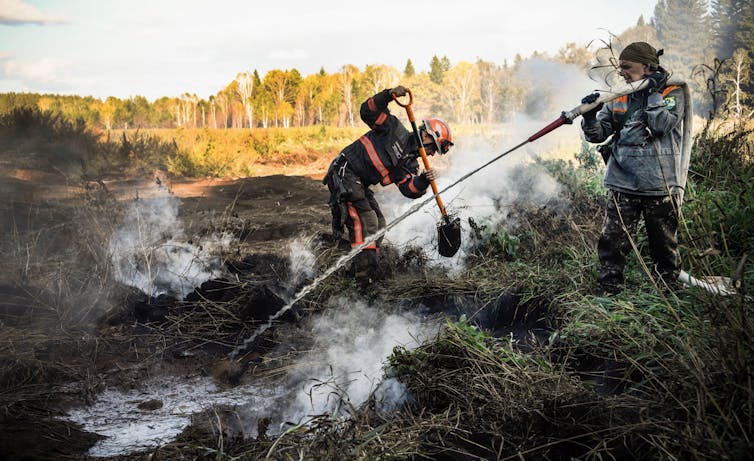
These smoldering fires also produce more smoke because of their lower temperature of combustion. Ultra-fine particles in smoke are particularly harmful to the respiratory and cardiovascular systems and can be carried far and wide by winds.
Because of the slow combustion process and the abundance of fuel in the form of carbon and oxygen, smoldering ground fires can also burn for months and sometimes years. They have been shown to “overwinter,” persisting through the cold season to reemerge in the warm, dry season. During the 2019-2020 fire season in Siberia, zombie fires were blamed for rekindling fires the following year.
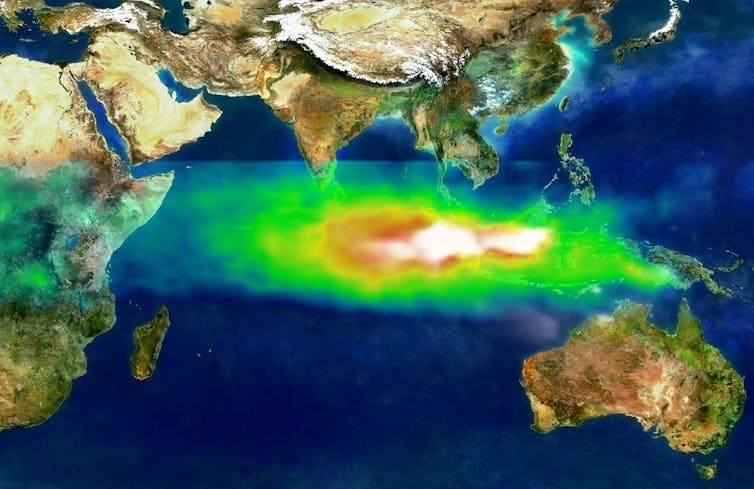
Some of these ground fires can become so massive that they release smoke plumes that cover vast geographical regions. In 1997, peat fires in Indonesia sent dangerous levels of smoke across Southeast Asia and parts of Australia and increased carbon emissions. They were ignited by slash-and-burn activities to plant palm plantations and amplified by drought conditions during a severe El Niño event.
Some hope and caution from past lessons
I have been studying the effects of wildfires on air and water, including in the Arctic, for many years. My work and that of many colleagues, however, focus on the combustion of above-ground biomass. More work is needed to understand the full extent of zombie fires in the Arctic and their potential for carbon and smoke emissions on a large scale. One recent study conducted at a handful of Canadian sites offered some hope, suggesting underground fires there were burning more in tree roots than in soil, suggesting potentially lower carbon emissions in some areas.
In the meantime, the continuing waves of wildfire haze in Canada and the U.S. are a reminder of the impact of these fires.
More regions will need help from trained firefighters, meaning sharing firefighting resources. Canada has seen an unprecedented level of international fire support in 2023. Best practices for safely fighting zombie fires are also needed, along with better public education about the health risks of wildfire smoke.
As a society, we are learning to live with some of the effects of climate change, but the risks are rising around the world.
This article is republished from The Conversation under a Creative Commons license. Read the original article.
