

Sen. Tommy Tuberville (R-AL) on Monday refused to walk back statements he recently made defining white nationalists as nothing more than your average patriotic “Americans.”
Continue reading “Tommy ‘110-Percent-Against-Racism’ Tuberville Still Doesn’t Think White Nationalists Are Racist”To Sabotage Or Not Sabotage The Tax Code? For SCOTUS, That’s The Question
The Supreme Court may be poised to upend how the federal government has collected money for more than a century, with wide-reaching implications for Congress, policymakers, businesses, and those who hope to one day collect more from the wealthiest Americans.
Continue reading “To Sabotage Or Not Sabotage The Tax Code? For SCOTUS, That’s The Question”The Extraordinary Clown Show Continues
Yesterday we noted how a major tentpole in the House GOP’s “crime family” investigations of President Biden collapsed when U.S. Attorney David Weiss denied there was any interference in his investigation. Now we have a revelation that manages to be even more stunning while being somehow entirely predictable. We and others last month had some fun at the expense of investigative ringleader Rep. James Comer (R-KY) when he said he had “lost” what he claimed was his top Biden whistleblower. What this meant was never clear and given how things work in Republican investigations it was never certain whether it actually “meant” anything. Now we know what he meant.
Continue reading “The Extraordinary Clown Show Continues”Trump: You Can’t Put Me On Trial While I’m POTUS, Or Now, Or Ever
A lot of things happened. Here are some of the things. This is TPM’s Morning Memo.
Too Bad For You, America!
A series of pre-trial developments in the Mar-a-Lago case culminated in a late-night filing in which former President Donald Trump sought to have his trial postponed indefinitely.
Some of the filing is the usual defense counsel performative moaning and groaning and sighing heavily about all the work involved and the inherent advantages prosecutors have over them because they’ve long had access to the evidence, blah blah blah. To that end, Trump wants U.S. District Judge Aileen Cannon to:
- withdraw her order for an August 2023 trial;
- reject DOJ’s proposal for a December 2023 trial; and
- postpone indefinitely even setting a trial date.
But there’s more than the usual slow-rolling going on here. And it matters to the big question of whether Cannon can and will keep the Mar-a-Lago case on track for a trial before the 2024 presidential election.
Trump’s claims in this regard are remarkable:
- He’s too busy running for president to be put on trial.
- He’s too busy with other criminal and civil trials to add this one to the calendar.
- He’s still trying to make the case about the Presidential Records Act (it’s not).
- “There is no ongoing threat to national security interests nor any concern regarding continued criminal activity.”
- You can’t find an impartial jury in the midst of a presidential election.
The overall thrust of the filing by Trump is that a trial before the election is not advisable, though it stops short of saying so explicitly.
The ball in now in Cannon’s court. More on that in a moment.
What Else Happened In The MAL Case
Trump’s late-night filing came after a day of maneuvering by the defense team to delay and drag out the proceedings. In this respect, Trump co-defendant Walt Nauta is a stalking horse for Trump.
Nauta’s protracted effort to find local counsel in Florida delayed his arraignment in mostly insignificant ways (though all the delays eventually add up), but Nauta is now using the fact that he has new counsel as justification for delaying the initial pre-trial hearing in the case, scheduled for July 14. Nauta raised all kinds of other objections to holding the pre-trial hearing this week, including one of his lawyer’s involvement in an ongoing trial back in DC.
DOJ was ready for any attempt to delay the proceedings, and quickly objected. (In a weird sidenote to all this, the judge in the DC case Nauta lawyer Stan Woodward is involved in right now said in open court that his chambers had heard from U.S. District Judge Aileen Cannon’s chambers about his trial schedule, presumably as she searched for a suitable new date for the pre-trial hearing.) DOJ also complained that Woodward was misrepresenting prior conversations between himself and prosecutors.
Confused? Don’t worry. In a filing later in the day, defense attorneys said they reached an agreement with DOJ that the pre-trial hearing can be pushed to July 18, when Woodward is not in trial. Judge Cannon still must sign off on that agreement, but it looks likely to be resolved with minimal additional delay.
What’s Next In The MAL Case?
All eyes are on U.S. District Judge Aileen Cannon to see if she plays ball with Trump’s delay tactics or takes steps to keep the case on track.
- The first thing we should expect from Cannon is a ruling on whether to move the pretrial hearing and if so to when.
- The bigger question is what she will do about the trial date: DOJ wants an aggressive December 2023 trial, and Trump wants no trial date. Not just where she lands but how she gets there could be crucial in determining whether this case goes to trial before the presidential election.
I expect we will get a ruling on rescheduling the pretrial hearing as soon as today. If I were a betting man, I wouldn’t look for a decision from her on a trial date until she’s heard from both sides again at the pretrial hearing, whenever that ultimately happens but probably next Tuesday.
Fani Willis Is Getting Her Real Grand Jury
The Georgia grand jury that will likely consider criminal charges against Donald Trump for his efforts to interfere in the state’s 2020 election is being seated today in Atlanta.
I Need Your Feedback
How much do you want Morning Memo covering the procedural ins and outs of the Trump prosecutions?
Too much of that coverage I find boring, to be honest. But eschewing all of it risks the narrative become fractured and misleading.
So I’m shooting for a balance: Alerting you to significant developments and trying to succinctly explain things that are either inherently confusing or that have been muddled in the larger coverage.
Let me know how that suits you (email address at the bottom of Morning Memo).
Meanwhile …
The whacked-out former president is wildly decompensating:
DOJ Moves At High Speed In Social Media Case
Within a couple of hours of a Trump judge in Louisiana handing the Justice Department a defeat, it sought emergency relief from the 5th Circuit Court of Appeal to pause the judge’s extraordinary injunction blocking several segments of the federal government from contacting social media platforms about mis- and disinformation.
Fox’s Next Dominion Disaster?
Ray Epps is reportedly gearing up to file a defamation lawsuit against Fox News after being vilified by Tucker Carlson on air for more than 18 months in nearly 20 episodes, the NYT reports.
Cough It Up!
Former Trump adviser Steve Bannon has been ordered by a state judge in New York to pay nearly half a million dollars to his former lawyers for overdue and unpaid legal fees
The Dominance Space
Elon Musk’s Twitter is now a place centered on performative supremacy, Philip Bump notes, which partly explains why right-wingers need for social media platforms with broad appeal to exist. They need opponents: “Musk has attained dominance and offers it to you for only $8 a month — at least until everyone who isn’t interested in using social media primarily to bolster their self-esteem has left for less annoying pastures.”
Help Increase Our Thread Count!
We’re giving the new Threads a shot. It doesn’t have some of Twitter’s most useful tools yet (lists, please, and desktop functionality!), but a lot of you are flocking there. You can find me here. And TPM here.
The New Normal
Last summer’s heat wave in Europe killed more than 61,000 people, according to a new study, reinforcing the fact that excessive heat is the deadliest kind of extreme weather event.
Even White Nationalists Must Be Laughing
Sen. Tommy Tuberville (R-AL), not known as the smartest guy in the Senate, doesn’t seem to know the difference between the quiet part and the loud part. Or the meaning of words. Or that “white nationalist” doesn’t mean a patriot who happens to be white.
Like Morning Memo? Let us know!
Correction: MM originally gave conflicting information about DOJ’s proposed trial date for the Mar-a-Lago case: It proposed December 2023. My apologies for the confusion.
Same Old Same Old
Let me flag something to your attention. For the better part of two weeks the national press was consumed by House Republican claims that there was a cover-up in the investigation of the President’s son Hunter Biden and that the investigation had essentially been shut down by DOJ political appointees. According to a purported IRS whistleblower, U.S. Attorney David Weiss had been turned down when he requested special counsel status. His efforts to bring additional and more serious charges against the younger Biden were thwarted. Just as it seemed that the whole saga had come to a conclusion, suddenly it was ramping back up again, despite very little evidence that any of the claims were true.
Continue reading “Same Old Same Old”DOJ Immediately Tries Again After Trump Judge Denies Request To Pause His Social Media Contact Ban
A Trump-appointed district court judge denied the administration’s request to pause his sweeping ruling preventing many government entities from flagging social media misinformation to the platforms Monday, claiming that those being “censored” suffered far a greater injury than the government.
Continue reading “DOJ Immediately Tries Again After Trump Judge Denies Request To Pause His Social Media Contact Ban”Meatball Ron, His Rubber Stamp House and a Gay Fondling Cover-Up
Ordinarily this would not be a surprising or especially newsworthy story, at least not at the national level. A controversy-tangled freshman Republican member of the Florida state House of Representatives, Fabian Basabe, has been accused of sexual harassment and some mix of unwanted touching and assault by two members of his staff. Basabe, 45, is billed as a former New York City socialite who appeared on a couple reality shows. He’s married Martina Borgomanero, the heiress to a lingerie fortune. (A very South Florida story, as you can tell — he represents Miami Beach and environs.) He was already in some hot water in his socially tolerant, gay-friendly district for voting in lockstep with state Republicans pushing Ron DeSantis’s anti-“woke”/LGBTQ agenda. The accusers are one staffer, Nicholas Frevola, 25, and one former intern, Jacob Cutbirth, 24.
As I said, not unremarkable, but bordering on a news story cliche: An apparently closeted, if in this case perhaps lightly closeted, Republican rep accused of harassing and fondling male staffers. He denies it; news at 11.
Where it gets interesting though is that the investigation by The Miami Herald and CBS News Miami strongly suggests a cover-up by the Republican leadership of the state House, specifically House Speaker Paul Renner, a key DeSantis ally.
Continue reading “Meatball Ron, His Rubber Stamp House and a Gay Fondling Cover-Up”Clarence Thomas Has A History Of Snagging Free Stuff
A lot of things happened. Here are some of the things. This is TPM’s Morning Memo.
Must Read
Building on the recent ground-breaking work by ProPublica, the NYT added to the picture of the most senior justice on the Supreme Court with a Sunday piece titled: “Where Clarence Thomas Entered an Elite Circle and Opened a Door to the Court.”
The revelations in the latest piece may not be has glaringly problematic as ProPublica’s recent batch of Clarence Thomas stories, but in a way it paints a darker picture. Thomas has been accepting free stuff since well before he was confirmed to the Supreme Court:
- Bahama vacation: “A former girlfriend said in an interview that ‘a buddy’ of Justice Thomas had paid for their vacation in the Bahamas in the mid-1980s, when he was chairman of the Equal Employment Opportunity Commission. … In the mid-1980s, divorced and with custody of his son, Justice Thomas dated a woman named Lillian McEwen. In an interview, she remembered the Bahamas vacation, at a house with a caretaker and a car. She never knew the identity of the ‘buddy’ footing the bill but understood it to be a professional contact because that was how the justice referred to such people, she said.”
- Wedding reception: “A longtime friend said he had paid for the justice’s 1987 wedding reception. … Not long after Ms. McEwen and Justice Thomas broke up, he met Virginia Lamp, known as Ginni. They married in 1987; Armstrong Williams, a close friend from Justice Thomas’s earliest days in Washington who is now a conservative commentator, said in an interview that he paid for their wedding reception.”
The bulk of the NYT piece is focused on Thomas’ affiliation with something called the Horatio Alger Association of Distinguished Americans, which offered mutual access between Thomas and “extraordinarily wealthy, largely conservative members who lionized him and all that he had achieved.” That led to additional freebies of the kind ProPublica has previously documented. But again, Thomas’ willingness to accept such largesse appears to well pre-date his ascension to the high court.
Always Read Linda Greenhouse
The former NYT Supreme Court reporter: Look at What John Roberts and His Court Have Wrought Over 18 Years
House GOP Targets Chris Wray This Week
FBI Director Christopher Wray is scheduled to appear Wednesday before the House Judiciary Committee, where the House GOP’s assault on the rule of law and on an independent Justice Department will continue.
The committee itself says it will use the Wray hearing to “examine the politicization of the nation’s preeminent law enforcement agency under the direction of FBI Director Christopher Wray and Attorney General Merrick Garland.”
To give you a flavor of the right-wing attack plan here, check out the conservative Washington Examiner’s “Seven unanswered questions ahead of FBI Director Wray’s testimony”:
- Why did the FBI withhold the FD-1023 from Congress?
- Why did the FBI’s Washington field office conduct the raid of Mar-a-Lago, in a break from standard practice?
- Why did the FBI limit the number of witnesses who IRS investigators could contact during the Hunter Biden investigation?
- What has the FBI done to investigate attacks on anti-abortion centers and churches?
- Are agents who worked on the Russia investigation still at the FBI?
- How closely has the FBI worked with social media companies to censor speech?
- Has Merrick Garland ever asked you to stand down on an investigative step?
Alright, we’re back from that dip into wingnut-o-sphere. You okay? We’ve got one more …
My Head Hurts
The REAL Weaponization
NYT:
John F. Kelly, who served as former President Donald J. Trump’s second White House chief of staff, said in a sworn statement that Mr. Trump had discussed having the Internal Revenue Service and other federal agencies investigate two F.B.I. officials involved in the investigation into his campaign’s ties to Russia. …
“President Trump questioned whether investigations by the Internal Revenue Service or other federal agencies should be undertaken into Mr. Strzok and/or Ms. Page,” Mr. Kelly said in the statement. “I do not know of President Trump ordering such an investigation. It appeared, however, that he wanted to see Mr. Strzok and Ms. Page investigated.”
This Week In Trump Prosecutions …
Today: Trump is due to respond to the government’s request to continue the Mar-a-Lago until January 2024. This will be Trump’s first bite at trying to delay the trial until after the 2024 election.
Friday: A hearing is scheduled before U.S. District Judge Aileen Cannon in the Mar-a-Lago case to address pre-trial matters related to the use of classified information. This hearing may provide an early indication of how quickly – or not – Cannon will move the case along.
Lemme Fetch The World’s Tiniest Violin
Lin Wood, who just surrendered his law license rather than be disbarred, calls himself the “second-most persecuted person in America” after Donald Trump.
It’s Bad, Y’all
WaPo:
A July 4 injunction that places extraordinary limits on the government’s communications with tech companies undermines initiatives to harden social media companies against election interference, civil rights groups, academics and tech industry insiders say.
After companies and the federal government spent years expanding efforts to combat online falsehoods in the wake of Russian interference on the platforms during the 2016 election, the ruling is just the latest sign of the pendulum swinging in the other direction. Tech companies are gutting their content moderation staffs, researchers are pulling back from studying disinformation and key government communications with Silicon Valley are on pause amid unprecedented political scrutiny.
It Gets Weirder
Wagner boss Prigozhin met with Vladimir Putin after the failed mutiny last month, the Kremlin says.
For Your General Awareness …
- President Biden is in the UK Monday for meetings with the king and the prime minister ahead of a two-day NATO summit in Vilnius, Lithuania. He’ll end the trip with a visit to Finland, NATO’s newest member.
- Congress is back for its final push before the long August break.
2024 Ephemera
- NV-Sen: Republican Sam Brown will seek the GOP nomination to challenge Sen. Jacky Rosen (D-NV). Brown, badly injured by an IED while serving in Afghanistan, lost in the GOP Senate primary last year. This time, the NRSC is already throwing its support to Brown, trying to avert another general election disaster where the party nominates an extremist. Big Lie aficionado Jim Marchant, who lost the secretary of state race last year, is the candidate the NRSC wants to pre-empt making it to the general election.
- Win it Back, a group with ties to the Club For Growth, is beginning a $3.6 million anti-Trump TV ad blitz in the early GOP primary states of Iowa and South Carolina.
- The New Yorker’s David Remnick interviews Robert F. Kennedy, Jr.
Sole Suspect In 1982 Tylenol Murders Has Died
James Lewis, the lone suspect in the 1982 Tylenol murders, was found dead Sunday at his home in suburban Boston, multiple law-enforcement sources confirmed to the Tribune.
His death comes after 40 years of intense scrutiny from law enforcement, in which Lewis played a cat-and-mouse game with investigators. Local authorities questioned him as recently as September as part of a renewed effort to bring charges in the case.
With the investigation’s only suspect dead, it now seems unlikely that charges will ever be brought in poisonings that killed seven people and caused a worldwide panic.
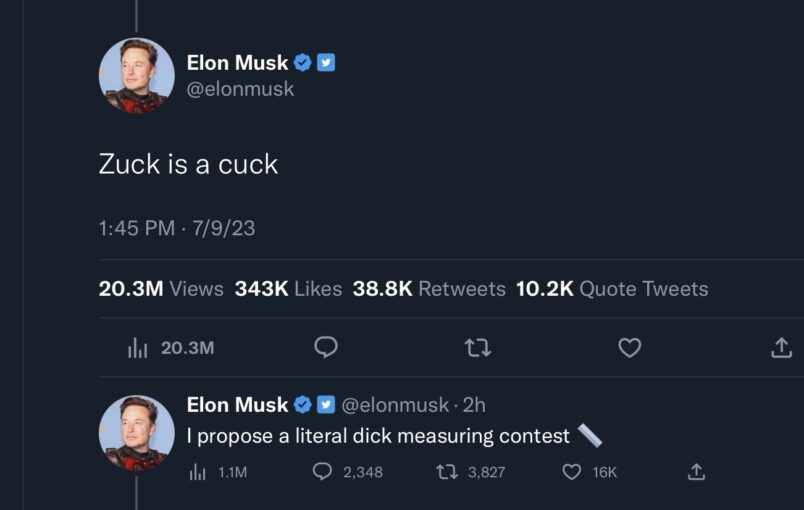
The Gelded Age?
I leave you this morning with Elon self-fiddling while the world burns:
Like Morning Memo? Let us know!
Santos Compares Himself To Rosa Parks, Saying He Refuses To ‘Sit In The Back’
Embattled Rep. George Santos (R-NY) compared himself to civil rights icon Rosa Parks during a podcast interview last week, saying as “a Latino gay man” he will not “sit in the back.”
Continue reading “Santos Compares Himself To Rosa Parks, Saying He Refuses To ‘Sit In The Back’”Kakhovka Dam Breach In Ukraine Caused Economic, Agricultural And Ecological Devastation That Will Last For Years
This article is part of TPM Cafe, TPM’s home for opinion and news analysis. It was originally published at The Conversation.
When an explosion breached the Kakhovka Dam in Ukraine on June 6, 2023, much analysis focused on near-term impacts, including the flooding of the city of Kherson, threats to the Zaporizhzhia Nuclear Power Plant and consequences for Ukrainian military forces’ expected spring offensive against Russian troops.
But the most severe long-term effects will fall on Southeast Ukraine’s farmers.
Villages there were flooded. Roads, train tracks and irrigation canals were washed away. Crops in fields and orchards in the Kherson and Zaporizhzhia region were inundated, then left to shrivel after the water drained.
The long-term ecological disaster will unfold over decades to come. Crimea, once a region known for its sunny beaches and rice fields, could dry up without irrigation.
We are a U.S. political scientist with research expertise on the post-Soviet region and a Ukrainian economist who studies agriculture. While the long-term effects of the dam break are difficult to calculate, we believe that it will have a lasting impact on the climate of southern Ukraine.
Farmland that is no longer irrigated and cultivated because canals are destroyed and the reservoir drained will dry up, becoming more vulnerable to soil erosion and dust storms. Agricultural production could be reduced for years to come, with impacts that ripple through supply chains and affect food security around the world.
As we see it, the dam explosion has all the hallmarks of a scorched-earth strategy, intended to destroy anything that might be useful to the enemy. It is hard to imagine any country inflicting damage this sweeping on its own soil.


A fertile farming region
Like other Soviet hydroelectric projects, the Kakhovka Dam and power plant were hailed as harbingers of progress and a bright socialist future when they were built in 1956 on the Dnieper River. The North Crimean and Dnieper-Kryvyi Rih canals, constructed in the 1960s and 1970s, transported water from the Kakhovka reservoir to Crimea in the south and the Kryvvi Rih iron ore basin and Zaporizhzhia nuclear power plant in the north.
Local villages and towns came to depend on water and electricity from the dam and its reservoir. Some 545,000 acres (220,000 hectares) of arable land in these two regions are irrigated, including over 20% of Kherson’s farmland.
Kherson’s farms grow watermelons and tomatoes. The region’s cherry, apricot, peach, apple and plum orchards produce Ukraine’s sweetest fruits. Southeast Ukraine also grows vast quantities of soy and sunflower seeds, mostly destined for global markets.
Flooded fields, toxic water
The dam breach inundated fields along the Dnieper’s banks. By July 1, the Dnieper River near the Kherson post had returned to its natural level, although a number of settlements in the territory temporarily occupied by Russian forces remained submerged.
Based on conditions that have been reported so far, we expect that this year’s crops in the flooded zone will be waterlogged, and much of the harvest will be destroyed. Valuable perennial crops that relied on irrigation infrastructure fed by the reservoir will be flooded and then parched. Rich and productive topsoil may be washed away. https://www.youtube.com/embed/64NsrW3AVB8?wmode=transparent&start=0 A news report a week after the dam breach shows the scale of the initial flooding.
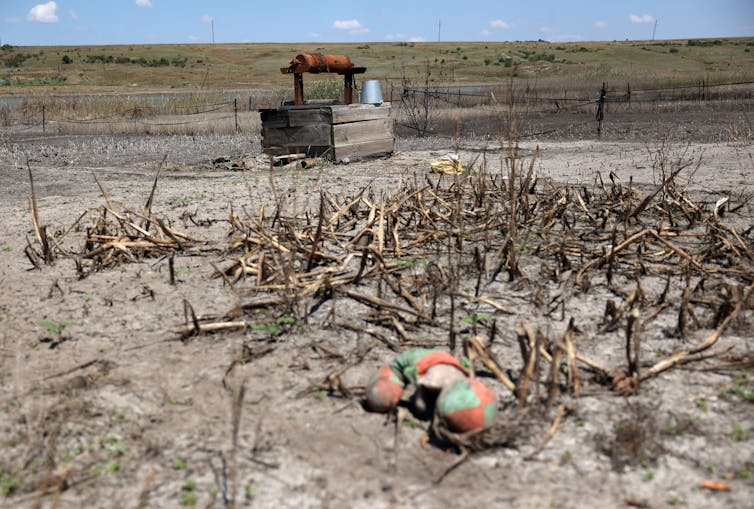
Farther downstream, the lower Dnieper, Southern Bug and Inhulets river basins have been polluted, imperiling agriculture and drinking water for southern Ukraine. During the dam breach, 150 tons of oil leaked out, and at least 17 gas stations have been flooded. There is widespread concern about impacts on the region’s wildlife, including many types of nesting and migratory birds.
After the flood, water shortages
Flooding from the reservoir also imperiled infrastructure that is critical for Ukraine’s agricultural exports, including irrigation canals, hydraulic pumping stations, river ports and grain terminals.
Most importantly, without water from the reservoir, the fields of Kherson, Zaporizhzhia and Crimea will dry out. Coastal towns on the Sea of Azov, most importantly Berdyansk, have lost their main source of drinking water.
Crimea is particularly dependent on irrigation. Before Russia annexed it in 2014, Crimea’s farms planted rice and corn. After the annexation Ukraine blocked water from flowing to Crimea. When Russia captured Kherson in March 2022, it reopened the North Crimean Canal and allowed the peninsula’s reservoirs to fill.
Without the Kakhovka Reservoir, however, Crimea is unlikely to receive irrigation water for at least a decade. Effectively, the peninsula will turn into a desert with a naval base.
Fewer exports, higher prices
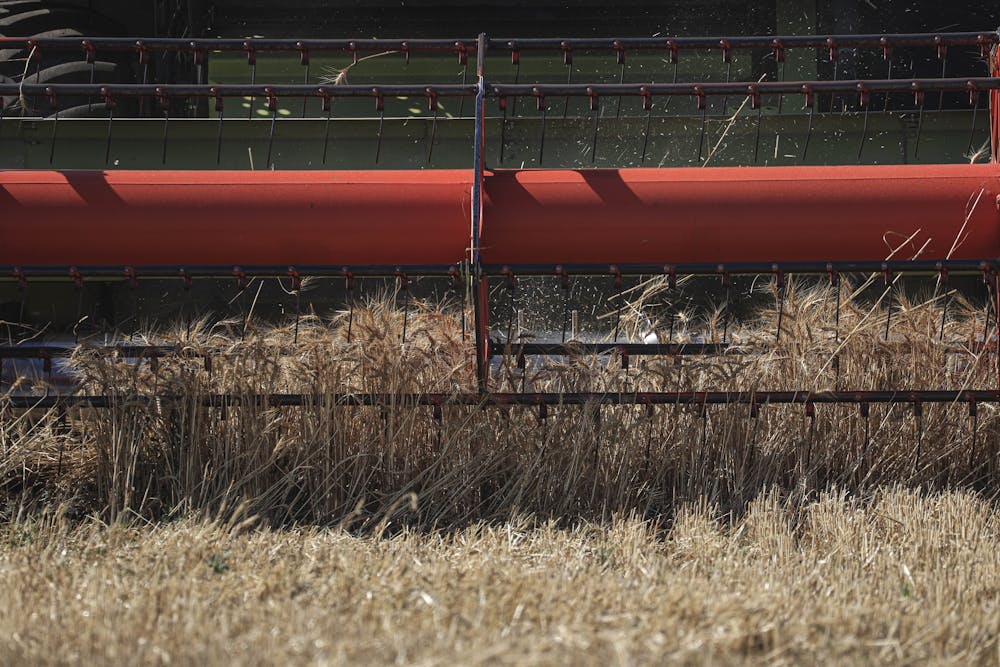
Beyond Ukraine, the dam breach will critically affect global food supplies. Southern Ukraine’s sunflower seeds, soy and cereals are major ingredients for industrially processed foods and livestock feed. They provide the proteins and lipids that are the building blocks of the 21st-century diet.
After these commodities are harvested, they have to be dried, transported domestically, stored and then shipped internationally. Many facilities along the Dnieper and its tributaries are key nodes in the supply chains that connect Ukrainian farms with world markets.
Storage elevators and loading terminals at the port of Kozatske, located just downstream of the dam, were inundated within hours of the breach. The upstream ports of Kamianets-Dniprovska, Nikopol and Enerhodar are closed and likely will be inoperable for years to come.
Global food commodity prices shot up hours after the dam broke, as global grain traders anticipated food commodity shortages. U.N. aid chief Martin Griffiths told the BBC that the impact on food security could be significant.
“… That whole area going down towards the Black Sea and Crimea is a breadbasket not only for Ukraine but also for the world,” Griffiths told the BBC. “It is almost inevitable that we are going to see huge, huge problems in harvesting and sowing for the next harvest. And so what we are going to see is a huge impact on global food security.”
An uncertain future
Loss of the Kakhovka Dam is the latest blow to a region that has suffered heavily during the war. Most fields along the lower Dnieper are littered with mines. NASA satellite images show crops planted in 2022 that were never harvested.
Before the dam breach, the area under cultivation in 2023 in Ukraine had already contracted by 45%, and overall yields had fallen by as much as 60% compared with 2021 before the war. With the loss of the dam and reservoir, harvests are likely to shrink further.
Many residents of the area’s 80 inundated villages are farmers. If and when they are able to return to their land, the fields and orchards may not be able to produce and earn enough to sustain their families, who have already suffered grievously during heavy fighting in Kherson and Zaporizhzhia.
In 1941, Joseph Stalin ordered Soviet troops to destroy the predecessor of the Kakhovka Dam to slow the advancing German army. It was not rebuilt until 1956. Even if postwar relief efforts can replace the Kakhovka Dam more quickly, we expect that droughts between now and then will virtually destroy rural life in southeastern Ukraine as it existed before June 6.
This article is republished from The Conversation under a Creative Commons license. Read the original article.
