You’ve probably seen the brouhaha about ersatz Democratic presidential candidate Robert F. Kennedy Jr. getting in trouble for saying that COVID was “ethnically targeted” to “spare the Jews.” I wanted to take a moment to dig into just what happened, just what he said and what if anything it all means. This is one of those crazy and yet in many ways predictable stories that manages to be both deeply stupid and yet also quite illustrative of our times.
First, what’s the story? I noticed immediately that all the coverage stemmed from a single story in The New York Post (not a great sign) by Jonathan Levine. I’ve had a couple run-ins with Levine over the years, or at least I’ve seen pieces of his that struck me as tendentious, either by design or lack of familiarity with certain political questions. Don’t get hung up on whether I was right or wrong about him. I note this only to highlight that even though I have an extremely low opinion of RFK Jr. I went into this story with more than a little skepticism.
But in this case, Levine was right on the mark. Kennedy’s words are his words. In fact Levine was so right on the mark it’s a bit shocking he was the only one to write it up. Lots of reporters were at this dinner and a lot of them wrote it up. But none mentioned this. The most one can say about Levine’s reporting in this case is that he drew out the obvious implication of Kennedy’s remark which was necessary because Kennedy used the standard many-people-are-saying and just-asking-questions type phrasings that are the calling card of his brand of conspiracy freaks. But again, his words are his words. He’s guilty as charged.
A lot of things happened. Here are some of the things. This is TPM’s Morning Memo.
All Insurrection-ing Is Local
A few developments over the last few days in Special Counsel Jack Smith’s Jan. 6 investigation that I want to draw your attention to. A word of caution though: These developments are recently surfaced in the coverage, which isn’t the same thing as new.
We’re invariably limited in what we can see of Smith’s investigation, and there’s a tendency to frame up what we do see as if it mirrors the reality of what is going on. It may, but it also may not. Another tendency is to imbue newly surfaced developments with a sense of movement, like Jack Smith has turned his attention to the local angle. Again, maybe. But our view is very constrained, so our conclusion should be tentative and contingent.
With that out of the way, a few of the new data points:
Milwaukee’s top election official confirms that she spoke with Smith’s team last month virtually.
New Mexico’s secretary of state was interviewed by Smith’s team in “recent months”
Pennsylvania’s secretary of state met with Smith’s team in March.
Michigan’s secretary of state was interviewed for several hours by Smith’s team in March.
As you can see, the timing above doesn’t suggest this is a sudden turn in in the investigation or a newly discovered angle. Also recall that subpoenas were sent out last year to many of these same election officials as part of the Jan. 6 probe.
There’s three broad categories of potential significance for these efforts by Smith:
Charging threats and intimidation against election officials;
Using the threats and intimidation to illustrate the larger conspiracy and its effects;
Less sexy: tying up loose ends and closing off avenues of investigation.
Here’s a salient thread on the recent developments that goes a little deeper than Morning Memo will today:
Something very significant in this new reporting.👇
Suggests a new track of Special Counsel investigation: into threats of violence and intimidation against state officials.
We’ll get our first real read on whether U.S. District Judge Aileen Cannon is going to bend over backwards to accommodate former President Donald Trump when she convenes the first substantive pre-trial hearing in the Mar-a-Lago case on Tuesday.
The target letter is aimed at a low-level employee of Trump’s family business who had dealings at Mar-a-Lago, the former president’s Florida home and private club. The worker is not an executive or someone with significant decision-making authority, said the person, who spoke on the condition of anonymity to discuss an ongoing investigation.
Poor Rudy
The Messenger: “Rudy Giuliani Could Be at the Ultimate Crossroads: To Protect Trump or Protect Himself”
Kari Lake’s legal team, including lawyer Alan Dershowitz, must pay $122,200 in sanctions after a federal court in Arizona found that the former Republican gubernatorial candidate’s lawsuit contesting voting methods was “frivolous.”
Trump’s Weird Mandamus Thing In Georgia
In another sign of his desperation, former President Donald Trump is imploring the Georgia Supreme Court to help him avoid being indicted in Atlanta. There’s really no precedent for the kind of intervention Trump is seeking, and it is probably better seen as an early public relations move aimed at potential jurors than a real legal argument.
Everything You Want To Know About Fani Willis
WSJ: The No-Nonsense Georgia Prosecutor on a Collision Course With Donald Trump
Donald J. Trump and his allies are planning a sweeping expansion of presidential power over the machinery of government if voters return him to the White House in 2025, reshaping the structure of the executive branch to concentrate far greater authority directly in his hands.
Need A Ray Epps Primer?
Liz Dye: How Tucker’s “FedEpps” conspiracy theory led to Fox News’s latest legal mess
A Worthy Debate
How to build an entirely new energy economy starting yesterday and proceed as fast as possible remains the singular challenge of our time. We should talk about it, debate it publicly, be clear-eyed about the challenges ahead. But we better not waste much time talking about. Gotta get moving.
The 5th Circuit Hasn’t Completely Lost Its Mind
The nation’s most conservative appeals court put a temporary hold on the order by a Louisiana federal judge limiting Biden administration contact with social media platforms. It also expedited oral arguments in the case.
Politico: Joe Biden is redefining presidential campaign frugality
WaPo: Robert F. Kennedy Jr. suggests covid was designed to spare Jews, Chinese people
Jayapal Walks Back ‘Israel Is A Racist State’ Remark
Rep. Pramila Jayapal (D-WA), chair of the Congressional Progressive Caucus, apologized and said she doesn’t in fact believe that Israel is a “racist state”:
Former President Donald Trump seemed to be trying to flatter his way out of part of his ongoing legal troubles by praising Judge Aileen Cannon — the U.S. District judge from Florida overseeing Jack Smith’s Mar-a-Lago classified documents case — during a Fox News interview Sunday.
This story first appeared at ProPublica. ProPublica is a Pulitzer Prize-winning investigative newsroom. Sign up for The Big Story newsletter to receive stories like this one in your inbox.
For months, Harlan Crow and members of Congress have been engaged in a fight over whether the billionaire needs to divulge details about his gifts to Supreme Court Justice Clarence Thomas, including globe-trotting trips aboard his 162-foot yacht, the Michaela Rose.
Crow’s lawyer argues that Congress has no authority to probe the GOP donor’s generosity and that doing so violates a constitutional separation of powers between Congress and the Supreme Court.
Members of Congress say there are federal tax laws underlying their interest and a known propensity by the ultrarich to use their yachts to skirt those laws.
Tax data obtained by ProPublica provides a glimpse of what congressional investigators would find if Crow were to open his books to them. Crow’s voyages with Thomas, the data shows, contributed to a nice side benefit: They helped reduce Crow’s tax bill.
The rich, as we’ve reported, often deduct millions of dollars from their taxes related to buying and operating their jets and yachts. Crow followed that formula through a company that purported to charter his superyacht. But a closer examination of how Crow used the yacht raises questions about his compliance with the tax code, experts said. Despite Crow’s representations to the IRS, ProPublica reporters could find no evidence that his yacht company was actually a profit-seeking business, as the law requires.
“Based on what information is available, this has the look of a textbook billionaire tax scam,” said Senate Finance Committee chair Ron Wyden, D-Ore. “These new details only raise more questions about Mr. Crow’s tax practices, which could begin to explain why he’s been stonewalling the Finance Committee’s investigation for months.”
Crow, through a spokesperson, declined to respond to ProPublica’s questions.
As ProPublica reported in April, Crow lavished gifts on Thomas for over 20 years, often in the form of luxury trips on Crow’s jet and yacht. One focus of the investigations is whether Crow disclosed his generosity toward Thomas to the IRS, since large gifts are subject to the gift tax. Another is whether Crow treated his trips with Thomas as deductible business expenses. (While the data sheds light on how Crow might have accounted for Thomas’ trips, there are no clear implications for Thomas’ own taxes, experts said.)
Crow’s entry into the world of superyacht owners came nearly 40 years ago. By 1984, his father, Trammell Crow, had forged his real estate fortune, and Harlan, then in his 30s, was taking an increasing role in the family business. That year, father and son worked together to erect the 50-story Trammell Crow Center in downtown Dallas. They also formed a company, Rochelle Charter Inc., with the purpose of leasing out their new yacht, the Michaela Rose.
ProPublica’s trove of IRS data, which contains tax information for thousands of wealthy individuals, includes both Harlan Crow and his parents, who filed jointly. The data shows his parents with a majority share in Rochelle Charter. After they both died, Harlan Crow took full control in 2014.
ProPublica’s data for the company runs from 2003 to 2015. Rochelle Charter reported losing money in 10 of those 13 years. Overall, the net losses totaled nearly $8 million, with about half flowing to Harlan Crow. By using those deductions to offset income from other sources, the Crows saved on taxes. (The wealthy often find ways to deduct the expense of a private jet; the records don’t make it clear whether Crow is doing so.)
Crow’s biggest deduction from the Michaela Rose came in 2014, when, after the death of his mother, Crow decided to renovate the yacht. The interior needed updating to fit more contemporary notions of glamour (for one, less gold plating). The work was expensive: Crow’s tax information shows a $1.8 million loss from Rochelle Charter that year.
In order to claim these sorts of deductions, taxpayers must be engaged in a real business, one that’s actually trying to make a profit. If expenses dwarf revenues year after year, the IRS might conclude the activity is more of a hobby. That could lead to the deductions being disallowed, plus penalties. Nevertheless, the ultrawealthy often pass off their costly pastimes, like horse racing, as profit-seeking businesses. In doing so, they essentially dare the IRS to prove otherwise in an audit.
For a yacht owner to meet the legal standard of operating a for-profit business, said Michael Kosnitzky, co-chair of the private client and family office group at the law firm Pillsbury Winthrop, “You have to be regularly chartering the yacht to third parties at fair market value,” typically through an independent charter broker.
ProPublica interviewed around a dozen former crew members of the Michaela Rose, some of whom spent years aboard the ship, and none said they were aware of the boat ever being chartered. ProPublica also reviewed cruising schedules for three different years. According to the former staff and the schedules, use of the vessel appears to have been limited to Crow’s family, friends and executives of Crow’s company, along with their guests.
Moreover, in an attempt to trademark the name of his yacht, Crow struggled to provide evidence that he chartered his ship. In 2019, an attorney representing Rochelle Charter filed an application with the U.S. Patent and Trademark Office for the request. This required demonstrating commercial use of the name Michaela Rose. The attorney, of the law firm Locke Lord, wrote that the name was used for “yacht charter services for entertainment purposes” and as evidence attached a brochure.
“This magnificent yacht has cruised the oceans of the world with a graceful and gentle motion found only on the most superior seagoing vessels,” the pamphlet said, and it went on to extoll the vessel’s “fine, seakindly hull” and “mahogany paneled formal dining room” that seats 16. But it said nothing about chartering.
“Registration is refused because the specimen does not show the applied-for mark in use in commerce,” the USPTO’s attorney responded.
Crow’s attorney asked the USPTO to reconsider. The brochure was “provided by Applicant directly to its customers and potential customers,” he wrote. Wasn’t that enough?
When USPTO again refused, the attorney provided new evidence: screenshots of the websites superyachts.com and liveyachting.com. These show “links and references to yacht ‘Charter’ services offered in connection with Applicant’s MICHAELA ROSE mark,” the attorney wrote.
At this point, the USPTO agreed to approve the trademark, but the evidence was dubious. Hundreds of ships have profiles on superyachts.com whether they are available to charter or not. The LiveYachting page merely encouraged readers to contact a broker “for finding out if she could be offered for yacht charters.”
“Reviewing the file, it’s not clear to me that the yacht was actually offered for use in commerce in a way that would justify a trademark,” said Neel Sukhatme, a professor at Georgetown Law and visiting scholar with USPTO.
Since April, when the Senate Finance Committee first sent Crow a long list of questions about Thomas’ trips on his jet and yacht, Crow has refused to provide extensive answers. But last month, his attorney, Michael Bopp of the law firm Gibson Dunn, did shed some light on how his chartering business worked: Crow leased from himself. (Gibson Dunn is representing ProPublica pro bono in a case against the U.S. Navy.)
For Crow’s personal use of the Michaela Rose, including trips when the Thomases were guests, “charter rates … were paid to the Crow family entities” that owned the yacht, Bopp wrote in a letter to Wyden. The letter did not specify who, if anyone, paid when Crow’s friends, family or employees used the vessel or how he determined the charter rate. Crow’s spokesperson declined to clarify these details.
According to Bopp, then, whenever Crow used his yacht, Crow (or one of his businesses) would pay his own company, Rochelle Charter, and Rochelle Charter would put that down as revenue. On the other side of the ledger would go the considerable expenses of operating the yacht: maintenance, crew, fuel and other costs. If, at the end of the year, Rochelle Charter’s revenue from chartering exceeded those expenses, Crow would pay tax on that income.
But the taxes of the ultrawealthy often have an up-is-down quality. The clear incentive is to welcome losses, not profits. If, as happened most years for which ProPublica has data, Rochelle Charter’s expenses far exceeded revenue, Crow would save on taxes.
These sorts of arrangements “should be aggressively audited,” said Brian Galle, a professor at Georgetown Law and former federal prosecutor of tax crimes.
“Assuming that the uses of the yacht are mostly personal, Crow should not be able to take a deduction,” he said, calling “absurd” the idea that “the more personal use you get from the yacht, the more deduction you get to claim.”
Crow treated personal trips on his jet in a similar fashion, according to his attorney. Wealthy business owners often derive tax savings from their jets, since business-related flights are fully deductible, and the rich can often find ways to blend business and pleasure, as ProPublica has reported. The company that owns Crow’s jet is not in ProPublica’s data set, so it’s unclear if it reported net losses.
Bopp’s letter describes the standard way that jet owners account for nonbusiness guests: “Reimbursements at rates prescribed by law,” he wrote, were paid to the Crow business that owned his jet. The IRS has a “Standard Industry Fare Level” that jet owners use to calculate the value of a seat aboard a jet for any trip. The amount is roughly equivalent to the cost of a first-class commercial ticket, far below what it would actually cost to charter a jet.
The Senate investigation has also focused on an entirely different tax question: Given that Thomas’ trips on Crow’s jets and yachts could easily be valued in the hundreds of thousands of dollars, did Crow report them to the IRS as taxable gifts?
For each year that Crow gave gifts to someone that exceeded a certain threshold ($17,000 in 2023), he was required to file a gift tax return. That might or might not have resulted in a tax bill for Crow, depending on how much he’d already given to others over the course of his life. (The lifetime limit for total gifts is $12.9 million in 2023.)
But, according to Bopp’s letter, Crow didn’t consider the trips reportable. The gift tax, Bopp wrote, was created to prevent people from avoiding the estate tax by simply giving away assets before death. But Crow still owned his jet and yacht after hosting Thomas. “Value [was] not transferred out of the hosts’ taxable estates,” he argued. Therefore, no gift tax.
Tax experts told ProPublica, on the contrary, that these sorts of luxury trips should be analyzed as gifts.
Beth Kaufman, a partner with Lowenstein Sandler who specializes in estate planning and a veteran of the Treasury Department’s Office of Tax Policy, said she’d counseled clients on the issue. After one couple took their extended family on an exotic vacation, she said, she helped them calculate the reportable costs and file a gift tax return.
However, taxpayers rarely report these sorts of trips, experts said. One important factor is that the IRS has no way of knowing about gifts like these unless they happen to be uncovered in an audit. The agency has also signaled no interest in scrutinizing these kinds of interactions. In fact, experts weren’t aware of any audits related to gifts of this kind.
The result is a situation where, counterintuitively, the gift tax can be easier to avoid the richer the host is.
As explained in a recent paper by two law professors and a private practitioner, everyone agrees that giving $500,000 to a friend would necessitate filing a gift tax return for that amount. Using that $500,000 to buy an all-expense-paid yacht cruise for friends would be treated no differently. But if someone owns a luxury yacht and takes their friends on a cruise, the situation gets muddy. Crow’s attorney even argues there was no gift at all.
That “doesn’t square with fundamental notions of fairness,” said Bridget Crawford, one of the paper’s authors and a professor at Pace Law School.
How to apportion the costs for Crow and his guests is debatable, Crawford said. Crow might argue he would have gone on the cruise without his friends anyway, but at the very least, she said, some portion of the costs of the trip (e.g., the crew and food) should be allocated to his guests.
She and her co-authors urged Congress and the IRS to make it clear these sorts of gifts should be disclosed and provide guidelines for valuing them.
“A lot of these tax rules were developed in an era where there were a few millionaires and the tiniest number of billionaires,” Crawford said, “and now there are many. This is becoming a more visible problem.”
If you’ll remember the last time we discussed Incel Chieftain Ron DeSantis the story was that even though his polling numbers had faltered and campaign discourse had settled into describing his deep personal weirdness he was still sitting on a mountain of money. Well, maybe not. Now DeSantis has been forced to fire staff amid a spending crunch. A campaign insider tells Politico the number was “fewer than 10 staffers.” NBC says it was a dozen. The first reports tried to suggest this was part of a strategy shift as opposed to spending woes. But in those terms the new strategy seems to be to not run out of money before the end of the summer.
Heavy rain inundated several states across the northeastern U.S. this week. Storms and flash floods washed out highways and killed at least one person in New York state and one person in Vermont. New York Governor Kathy Hochul declared states of emergency in two counties. Here’s a look at this latest manifestation of a warming planet.
A Stranded Mailbox
A mailbox sits above water in front of a flooded property on Route 11 in Vermont. (Photo by Scott Eisen/Getty Images)
A Flooded Yard
A yard is flooded by rushing water in Vermont. (Photo by Scott Eisen/Getty Images)
Flood-Damaged Road
A Vermont road is severely damaged by flooding. (Photo by Scott Eisen/Getty Images)
A Flood-Isolated Home
Water floods around a house on Route 11 in Windham, Vermont. (Photo by Scott Eisen/Getty Images)
A River Overflows
Water floods around homes as the river overflows in Windham, Vermont. (Photo by Scott Eisen/Getty Images)
Flooded House
Water floods around homes as the river overflows in Windham, Vermont. (Photo by Scott Eisen/Getty Images)
A New River
Water floods around homes as the river overflows along Route 11 on July 10, 2023 in Windham, Vermont. (Photo by Scott Eisen/Getty Images)
Flooded Yard
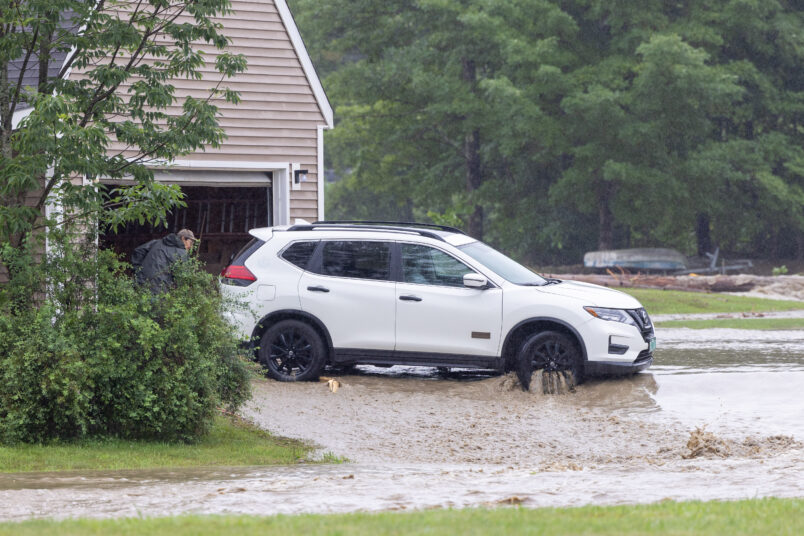
Water rushes around an SUV on July 10, 2023 in Windham, Vermont. (Photo by Scott Eisen/Getty Images)
Checking Out a Flooded Road
Onlookers check out a flooded road on July 10, 2023 in Chester, Vermont. (Photo by Scott Eisen/Getty Images)
Watching the Water
Onlookers check out a flooded road on July 10, 2023 in Chester, Vermont. (Photo by Scott Eisen/Getty Images)
A Flooded Home Goods Store
Bailey Road, a clothing and home goods store on Main Street, was left severely damaged from flood waters on July 11, 2023 in Montpelier, Vermont. Up to eight inches of rain fell over 48 hours and residents were warned that Wrightsville Dam could reach capacity, forcing it to release more water that could impact the downtown area. (Photo by Kylie Cooper/Getty Images)
A Business Owner Washes His Storefront
Andrew Brewer, a resident of Montpelier and former business owner on Langdon Street, helps wash away the mud from the sidewalk July 11, 2023 in Montpelier, Vermont. (Photo by Kylie Cooper/Getty Images)
Debris Wash Onto the Road
Water rushes down Route 11 as rock debris accumulates in heavy rain on July 10, 2023 in Londonderry, Vermont. (Photo by Scott Eisen/Getty Images)
A Truck Fords the Flooding
In an aerial view, a pick-up truck drives along a flooded road after heavy rain on July 10, 2023 in Londonderry, Vermont. (Photo by Scott Eisen/Getty Images)
A Tractor Pushes Forward
A tractor makes its way through a flooded road after heavy rain on July 10, 2023 in Londonderry, Vermont. (Photo by Scott Eisen/Getty Images)
Water Covers Residential Property
In an aerial view, water covers residential property on Route 11 after heavy rain on July 10, 2023 in Londonderry, Vermont. (Photo by Scott Eisen/Getty Images)
Firefighters and Police Officers Assess the flood
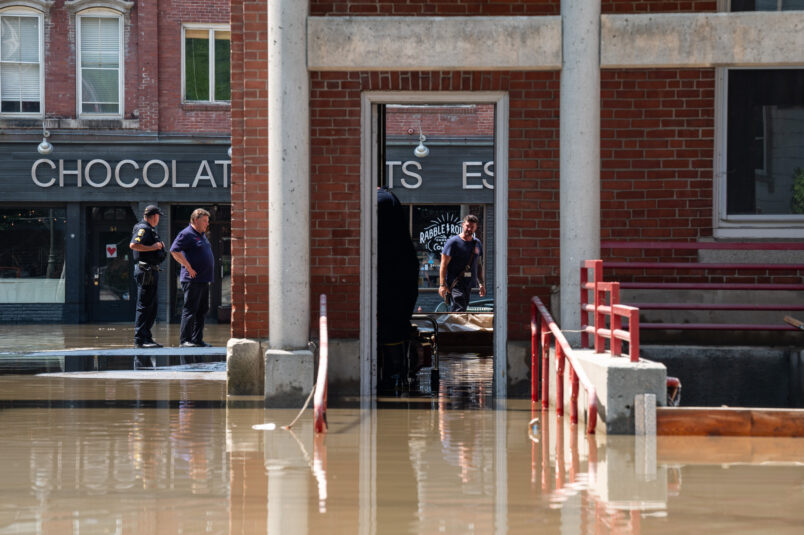
Firefighters and police officers assess the flood waters inside and around the Montpelier Fire and Ambulance Department on July 11, 2023 in Montpelier, Vermont. (Photo by Kylie Cooper/Getty Images)
Stranded Hotel Guests Look On
Guests of the Capitol Plaza Hotel look at the flooding from a fire escape on July 11, 2023 in Montpelier, Vermont. (Photo by Kylie Cooper/Getty Images)
U.S. Geological Survey Hydrographers Measure the Flooding
U.S. Geological Survey hydrographers Samuel Jacob, left, and Jeff Rowan measure the flooded Winooski River’s discharge on July 11, 2023 in Montpelier, Vermont. Jacob said it was 15,000-16,000 cubic feet per second. (Photo by Kylie Cooper/Getty Images)
New Dam
Debris in the flooded Wisnooski River gets caught under a bridge on July 11, 2023 in Montpelier, Vermont. (Photo by Kylie Cooper/Getty Images)
The Vermont State House
The Vermont State House is seen through a bridge and behind the flooded Winooski River on July 11, 2023 in Montpelier, Vermont. (Photo by Kylie Cooper/Getty Images)
A Man and a Bench
A person walks through the flooded waters of Main Street on July 11, 2023 in Montpelier, Vermont. (Photo by Kylie Cooper/Getty Images)
Main Street is Flooded
Main Street is flooded on July 11, 2023 in Montpelier, Vermont. (Photo by Kylie Cooper/Getty Images)
Welcome to Montpelier
A sign welcoming visitors to downtown Montpelier is seen behind the flooded Winooski River on July 11, 2023 in Montpelier, Vermont. (Photo by Kylie Cooper/Getty Images)
Kayaking Through It
People kayak up and down the flooded waters of Elm Street on July 11, 2023 in Montpelier, Vermont. (Photo by Kylie Cooper/Getty Images)
A Kayaker Paddles
In an aerial view, a kayaker paddles through the flooded waters of Elm Street on July 11, 2023 in Montpelier, Vermont. (Photo by Kylie Cooper/Getty Images)
Reversing Course
In an aerial view, a truck backs up after attempting to drive through heavily flooded waters on Elm Street on July 11, 2023 in Montpelier, Vermont. (Photo by Kylie Cooper/Getty Images)
Downtown Montpelier
Water floods multiple downtown streets on July 11, 2023 in Montpelier, Vermont. (Photo by Kylie Cooper/Getty Images)
Walking in Muddy Waters
Residents walk along a muddy Main Street after flood waters receded on July 11, 2023 in Montpelier, Vermont. (Photo by Kylie Cooper/Getty Images)
Damage
A route is damaged after heavy rainfall in Cornwall-On-Hudson, New York, on July 10, 2023. (Photo by KENA BETANCUR/AFP via Getty Images)
A Home is Damaged
A home is damaged after heavy rainfall in Cornwall-On-Hudson, New York, on July 10, 2023. (Photo by KENA BETANCUR/AFP via Getty Images)
A Road is Damaged
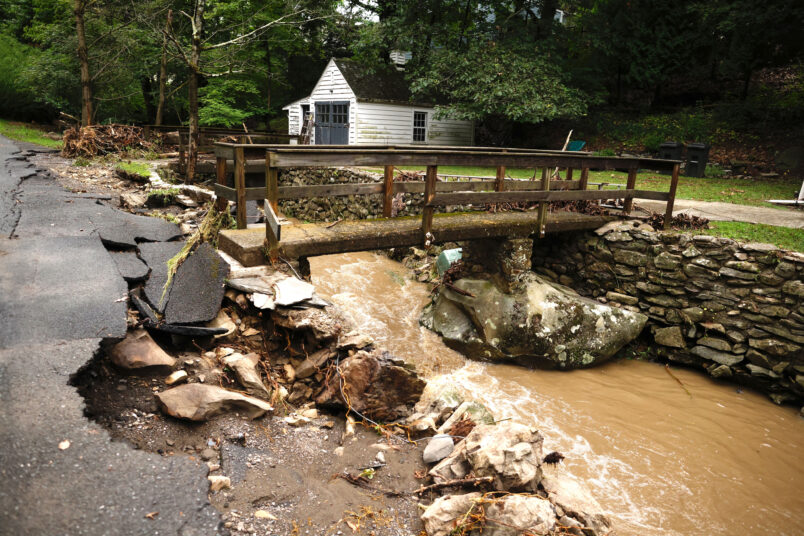
A road is damaged as water in a creek rushes after heavy rainfall in Cornwall-On-Hudson, New York, on July 10, 2023. (Photo by KENA BETANCUR/AFP via Getty Images)
Fencing and a Swimming Pool Are Damaged
Fencing and a swimming pool are damaged after heavy rainfall in Cornwall-On-Hudson, New York, on July 10, 2023. (Photo by KENA BETANCUR/AFP via Getty Images)
Road Destroyed
Governor Kathy Hochul visited Highland Falls on Monday morning to survey the damage after flooding devastated the area. (Photo by Fatih Aktas/Anadolu Agency via Getty Images)
Flea Market is Closed
Flood waters overtook Farr’s Field. (Photo by Jessica Rinaldi/The Boston Globe via Getty Images)
Workers Remove Mud from Main Street
Workers remove mud from Main street after heavy rains in Highland Falls, New York, on July 10, 2023. (Photo by KENA BETANCUR/AFP via Getty Images)
An Iowa judge said Friday that it would be “insulting” for him to “flippantly” rule on blocking Iowa’s new six-week abortion ban from the bench, meaning that the ban will be live for at least a few days this weekend.
A panel of 5th Circuit judges granted the Biden administration’s request for an administrative stay of a widely panned lower court decision that blocked wide swaths of the government from flagging misinformation to the companies that operate social media sites.
If you spend time listening to Trump/Musk/Sacks/Bitcoin anti-Ukraine discourse you’ll hear the following argument: while the U.S. launched (by remote control presumably) its Russia/Ukraine proxy war to degrade Russian military power, quite the opposite has happened. Now the U.S. is running out of artillery shells, thus degrading its own military power. Meanwhile, Ukraine is doomed because we can’t send them any more and Russia can sustain its supply forever. In other words, the U.S. is owned; Russia is on the march; Ukraine is doomed.
This is a bogus argument. The U.S. hasn’t run out of artillery ammunition. Not even close. The U.S. has what amounts to a one-and-a-half-war doctrine. The U.S. needs to be able to fight two major wars simultaneously or, short of that, needs to be able to defeat its adversary in one major war while holding its adversary in the second at bay long enough to win war one and move on to winning war two. A bureaucracy like the Pentagon takes the official doctrine and computes what amount of human and material resources are required to make good on it and then is responsible for making sure all of that is available if and when those wars break out. This is basically what Joint Staffs do. That includes, among many other things, stockpiling enough artillery and ammunition to meet the needs of fighting those two wars. That’s an almost unimaginable amount of stuff that is still sitting in U.S. stockpiles.
First term Rep. Eli Crane (R-AZ) referred to Black people as “colored people” Thursday night during a floor debate over an amendment he proposed for the House-passed National Defense Authorization Act, the legislation that authorizes the annual budget for the U.S. military.