Republican officials in Montana are already resurrecting the independent state legislature theory, which would imbue state legislatures with enormous power over federal elections.
Getting a majority on the Supreme Court to affirm some version of the theory has been a recent white whale of Republican state legislatures as they seek to make voting more difficult without the other branches of state government interfering. The Supreme Court in 2023 rejected a maximalist version of the theory pushed by North Carolina Republicans that would have empowered state legislatures to control voting laws, election administration and redistricting alone, to the exclusion of state courts and state constitutional guardrails..
But the majority, led by Chief Justice John Roberts, left room for ambiguity, saying that “state courts do not have free rein” in hemming in state legislative action, that the courts cannot “transgress the ordinary bounds of judicial review such that they arrogate to themselves the power vested in state legislatures to regulate federal elections.”
What “transgresses the ordinary bounds,” though, is anybody’s guess.
Montana Republicans are taking advantage of that vagueness to encourage the Court to produce a more robust form of Roberts’ theory, one which severely limits the extent to which state courts can enforce their constitutions (many of which include a right to vote).
In this case, the Montana Supreme Court knocked down two voter suppression measures — one of which would end same-day registration, curtailing registration at noon the day before the election, and the other which would ban the paid collection of absentee ballots — finding that they violated the state constitutional right to vote.
The Republicans say that the court has gone too far into the legislature’s terrain, that they should be able to make voting more difficult with impunity. They’re asking the Supreme Court to take up the case this term.
It’ll be a critical test to see how thoroughly the Court actually opposes the theory, which puts the true integrity of our elections (not the shorthand Republicans use when they want to give a respectable gloss to voter suppression) at serious risk.
Special Counsel Jack Smith laid out his most detailed case yet in a filing unsealed Wednesday for why Trump can still be prosecuted in spite of the Supreme Court’s capacious immunity decision.
A new episode of The Josh Marshall Podcast is live! This week, Kate and Josh discuss the VP debate, the last big scheduled event before the election, along with some 11th-hour Senate plays and Eric Adams’ indictment.
You can listen to the new episode of The Josh Marshall Podcast here.
As I’ve explained, this issue of turnout operations and what we can glean about them is one of the things I’m most interested in finding out more about as we hurtle into the last 30 days of the campaign. None of the information I’ve found so far gives any definitive answers. I’m not even sure definitive answers are possible. But I’m going to pass on some interesting hints I’m finding. The thing you hear again and again about canvassing and ground operations is that you cannot just overwhelm it with money. Money is obviously critical. But you need a lot of institutional experience and time to make it work. With TV ads you really can overwhelm it with money. Get a billionaire with unlimited funds, cut some good ads and get them on TV. Done and done. One of the big factors operating now in swing states is that outside groups are paying 10 to 25 times the ad rates of campaigns. But still, unlimited money can help with that. Canvassing and field operating takes time and institutional experience.
I’m a broken record on this. But I’m struck by the relative stasis of the Harris-Trump presidential campaign. It hasn’t always felt like that of course. It’s hard on the nerves. And it’s not like nothing has happened. We’ve had a sitting president drop out of the race, a mind-boggling two assassination attempts, a smackdown of a debate, two conventions. And yet stability in the polling numbers has been the calling card of this race. Joe Biden was behind. He fell further behind starting about two weeks after the June debate. After he dropped out Harris immediately moved the race into a tie. Then over a couple weeks she opened up a lead of roughly three points. It’s basically stayed right there for the last two months. The minor undulations have been so small as to likely represent little more than churn and statistical noise.
The Story Of What Happened On Jan. 6 Is Ours To Own
In what is likely the last big Jan. 6 development before the election, U.S. District Judge Tanya Chutkan ordered the unsealing Wednesday of the 165-page filing by Special Counsel Jack Smith that presents his best case for why presidential immunity doesn’t shield Donald Trump from criminal prosecution for subverting the 2020 election.
The case laid out by Smith broadly follows the already-familiar contours of the conspiracy to overturn the results of an election Trump lost. It’s a narrative we know because we saw most of it with our own eyes. What we couldn’t see directly was pieced together by the House Jan. 6 committee and journalists working tirelessly to document the conspiracy’s many disparate elements and to identify the vast cast of characters that ended the United States’ streak of peaceful transitions of power.
There remains great civic value in repeating that story for ourselves and for future generations so that it becomes woven into our collective memory like the Boston Tea Party or the firing on Fort Sumter or the internment of Japanese-Americans during World War II.
The Jan. 6 debacle is a part of the nation’s founding story, even though it comes nearly 250 years later, because the same principles that animated its creation were under sustained attack, the same threats that the constitutional system was specifically designed to protect against were on full display, and the reactionary forces of chaos and destruction that always linger just over the horizon advanced to within minutes and feet of prevailing over democracy and the rule of law.
Smith and investigators have amassed an overwhelming body of evidence of Trump’s culpability. The challenge for prosecutors in light of the Supreme Court’s ahistorical decision on presidential immunity is to demonstrate that Trump fomented, led and engaged in the conspiracy in his capacity as a private citizen running for the presidency, not in his capacity as sitting president. Alternatively, Smith also argues that in some instances where Trump’s conduct was as president, the rebuttable presumption of immunity can be overcome. But the delicate dance of overcoming the Supreme Court’s heavy thumb on the scale of justice, isn’t the core value of Smith’s work. The real value of the fact-based narrative presented by Smith is the story it gives all of us to remember and repeat.
As I read through Smith’s filing, I shared Rick Hasen’s “red-hot anger and wistfulness” that the Supreme Court has hamstrung the timely prosecution of Trump and that this case may never go to trial if Trump wins in November. Coupled with U.S. District Judge Aileen Cannon’s dismissal of the slam-dunk indictment of Trump in the Mar-a-Lago documents case, we have edged to the precipice of irretrievably undermining the rule of law by creating a presidency beyond the law, at least when the White House is held by Republicans and given unlimited rein by this corrupt Supreme Court.
In the face of such extreme threats to democracy, it can seem quaint, trivial, or even pointless to continue to document the transgressions being committed against the will of the American people, which is fundamentally what Jan. 6 was all about. But the careful, meticulous, and relentless collecting of evidence, recording of facts, and repeating of the stories we tell ourselves about what happened and who was responsible powerfully cement in our national consciousness the story of who we are, where we came from, and what we must overcome to get where we want to be as a democratic, pluralistic country.
A Point Of Pride
I want to acknowledge briefly the work of the TPM team for its early, consistent, and ongoing coverage of the 2020 election subversion conspiracy because it in so many ways presaged the case Special Counsel Jack Smith laid out in full yesterday.
We have done too many stories to note them all here, and I will inevitably overlook some of the work of our team, so apologies to them for that, but here is a sampling of a handful of some of our most significant stories:
NYT: How Donald Trump could use the Justice Department to target his perceived political adversaries
Important
TPM’s Nicole Lafond: DHS Warns Every Level Of Election Admin Could Be Targeted By Domestic Extremists Next Month
Exclusive
WSJ: Elon Musk Gave Tens of Millions to Republican Causes Far Earlier Than Previously Known
2024 Ephemera
Former Rep. Liz Cheney (R-WY) will make a campaign appearance with Kamala Harris on Thursday in Ripon, Wisconsin, the birthplace of the Republican Party.
The cash-starved National Republican Senatorial Committee is making a last-minute shift in its TV ad strategy.
CA Alleges Catholic Hospital Illegally Denied Abortion Care
The state of California is suing Providence St. Joseph Hospital of Eureka for allegedly breaking the law by refusing emergency abortion case to a woman carrying twins when her water broke at 15 weeks.
California Bans Legacy Admissions
California Gov. Gavin Newsom (D) signed into law a new ban on legacy admissions at private colleges and universities that is scheduled to go into effect in the fall of 2025.
NYC Mayor Adams Could Face Additional Criminal Charges
During a hearing in federal court in Manhattan, prosecutors indicated that more charges against NYC Mayor Eric Adams are possible and that new charges against additional defendants are likely.
Hurricane Helene Update
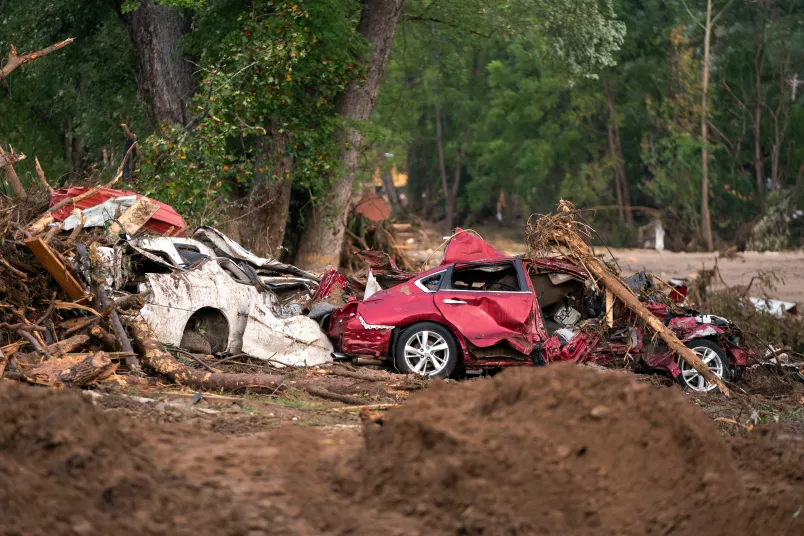
OLD FORT, NORTH CAROLINA – SEPTEMBER 30: Storm damaged cars sit along Mill Creek in the aftermath of Hurricane Helene on September 30, 2024 in Old Fort, North Carolina. (Photo by Sean Rayford/Getty Images)
Hurricane Helene’s death toll rose to 180, making it the third deadliest hurricane to strike the U.S. and its territories in the last 50 years.
After visiting the Carolinas on Wednesday, President Biden will be surveying storm damage in Florida and Georgia on Thursday.
The hidden toll of hurricanes: “An analysis of more than 500 tropical cyclones that have hit the United States since 1930 found that the average hurricane leads to as many as 11,000 excess deaths — a figure hundreds of times higher than official mortality estimates.”
Nearly two years after Jack Smith was named special counsel, a federal judge has unsealed the most damning evidence Smith’s collected to demonstrate that Trump sought to block the peaceful transfer of power in the 2020 election.
U.S. District Judge Tanya Chutkan for the District of Columbia ordered that the filing, clocking in at 165 pages, be released after a back-and-forth with the Trump team over redactions.
The motion, styled as a legal brief addressing why Trump’s actions are not immune from prosecution under the Supreme Court’s July immunity decision, cites exhibits and evidence about Trump’s 2020 self-coup attempt. Its appendices have not yet been released. It may be Smith’s last chance to show his case to the public: Trump has said that, if he wins in November, he will have the DOJ terminate the cases against him.
The Department of Homeland Security is warning that domestic violent extremists, many of whom will be motivated by political policy and ideological grievances, pose the most “significant physical threat” to the election system and those who will work to administer it next month.
One thing we’ve talked about a lot this year in the Backchannel and the podcast is changes pollsters have made to their methodologies over recent years, in large part because of 2016 and 2020 polling errors tied to Trump. Kyle Kondick, of Larry Sabato’s Crystal Ball, posted two good links on this that I wanted to share with you. The first is this short interview with Professor Charles Franklin of Marquette Law School who runs what is generally considered the signature in-state poll in Wisconsin and one of the most reliable nationwide. (Some of you may remember that Franklin was our polling methodology advisor back in the days of TPMPollTracker.) Then there’s this short article which goes over the changes industry-wide.
This note from TPM Reader DK doesn’t answer for us the questions we discussed yesterday about Republican GOTV efforts. But it does point to key questions to ask to find out more. And I found it just a fascinating window into the nuts and bolts of campaign field operations.
I’ve done GOTV for two decades, including my own campaign long ago. A few observations: