Let’s go back in time for a minute. Back when House Speaker Nancy Pelosi (D-CA) was putting together a panel of House members to participate in the Jan. 6 select committee to probe the insurrection, she rejected two of Minority Leader Kevin McCarthy’s (R-CA) panelist picks (the Jims) — Reps. Jim Jordan (R-OH) and Jim Banks (R-IN).
The decision was rooted in her correct understanding that both of the Jims would use the committee’s probe of the Capitol attack as a platform for spewing the Big Lie and other Trumpy nonsense and conspiracy theories, thus likely derailing the serious work of the committee. Both Jims not only voted to overturn the election results on Jan. 6, but they also both signed onto a request out of Texas asking the Supreme Court to invalidate election results in Georgia, Michigan, Pennsylvania and Wisconsin.
In retaliation for Pelosi’s move against the Jims, McCarthy pulled all of his Republican picks from the panel, leaving only Reps. Liz Cheney (R-WY) and Adam Kinzinger (R-IL) as GOP members (who joined out of their own volition). Both have been highly critical of Trump for some time and have, at least thus far, taken their assignments very seriously, signing off on all of the committee’s subpoenas and publicly supporting each layer of the committee’s investigation. Cheney is the committee’s vice-chair.
But one of the Jims, Jim Banks, is apparently now trying to play dress up — pretending to be a member of the panel probing the insurrection.
Senate Democrats have been cheerfully saying that they could see a deal on a reconciliation framework coming as soon as Friday. According to our sources, that’s tomorrow. There are still some major sticking points, though progress has happened in leaps and bounds the past couple days.
A new episode of The Josh Marshall Podcast is live! This week, Josh and Kate discuss the sudden forward lurch of the reconciliation negotiations that has Democrats feeling optimistic about reaching a deal potentially by the end of the week.
You can listen to the new episode of The Josh Marshall Podcast here.
This article is part of TPM Cafe, TPM’s home for opinion and news analysis. It first appeared at The Conversation.
Two powerful storm systems known as atmospheric rivers are heading for northern California and Oregon, a region in the midst of an historic drought.
While the storms will bring much-needed water to a parched region and should significantly lower the wildfire risk, they also bring dangerous new flood and mudslide risks, particularly in areas recovering from wildfires.
Wildfires strip away vegetation and leave the soil less able to absorb water. A downpour on these vulnerable landscapes can quickly erode the ground as fast-moving water carries debris and mud with it.
The National Weather Service has warned of ash and debris flows from Oct. 21-26 in several burned areas, including the site of the nearly 1-million-acre Dixie Fire in the Sierra Nevada.
I study cascading hazards like this, in which consecutive events lead to human disasters. Studies show climate change is raising the risk of multiple compound disasters, and it’s clear that communities and government agencies aren’t prepared.
When storms hit burn scars
California has experienced this kind of cascading disaster before.
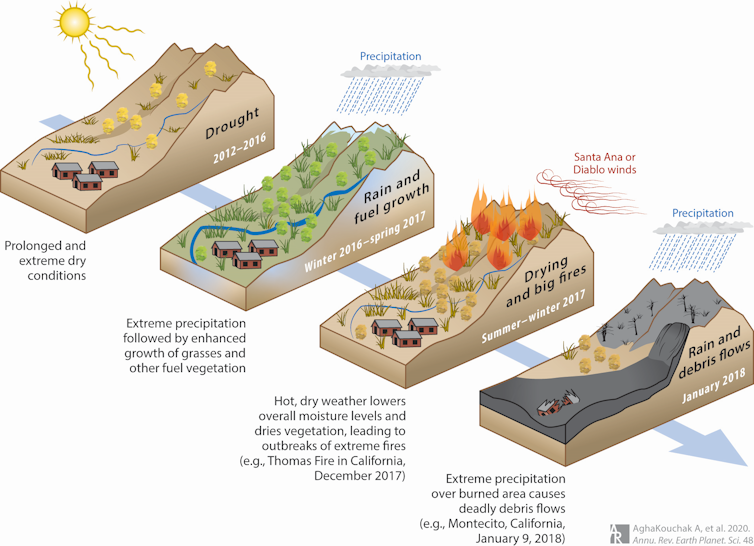
In early 2017, following years of drought, the region had a wet winter that fueled dense growth of vegetation and shrubs. An unusually warm and dry spring and summer followed, and it dried out the vegetation, turning it into fuel ready to burn. That fall, extreme Santa Ana and Diablo winds – known for their sustained low humidity – created the perfect conditions for wildfires.
The Thomas Fire began near Santa Barbara in December 2017 and burned over 280,000 acres. The following January, extreme rainfall hit the region, including the burn scar left by the fire, and caused the deadliest mudslide-debris flow event in California’s history. More than 400 homes were destroyed in about two hours, and 23 people died.
These kinds of cascading events aren’t unique to California. Australia’s Millennium Drought (1997-2009) also ended with devastating floods that inundated urban areas and breached levees. A study linked some of the levee and dike failures to earlier drought conditions, such as cracks forming because of exposure to heat and dryness.
Individually, they might not have been disasters
When multiple hazards, such as droughts, heat waves, wildfires and extreme rainfall, interact, human disasters often result.
The individual drivers might not be very extreme on their own, but combined they can become lethal. These types of events are broadly referred to as compound events – for example, a drought and heat wave hitting at the same time. Their combined impact can be harder to forecast. A cascading event involves compound events in succession, like wildfires followed by downpours and mudslides. https://www.youtube.com/embed/2cgkcFsLEho?wmode=transparent&start=0 Video shows how quickly a mudslide overtakes a town.
While the drivers and physical mechanisms behind compound and cascading events are not fully understood, they are often linked to large-scale circulation patterns like the El Niño-Southern Oscillation (ENSO). Meanwhile, lack of preparedness and high degrees of vulnerability at the local level can also increase the impacts of multiple connected events.
With compound and cascading events likely to become more common in a warming world, being able to prepare for and manage multiple hazards will be increasingly essential.
Climate change intensifies the risk
Severalresearch studies have shown that compound events with both drought and heat waves have become more severe and frequent in recent years. One study attributed the increase in the risk of these dry-warm events in California to human-caused global warming and projected that the increased risk of dry-warm conditions will continue in the future.
An important physical process responsible for increases in compound drought and heat is land-atmosphere interactions. Evaporation from soil cools down the land surface, similar to how the human body cools down by sweating. During droughts, the lack of moisture limits soil evaporation, which increases the surface temperature and eventually the air temperature in the area. Data shows temperatures during droughts are rising in many parts of the United States, including the Southwest – a pattern that is expected to continue in the future.
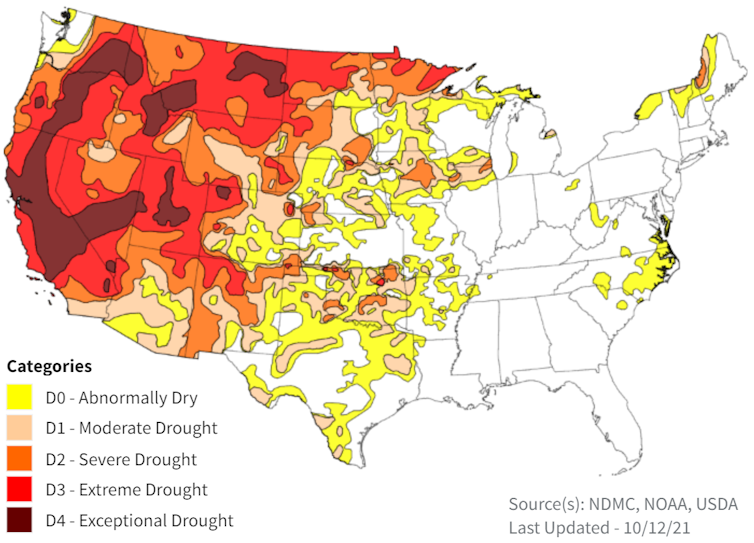
Most of the West is still in severe drought. NOAA/NDIS
At the same time, extreme rainfall events are expected to intensifyin a warming climate. A warmer atmosphere can hold more moisture, leading to wetter storms. This means there will likely be more burned acres exposed to potentially extreme rainfall events in a warmer world.
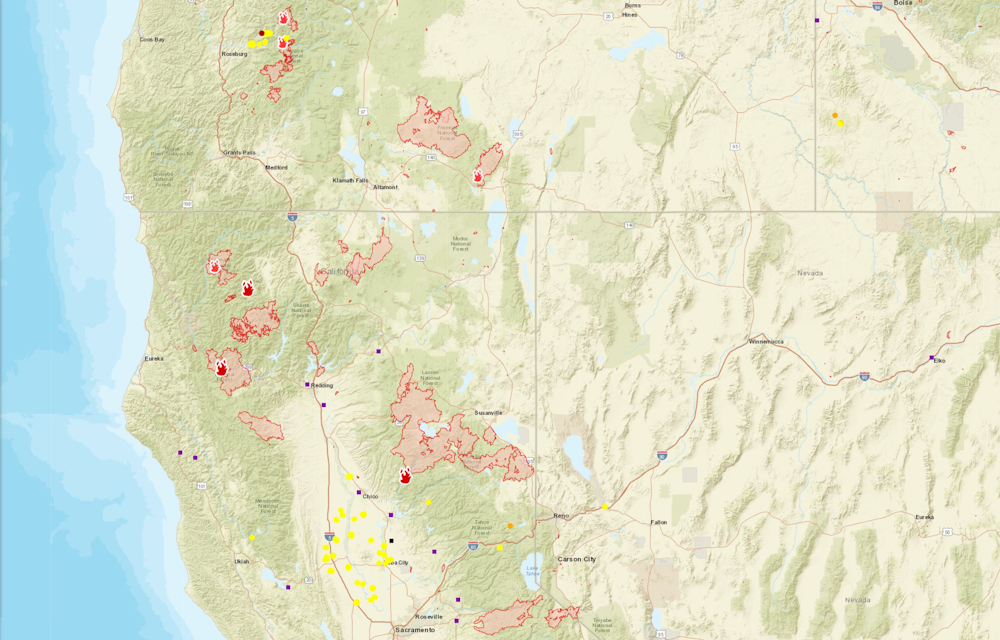
Large parts of northern California and southern Oregon had fires in 2021, some still burning in mid-October. National Wildfire Coordinating Group
It’s also important to recognize that human activities and local infrastructure can also affect extreme events. Urbanization and deforestation, for example, can intensify flooding and worsen mud or debris flow events and their impacts.
Managing multiple disasters and climate change
Despite the high risk when extreme rainfall and droughts interact, most research in this area focuses on only one or the other. Different government agencies oversee flood and drought monitoring, warning and management, even though both are extremes of the same hydrological cycle.
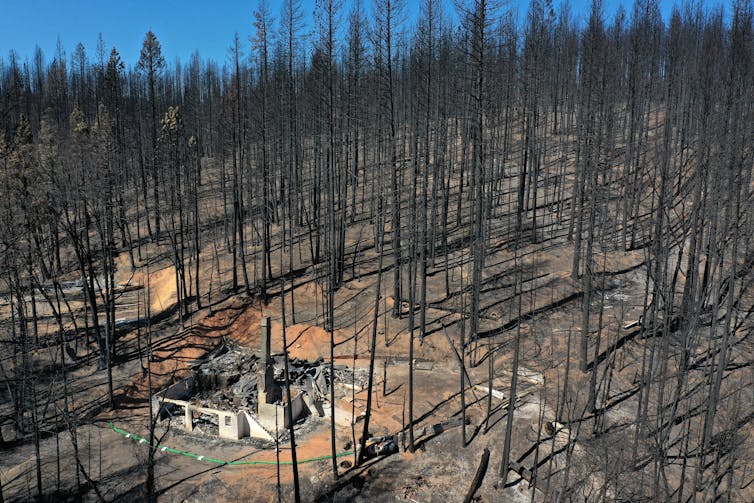
An aerial view of the location of the Dixie Fire near Greenville shows the bare soil left behind. Justin Sullivan/Getty Images
As a society, we cannot prevent cascading hazards from happening. But we can become better prepared for plausible cascading hazards in a changing climate.
We are back in this guessing game on what is up with Sen. Kyrsten Sinema. Mostly it doesn’t matter. She has the vote and Democrats need that vote. And that’s really 90% of the story and quite likely 100%. I’ll just revisit what I’ve learned trying to get to the bottom of this mystery myself.
One thing I hear again and again is that Sinema is doing some version of a mafia bust-out, paying off lobbyists in every way she can think of and the pay off is a cushy perch on K Street as a lobbyist herself. This version of the story presents a wonderful morality tale about Washington. But I’m pretty certain it’s not true. It would all be much easier to understand. But again I’m pretty certain this is not true.
Rep. Louie Gohmert (R-TX) on Thursday compared a 2016 congressional sit-in led by the late civil rights hero Rep. John Lewis (D-GA) to the Jan. 6 Capitol attack.
Like lots of other rank-and-file Republicans, Robert Boyd has his doubts about the integrity of the last election, particularly in his home state of Michigan — and particularly in Detroit’s TCF Center, where the city’s votes were counted last year despite a concertedeffort from local Republicans to disrupt the counting process.
Five veterans on Sen. Kyrsten Sinema’s (D-AZ) advisory board for Arizona service members quit while publicly dragging the senator over the coals for persistently blocking progressive policies by clinging onto the filibuster and holding up Democrats’ reconciliation package.