A lot of things happened. Here are some of the things.
Reaching The Finish Line
The Senate is slated for a final vote on the bipartisan infrastructure bill this morning at 11 a.m. ET. It is expected to pass.
Senate Majority Leader Chuck Schumer (D-NY) declared last night that after the vote the chamber will “immediately” take up Democrats’ mammoth $3.5 trillion budget reconciliation resolution.
You can read our breakdown of the reconciliation resolution in yesterday’s liveblog here.
Democratic senators are gearing up for the next fight: lifting the debt ceiling in the face of Senate Minority Leader Mitch McConnell’s (R-KY) stated refusal to do so.
The state’s Supreme Court is declining to intervene in the big fight over new proposed voting restrictions that sent Democratic lawmakers fleeing the state. In retaliation against the Dems, Gov. Greg Abbott (R) had vetoed funding for the legislature. Democrats were asking the court to overturn the veto; it refused to do so.
The court, which is comprised entirely of GOP justices, stated that the “principle dispute” that led to Abbott’s veto is between the Democratic and Republican lawmakers over the anti-voting bill. “This political dispute within the legislative branch is not an issue of separation of powers that we can decide,” the court wrote.
Cheering the court’s decision, Abbott’s office said of the Democrats, “It’s time to stop the charades and get back to work doing the job they were elected to do.”
State House Democratic leader Chris Turner (D) expressed disappointment that the court didn’t intervene to stop the governor’s “tyrannical violation of the separation of powers,” but Turner swore that his Democratic colleagues “will continue to fight back against Gov. Abbott’s systematic undermining of our democracy.”
DeSantis Tries To Bully Schools Into Exposing Kids To COVID-19
The Florida Board of Education “could move to” withhold the salaries of school superintendents and school board members who ignore Florida Gov. Ron DeSantis’ (R) ban on mask mandates, the governor’s office claims.
Dr. Carlee Simon, the superintendent for Florida’s Alachua Public Schools, told CNN that DeSantis has “other interests” that are informing his war on masks.
“I believe the Governor has other interests that he’s focusing on and I’m right now focusing on education and I would like him to let me do my job” pic.twitter.com/GXHBBncl06
In Texas, the Dallas Independent School District is requiring all students, school employees and visitors to wear masks despite Texas Gov. Greg Abbott’s (R) similar mask mandate ban.
The Fight Over Trump’s Tax Returns Drags On
The Biden administration won’t be handing over the ex-president’s long-sought-after tax returns to the House Ways and Means Committee until at least November.
The administration told a court that it would agree to let Trump make his legal arguments against the Treasury Department turning over the returns even though the administration believes it ought to release the documents “promptly.”
Mandatory COVID-19 Vaccination In The Military
The Defense Department is expected to require all active duty military members to get the COVID-19 vaccine by mid-September upon receiving approval by Biden.
A Dubious First
The Biden administration is being sued by lawyers of migrant children who say that they’ve been stuck in emergency detainment centers under poor conditions.
It’s the first time the Biden administration has been sued for allegedly violating the 1997 Flores Settlement Agreement, which established rules for the treatment of migrant children.
Rudy Lonely-ani
Rudy Giuliani, sinking ever deeper in legal quicksand, still finds himself marooned by Trump and his allies, who won’t promote or even retweet links to the ex-Trump attorney’s legal fund when asked, according to the Daily Beast.
Still, Giuliani apparently doesn’t want to burn that bridge; he’s reportedly told his associates not to call out Trump by name when publicly complaining about how MAGAland has left him in the dust.
Fake COVID-19 vaccination cards are being sold online, and apparently there’s a market for people who would rather spend $400 dollars on getting one of those instead of spending zero dollars on a real card that comes with the added bonus of getting a vaccine that’ll protect you during a global pandemic.
Burner Or Boomer?
It’s not clear whether Caitlyn Jenner, currently running a vanity GOP gubernatorial campaign to unseat California Gov. Gavin Newsom (D), accidentally forgot to switch to a fake Twitter account or if she just didn’t know how retweeting works when she posted this bizarre tweet:
At TPM, we’ve been harping on the fact that the whole bipartisan back-and-forth that unfolded over the last two months — and that might conclude early tomorrow morning — doesn’t really matter that much. It’s the reconciliation package that matters. If it passes in a form similar to what Senate Majority Leader Chuck Schumer outlined this morning, it would be the most significant progressive legislation in at least a decade.
It might also be the last significant progressive legislation for at least a decade.
A former top vaccine official, who had sued the Trump administration for allegedly demoting him as retaliation for his criticism of its COVID response, has reached a settlement with the Department of Health and Human Services.
As we’ve been discussing there is a paucity of information on the precise effectiveness of vaccines vs the Delta variant and the contours of the pandemic in the new circumstances of the last eight weeks or so. We know in general that vaccines continue to be highly effective at preventing severe illness. But the details are not as easy as they should be to come by. This seems to be both the product of very new facts which studies are only catching up with and a continued paucity of good national data from the CDC. That vacuum is filled by anecdotal information.
A Texas judge has granted temporary reprieve to Democratic lawmakers who fled the state in an attempt to block Republicans’ tranche of restrictive voting legislation.
Senators investigating Trump’s attempt to overturn the results of last year’s election will next interview BJ Pak, the former U.S. Attorney for the Northern District of Georgia.
I was raised by a man steeped in the life sciences. He wasn’t a climate scientist. He was a marine botanist who spent the first and last parts of his career teaching general biology at various colleges. But this professional description doesn’t capture the depth of the imprint on him and thus indirectly on me. For him it was an entire ethic and worldview, one rooted in evolutionary theory and furnished from various domains of knowledge: archeology, paleontology, paleo-zoology, ecology, astronomy in addition to biology.
This article is part of TPM Cafe, TPM’s home for opinion and news analysis.
The world watched in July 2021 as extreme rainfall became floods that washed away centuries-old homes in Europe, triggered landslides in Asia and inundated subways in China. More than 900 people died in the destruction. In North America, the West was battling fires amid an intense drought that is affecting water and power supplies.
In a new international climate assessment published Aug. 9, 2021, the Intergovernmental Panel on Climate Change warns that the water cycle has been intensifying and will continue to intensify as the planet warms.
The report, which I worked on as a lead author, documents an increase in both wet extremes, including more intense rainfall over most regions, and dry extremes, including drying in the Mediterranean, southwestern Australia, southwestern South America, South Africa and western North America. It also shows that both wet and dry extremes will continue to increase with future warming.
Why is the water cycle intensifying?
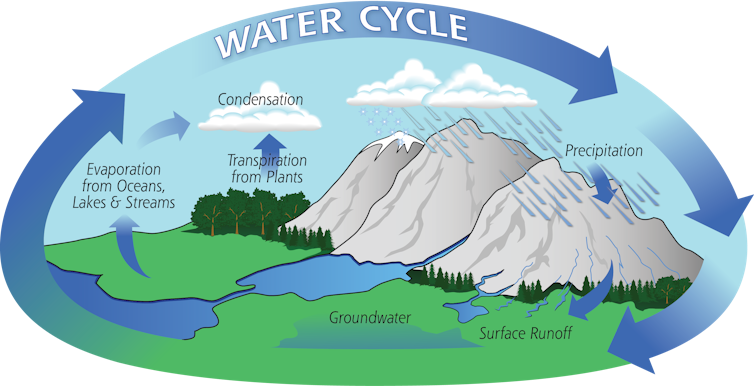
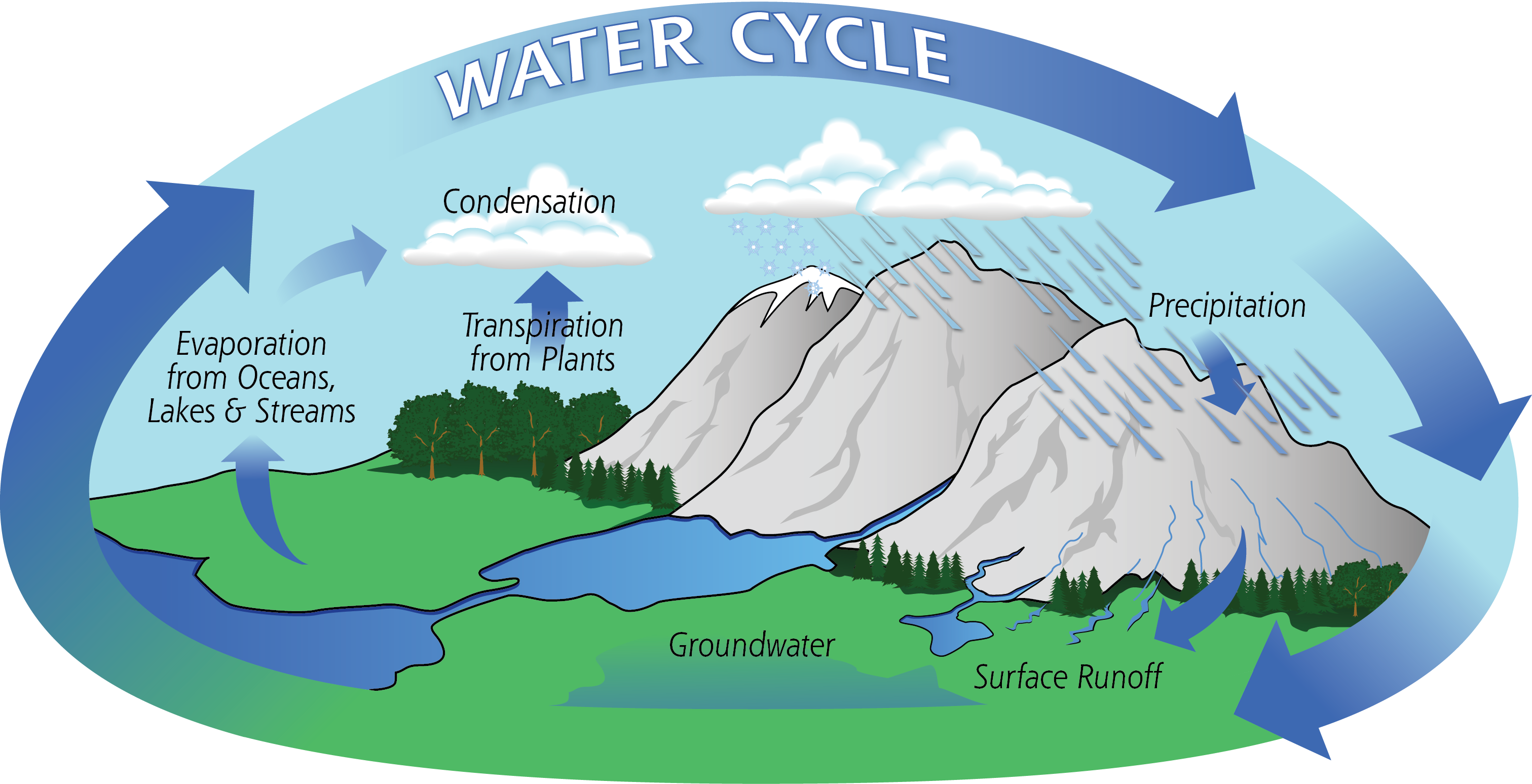
Water cycles through the environment, moving between the atmosphere, ocean, land and reservoirs of frozen water. It might fall as rain or snow, seep into the ground, run into a waterway, join the ocean, freeze or evaporate back into the atmosphere. Plants also take up water from the ground and release it through transpiration from their leaves. In recent decades, there has been an overall increase in the rates of precipitation and evaporation.
A number of factors are intensifying the water cycle, but one of the most important is that warming temperatures raise the upper limit on the amount of moisture in the air. That increases the potential for more rain.
This aspect of climate change is confirmed across all of our lines of evidence: It is expected from basic physics, projected by computer models, and it already shows up in the observational data as a general increase of rainfall intensity with warming temperatures.
Understanding this and other changes in the water cycle is important for more than preparing for disasters. Water is an essential resource for all ecosystems and human societies, and particularly agriculture.
What does this mean for the future?
An intensifying water cycle means that both wet and dry extremes and the general variability of the water cycle will increase, although not uniformly around the globe.
Rainfall intensity is expected to increase for most land areas, but the largest increases in dryness are expected in the Mediterranean, southwestern South America and western North America.
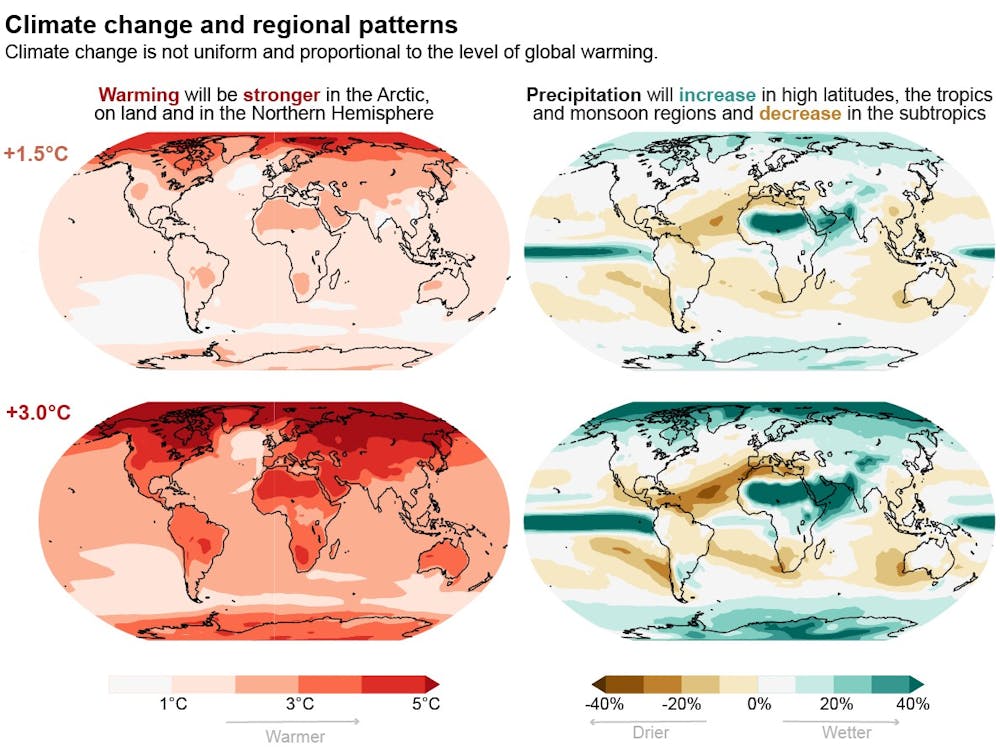
Annual average precipitation is projected to increase in many areas as the planet warms, particularly in the higher latitudes. IPCC Sixth Assessment Report
Globally, daily extreme precipitation events will likely intensify by about 7% for every 1 degree Celsius (1.8 degrees Fahrenheit) that global temperatures rise.
Many other important aspects of the water cycle will also change in addition to extremes as global temperatures increase, the report shows, including reductions in mountain glaciers, decreasing duration of seasonal snow cover, earlier snowmelt and contrasting changes in monsoon rains across different regions, which will impact the water resources of billions of people.
The IPCC does not make policy recommendations. Instead, it provides the scientific information needed to carefully evaluate policy choices. The results show what the implications of different choices are likely to be.
One thing the scientific evidence in the report clearly tells world leaders is that limiting global warming to the Paris Agreement target of 1.5 C (2.7 F) will require immediate, rapid and large-scale reductions in greenhouse gas emissions.
Regardless of any specific target, it is clear that the severity of climate change impacts are closely linked to greenhouse gas emissions: Reducing emissions will reduce impacts. Every fraction of a degree matters.
This article is part of TPM Cafe, TPM’s home for opinion and news analysis.
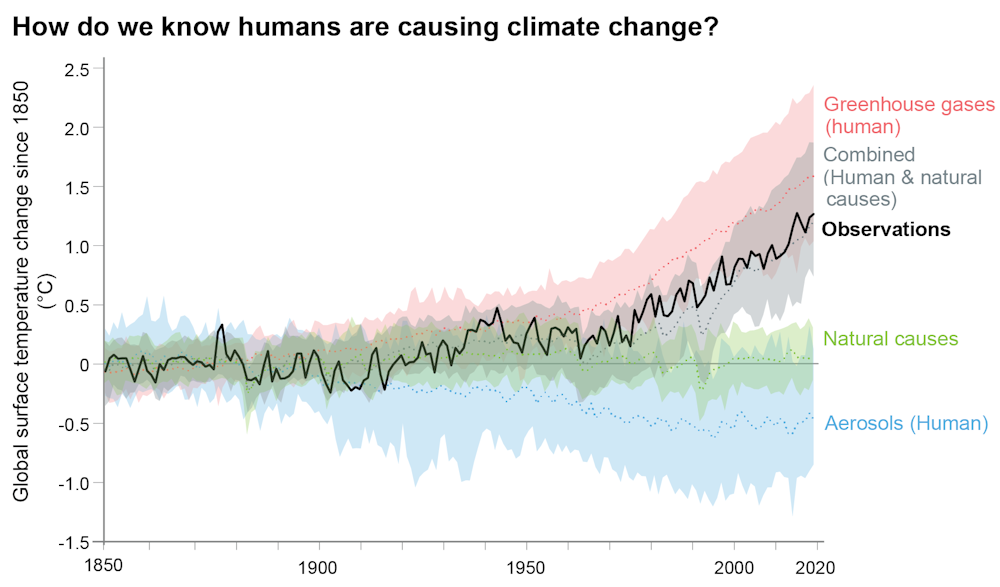
Humans are unequivocally warming the planet, and that’s triggering rapid changes in the atmosphere, oceans and polar regions, and increasing extreme weather around the world, the Intergovernmental Panel on Climate Change warns in a new report.
The IPCC released the first part of its much anticipated Sixth Assessment Report on Aug. 9, 2021. In it, 234 scientists from around the globe summarized the current climate research on how the Earth is changing as temperatures rise and what those changes will mean for the future.
What are the IPCC report’s most important overall messages in your view?
At the most basic level, the facts about climate change have been clear for a long time, with the evidence just continuing to grow.
As a result of human activities, the planet is changing at a rate unprecedented for at least thousands of years. These changes are affecting every area of the planet.
Humans produce large amounts of greenhouse gas emissions, primarily through fossil fuel burning, agriculture, deforestation and decomposing waste. IPCC Sixth Assessment Report
While some of the changes will be irreversible for millennia, some can be slowed and others reversed through strong, rapid and sustained reductions in greenhouse gas emissions.
But time is running out to meet the ambitious goal laid out in the 2015 international Paris Agreement to limit warming to well below 2 degrees Celsius above preindustrial levels (2 C equals 3.6 degrees Fahrenheit). Doing so requires getting global carbon dioxide emissions on a downward course that reaches net zero around or before 2050.
What are scientists most concerned about right now when it comes to the oceans and polar regions?
Global sea level has been rising at an accelerating rate since about 1970, and over the last century, it has risen more than in any century in at least 3,000 years.
Over the last decade, global average sea level has risen at a rate of about 4 millimeters per year (1.5 inches per decade). This increase is due to two main factors: the melting of ice in mountain glaciers and at the poles, and the expansion of water in the ocean as it takes up heat.
Ice sheets in particular are primarily responsible for the increase in the rate of sea level rise since the 1990s. There is clear evidence tying the melting of glaciers and the Greenland Ice Sheet, as well as ocean warming, to human influence. Sea level rise is leading to substantial impacts on coastal communities, including a near-doubling in the frequency of coastal flooding since the 1960s in many sites around the world.
Since the previous reports, scientists have made substantial advances in modeling the behavior of ice sheets. At the same time, we’ve been learning more about ice sheet physics, including recognizing the potential ways ice sheets can become destabilized. We don’t well understand the potential speed of these changes, but they have the potential to lead to much more rapid ice sheet loss if greenhouse gas emissions grow unchecked.
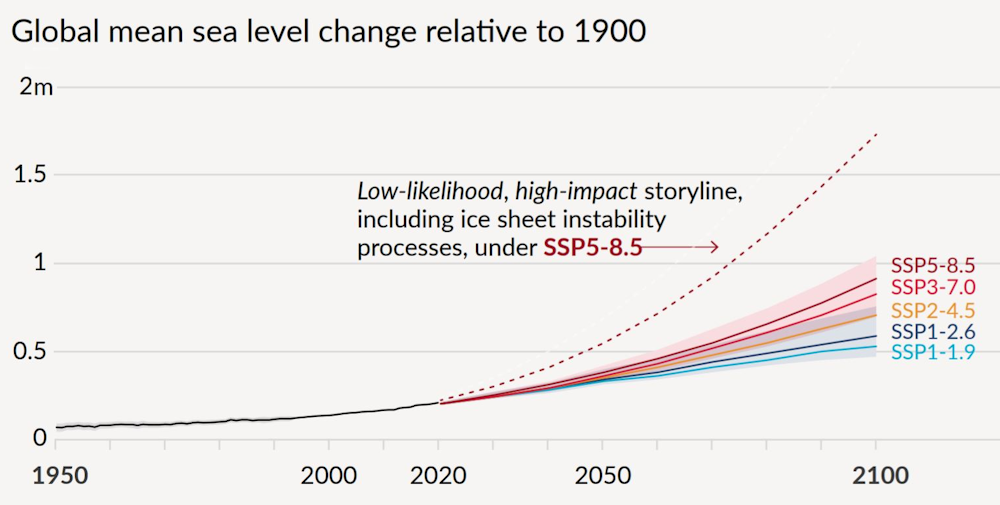
Sea level change through 2050 is largely locked in: Regardless of how quickly nations are able to lower emissions, the world is likely looking at about 15 to 30 centimeters (6 to 12 inches) of global average sea level rise through the middle of the century.
But beyond 2050, sea level projections become increasingly sensitive to the world’s emissions choices. If countries continue on their current paths, with greenhouse gas emissions likely to bring 3-4 C of warming (5.4-7.2 F) by 2100, the planet will be looking at a most likely sea level rise of about 0.7 meters (a bit over 2 feet). A 2 C (3.6 F) warmer world, consistent with the Paris Agreement, would see lower sea level rise, most likely about half a meter (about 1.6 feet) by 2100.
The IPCC’s projections for global average sea level rise in meters with higher-impact pathways and the level of greenhouse gas emissions. IPCC Sixth Assessment Report
What’s more, the more the world limits its greenhouse gas emissions, the lower the chance of triggering instabilities in the polar ice sheets that are challenging to model but could substantially increase sea level rise.
Under the most extreme emissions scenario we considered, we could not rule out rapid ice sheet loss leading to sea level rise approaching 2 meters (7 feet) by the end of this century.
Fortunately, if the world limits warming to well below 2 C, it should take many centuries for sea level rise to exceed 2 meters – a far more manageable situation.
Are the oceans or ice nearing any tipping points?
“Tipping point” is a vague term used in many different ways by different people. The IPCC defines tipping points as “critical thresholds beyond which a system reorganizes, in a way that is very fast or irreversible” – for example, a temperature rise beyond which climate dynamics commit an ice sheet to massive loss.
Because the term is so vague, the IPCC generally focuses on characteristics of changes in a system – for example, whether a system might change abruptly or irreversibly – rather than whether it fits the strict dynamic definition of a “tipping point.”
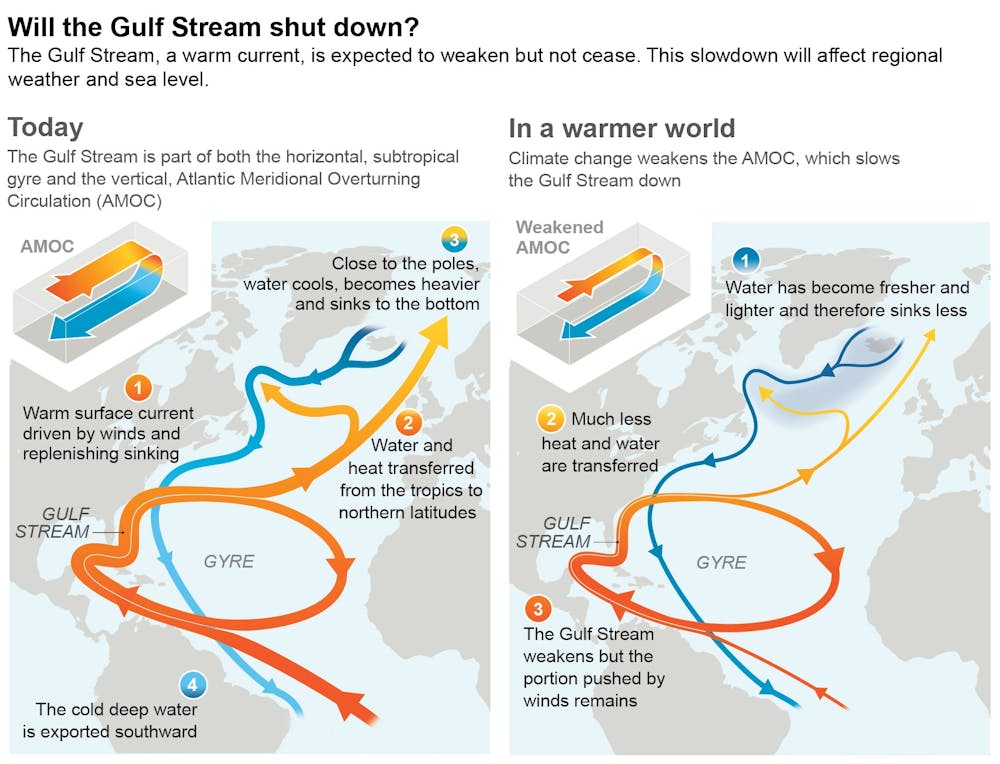
One example of a system that might undergo abrupt changes is the large-scale pattern of ocean circulation known as the Atlantic Meridional Overturning Circulation, or AMOC, of which the Gulf Stream is part. Paleoclimate evidence tells us that AMOC has changed rapidly in the past, and we expect that AMOC will weaken over this century. If AMOC were to collapse, it would make Europe warm more slowly, increase sea level rise along the U.S. Atlantic coast, and shift storm tracks and monsoons. However, most evidence indicates that such a collapse will not happen in this century.
The Gulf Stream is part of the Atlantic Meridional Overturning Circulation. A slowdown would affect temperature in Europe and sea level rise along the U.S. East coast. IPCC Sixth Assessment Report
There is mixed evidence for abrupt changes in the polar ice sheets, but clear evidence that changes in the ice sheets can be locked in for centuries and millennia.
If the world succeeds in limiting warming to 1.5 C (2.7 F), we expect to see about 2-3 meters (7-10 feet) of sea level rise over the next 2,000 years; if the planet continues to warm and reaches a 5 C (9 F) increase, we expect to see about 20 meters (70 feet) over the next 2,000 years.
Some people also discuss summer Arctic sea ice – which has undergone substantial declines over the last 40 years and is now smaller than at any time in the past millennium – as a system with a “tipping point.” However, the science is pretty clear that there is no critical threshold in this system. Rather, summer Arctic sea ice area decreases roughly in proportion to the increase in global temperature, and if temperature were stabilized, we would expect sea ice area to stabilize also.
What do scientists know now about hurricanes that they didn’t realize when the last report was written?
Since the last IPCC assessment report in 2013, there has been increasing evidence that hurricanes have grown more intense, and intensified more rapidly, than they did 40 years ago. There’s also evidence that hurricanes in the U.S. are moving more slowly, leading to increased rainfall.
However, it’s not clear that this is due to the effects of greenhouse gases – reductions in particulate pollution have also had important effects.
[Over 100,000 readers rely on The Conversation’s newsletter to understand the world.Sign up today.]
The clearest effect of global warming is that a warmer atmosphere holds more water, leading to more extreme rainfall, like that seen during Hurricane Harvey in 2017. Looking forward, we expect to see hurricane winds and hurricane rains continue to increase. It’s still unclear how the overall number of hurricanes will change.
The report involved 234 scientists, and then 195 governments had to agree on the summary for policymakers. Does that broad range of views affect the outcome?
When you’re writing a report like this, a key goal for the scientists is to accurately capture points of both scientific agreement and scientific disagreement.
For example, with respect to ice sheet changes, there are certain processes on which there is broad agreement and other processes where the science is still emerging and there are strong, discordant views. Yet knowing about these processes may be crucially important for decision-makers trying to manage risk.
That’s why, for example, we talk not only about most likely outcomes, but also about outcomes where the likelihood is low or as-yet unknown, but the potential impacts are large.
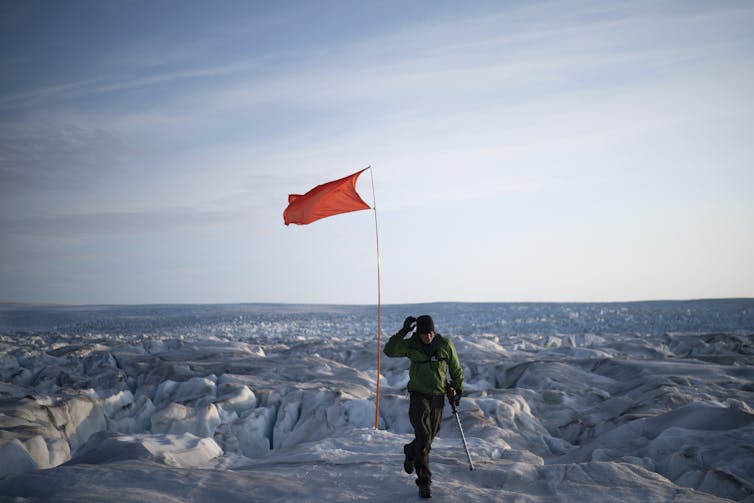
A scientist plants a flag to identify a GPS position on Greenland’s Helheim Glacier in 2019. The glacier had shrunk about 6 miles (10 kilometers) since scientists visited in 2005. AP Photo/Felipe Dana
The IPCC uses a transparent process to produce its report – the authors have had to respond to over 50,000 review comments over the three years we’ve spent writing it. The governments also weigh in, having to approve every line of a concise Summary for Policy Makers that accurately reflects the underlying assessment – oftentimes making it clearer in the process.
I’m very pleased that, as with past reports, every participating government has signed off on a summary that accurately reports the current state of climate science.
Robert Kopp is a professor in the Department of Earth & Planetary Sciences and the director of the Rutgers Institute of Earth, Ocean, and Atmospheric Sciences at Rutgers University.