Climate Change Is Relentless: Why Seemingly Small Shifts Have Such Big Consequences

This article is part of TPM Cafe, TPM’s home for opinion and news analysis.

Climate change has been accumulating slowly but relentlessly for decades. The changes might sound small when you hear about them – another tenth of a degree warmer, another centimeter of sea level rise – but seemingly small changes can have big effects on the world around us, especially regionally.

The problem is that while effects are small at any time, they are in the same direction of warming, and they accumulate. Those effects have now accumulated to the point where their influence is contributing to damaging heat waves, drought and rainfall extremes that can’t be ignored.

The most recent report from the United Nations’ Intergovernmental Panel on Climate Change is more emphatic than ever: Climate change, caused by human activities like burning fossil fuels, is having damaging effects on the climate as we know it, and those effects are rapidly getting worse.

Earth’s energy imbalance

An excellent example of how climate change accumulates is Earth’s energy imbalance. I am a climate scientist and have a new book on this, about to be published by Cambridge University Press.

The Sun bombards Earth with a constant stream of about 173,600 terawatts (that is 12 zeros) of energy in the form of solar radiation. About 30% of that energy is reflected back into space by clouds and reflective surfaces, like ice and snow, leaving 122,100 terawatts to drive all the weather and climate systems around us, including the water cycle. Almost all of that energy cycles back to space – except for about 460 TW.

That remaining 460 TW is the problem we’re facing. That excess energy, trapped by greenhouse gases in the atmosphere, is heating up the planet. That is the Earth’s energy imbalance, or in other words, global warming.
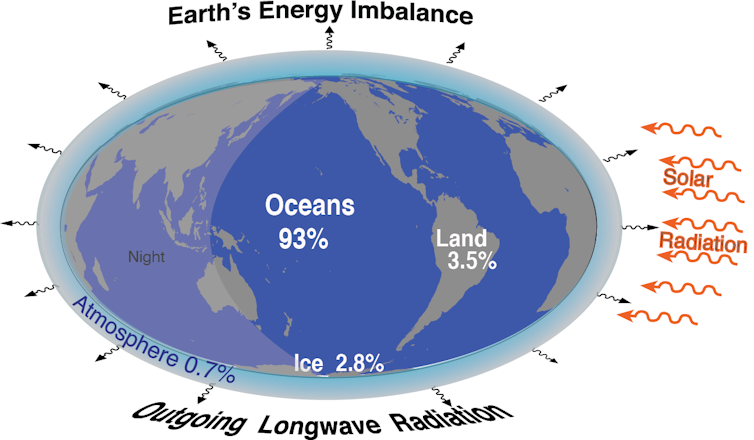
Globe illustration showing energy in and out and the remainder, trapped by greenhouse gases, going primarily into the oceans
Outgoing radiation is decreasing, owing to increasing greenhouse gases in the atmosphere, and leading to Earth’s energy imbalance of 460 terawatts. The percentage going into each domain is indicated.
Kevin Trenberth, CC BY-ND

In comparison with the natural flow of energy through the climate system, 460 TW seems small – it’s only a fraction of 1 percent. Consequently, we cannot go outside and feel the extra energy. But the heat accumulates, and it is now having consequences.

To put that in perspective, the total amount of electricity generated worldwide in 2018 was about 2.6 TW. If you look at all energy used around the world, including for heat, industry and vehicles, it’s about 19.5 TW. Earth’s energy imbalance is huge in comparison.

Interfering with the natural flow of energy through the climate system is where humans make their mark. By burning fossil fuels, cutting down forests and releasing greenhouse gases in other ways, humans are sending gases like carbon dioxide and methane into the atmosphere that trap more of that incoming energy rather than letting it radiate back out.

Before the first industries began burning large amounts of fossil fuels in the 1800s, the amount of carbon dioxide in the atmosphere was estimated at around 280 parts per million of volume. In 1958, when Dave Keeling began measuring atmospheric concentrations at Mauna Loa in Hawaii, that level was 310 parts per million. Today, those values have climbed to about 415 parts per million, a 48% increase.

Carbon dioxide is a greenhouse gas, and increased amounts cause heating. In this case, the human increment is not small.

Where does the extra energy go?

Measurements over time show that over 90% of this extra energy is going into the oceans, where it causes the water to expand and sea level to rise.

The upper layer of the oceans started warming around the 1970s. By the early 1990s, heat was reaching 500 to 1,000 meters (1,640 to 3,280 feet) deep. By 2005, it was heating the ocean below 1,500 meters (nearly 5,000 feet).
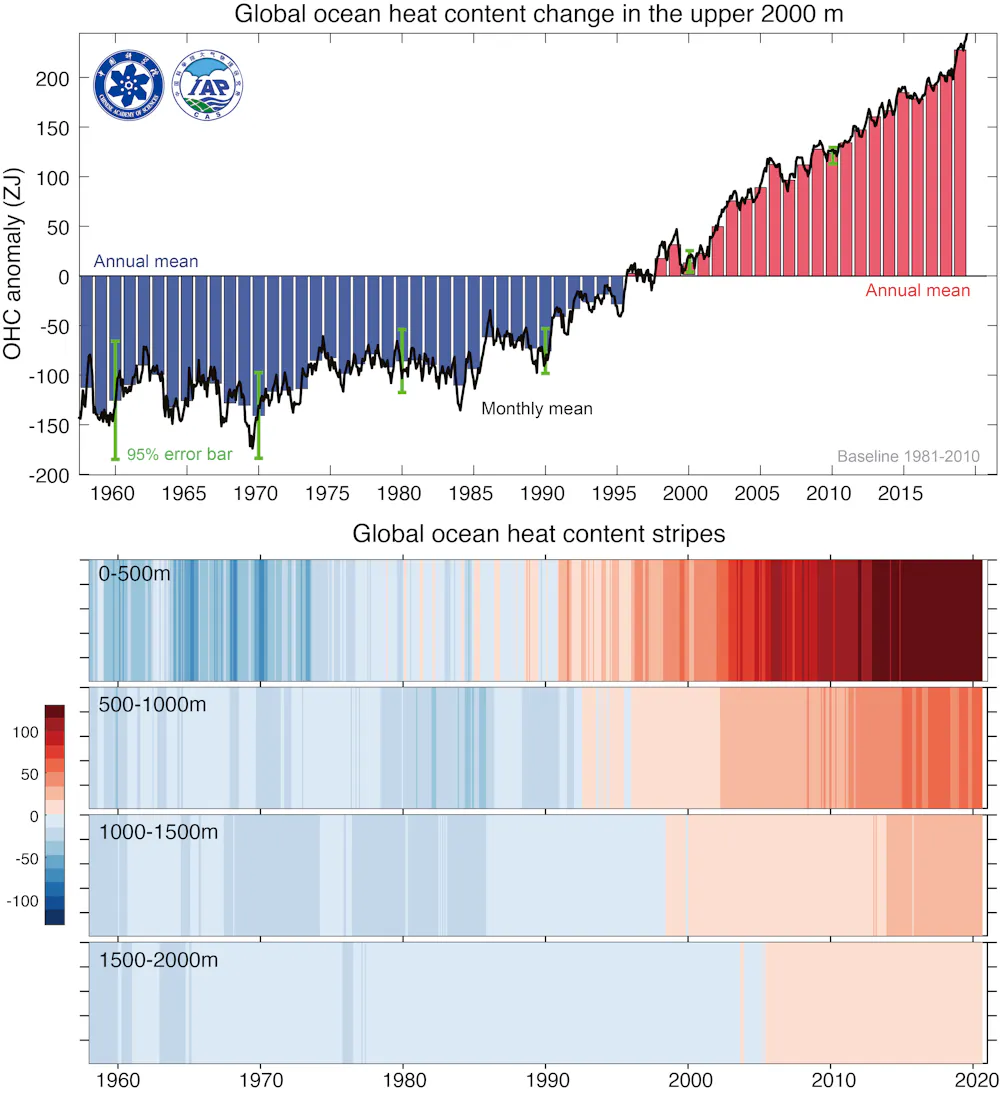
Two charts, one showing the annual increase in temperature in the top 2000 meters of ocean. The other is colored stripes showing heat increasing at several levels.
The average global temperature change at different ocean depths, in zetajoules, from 1958 to 2020. The top chart shows the upper 2,000 meters (6,561 feet) compared with the 1981-2010 average. The bottom shows the increase at different depths. Reds are warmer than average, blues are cooler.
Cheng et al, 2021, CC BY-ND

Global sea level, measured by flights and satellites, was rising at a rate of about 3 millimeters per year from 1992 to 2012. Since then, it been increasing at about 4 millimeters a year. In 29 years, it has risen over 90 millimeters (3.5 inches).

If 3.5 inches doesn’t sound like much, talk to the coastal communities that exist a few feet above sea level. In some regions, these effects have led to chronic sunny day flooding during high tides, like Miami, San Francisco and Venice, Italy. Coastal storm surges are higher and much more destructive, especially from hurricanes. It’s an existential threat to some low-lying island nations and a growing expense for U.S. coastal cities.

Some of that extra energy, about 13 terawatts, goes into melting ice. Arctic sea ice in summer has decreased by over 40% since 1979. Some excess energy melts land ice, such as glaciers and permafrost on Greenland, Antarctica, which puts more water into the ocean and contributes to sea level rise.

Some energy penetrates into land, about 14 TW. But as long as land is wet, a lot of energy cycles into evapotranspiration – evaporation and transpiration in plants – which moistens the atmosphere and fuels weather systems. It is when there is a drought or during the dry season that effects accumulate on land, through drying and wilting of plants, raising temperatures and greatly increasing risk of heat waves and wildfire.

Consequences of more heat

Over oceans, the extra heat provides a tremendous resource of moisture for the atmosphere. That becomes latent heat in storms that supersizes hurricanes and rainstorms, leading to flooding, as people in many parts of the world have experienced in recent months.

Air can contain about 4% more moisture for every 1 degree Fahrenheit (0.55 Celsius) increase in temperature, and air above the oceans is some 5% to 15% moister than it was prior to 1970. Hence, about a 10% increase in heavy rain results as storms gather the excess moisture.

Again, this may not sound like much, but that increase enlivens the updrafts and the storms, and then the storm lasts longer, so suddenly there is a 30% increase in the rainfall, as has been documented in several cases of major flooding.
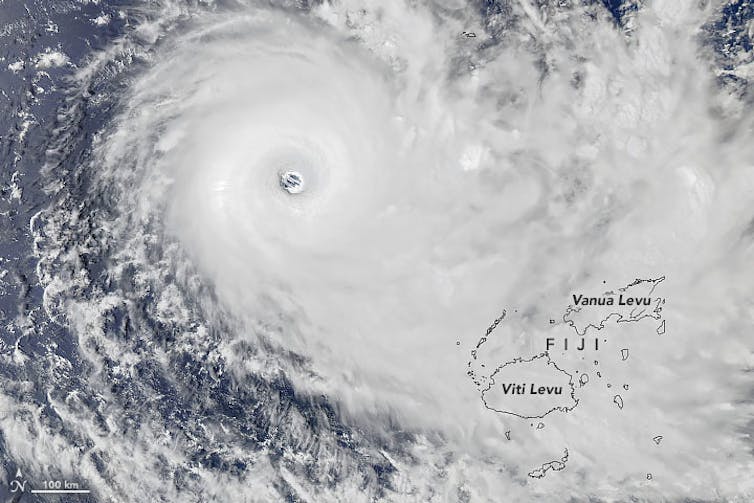
Satellite view of a hurricane with outlines of the islands in its path
Cyclone Yasa heads for Fiji in December 2020. It was the fourth most-intense tropical cyclone on record in the South Pacific.
NASA Earth Observatory

In Mediterranean climates, characterized by long, dry summers, such as in California, eastern Australia and around the Mediterranean, the wildfire risk grows, and fires can be readily triggered by natural sources, like dry lightning, or human causes.

Extreme events in weather have always occurred, but human influences are now pushing them outside their previous limits.

The straw that breaks the camel’s back syndrome

So, while all weather events are driven by natural influences, the impacts are greatly magnified by human-induced climate change. Hurricanes cross thresholds, levees break and floods run amok. Elsewhere, fires burn out of control, things break and people die.

I call it “The straw that breaks the camel’s back syndrome.” This is extreme nonlinearity, meaning the risks aren’t rising in a straight line – they’re rising much faster, and it confounds economists who have greatly underestimated the costs of human-induced climate change.

The result has been far too little action both in slowing and stopping the problems, and in planning for impacts and building resilience – despite years of warnings from scientists. The lack of adequate planning means we all suffer the consequences.


Kevin Trenberth is a distinguished scholar at the National Center for Atmospheric Research.

This article is republished from The Conversation under a Creative Commons license. Read the original article.

The MAGA Freakout Over Afghan Refugees Kicks Into Overdrive

A lot of things happened. Here are some of the things.

You Saw It Coming From Miles Away

As images filter out of Afghanistan of U.S. allies desperate to escape, and as President Biden pledges assistance to continue those evacuation efforts, MAGA world and the right-wing media are trying to gin up a new freakout: that the administration will resettle too many Afghans in the U.S.

  • Stephen Miller — who else? — was early out of the gate with this take Sunday evening.

  • Candidates for office got in on the act Monday afternoon.

  • By Monday evening, the drumbeat of xenophobia had, predictably, made its way to Tucker Carlson’s show.

  • Laura Ingraham followed on his heels.

‘Hard Not To Respect That’

Meanwhile, even further to the right, some are impressed by the Taliban’s sweep across Afghanistan and its commitment to religious fundamentalism.

  • “I think Islam is poisonous,” opined one Proud Boys Telegram account cited by Vice’s Ben Makuch. “BUT, these farmers and minimally trained men fought to take their nation back from [world governments]. They took back their national religion as law, and executed dissenters. Hard not to respect that.”

Breaking This Morning

The Taliban has offered its first — and very vague — comments about how it might govern, the AP reports:

  • “The Taliban declared an ‘amnesty’ across Afghanistan and urged women to join their government Tuesday, seeking to convince a wary population that they have changed a day after deadly chaos gripped the main airport as desperate crowds tried to flee the country.”

Must Reads on Afghanistan

Good To Know!

Former president George W. Bush is “watching the tragic events unfolding in Afghanistan with deep sadness,” he informed us in a statement.

Third Shot

The Biden administration has decided Americans should get a COVID-19 booster shot eight months after their second dose of the two-dose vaccines, the Times reports. Those who got the one-dose Johnson & Johnson shot are expected to also need a second dose.

Grim Statistic

The death toll in Haiti following an earthquake Saturday has now topped 1,400 people. This comes as the country grapples with political instability and as a tropical storm pounds the region.

California Recall

California Gov. Gavin Newsom’s (D) defense strategy ahead of the recall election next month isn’t to win over undecided voters — it’s to light a fire under the butts of Democratic voters who might otherwise not turn out during a non-election year.

  • In addition to warning Californians of top GOP rival Larry Elder’s deeply conservative stances, Newsom also says that “we’ve just got to gin up that enthusiasm” among blue voters. “That’s what the next 30 days is about,” he tells CNN.

Sign Of What’s To Come

The Biden administration has declared a water shortage along the Colorado River and is instituting cutbacks to the water it supplies to Arizona and Nevada, E&E News reports.

  • The river is a key source of water for over 40 million people and millions of acres of farmland across seven states.

NY Lawmakers Reverse Course On Cuomo Investigation

The New York State Assembly will finish its impeachment investigation into disgraced Gov. Andrew Cuomo (D) after drawing backlash over its initial decision to drop the probe in the wake of Cuomo’s resignation.

Delete Your Account

Sen. Ted Cruz (R) retweeted a clip of CNN correspondent Clarissa Ward’s report in Kabul that was selectively cropped by right-wing troll Jack Posobiec to make it look like CNN is….pro-Taliban or something?

Here’s Ward’s full report where she speaks to Taliban forces on the ground:

Hey, remember when Cruz ran away to sunny Mexico while millions of his constituents froze in their homes earlier this year? CNN’s comms team does:

Do you like Morning Memo? Let us know!

Tensions Escalate Over School Mask Mandates As Kids Return To Classroom

Many schools around the country are kicking off the academic year this week, and local officials are finding themselves at the center of a culture war over COVID-19 protection measures as GOP governors work to ban school mask mandates and angry anti-mask parents hijack school board meetings to rail against the policy.

Texas officials in Dallas and Bexar counties are fighting against Gov. Greg Abbott’s (R) mandate ban, and several of those officials have upheld their mandates today even after the Texas Supreme Court temporarily blocked their ability to pass mask rules at the local level.

Meanwhile, extra police officers have been dispatched to Eagle County School District schools in Colorado today “due to the tensions in the community, related to the new mask guidelines.” And in California, at least one teacher was reportedly physically injured during a dispute with a parent over masks.

Follow our live coverage below:

Masks Are One Of The Few Proven COVID Prevention Measures In Schools That Are Worth The Effort

This article is part of TPM Cafe, TPM’s home for opinion and news analysis. 

Just when schools were getting ready to reopen for the new school year, cases of COVID-19 started surging in the United States, driven in large part by the more contagious delta variant. School administrators around the country are working to bring students back into the classroom safely, while still providing kids an enriching learning environment. Continue reading “Masks Are One Of The Few Proven COVID Prevention Measures In Schools That Are Worth The Effort”

Congress Has The Power To Prevent A Repeat Of January 6 

This article is part of TPM Cafe, TPM’s home for opinion and news analysis. 

The barriers voters face before casting a ballot have rightly grabbed headlines recently. But there’s a way that tens of millions of Americans could be disenfranchised after voting in the next election that has gone under the radar. As the stirring testimony of the Capitol police officers recedes into our memory, we shouldn’t forget our democracy is still vulnerable to attack.   Continue reading “Congress Has The Power To Prevent A Repeat Of January 6 “

In 20-Page Plea, Top DOJ Official Implores Congress To Repair Mutilated Voting Rights Act

U.S. Assistant Attorney General Kristen Clarke testified before a House subcommittee Monday, submitting a 20-page document to underscore the dire threat faced by democracy without a robust Voting Rights Act. 

Continue reading “In 20-Page Plea, Top DOJ Official Implores Congress To Repair Mutilated Voting Rights Act”

Catching Up on the Fall of the Afghan Government

If you weren’t around over the weekend I did a series of posts on the unfolding situation in Afghanistan. In succession, “A Few Thoughts on Afghanistan,” “Vindication and the Fall of Kabul,” “After Sunday It’s Even More Clear Biden Was Right.” The titles give you the gist of my views: for all the chaos and horror, the rapidity of the collapse not only of the Afghan military but the Afghan state itself made me even more convinced the decision to leave was correct and more impressed that Biden had the courage to do it.

Biden is speaking to the American public this afternoon about the unfolding situation. It is the correct decision to do so. I think the entirety of what he needs to do is not second-guess the decision or chase after the emotions or hyperbole of the moment. The most important reason not to do that is that the decision was and is the correct one. But equivocation signals weakness. At a moment of uncertainty and chaotic images, the most important thing a leader can do is to be clear that he has a plan, that it is the right plan, and that because it is the right plan he will stick to that plan regardless of the political consequences and even if it is painful to do so.

Continue reading “Catching Up on the Fall of the Afghan Government”

TX Local Officials Go On With School Mask Mandates Despite State Supreme Court Decision

Some students and school staff in two of Texas’ biggest counties are required to wear masks to school on Monday despite the newest roadblock by the state’s Supreme Court.

Continue reading “TX Local Officials Go On With School Mask Mandates Despite State Supreme Court Decision”