A new episode of The Josh Marshall Podcast is live! This week, Josh and Kate discuss yet another week where Democrats are close to a reconciliation deal — if they can just circumvent Joe Manchin’s obstinance on a few key proposals.
You can listen to the new episode of The Josh Marshall Podcast here.
The White House unveiled a new reconciliation framework this morning, one it says it believes all Democrats will get behind. Biden is pushing both chambers of Congress to pass the bipartisan infrastructure deal alongside the new, $1.75 trillion reconciliation package that the framework details. It remains unclear whether centrist senators Manchin and Sinema are supporting the new framework, and whether House progressives will support the BIF.
Testifying at a Senate hearing this week, Arizona Secretary of State Katie Hobbs (D) detailed one of the many threats her office received in the aftermath of the 2020 election.
After the Congressional Progressive Caucus meeting today, chairwoman Pramila Jayapal (D-WA) told reporters that the group is scaling back its demands. To get their votes on the bipartisan infrastructure bill, she said, they need to see the legislative text of the reconciliation bill and to get a promise from President Joe Biden that he has all 50 Senate votes to pass it.
Previously, Jayapal had been insisting on back-to-back votes — the better to ensure that Sens. Kyrsten Sinema (D-AZ) and Joe Manchin (D-WV) don’t see the bipartisan bill out the door then leave reconciliation to fail.
When asked by TPM whether she’d need explicit public statements from Manchin and Sinema saying they’d vote for reconciliation, Jayapal said she’d “like” it, but would accept Biden’s word if he said he had their commitment. It’s a sign of the current high levels of trust in the President among the caucus.
Jayapal, and a host of other progressives, were eager to share their support of the reconciliation framework released by the White House Thursday morning. It contained disappointments for the group — especially Manchin’s killing of federal paid leave — but they applauded the President for getting the negotiation to this point and pointed out that many of their priorities made it into the “transformational” bill.
“It is not everything we would do if we had much bigger majorities, and we are not giving up the fight for anything,” Jayapal said.
The logistics of how to move these two bills forward at this point boils down to trust. House progressives trust the President, and trust 48 of the senators. But they don’t trust that Manchin and Sinema will be there on reconciliation if they give away their leverage on the bipartisan bill early.
The House Rules Committee released the text of the bill at breakneck speed Thursday afternoon. Now all eyes are on the two senators. Sinema put out a vaguely supportive statement on the framework, and Manchin told reporters he’d need to see the text; both stopped short of committing to vote for the final bill.
This article is part of TPM Cafe, TPM’s home for opinion and news analysis. It first appeared at The Conversation.
Four years ago, I traveled around America, visiting historical archives. I was looking for documents that might reveal the hidden history of climate change – and in particular, when the major coal, oil and gas companies became aware of the problem, and what they knew about it.
I pored over boxes of papers, thousands of pages. I began to recognize typewriter fonts from the 1960s and ‘70s and marveled at the legibility of past penmanship, and got used to squinting when it wasn’t so clear.
What those papers revealed is now changing our understanding of how climate change became a crisis.
On Oct. 28, 2021, executives from Exxon, BP, Chevron, Shell and the American Petroleum Institute faced questions from a Congressional subcommittee about the oil industry’s efforts to downplay the role of fossil fuels in climate change. The industry’s own words, as I found in my research, show they knew about the risk long before most of the rest of the world.
Surprising discoveries
At an old gunpowder factory in Delaware – now a museum and archive – I found a transcript of a petroleum conference from 1959 called the “Energy and Man” symposium, held at Columbia University in New York. As I flipped through, I saw a speech from a famous scientist, Edward Teller (who helped invent the hydrogen bomb), warning the industry executives and others assembled of global warming.
“Whenever you burn conventional fuel,” Teller explained, “you create carbon dioxide. … Its presence in the atmosphere causes a greenhouse effect.” If the world kept using fossil fuels, the ice caps would begin to melt, raising sea levels. Eventually, “all the coastal cities would be covered,” he warned.
1959 was before the moon landing, before the Beatles’ first single, before Martin Luther King’s “I Have a Dream” speech, before the first modern aluminum can was ever made. It was decades before I was born. What else was out there?
In Wyoming, I found another speech at the university archives in Laramie – this one from 1965, and from an oil executive himself. That year, at the annual meeting of the American Petroleum Institute, the main organization for the U.S. oil industry, the group’s president, Frank Ikard, mentioning a report called “Restoring the Quality of Our Environment” that had been published just a few days before by President Lyndon Johnson’s team of scientific advisers.
“The substance of the report,” Ikard told the industry audience, “is that there is still time to save the world’s peoples from the catastrophic consequences of pollution, but time is running out.” He continued that “One of the most important predictions of the report is that carbon dioxide is being added to the earth’s atmosphere by the burning of coal, oil, and natural gas at such a rate that by the year 2000 the heat balance will be so modified as possibly to cause marked changes in climate.”
Ikard noted that the report had found that a “nonpolluting means of powering automobiles, buses, and trucks is likely to become a national necessity.”
As I reviewed my findings back in California, I realized that before San Francisco’s Summer of Love, before Woodstock, the peak of the ’60s counterculture and all that stuff that seemed ancient history to me, the heads of the oil industry had been privately informed by their own leaders that their products would eventually alter the climate of the entire planet, with dangerous consequences.
Secret research revealed the risks ahead
While I traveled the country, other researchers were hard at work too. And the documents they found were in some ways even more shocking.
By the late 1970s, the American Petroleum Institute had formed a secret committee called the “CO2 and Climate Task Force,” which included representatives of many of the major oil companies, to privately monitor and discuss the latest developments in climate science.
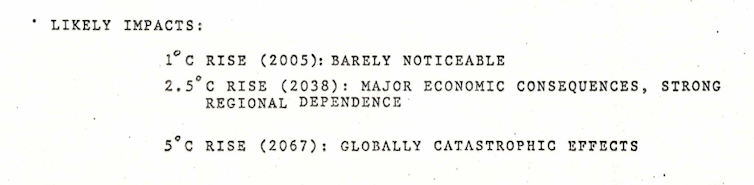
In 1980, the task force invited a scientist from Stanford University, John Laurmann, to brief them on the state of climate science. Today, we have a copy of Laurmann’s presentation, which warned that if fossil fuels continued to be used, global warming would be “barely noticeable” by 2005, but by the 2060s would have “globally catastrophic effects.” That same year, the American Petroleum Institute called on governments to triple coal production worldwide, insisting there would be no negative consequences despite what it knew internally.
A slide from John Laurmann’s presentation to the American Petroleum Institute’s climate change task force in 1980, warning of globally catastrophic effects from continued fossil fuel use.
Exxon had a secretive research program too. In 1981, one of its managers, Roger Cohen, sent an internal memo observing that the company’s long-term business plans could “produce effects which will indeed be catastrophic (at least for a substantial fraction of the earth’s population).”
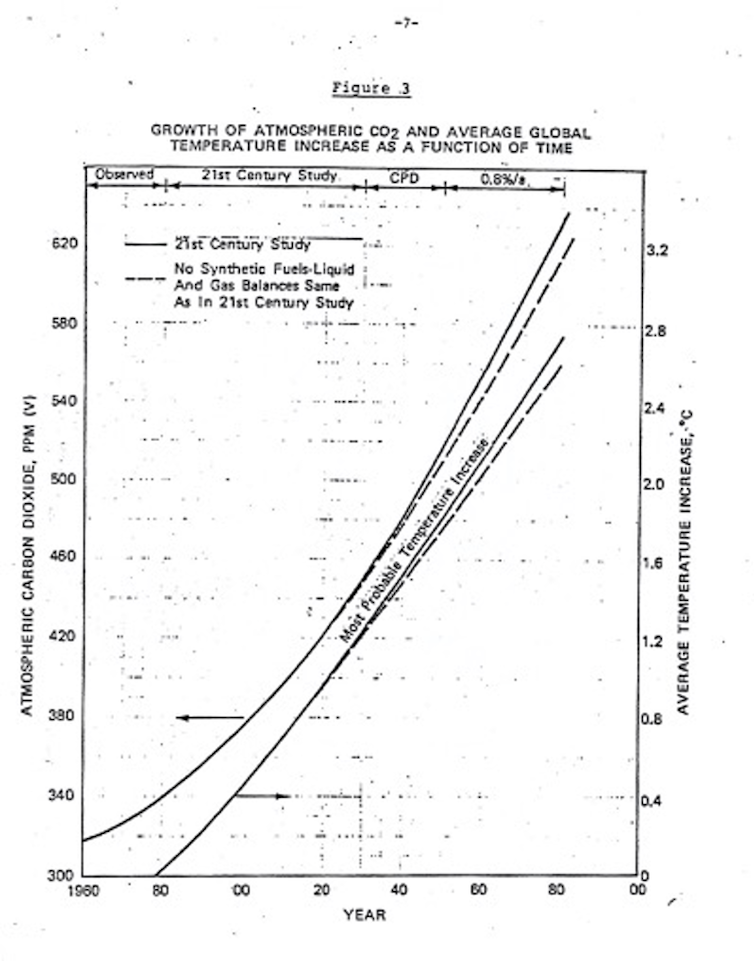
The next year, Exxon completed a comprehensive, 40-page internal report on climate change, which predicted almost exactly the amount of global warming we’ve seen, as well as sea level rise, drought and more. According to the front page of the report, it was “given wide circulation to Exxon management” but was “not to be distributed externally.”
And Exxon did keep it secret: We know of the report’s existence only because investigative journalists at Inside Climate News uncovered it in 2015.
A figure from Exxon’s internal climate change report from 1982, predicting how much carbon dioxide would build up from fossil fuels and how much global warming that would cause through the 21st century unless action was taken. Exxon’s projection has been remarkably accurate.
Other oil companies knew the effects their products were having on the planet too. In 1986, the Dutch oil company Shell finished an internal report nearly 100 pages long, predicting that global warming from fossil fuels would cause changes that would be “the greatest in recorded history,” including “destructive floods,” abandonment of entire countries and even forced migration around the world. That report was stamped “CONFIDENTIAL” and only brought to light in 2018 by Jelmer Mommers, a Dutch journalist.
In October 2021, I and two French colleagues published another study showing through company documents and interviews how the Paris-based oil major Total was also aware of global warming’s catastrophic potential as early as the 1970s. Despite this awareness, we found that Total then worked with Exxon to spread doubt about climate change.
Big Oil’s PR pivot
These companies had a choice.
Back in 1979, Exxon had privately studied options for avoiding global warming. It found that with immediate action, if the industry moved away from fossil fuels and instead focused on renewable energy, fossil fuel pollution could start to decline in the 1990s and a major climate crisis could be avoided.
But the industry didn’t pursue that path. Instead, colleagues and I recently found that in the late 1980s, Exxon and other oil companies coordinated a global effort to dispute climate science, block fossil fuel controls and keep their products flowing.
We know about it through internal documents and the words of industry insiders, who are now beginning to share what they saw with the public. We also know that in 1989, the fossil fuel industry created something called the Global Climate Coalition – but it wasn’t an environmental group like the name suggests; instead, it worked to sow doubt about climate change and lobbied lawmakers to block clean energy legislation and climate treaties throughout the 1990s.
For example, in 1997, the Global Climate Coalition’s chairman, William O’Keefe, who was also an executive vice president for the American Petroleum Institute, wrote in the Washington Post that “Climate scientists don’t say that burning oil, gas and coal is steadily warming the earth,” contradicting what the industry had known for decades. The fossil fuel industry also funded think tanks and biased studies that helped slow progress to a crawl.
Will the world experience the global catastrophe that the oil companies predicted years before I was born? That depends on what we do now, with our slice of history.
This article was updated Oct. 28, 2021, with the congressional hearing beginning.
This story first appeared at ProPublica. ProPublica is a Pulitzer Prize-winning investigative newsroom. Sign up for The Big Story newsletter to receive stories like this one in your inbox.
After Sen. Richard Burr of North Carolina dumped more than $1.6 million in stocks in February 2020 a week before the coronavirus market crash, he called his brother-in-law, according to a new Securities and Exchange Commission filing.
They talked for 50 seconds.
Burr, according to the SEC, had material nonpublic information regarding the incoming economic impact of coronavirus.
The very next minute, Burr’s brother-in-law, Gerald Fauth, called his broker.
ProPublica previously reported that Fauth, a member of the National Mediation Board, had dumped stock the same day Burr did. But it was previously unknown that Burr and Fauth spoke that day, and that their contact came just before Fauth began the process of dumping stock himself.
The revelations come as part of an effort by the SEC to force Fauth to comply with a subpoena that the agency said he has stonewalled for more than a year, and which was filed not long after ProPublica’s story.
In the filings, the SEC also revealed that there is an ongoing insider trading investigation into both Burr and Fauth’s trades.
It had previously been reported that federal prosecutors had decided not to charge Burr.
Burr’s spokesperson did not immediately respond to questions. Fauth’s lawyer and the SEC did not respond to questions. Fauth hung up on a ProPublica reporter.
According to the SEC, Fauth has cited a medical condition for why he cannot comply with the subpoena, even as he has been healthy enough to continue his duties at the National Mediation Board. In its filings, the SEC accuses Fauth of engaging in “a relentless battle” to dodge the subpoena.
In 2017, President Donald Trump appointed Fauth to the three-person board, a federal agency that facilitates labor-management relations within the nation’s railroad and airline industries. President Joe Biden reappointed him to the board.
On the day he received the call from Burr, Fauth sold between $97,000 and $280,000 worth of shares in six companies — including several that were hit particularly hard in the market swoon and economic downturn. According to the SEC, the first broker he called after hearing from Burr was out of the office, so he immediately called another broker to execute the trades.
In its filings, the SEC also alleges, for the first time, that Burr had material nonpublic information about the economic impact of the coming coronavirus crisis, based on his role at the time as chairman of the intelligence committee, as a member of the health committee and through former staffers who were directing key aspects of the government response to the virus.
The week after the trades, the market began its crash, falling by more than 30% in the subsequent month.
Burr came under scrutiny after ProPublica reported that he sold off a significant percentage of his stocks shortly before the market tanked, unloading between $628,000 and $1.72 million of his holdings on Feb. 13 in 33 separate transactions. The precise amount of his stock sales, more than $1.6 million, is also a new detail from this week’s SEC filings. In his roles on the intelligence and health committees, Burr had access to the government’s most highly classified information about threats to America’s security and public health concerns.
Before his sell-off, Burr had assured the public that the federal government was well prepared to handle the virus. In a Feb. 7 op-ed that he co-authored with another senator, he said “the United States today is better prepared than ever before to face emerging public health threats, like the coronavirus.”
That month, however, according to a recording obtained by NPR, Burr had given a VIP group at an exclusive social club a much more dire preview of the economic impact of the coronavirus, warning it could curtail business travel, cause schools to be closed and result in the military mobilizing to compensate for overwhelmed hospitals.
Burr defended his actions, saying he relied solely on public information, including CNBC reports, to inform his trades and did not rely on information he obtained as a senator.
Alice Fisher, Burr’s attorney, told ProPublica at the time that “Sen. Burr participated in the stock market based on public information and he did not coordinate his decision to trade on Feb. 13 with Mr. Fauth.”
There was little consensus as House progressives streamed out of a meeting with President Joe Biden about the reconciliation framework released by the White House Thursday morning.
I can’t tell whether I’m more miffed at Manchin and Sinema for cutting the reconciliation outline in half or forcing this months long delay and death by a thousand cuts which in addition to being incredibly annoying has greatly damaged Democrats’ and the White House’s political standing. And in case you’re putting the politics up against the policy and finding the former wanting – get real, the politics is what makes it possible to sustain the policy over time. In any case, it’s still not clear to me in what sense this is even a deal or a framework since neither side (“Manchin/Sinema” and “EveryoneElse”) appears to have agreed to it. This is more like what the President probably should have done a while ago which is to say: this is the deal, this is my plan, this is what I want. Now everyone get on board and support it.
Democrats made significant progress last night on the corporate minimum tax, a much-needed agreement on a revenue stream that seems to have netted support from the ever-difficult Sens. Kyrsten Sinema (D-AZ) and Joe Manchin (D-WV). Sen. Angus King (I-ME) said that the tax could garner up to $400 billion in 10 years — a significant chunk, but not enough to pay for the whole thing as moderates demand.
Another option is the billionaires income tax, text of which was released by the Senate Finance Committee this morning. So far though, Democrats are less unified behind this proposal, making its future uncertain.
There are also a host of other proposals — paid leave to Medicare benefits to prescription drug negotiations — currently stuck in limbo. The White House wanted this done, or at least to feel “a sense of momentum” as Sen. Tim Kaine (D-VA) put it to TPM, by the time President Joe Biden leaves for his European trips tomorrow. Right now, that’s looking like a tall order.