

A lot has happened over the last 12 hours, so a quick rundown on where we are:
Continue reading “Trust Me”Fox Set To Go Whole Hog On Whitewashing Jan. 6 As A ‘False Flag’ Operation
A lot of things happened. Here are some of the things.
Move Over, Alex Jones
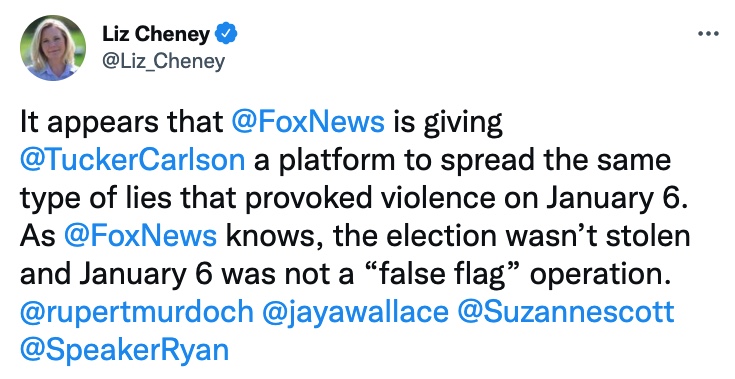
Fox News host Tucker Carlson announced last night his upcoming FOX Nation “documentary” on the Jan. 6 Capitol insurrection that he claimed “answers a lot of the remaining questions from that day,” and based on the trailer, one of those remaining questions seems to be “why is the government being so mean to the people who tried to overthrow the government for Trump?”
- The dark trailer of the documentary, titled “Patriot Purge,” portrays the violent insurrectionists as fighting a righteous war against an oppressive government.
- Violence and patriotism are the themes of the trailer, opening with a military drum riff against images of gunfire, law enforcement agents breaking into buildings, helicopters, and the torture of prisoners in Guantanamo Bay.
- “The helicopters have left Afghanistan, and they’ve landed here at home,” Carlson declares in the trailer.
- The trailer ends with an interviewee suggesting that the insurrection was a “false flag” operation.
- And in case you still had any doubts that this documentary is about anything but rebranding the insurrectionists as brave patriots, Carlson commented during his “Tucker Carlson Today” program yesterday that “you can see why the people who showed up in Washington on January 6th were mad.”
- The reactions are already pouring in:
Biden To Announce Reconciliation Framework
The President is expected to publicly lay out the “framework” of whatever’s left of his Build Back Better plan in the reconciliation bill after these long, long months of negotiations, according to the Washington Post.
- Biden is delaying departure for his trip to Europe today and will meet privately with the House Democratic Caucus this morning, according to Politico and the Washington Post.
- So with two years of free community college, the Clean Electricity Performance Program and now paid family and medical leave out, what social benefits are we left with right now in the package?
- Free universal pre-K, a one-year expansion of the child tax credit, three years of expanded Obamacare premiums, child care expansion, and housing subsidies seem to have survived the negotiations with Sens. Joe Manchin (D-WV) and Kyrsten Sinema (D-AZ), according to CNN.
Key Analysis
“Who is killing the billionaires’ tax?” – Washington Post columnist Greg Sargent
Eastman Still Advising GOPers On Voting Restrictions
Ex-Trump legal adviser John Eastman, the guy who tried to map a way for Mike Pence to steal the 2020 election, is “still very involved with a lot of the state legislators and advising them on election integrity,” according to Ryan Williams, the president of the conservative think tank where Eastman works as a senior fellow.
- Williams told undercover progressive activists at a gala this past weekend that Eastman was still “running the legal side” of the think tank, Claremont Institute.
Whoops, We Might Have Fomented A Fascism
An attendee at a Turning Points USA event earlier this week asked Charlie Kirk, the right-wing group’s founder, when conservatives should just straight-up murder their enemies, because “at this point, we’re living under corporate and medical fascism.”
- Emphasizing that his question was “not a joke,” the attendee asked Kirk, “When do we get to use the guns?” and “How many elections are they going to steal before we kill these people?”
- Kirk tried to “denounce” the guy’s proposal–but only the basis that killing people would be somehow giving the left “what they want,” not because violence is bad. “They are trying to make you do something that will be violent that will justify a takeover of your freedoms and liberties, the likes of which we have never seen,” he said.
Big Oil Finally In The Hot Seat As World Burns
Executives from oil and gas giants Exxon Mobil, Chevron, BP and Shell will testify in front of the House Oversight Committee today.
- It’ll be the first time oil chiefs will be forced to answer under oath how they peddled disinformation about climate change as the U.S. and the rest of the world suffer extreme (and sometimes deadly) weather patterns caused by burning fossil fuels.
Prosecutor Drops Felony Charge Against Man Who Underpaid For Soda
A Pennsylvania DA dismissed the charge against a homeless man who had accidentally paid $2 for a Mountain Dew that cost $2.29 plus tax at a gas station, which had deprived the gas station of a whole $0.43.
- The man had been facing up to seven years in prison for the offense. He was also put on a $50,000 cash-only bond.
Child Does Not Become Magnet During COVID Vaccine Trial
During a clinical trial for Pfizer’s COVID-19 vaccine for kids ages 5-11, there were five “severe adverse events” (none of which were linked to the vaccine), including “ingestion of a penny.”
- The FDA’s advisory panel approved that vaccine yesterday. COVID-19 was “the eighth-highest killer” of kids in that age group over the past year, according to a CDC official.
- Remember when people tried to testify that the vaccine made them magnetic? (Yes I know copper pennies aren’t magnetic but the steel pennies that were minted during World War II are, so my vaccine-magnet bit still works, okay?)
Do you like Morning Memo? Let us know!
The Sausage Making: Manchin Appears To Be The Problem On Nearly Every Remaining Issue
Democrats have been saying for days (weeks!) that they’re close to a deal on reconciliation — with just a handful of outstanding issues. Sen. Joe Manchin (D-WV) has the distinction of being the problem lawmaker blocking progress on just about all of them.
Continue reading “The Sausage Making: Manchin Appears To Be The Problem On Nearly Every Remaining Issue”Where Things Stand: The OTHER Reason The Filibuster Is So Devastating
(A lot going on in that photo beyond what the caption says, on so many levels. It is from June 21, 1947, after Senate Democrats spent the previous night filibustering the eventual GOP override of President Truman’s veto of Taft-Hartley.)
Set aside for a moment the big issues like democracy reform that we know are stymied by the filibuster — it’s a given that its anti-majoritarianism holds up major generational reforms. Its impact goes far beyond that. The ways in which the filibuster infects not just legislating but the basic task of governance is so pervasive that it’s become part of the background noise of Washington. We don’t notice it anymore, but it’s hugely significant.
Continue reading “Where Things Stand: The OTHER Reason The Filibuster Is So Devastating”Eastman Spins Wild Tales Of Jan. 6 As A Trap Sprung By Media And FBI
John Eastman is sure having trouble keeping his story straight.
A week ago, the ex-Trump legal adviser, whose legal memo laid out a path for Mike Pence to thwart the 2020 Electoral College certification, went to great lengths to downplay and minimize his memo.
Continue reading “Eastman Spins Wild Tales Of Jan. 6 As A Trap Sprung By Media And FBI”Did We Mention This Is Urgent?
Democrats appear to be limping their way toward passing a slimmed down version of the President’s agenda. I don’t think we should be overly distressed that the final number is around $2 trillion as opposed to $3.5 trillion. You never get everything you want. And we can’t run from the reality that Democrats control Congress by the most tenuous of margins – in fact, no margin at all in the Senate. But Democrats should be asking themselves why it is that over the last three to four months the President’s public approval has fallen roughly ten points. In a highly partisan and polarized age that is simply a massive drop.
Why has this happened?
Continue reading “Did We Mention This Is Urgent?”Man Arrested For Allegedly Threatening Gaetz And His Family
Law enforcement arrested a California man last week for allegedly leaving a threatening voicemail for Rep. Matt Gaetz (R-FL) in January.
Continue reading “Man Arrested For Allegedly Threatening Gaetz And His Family”A Revealing Look At Zuckerberg
I haven’t been reading all of the articles now coming out of the so-called “Facebook Papers”. But this article from the Post captures some important issues, ones that aren’t tied necessarily to the specific revelations getting the most attention but a general picture. There are two big focuses to the piece. The first is that for a company of its scale Facebook still has an extremely top-down management structure. Basically Zuckerberg is deep in the details and makes all the big decisions. The second is that he has repeatedly shot down internal ‘harm reduction’ proposals because they threaten core engagement metrics.
I noted a few weeks back that these tradeoffs get to the heart of Facebook’s problem and the heart of what the site is. The harm is inherent to Facebook’s business model. When you find ways to reduce harm they’re almost always at the expense of engagement metrics the maximization of which are the goal of basically everything Facebook does. The comparison may be a loaded or contentious one. But it is a bit like the Tobacco companies. The product is the problem, not how it’s used or abused. It’s the product. That’s a challenging place for a company to be.
Continue reading “A Revealing Look At Zuckerberg”Climate Change Is Muting Fall Colors, But It’s Just The Latest Way That Humans Have Altered US Forests
This article is part of TPM Cafe, TPM’s home for opinion and news analysis. It first appeared at The Conversation.
Fall foliage season is a calendar highlight in states from Maine south to Georgia and west to the Rocky Mountains. It’s especially important in the Northeast, where fall colors attract an estimated US$8 billion in tourism revenues to New England every year.
As a forestry scientist, I’m often asked how climate change is affecting fall foliage displays. What’s clearest so far is that color changes are occurring later in the season. And the persistence of very warm, wet weather in 2021 is reducing color displays in the Northeast and mid-Atlantic. But climate change isn’t the only factor at work, and in some areas, human decisions about forest management are the biggest influences.
Longer growing seasons
Climate change is clearly making the Northeast warmer and wetter. Since 1980, average temperatures in the Northeast have increased by 0.66 degrees Fahrenheit (0.37 Celsius), and average annual precipitation has increased by 3.4 inches (8.6 centimeters) – about 8%. This increase in precipitation fuels tree growth and tends to offset stress on the trees from rising temperatures. In the West, which is becoming both warmer and drier, climate change is having greater physiological effects on trees.
My research in tree physiology and dendrochronology – dating and interpreting past events based on trees’ growth rings – shows that in general, trees in the eastern U.S. have fared quite well in a changing climate. That’s not surprising given the subtle variations in climate across much of the eastern U.S. Temperature often limits trees’ growth in cool and cold regions, so the trees usually benefit from slight warming.
In addition, carbon dioxide – the dominant greenhouse gas warming Earth’s climate – is also the molecule that fuels photosynthesis in plants. As carbon dioxide concentrations in the atmosphere increase, plants carry out more photosynthesis and grow more.
More carbon dioxide is not automatically good for the planet – an idea often referred to as “global greening.” There are natural limits to how much photosynthesis plants can carry out. Plants need water and nutrients to grow, and supplies of these inputs are limited. And as carbon dioxide concentrations rise, plants’ ability to use it decreases – an effect known as carbon dioxide saturation.
For now, however, climate change has extended the growing season for trees in the Northeast by about 10-14 days. In my tree ring research, we routinely see trees putting on much more diameter growth now than in the past.
This effect is particularly evident in young trees, but we see it in old trees as well. That’s remarkable because old trees’ growth should be slowing down, not speeding up. Scientists in western states have even noted this acceleration in bristlecone pines that are over 4,000 years old – the oldest trees in the world.
Fall colors emerge when the growing season ends and trees stop photosynthesizing. The trees stop producing chlorophyll, the green pigment in their leaves, which absorbs energy from sunlight. This allows carotenoid (orange) and xanthophyll (yellow) pigments in the leaves to emerge. The leaves also produce a third pigment, anthocyanin, which creates red colors. A longer growing season may mean that fall colors emerge later – and it can also make those colors duller.
A changing mix of trees
Climate isn’t the only thing that affects fall colors. The types of tree species in a forest are an even bigger factor, and forest composition in the eastern U.S. has changed dramatically over the past century.
Notably, eastern forests today have more species such as red maple, black birch, tulip poplar and blackgum than they did in the early 20th century. These trees are shade-tolerant and typically grow in conditions that are neither extremely wet nor extremely dry. They also produce intense red and yellow displays in the fall.
This shift began in the 1930s, when federal agencies adopted policies that called for suppressing all wildfires quickly rather than letting some burn. At that time, much of the eastern U.S. was dominated by fire-adapted oak, pine and hickory. Without fires recurring once or twice a decade, these species fail to regenerate and ultimately decline, allowing more shade-tolerant, fire-sensitive trees like red maple to invade.
There is evidence that some tree species in the eastern U.S. are migrating to the north and west because of warming, increasing precipitation and fire suppression. This trend could affect fall colors as regions gain or lose particular species. In particular, studies indicate that the range of sugar maples – one of the best color-producing trees – is shifting northward into Canada. https://www.youtube.com/embed/4YAIq-Whttg?wmode=transparent&start=0 Intensive logging and forest clearance across the eastern U.S. through the mid-1800s altered forests’ mix of tree species.
Forests under pressure
So far it’s clear that warming has caused a delay in peak colors for much of the East, ranging from a few days in Pennsylvania to as much as two weeks in New England. It’s not yet known whether this delay is making fall colors less intense or shorter-lasting.
But I’ve observed over the past 35 years that when very warm and wet weather extends into mid- and late October, leaves typically go from green to either dull colors or directly to brown, particularly if there is a sudden frost. This year there are few intense red leaves, which suggests that warmth has interfered with anthocyanin production. Some classic red producers, such as red maple and scarlet oak, are producing yellow leaves.
Other factors could also stress eastern forests. Climate scientists project that global warming will make tropical storms and hurricanes more intense and destructive, with higher rainfall rates. These storms could knock down trees, blow leaves off those left standing and reduce fall coloration.
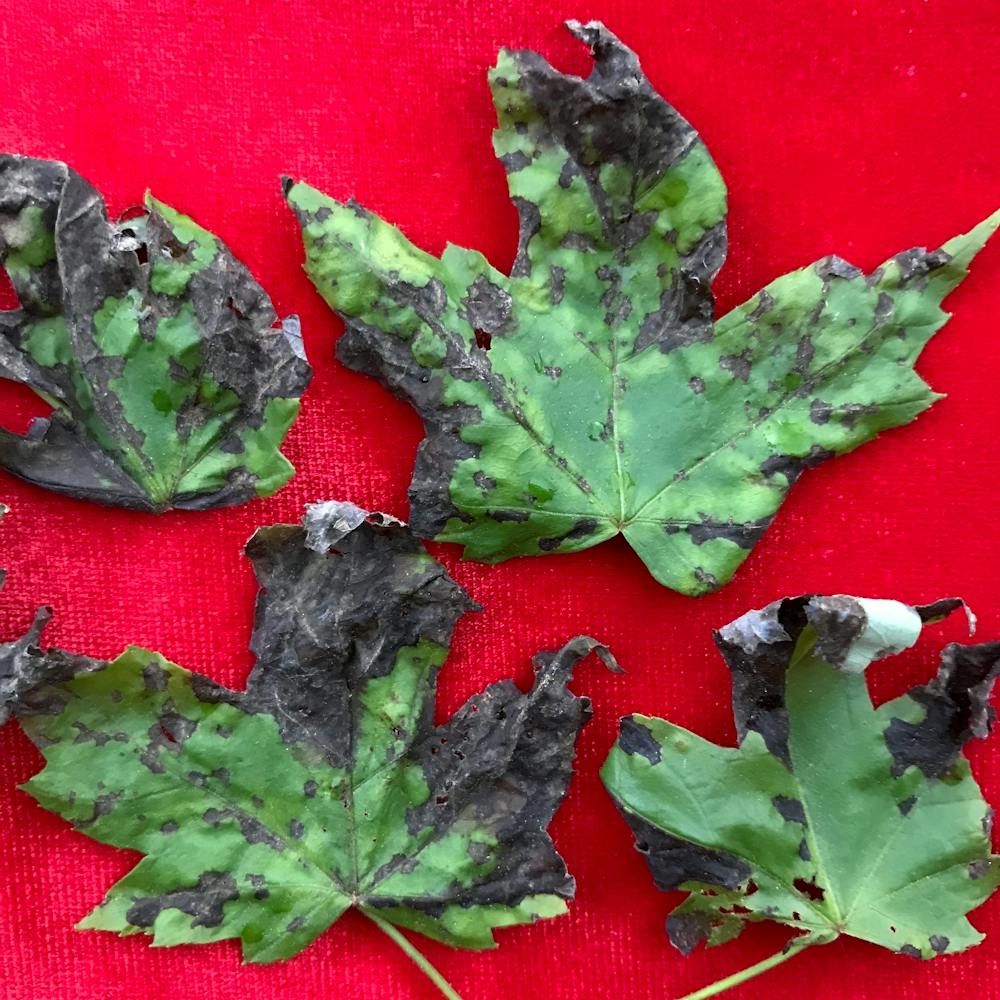
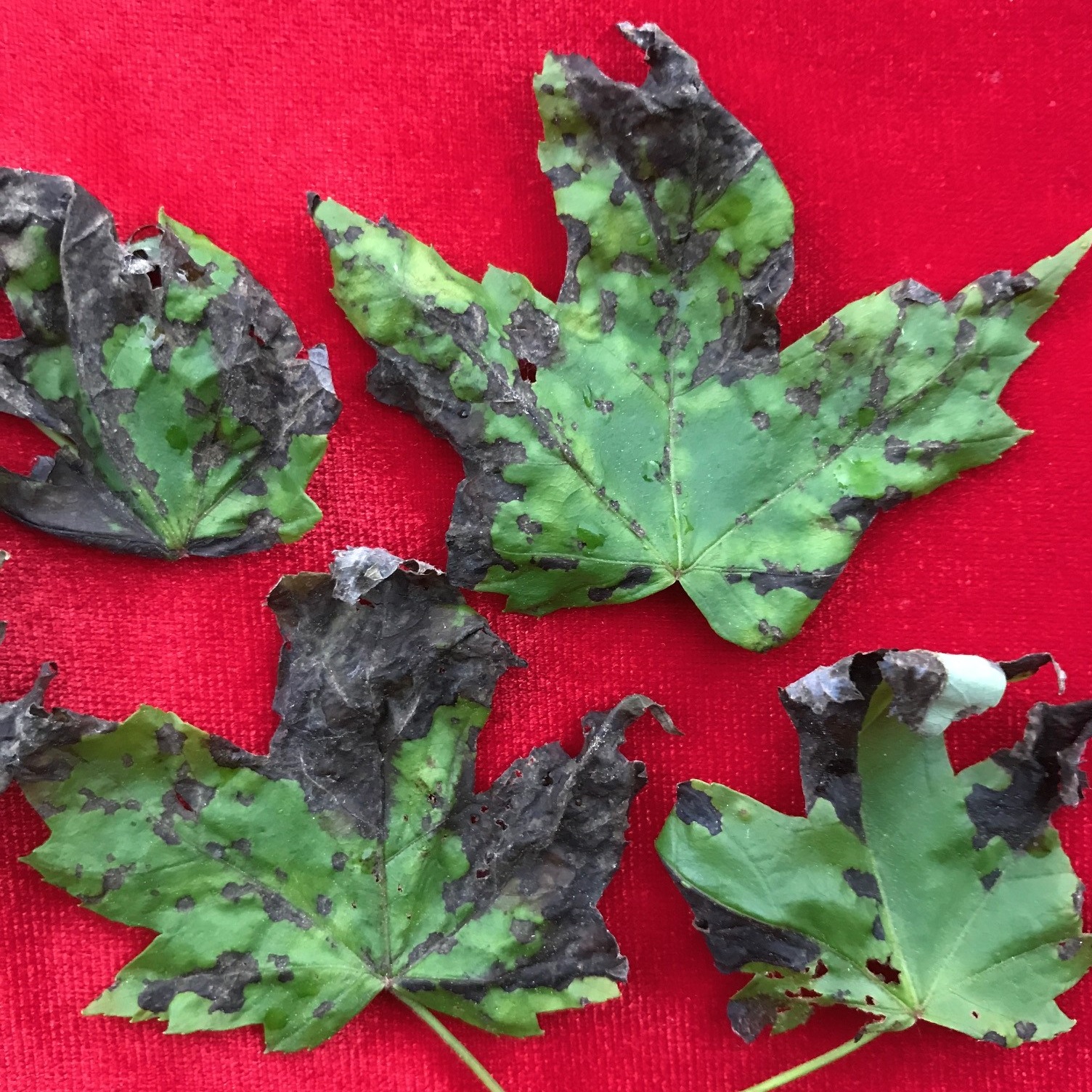
Scientists also expect climate change to expand the ranges of insects that prey on trees, such as the emerald ash borer. And this year’s very wet fall has also increased problems with leaf-spotting fungi, which are hitting sugar maples particularly hard.
Forests shade the earth and absorb carbon dioxide. I am proud to see an increasing number of foresters getting involved in ecological forestry, an approach that focuses on ecosystem services that forests provide, such as storing carbon, filtering water and sheltering wildlife.
Foresters can help to slow climate change by revegetating open land, increasing forests’ biodiversity and using highly adaptable tree species that are long-lived, produce many seeds and migrate over time. Shaping eastern forests to thrive in a changing climate can help preserve their benefits – including fall color displays – well into the future.
Marc Abrams is a professor of Forest Ecology and Physiology at Penn State.
This article is republished from The Conversation under a Creative Commons license. Read the original article.
Jan. 6 Panel Temporarily Pauses Request For Some Trump WH Docs
The House Jan. 6 select committee has delayed its request to President Joe Biden’s team for about 50 pages worth of Trump-era White House documents that the National Archivist has already approved for the panel to obtain.
Continue reading “Jan. 6 Panel Temporarily Pauses Request For Some Trump WH Docs”