

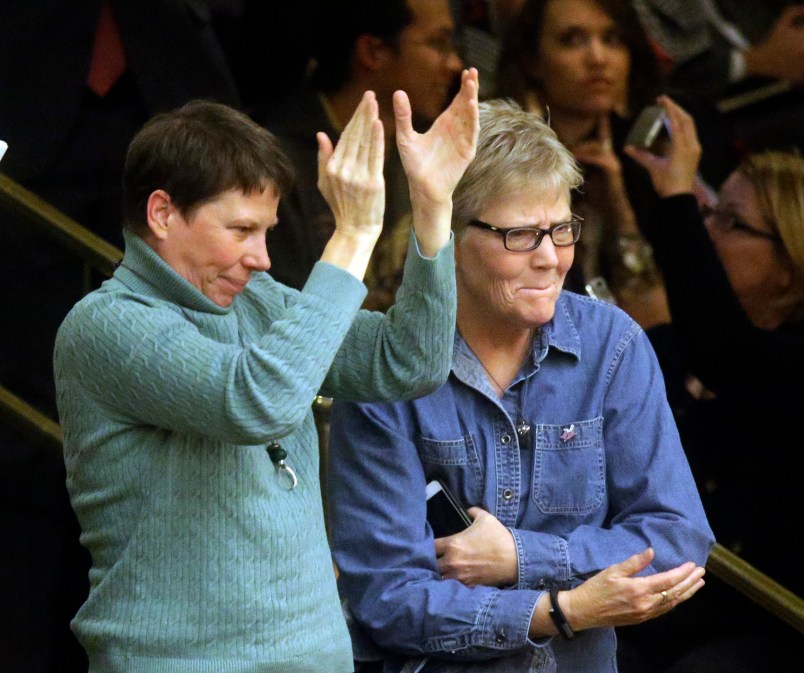
SALT LAKE CITY (AP) — A Mormon-church-backed anti-discrimination bill that protects LGBT Utah residents and religious rights received final approval at the state’s Republican-controlled Legislature on Wednesday.
“I’m not asking you tonight to condone the lifestyle that you don’t believe in. I’m not asking you to give rights to them to preserve their lifestyle. In the narrowest form, I’m asking you to guarantee their rights, the same rights you and I have today,” said Rep. Brad Dee, a Republican from Ogden who is one of the sponsors of the bill.
The House of Representatives voted 65-10 to pass the bill, which was only unveiled last week. The Senate passed it Friday.
The bill earned a rare endorsement from the Utah-based Church of Jesus Christ of Latter-day Saints, which has helped fast-track the measure through the Legislature.
Gov. Gary Herbert, a Republican and member of the church, has said he’ll sign the bill.
He’s scheduled to do so at 6 p.m. on Thursday, according to his spokesman Marty Carpenter.
Conservative opponents have argued that the proposal, which is limited to housing and employment, doesn’t go far enough to protect religious rights.
The bill doesn’t address thornier discrimination questions about whether a business can refuse to serve someone for religious reasons, such as a wedding photographer who objects to photographing a same-sex marriage.
Critics have also argued that the bill creates special protections for gay and transgender people.
The Mormon church said it is fully behind the legislation, which follows the principles set out in its call for laws that balance religious rights and protections for lesbian, gay, bisexual and transgender people.
The church’s support for the measure comes as the faith’s leaders have softened their tone in recent years regarding same-sex attraction. While moving away from harsh rhetoric and preaching compassion and acceptance, the LDS church insists it is not changing doctrine and still believes sex is against the law of God unless it’s within a marriage between a man and a woman.
LGBT advocates who’ve been pushing the issue at Utah’s Legislature for more than half a dozen years have celebrated the church’s endorsement, which has offered the kind of broad support they need to pass an anti-discrimination law in conservative Utah.
The bill would make it illegal to base hiring, firing and other employment decisions based on someone’s sexual orientation or gender identity.
It would also make it illegal to refuse to sell or rent, to deny a home loan, or to base other housing decisions because someone is LGBT.
Rep. Jeremy Peterson, an Ogden Republican who voted against the bill, said as a property manager, he rents to gay people and he doesn’t think there’s a need to a law protecting their right to housing.
“The free market is working in this. Landlords do what they’re paid to do, which is fill vacancies and collect rents,” he said.
Religious organizations and their affiliates such as schools and hospitals are exempt from the law, as is the Boy Scouts of America, which has a ban on gay adult Scout leaders and has close ties to the LDS Church.
For religious rights, the bill allows for people to express their beliefs in the workplace without retribution as long as they are not harassing someone and the speech doesn’t interfere with the company’s core business.
For example, if a company offered wedding planning services specifically tailored to same-sex ceremonies, an employee would not be able to express their views opposing against gay marriage.
It allows employers to adopt “reasonable dress and grooming standards” and “reasonable rules and polices” for gender-specific restrooms and other facilities, as long as they also accommodate transgender people.
Lawmakers say they specifically didn’t define a “reasonable” regulation in order to give employers flexibility to find a solution to their situation.
Later Wednesday, the House voted 66-9 to approve a bill that allows county clerks to refuse to marry same-sex couples for religious reasons. But the bill requires a county clerk’s office to designate someone who will marry all couples, including gay couples, if the clerk opts out.
The 11 members of the House Judiciary Committee approved the measure earlier Wednesday, calling it a good balance between protecting religious rights while still accommodating gay couples who wish to marry.
Republican Sen. Stuart Adams sponsored the bill and said it guarantees same-sex couples will be able to find someone to marry them in each county.
LGBT advocates initially opposed Adams’ bill when it included broader religious protections.
Equality Utah’s executive director, Troy Williams, said Wednesday that his organization is now neutral on the bill after Adams addressed their concerns.
Several conservative organizations spoke in favor of the bill Wednesday, and the Mormon church issued a statement of support for the proposal.
It’s unclear whether the governor would support the marriage bill.
___
Follow Michelle L. Price at https://twitter.com/michellelprice
Copyright 2015 The Associated Press. All rights reserved. This material may not be published, broadcast, rewritten or redistributed.





Why do I feel suspicious? Like there’s some sort of sneaky provision in here.
I’m going to try to take it at face value. Thank you, Mormons, for taking a step in the right direction. And thanks to the Republicans who supported the bill for showing that, at least at the state level a Republican can take a reasonable stance on something.
As a gay person I’m actually ok with the provision that allows individual clerks to opt out of performing a gay marriage…as long as there is a requirement that they designate someone who WILL perform the marriages.
The last thing I would want on a special day is for a justice of the peace to grudgingly perform the ceremony.
Agreed. I’m okay with it on face value, as long they aren’t sneaking something into the bill somewhere that is being missed.
I’m not sure about the main group in Utah, but my experience from the marriage equality debate in Hawaii (where there is also a significant Mormon presence - the temple here was set up in 1867, only 20 years after they got to Utah and the first one outside the US) is that they aren’t nearly as bad as others. I accidentally joined an anti-marriage group on FB (thinking from the title that it was pro-) that was moderated by a group of Mormons, and found they were mostly interested in ensuring the church didn’t have to do anything related to gay marriages. One of the reasons I suspect it will be difficult to get a full public accomodations clause passed is that the church itself owns a lot of for-profit commercial entities that would be affected; though it does mean the employment clause is somewhat significant.
The really interesting thing was that as the vote in the legislature came closer the arguments on the FB group became more acrimonious (there were a few pro-equality people on there, trying to get the antis to question why they believed what they did, and some wanted to kick us all off). Eventually the Mormons who ran it left and moderation was taken over by a group of evangelicals, and that was when the real hate came out all over. It was quite a striking change.
Because the Mormons have no room to pretend that they are above controversial issues.
The church controls liquor sales including the large profits. The church is anti-caffeine and yet owns considerable amounts of stock in PepsiCo.
The bigamy/polygamy thing is a bit outside of the main church but stems from Mormonism and the big/poly people practice Mormonism so it is a Mormon thing.
Protecting LGBT citizens is right in the Mormon wheelhouse truthfully. Even the practice of Mormonism is viewed as outside of mainstream religion. Just ask the fundies or many everyday Christians. Knowing Romney’s lack of tact, there is likely some 47% number that connects to Mormons.