

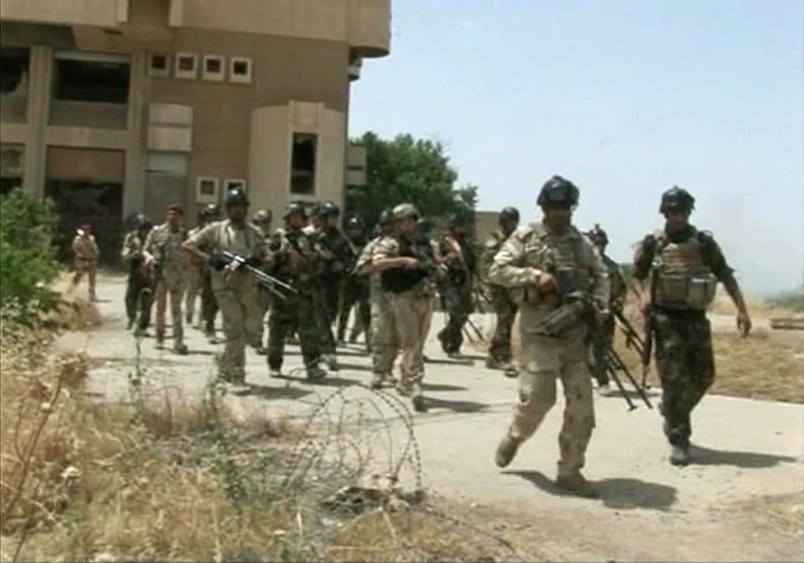
WASHINGTON (AP) — Nearly 300 armed American forces are being positioned in and around Iraq to help secure U.S. assets as President Barack Obama nears a decision on an array of options for combating fast-moving Islamic insurgents, including airstrikes or a contingent of special forces.
The U.S. and Iran also held an initial discussion on how the longtime foes might cooperate to ease the threat from the al-Qaida-linked militants that have swept through Iraq. Still, the White House ruled out the possibility that Washington and Tehran might coordinate military operations in Iraq.
Obama met with his national security team Monday evening to discuss options for stopping the militants known as the Islamic State of Iraq and the Levant. Officials said the president has made no final decisions on how aggressively the U.S. might get involved in Iraq, though the White House continued to emphasize that any military engagement remained contingent on the government in Baghdad making political reforms.
Still, there were unmistakable signs of Americans returning to a country from which the U.S. military fully withdrew more than two years ago. Obama notified Congress that up to 275 troops would be sent to Iraq to provide support and security for U.S. personnel and the American Embassy in Baghdad. The soldiers — 170 of which have already arrived in Iraq — were armed for combat, though Obama has insisted he does not intend for U.S. forces to be engaged in direct fighting.
“We are hard-wired into their system,” the fledgling democracy that America helped institute, said Ryan Crocker, a former U.S. ambassador to Baghdad. “We can’t walk away from it.”
About 100 additional forces are being put on standby, most likely in Kuwait, and could be used for airfield management, security and logistics support, officials said.
Separately, three U.S. officials said the White House was considering sending a contingent of special forces soldiers to Iraq. Their limited mission — which has not yet been approved — would focus on training and advising beleaguered Iraqi troops, many of whom have fled their posts across the nation’s north and west as the al-Qaida-inspired insurgency has advanced in the worst threat to the country since American troops left in 2011.
Taken together, the developments suggest a willingness by Obama to send Americans into a collapsing security situation in order to quell the brutal fighting in Iraq before it morphs into outright war.
If the U.S. were to deploy an additional team of special forces, the mission almost certainly would be small. One U.S. official said it could be up to 100 special forces soldiers. It also could be authorized only as an advising and training mission — meaning the soldiers would work closely with Iraqi forces that are fighting the insurgency but would not officially be considered combat troops.
The White House would not confirm that special operations forces were under consideration. But spokeswoman Caitlin Hayden said that while Obama would not send troops back into combat, “He has asked his national security team to prepare a range of other options that could help support Iraqi security forces.”
It’s not clear how quickly the special forces could arrive in Iraq. It’s also unknown whether they would remain in Baghdad or be sent to the nation’s north, where the Sunni Muslim insurgency has captured large swaths of territory ringing Baghdad, the capital of the Shiite-led government.
The troops would fall under the authority of the U.S. ambassador in Baghdad and would not be authorized to engage in combat, another U.S. official said. Their mission would be “non-operational training” of both regular and counterterrorism units, which the military has in the past interpreted to mean training on military bases, the official said.
However, all U.S. troops are allowed to defend themselves in Iraq if they are under attack.
The three U.S. officials all spoke on condition of anonymity because they were not authorized to publicly discuss the plans by name.
Obama made the end of the war in Iraq one of his signature campaign issues, and has touted the U.S. military withdrawal in December 2011 as one of his top foreign policy successes. But he has been caught over the past week between Iraqi officials pleading for help — as well as Republicans blaming him for the loss of a decade’s worth of gains in Iraq — and his anti-war Democratic political base, which is demanding that the U.S. stay out of the fight.
The crisis has sparked a rare alignment of interests between the U.S. and Iran, which wants to preserve Iraq’s Shiite-dominated government. The U.S. and Iran are engaged in sensitive nuclear negotiations and used a round of talks Monday in Vienna, Austria, to hold a separate bilateral discussion on Iraq.
While the U.S. and Iran have similar short-term goals in Iraq, they have different long-term aims. The United States would like to see an inclusive, representative democracy take hold in Iraq, while predominantly Shiite Iran is more focused on protecting Iraq’s Shiite population and bolstering its own position as a regional power against powerful Sunni Arab states in the Gulf.
Crocker said that Iran should “use all the influence” possible to keep the al-Qaida-style Islamic group from exacerbating the sectarian strife in Iraq.
Appearing Tuesday on “CBS This Morning,” Crocker said if he’d have Secretary of State John Kerry “on a plane right now for Baghdad.”
“I would have liked to have seen more sustained, high-level diplomatic engagement with the Iraqis,” Crocker said. He said that for the country to have any change at survival there must quickly be a show of “Kurdish, Shia and Sunni” solidarity.
Republican Rep. Mike Rogers of Michigan, chairman of the House Intelligence Committee, said Washington must move immediately “to disrupt their ability to continue their operations.” He said the insurgents are holding sway currently and that “all the ingredients are going into the stew. We see it happening on our watch.”
Appearing on CNN, Rogers said he believes there still is time for the United States to make a difference, but that Washington must move now.
While the White House continues to review its options, Iran’s military leaders are starting to step into the breach.
The commander of Iran’s elite Quds Force, Gen. Ghasem Soleimani, was in Iraq on Monday and consulting with the government there on how to stave off insurgents’ gains. Iraqi security officials said the U.S. government was notified in advance of the visit by Soleimani, whose forces are a secretive branch of Iran’s Revolutionary Guard that in the past has organized Shiite militias to target U.S. troops in Iraq and, more recently, was involved in helping Syria’s President Bashar Assad in his fight against Sunni rebels.
___
Associated Press writers Matthew Lee, Lolita C. Baldor and Ken Dilanian contributed to this report.






And so it begins again…
This could quickly morph into the events that derail the Dem strategy for 2016. A steady increase in military personnel in Iraq followed by the inevitable caskets arising at Dover will not play well with the 2016 electorate.
Nor do I see how we come about with a “win” out of this. 100 special forces people does not seem likely to overturn a growing revolt, at best, the may hold onto that monstrosity we call a embassy in Baghdad, but little good that will do when the government we are propping up dissolve.
The neocons are out in full force, doing everything they can to goad the President into sending more troops. And without much doubt, rest of their GOP brethern will start screaming for impeachment for going into war without “consulting” Congress.
It seems that they are being deployed to protect what might be a quite vulnerable US Embassy. Vulnerable because of its massive size. It was probably never a good idea to have such a large display of American Power, but in hindsight, an even worse idea.
Imagine though, we had not reinforced the embassy. Imagine it had been overrun by either faction - Shia or Sunni. Imagine the calls of Benghazziiiii - Baghdad!
It’s tough enough to have to make these kinds of no good options calls. Made all the tougher by those hoping to cash in on any and all missteps.
It seems a little knee-jerk to conclude that a training mission and embassy security must necessarily turn into “it begins again.”
“Nearly 300 armed American forces are being positioned in and around Iraq to help secure U.S. assets”
So they are going to be deployed all over the country (read protect the infrastructure that American companies are so heavily invested). Nor is likely we are deploying special forces to be used as defensive measures. That isn’t their strength. They are going there to reconniter the situation on the ground, see if it is possible to command/rally the Iraqi armed forces, and then take steps towards a counter offense.
Given that it seem unlikely that the Iraqi army will stand up to this insurgency(based on mass surrenders we have seen so far), a counter offense is going to be done by…more American troops.
A training mission and embassy security? Don’t kid yourself. Special forces do not man embassies for security. And what sort of training do you envision happening for an army that is in full retreat/surrender? We are going to give them the super dooper secret final pages of the training manual that we forget to give them during the 10 years we spent training and equipping them?
What has been demonstrated is that the Iraqi army is a paper army only. It is totally inadequate for the tasks of defending against a concentrated insurgency. Nor is it likely that 100 special forces troops will be enough to put the necessary steel in their collective backbones to stand up.
Once you start sending “advisers” into hot military zones where the country you are advising is losing…badly, there is significant risk that your advisers are going to start ending up being causalities.
And what becomes the republican response to the first American casualty in this latest upheaval? Get behind the President and support the troops? Don’t make me laugh.