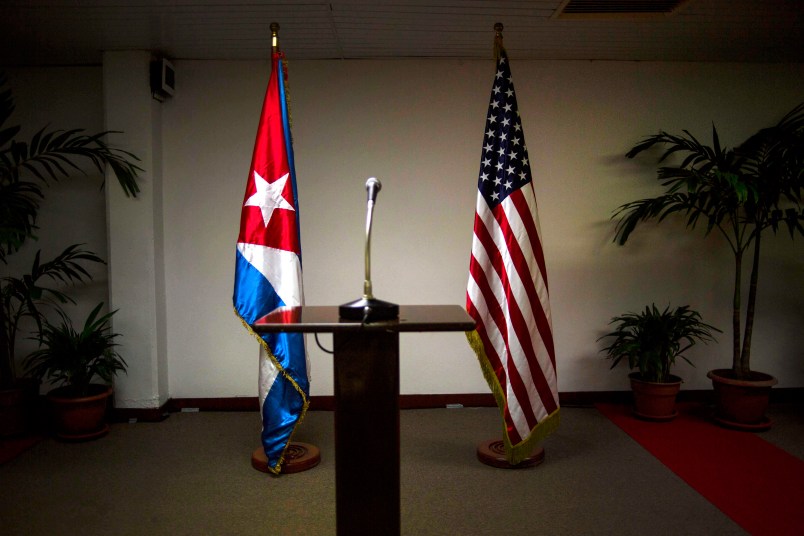
WASHINGTON (AP) — American and Cuban officials were trying Thursday to complete talks to re-establish embassies in each other’s capitals after a half-century interruption. Many differences appeared close to being resolved.
The top U.S. diplomat for Latin America, Roberta Jacobson, was meeting with her Cuban counterpart, Josefina Vidal, at the State Department, though officials suggested a breakthrough was unlikely.
The talks come as two of the biggest obstacles to the restoration of U.S.-Cuban diplomatic relations are being removed.
Cuba will come off the U.S. state sponsor of terrorism list on May 29. Also, the U.S. says Cuba’s Interests Section in Washington has established a relationship with a U.S.-based bank, meaning it won’t have to operate on cash anymore.
Other issues remain. The U.S. is still seeking to ensure its diplomats can travel throughout Cuba and meet with dissidents without restrictions.
In a symbolic show of closer U.S.-Cuban ties, 10 Cuban journalists attended Thursday’s White House briefing and press secretary Josh Earnest offered the final question to one of the reporters. A woman who identified her news organization as Cuban National Television took up the opportunity.
Cuban President Raul Castro recently complained about U.S. programs for training Cuban journalists, calling them an “illegal” infringement on Cuba’s sovereignty. The State Department says it maintains such democracy programs in “restrictive environments” around the world.
___
Associated Press writer Darlene Superville contributed to this report.
Copyright 2015 The Associated Press. All rights reserved. This material may not be published, broadcast, rewritten or redistributed.