

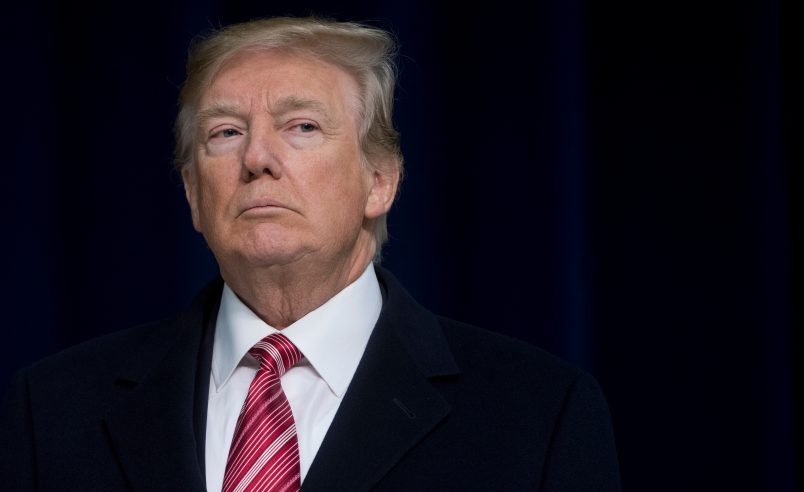
WASHINGTON (AP) — President Donald Trump has spoken: He wants U.S. troops and civilians out of Syria by the fall. But don’t call it a “timeline.”
Wary of charges of hypocrisy for publicly telegraphing military strategy after criticizing former President Barack Obama for the same thing, the White House has ordered Trump’s national security team not to speak of a “timeline” for withdrawal. That’s even after Trump made it clear to his top aides this week that he wants the pullout completed within five or six months.
It wasn’t the result top national security aides wanted. Trump’s desire for a rapid withdrawal faced unanimous opposition from the Joint Chiefs of Staff, the Pentagon, the State Department and the intelligence community, all of which argued that keeping the 2,000 U.S. soldiers currently in Syria is key to ensuring the Islamic State does not reconstitute itself.
But as they huddled in the Situation Room, the president was vocal and vehement in insisting that the withdrawal be completed quickly if not immediately, according to five administration officials briefed on Tuesday’s White House meeting of Trump and his top aides. The officials weren’t authorized to discuss internal deliberations and requested anonymity.
If those aides failed in obtaining their desired outcome, it may have been because a strategy that’s worked in the past — giving Trump an offer he can’t refuse — appears to have backfired.
Rather than offer Trump a menu of pullout plans, with varying timelines and options for withdrawing step-by-step, the team sought to frame it as a binary choice: Stay in Syria to ensure the Islamic State can’t regroup, or pull out completely. Documents presented to the president included several pages of possibilities for staying in, but only a brief description of an option for full withdrawal that emphasized significant risks and downsides, including the likelihood that Iran and Russia would take advantage of a U.S. vacuum.
Ultimately, Trump chose that option anyway.
The president had opened the meeting with a tirade about U.S. intervention in Syria and the Middle East more broadly, repeating lines from public speeches in which he’s denounced previous administrations for “wasting” $7 trillion in the region over the past 17 years.
What has the U.S. gotten for the money and American lives expended in Syria? “Nothing,” Trump said over and over, according to the officials.
The intensity of Trump’s tone and demeanor raised eyebrows and unease among the top brass gathered to hash out a Syria plan with Trump, officials said: Gen. Joseph Dunford, chairman of the Joint Chiefs of Staff; Defense Secretary James Mattis, CIA chief Mike Pompeo and acting Secretary of State John Sullivan.
At one point, Dunford spoke up, one official said, telling Trump that his approach was not productive and asked him to give the group specific instructions as to what he wanted.
Trump’s response was to demand an immediate withdrawal of all American troops and an end to all U.S. civilian stabilization programs designed to restore basic infrastructure to war-shattered Syrian communities.
Mattis countered, arguing that an immediate withdrawal could be catastrophic and was logistically impossible to pull off in any responsible way, without risking the return of the Islamic State and other terrorist groups in newly liberated territories, the officials said. Mattis floated a one-year withdrawal as an alternative.
Trump then relented — but only slightly, telling his aides they could have five or six months to complete the mission to destroy the Islamic State and then get out, according to the officials. Trump also indicated that he did not want to hear in October that the military had been unable to fully defeat the Islamic State and had to remain in Syria for longer.
The president had spoken. But what to say about it publicly?
In a brief and vague statement released the day after the meeting, the White House said the U.S. role in Syria is coming to a “rapid end” and emphasized that the U.S. was counting on other countries and the U.N. to deal with Syria’s future. But it offered no specificity as to the timing of a U.S. withdrawal.
“The president has actually been very good in not giving us a specific timeline,” Lt. Gen. Kenneth McKenzie, director of the Joint Staff, said Thursday. “We’ve always thought that as we reach finale against ISIS in Syria, we’re going to adjust the level of our presence there. So in that sense, nothing has actually changed.”
Pentagon officials stressed that no formal order had been handed down to the military to alter course or start a withdrawal. Nonetheless, the officials said Trump was clear in his intent.
For Trump, any notion of a “timeline” comes with significant political risk. After all, he had regularly bashed Obama on the campaign trail for forecasting his military moves in advance. In fact, Trump was so critical of Obama for putting an arbitrary deadline on the 2011 Iraq withdrawal that he dubbed Obama “the founder of ISIS,” arguing that Obama had signaled to al-Qaida sympathizers in Iraq that they need only wait the U.S. out.
And Trump’s whole strategy for dealing with Afghanistan, for example, is based on the idea that the U.S. presence should be “conditions-based” and not time-based.
“I’m not like other administrations, where they say we’re going to do this in four weeks and that. It doesn’t work that way,” Trump said last year, shortly after becoming president.



He wants withdrawal by November so his $30 million ego-trip military parade can be labeled a Victory in Syria parade.
I get the impression that he does not have the least clue as to what he is doing in his sub-zero capacity with the immense power and equivalent responsibility of the Presidency. What he does understand is that the worse his directives are the more they are reported on teevee, newspapers, and radio all over the world. That is what keeps the attention vampire alive and happy, happy, happy. So really there is no reason for him to change the behavior of chaos that has been his whole life.
I am reminded of a very good construction safety officer who knew he had to constantly be watching and wondering: What’s Bubba gonna do today? The trouble is, Congress don’t need no stinkin’ safety officer.
That’s because with Donnie Dotard, there is no national security anymore…
The level of detail about this meeting that’s leaked is stunning. It’s a cry for help by the Pentagon to save them from this dullard.
Trump’s policy is anathema to the Pentagon, Intelligence agencies, the State Department, and mainstream Republicans. It’ll be interesting to see how this develops.
He truly is out on his own with this, with nobody but Putin to blame when things go wrong.
His latest stunt of sending National Guard troops to the southern border is nothing more than national security theatre.