


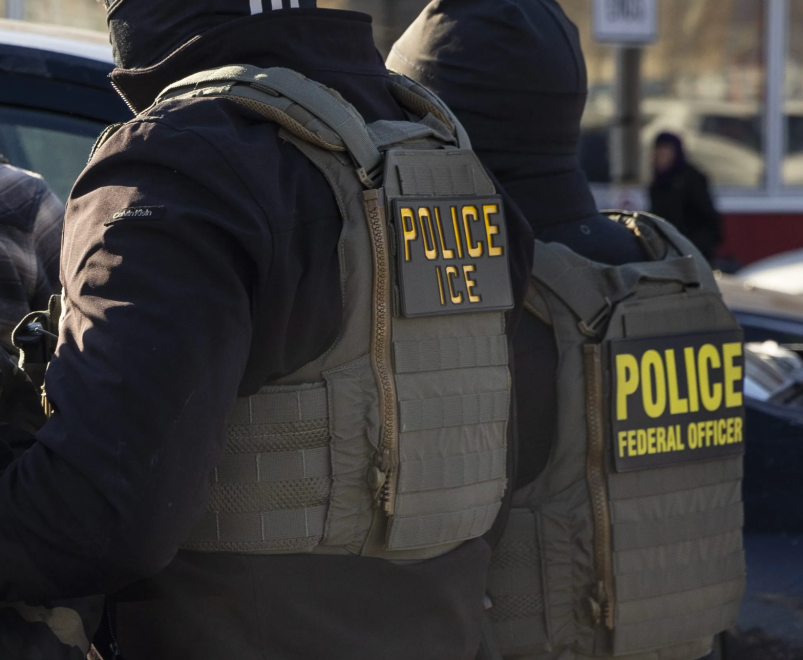
The Trump administration used a tool created in the early days of the War on Terror to obtain financial information without a search warrant as part of its broad crackdown on opposition groups, new documents show.
In newly released emails, agents with Homeland Security Investigations (HSI) used the law, established by the PATRIOT Act, to canvas financial institutions across the country for an investigation. While the target of the search is not clear, DHS produced the emails through discovery as part of the case against a supposed Minneapolis “Antifa” cell.
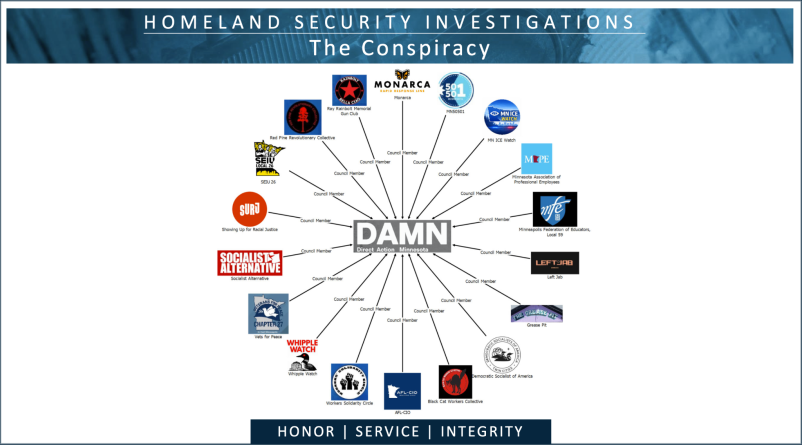
Fifteen people were eventually charged with conspiracy to impede law enforcement in the case; prosecutors and HSI agents posited to a grand jury that the 15 people were part of an octopus-like conspiracy involving a handful of groups it considers left-leaning, such as public sector unions, Democratic Socialists of America, the AFL-CIO, the SEIU and more.
The emails show HSI investigators making use of the PATRIOT Act provision, known as 314(a). Former prosecutors explained to TPM that 314(a) would allow law enforcement to map out an entity’s financial dealings without needing to obtain a warrant, convene a grand jury, or issue a subpoena. All investigators need to do is submit a search term to the Treasury Department and certify that the investigation concerns either money laundering or terrorism.
“With a single 314(a) issuance, you can get a nationwide vantage point into where a customer does all of his or her banking,” Jeff Breinholt, a former deputy chief at the DOJ’s Counterterrorism Section, told TPM.
In February, agents in Homeland Security Investigations’ St. Paul office opened Operation Puppet Master, looking at the “funding sources” of groups that it deemed responsible for organizing mass protests in Minneapolis during the surge of federal immigration enforcement there.
Senior Trump administration officials had openly discussed launching these types of investigations since the assassination of far-right activist Charlie Kirk: then-ICE Director Todd Lyons told Glenn Beck in September that HSI would begin investigating the financial backers of anti-ICE protests. At the same time, the White House issued National Security Presidential Memorandum 7 (NSPM-7), a national strategy purportedly designed to tamp down on domestic terrorism by defining left-wing beliefs as indicative of a likelihood to engage in political violence.
In the twin cities, HSI — DHS’ investigative agency, housed under Immigration and Customs Enforcement — used NSPM-7 to justify a wide-ranging investigation into the financial records of unions, climate groups, and more. In one investigation report, released by defense attorney for one of the 15 defendants Kevin Riach, an officer described the investigation as “involving protest domestic terrorist financing.”
Investigators do not receive detailed financial information from a 314(a) search, experts said. Rather, it shows whether a financial institution has records of an account or transactions that match a given search. It’s a lead: investigators have to obtain more detail by other means.
“What it shows is everybody on that chart that is purported to be part of this conspiracy — the government now knows exactly which financial institutions they deal with,” another former prosecutor, who requested anonymity, told TPM. “That network is being mapped out pretty assiduously.”
The U.S. Attorney’s Office in Minneapolis did not return a request for comment.
The vast majority of these searches are carried out under a money laundering justification, FinCEN, the Treasury’s office for tracking financial crime, says. Records from the Minneapolis conspiracy case — in which federal prosecutors accuse 15 anti-ICE protestors of engaging in an “Antifa” conspiracy to impede law enforcement — show that HSI has characterized the probe internally as a terrorism investigation.
Congress created 314(a) as a tool as part of the PATRIOT Act in late 2001. Instead of having to subpoena banks across the country to find a hit, the thinking went, it would allow banks to give law enforcement a lead on where to look. That portion of the law didn’t attract much attention among professional civil liberties advocates at the time; one editorial from the Cato Institute described the law as “gutting much of the Fourth Amendment” without naming the provision.
Since then, however, it’s become the focus of some civil libertarians, who argue that the breadth of the tool is itself a cause for concern, as is the lack of oversight.
“It sets out a nationwide canvas for a person of interest. There’s no judicial sign-off, there’s no court order, there’s no subpoena,” Nicholas Anthony, a research fellow at the Cato Institute, told TPM. “It’s just an internal request that’s effectively done. And it can reveal a lot of information about a person.”
One record that Riach obtained via the discovery process and released shows agents discussing the 314(a) request over email. The search terms are not revealed in the exchange; rather, HSI agents based in Los Angeles discuss issuing and receiving hits on the 314(a) requests.
“Quite a few more responses attached,” replied one agent, Amber Tallas, on the thread. A case number included in the thread matches a search for 29 different subjects in a document published by FinCEN.
One agent on the email thread discussing the 314(a) request is Ryan Ribner, a supervisory special agent for HSI based in the Los Angeles field office. Ribner appeared in the news last year for his arrest of SEIU-California leader David Huerta.
Ribner wrote a report of the arrest in which he accused Huerta of grabbing and pushing a federal officer. He then arrested the SEIU leader.
In an affidavit filed with a criminal complaint against Huerta, Ribner said that the officer placed his hands on Huerta first. That case accused Huerta of impeding federal law enforcement, saying that Huerta blocked a government car as agents conducted an immigration raid. Video of the arrest contradicted the agent’s reports; Huerta was later hospitalized with a head injury.
It’s not clear from the filings whether Ribner and others knew that Huerta was a leader of SEIU when they moved to detain him at the protest. Federal prosecutors dropped the case in July.




I guess latitude in statutory interpretation really is a double-edged sword; all it takes is a bit of evil intent and, bam, defense becomes a tryrant’s cutting edge.
Justin Wolfers writes:
The impending damage from Trump tariffs were covered intensely at first, but somehow the media slacked off as they became an on-again-off-again routine depending on the week or day of the week. Only now is the larger damage emerging. Americans must appreciate the damage done, they can’t be that ignorant or stupid.
Ah, this will get the nation’s militias to comment!
Please. Persecution, not “crackdown” as if this was law enforcement.
Yet another problem of separating the parliamentary function of writing legislation from the executive function of interpreting and enforcing legislation. It’s almost like there is a reason the majority of democracies don’t use a presidential system like ours.