


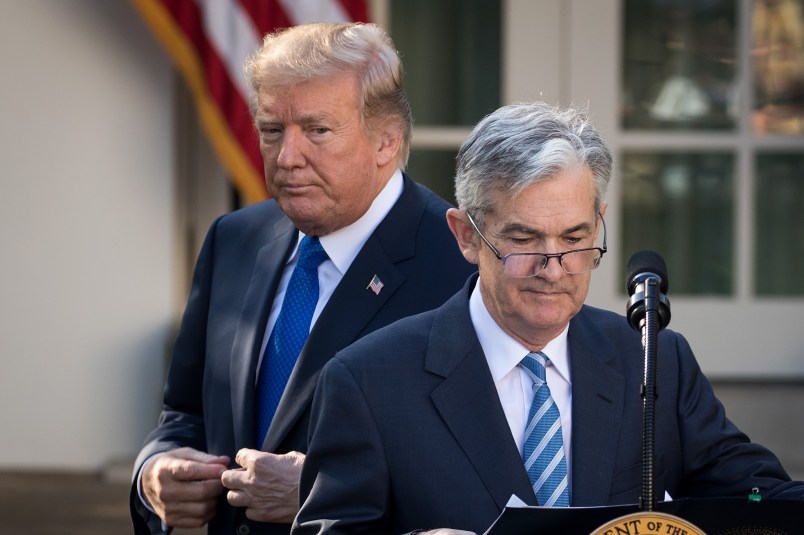
On Wednesday, the Supreme Court will hear oral arguments on whether President Trump can continue his rampage through the federal government by removing Federal Reserve Governor Lisa Cook without due process, giving the executive unprecedented power over the nation’s premier financial institution.
Trump has since his first term openly tried to manipulate Federal Reserve governors into cutting interest rates, seemingly to benefit his own political and business interests and those of his allies. He’s taken unprecedented steps to apply pressure, including trying to remove Cook on a manufactured allegation of mortgage fraud and arguing with Federal Reserve Board Chair Jerome Powell in-person over the cost of renovations to two Fed buildings. Late last week, Trump’s administration launched a sham criminal investigation of Powell, accusing the Chair of lying about the cost of the renovations in a move decried by a bipartisan panel of experts and elected officials.
At its core, the Federal Reserve is America’s central bank. It consists of the Board of Governors in Washington D.C. and 12 regional banks, each responsible for its own multi-state district.
The Fed’s two main mandates are to maintain maximum employment and to control price inflation. For those aims, it wields just one tool: controlling interest rates that affect the cost of borrowing money and doing business. Using economic data, members of the Fed vote eight times a year on whether to raise, lower, or hold interest rates.
If the Supreme Court decides Trump can remove Cook, it will swing wide open the door that would give the president full power to pluck out Fed governors and replace them with his own loyalists.
A Trump takeover of the Fed could mean the president, through his chosen governors, would be able to slash rates at will, risking skyrocketing inflation and driving up unemployment, as has happened in countries like Argentina and Turkey.
But the Fed has many more tools the president could seize if SCOTUS kills Federal Reserve independence, a panel of experts said on a Thursday morning press call organized by Groundwork Collective, a left-leaning economic policy organization.
Beyond a protracted affordability crisis, here’s what else is at stake.
Trump Could “Reward His Billionaire Friends.”
Sen. Elizabeth Warren (D-MA) highlighted the Federal Reserve levers Trump could pull to enrich himself and the billionaires who have adhered themselves to him in his second term, openly courting the president in exchange for preferential policy.
“Once Trump controls a majority of the Fed, he can use the Fed’s vast powers to enrich himself personally, to reward his billionaire friends, and to punish his enemies,” Warren said.
Trump could help himself and business owner friends by cutting interest rates and making it cheaper to do business.
He could also abuse the Fed’s role as the “bankers’ bank,” in which Federal Reserve Banks provide banks with commercial services the way banks serve their individual customers. Those responsibilities expanded during the 2008 global financial crisis, when the Federal Reserve bailed out Wall Street by purchasing tens of billions of dollars worth of “toxic” securities from the world’s largest financial institutions to bolster companies’ balance sheets.
Trump could further leverage that authority to lend money to financial institutions run by business people who have allied themselves with the president.
On the Flip Side, He Could Punish His Enemies.
A Trump-controlled Federal Reserve Board could withhold funds and services from banks whose leaders draw the president’s ire.
Trump has shown little to no restraint in weaponizing the federal government against his political opponents. He’s tried to yank funds from blue states, weaponized the Department of Justice against officials who have challenged him, and removed congressionally approved agency officials at-will, regardless of the law.
Exerting unprecedented influence over the central bank would give the president free rein to regulate and supervise financial institutions. The Fed helps write regulations for financial institutions, investigates banks for rules violations and enforces the law. The Fed has even more jurisdiction over the tens of state banks, those chartered by states rather than the federal government, including the power to force out-of-compliance state banks to “forfeit all rights and privileges of membership” in the Fed banking system. From there, it’s not hard to envision a megalomaniac president using the power of the Fed to bully blue states by manipulating their financial institutions.
“What if a bank doesn’t lend to a key ally of the White House?,” queried Rohit Chopra, former Consumer Financial Protection Bureau director, on Thursday. “Will they face losing access to the Fed’s primary credit programs? Or what if they don’t cooperate with a key item on the president’s agenda? Do they have to worry about getting debanked?”
A Backdoor Power of the Purse
The U.S. Treasury holds its checking accounts at the Fed, where the government receives revenues and issues payments. The Fed also facilitates Treasury auctions of securities, including Treasury notes, bonds and bills, to investors to raise money.
A Fed controlled by the president could help facilitate Treasury auctions not when the department’s spending exceeds its income, but at the president’s whim to raise revenue for whatever reason. Trump could also abuse the Fed’s Treasury account by exerting more unilateral influence over the department withholding or issuing payments outside of congressional approval.
“The central bank controls the monetary levers, is the backbone of the payment system,” said Columbia Law professor Lev Manand on Thursday. “And the monetary levers can be abused to lend money, to buy assets in ways that further the administration’s priorities and allow the administration to evade the legislature that is supposed to under our constitutional system have the power of the purse.
“A president that could control the Federal Reserve would be even more capable of evading Congress,” Manand said, “which is, I think, the reason why this is so high stakes.”




Because they’re wealthy enough (yes, even you Clarence), and afraid for the their money (which is really the only thing that matters), and the money of their benefactors, the SC radicals will likely find some novel way to keep the Fed safe from Trump’s predations. Of course, it will be method that they will make quite clear does not apply to anything else.
They’ll hear arguments? Can we all just get along?
Can we perhaps build on common solutions instead?
You must obey Hair Fuhrer. (sp?) Or else.
They are already building concentration camps.
I toured Dachau in 1975 and could still smell the burning flesh. A sobering experience at 16. Never forget.