


This story was originally reported by Sara Luterman of The 19th. Meet Sara and read more of their reporting on gender, politics and policy.
More than 25 years ago, Lois Curtis called a lawyer with the Atlanta Legal Aid Society from a pay phone in a hospital hallway. She had an intellectual disability and wanted help to get out of the state hospitals where she had lived for most of her life. Instead of spending her days heavily sedated and shuffling between the day room and the place where she slept, she wanted to be in her own apartment, to make her own decisions about what to do with her days.
“She’d say, ‘Get me out of here. Would you please get me out of here? When am I getting out of here?’” recalled the lawyer, Sue Jamieson, in an oral history for the Atlanta Legal Aid Society.
With representation from the legal aid group, Curtis and her co-plaintiff, fellow Georgia resident Elaine Wilson, brought a challenge to the U.S. Supreme Court, which ruled in their favor in 1999. In Olmstead v. L.C., which stands for Lois Curtis, the majority held that the 1990 Americans with Disabilities Act guarantees that people with disabilities have a right to live outside the walls of asylums, state hospitals and nursing homes.
More than two decades later, that right is under threat. In June, President Donald Trump’s Department of Justice published a memo stating that the federal government has no obligation to enforce Olmstead. In August, the DOJ began withdrawing from cases where it had previously been defending people with disabilities (and their families) who wanted to receive care in their own homes.
Last month, the department settled a case, Texas v. Kennedy, which invalidated federal regulations defining what it means to live in a community.
“Losing that clear direction is a serious setback,” said Maria Town, president of the American Association of People with Disabilities. “Disabled people should not have to enter an institution to get the services they need.”
Disability and caregiving issues are women’s issues. Family caregivers, mostly women, normally fill the gaps when state-funded care falls short. Recent changes by the Trump administration will affect what home care is available and whether it is available, profoundly reshaping the lives of these women and the people they support.
Here is a closer look at where things stand more than 25 years after the bedrock Supreme Court case and how the rights it affirmed are under threat.
What did the Olmstead case change for people living with disabilities?
In 1967, around 200,000 people with intellectual and developmental disabilities were confined to large institutions like asylums and state hospitals. By 2024, that number fell to 16,000 thanks to the Olmstead decision, DOJ enforcement and decades of expanding home care options through Medicaid and programs like Money Follows the Person.
“It’s really fundamentally about whether or not people with disabilities can live, work, go to school, make all the decisions about how you spend your day and you spend your life with — all the decisions that people without disabilities have,” said Regan Rush, who spent 15 years at the Department of Justice’s Civil Rights Division, where much of her work involved Olmstead enforcement.
Lois Curtis and Elaine Wilson, the plaintiffs in the original case, went on to live outside state hospitals and asylums. Wilson, who died in 2004, lived in her own home with a support person. She loved cooking, coupon-clipping and going to church.
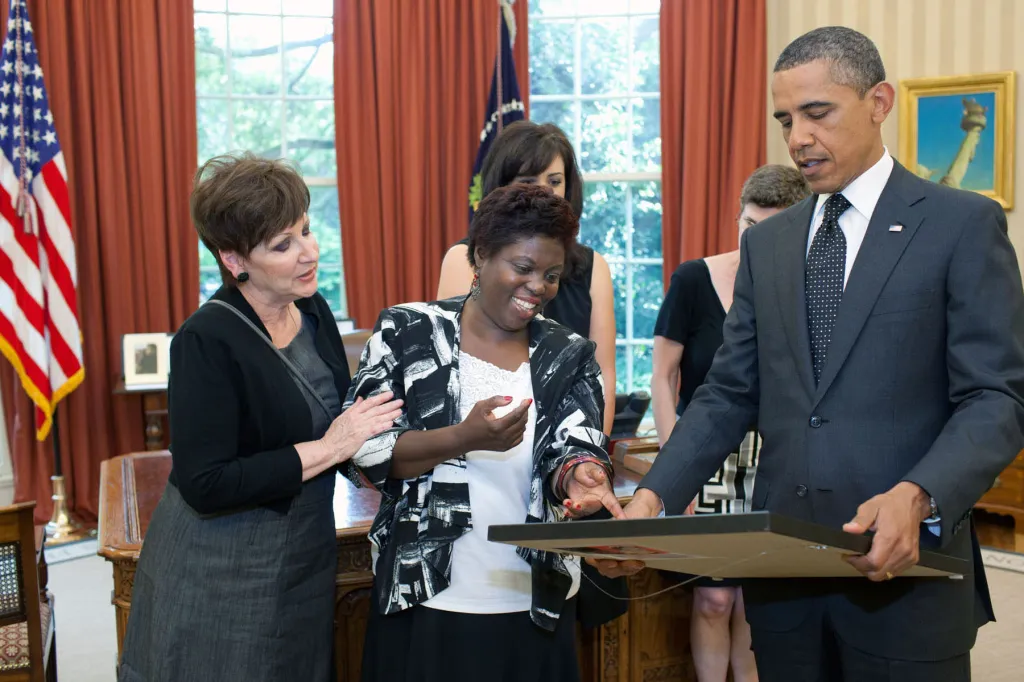
Curtis became an artist, and in 2011, she met President Barack Obama at the White House to celebrate the 12th anniversary of the Olmstead decision. Curtis gave the president a portrait of herself as a child, part of a series she created because no photos existed of her as a child. Curtis died in 2022.
What does the law actually say about where people with disabilities can live and receive care?
The Americans with Disabilities Act, known as the ADA, was passed in 1990 and is the bedrock of American disability rights law. Section 504 of the Rehabilitation Act of 1973 was a precursor to the ADA and was one of the first laws to provide people with disabilities protection from discrimination. The Olmstead decision established that these laws also provide a right to the “most integrated setting” possible when it comes to establishing where disabled people can receive services — and, by extension, where they can live.
“A ‘most integrated setting’” has long been considered a place where people with and without disabilities are able to interact,” said Alison Barkoff, a professor of health law and policy at George Washington University. Barkoff served as special counsel for Olmstead enforcement at the Department of Justice from 2010 to 2014.
“Do people have opportunities to go out into the broader community? Do people have choices in their day-to-day life? Things like when do they get to eat a meal and what time are they able to have visitors?” she continued.
What changed with Texas v. Kennedy?
Several years ago, 16 Republican-led states sued the Biden administration, challenging regulations framing “gender dysphoria” as a disability. The lawsuit also challenged the entirety of Section 504 of the Rehabilitation Act.
Over time, the litigation narrowed considerably and states withdrew from the case due to pressure from state-level disability advocates. By this summer, only Alaska, Florida, Louisiana, Montana and Texas remained parties to the lawsuit. Last month, the Justice Department and the remaining states reached a settlement that narrowly invalidated part of Section 504.
It is important to note that the resolution does not declare Section 504 or any other disability rights law unconstitutional.
“It doesn’t rescind the entirety of 504,” Barkoff said. “The constitutionality of 504 is off the table. It’s a lot narrower than it could have been.”
What the settlement agreement does do is invalidate regulations from 2024 that more precisely define the legal mandate for “the most integrated setting.” This is a more limited outcome than what was initially on the table, but still threatens integration for people with disabilities.
Before the legal mandate for the “most integrated setting,” there were places like Willowbrook State School in Staten Island, New York. Thousands of people with intellectual, developmental and psychiatric disabilities were left to languish in overcrowded, isolated facilities separate from the outside world. Before Olmstead and the disability rights movement, hundreds of thousands of people with disabilities were confined to state hospitals and asylums, often for their entire lives.
This history is one of the reasons many disability rights groups have responded so loudly to the resolution of Texas v. Kennedy. The other reason is the steps that the federal government under President Trump has taken to roll back the protections guaranteeing people with disabilities a right to live in homes of their choosing and as members of a community and not an institution.
The Olmstead decision is closely related, though technically separate from, the regulations and rules now under fire. The U.S. district court’s decision in Texas v. Kennedy does not alter the Supreme Court’s 1999 opinion. It does, however, reinforce the Trump administration’s assertion that the federal government is not obligated to enforce Olmstead.
The Department of Health and Human Services, or HHS, was represented by the DOJ in Texas v. Kennedy. According to Barkoff, the DOJ “decided to stop defending the long-standing obligations in the 504 case” by agreeing to remove language in the updated regulation about community living.
The Department of Justice did not respond to The 19th’s questions about why the government has come to this conclusion and what, if any, enforcement related to disability rights they plan on stepping back from next.
Does Texas v. Kennedy overturn Olmstead v. L.C.?
Not according to experts like Rush and Barkoff. Barkoff was careful to reassure people with disabilities and their families about the limited scope of the resolution.
“The Department of Justice can change their own interpretation, their enforcement priorities,” Barkoff said. “They cannot change the long-standing decision in Olmstead from the Supreme Court. The only way that could be changed is if the issues were revisited by the Supreme Court.”
“This is really scary for people with disabilities,” Barkoff said. “People have fought very long and very hard for decades, both for the civil right to be included, to be part of their communities, and also to make sure that the services are there to help support them in their right to be part of their community.”
A Supreme Court challenge to Olmstead isn’t impossible, but it is unlikely. For the past few years, disability advocates have worked hard to prevent cases that may threaten disability rights from going forward.
What do advocates for people with disabilities and their families plan to do next?
Until the next presidential election in 2028, the fight for the right to live in the community will primarily occur at the state level and through private cases.
A statement from several major disability rights groups, including the Arc of the United States and the Disability Rights and Education Fund, declared, “We will not go back.”
Barkoff also pointed to a recent letter from 18 Democrat-led states, calling for the DOJ to acknowledge and enforce the right to live in the community.
“It’s really going to be on states going to pick up the mantle,” Barkoff said.






As a disabled person, I find the whole concept of this terrifying. TFG has said he wants to bring back asylums. Lock people away where they won’t be seen or heard. Most people just shrug “doesn’t affect me”.
It’s scarier for families of children with disabilities
https://www.npr.org/2026/10/01/nx-s1-5981375/integration-mandate-disabilities-reversed-trump
Florida families are finding out how catastrophic this is
Add in the 26% cut to Title I, which not only provides funding to schools in low income areas, it also provides the money for speech language pathology, one-on-one aides for students with autism, in wheelchairs and other issues.
Lock 'em up!
Since the Olmstead ruling, many cities and states closed down their mental health facilities. The buildings no longer stand. Exactly where do the adults and children go if they get away with demolishing this law/ruling? There may be nursing homes, but there are not many who specialize in disabilities. Then the question is who pays for this care if the government is slashing the budget.
While I don’t have anyone in my family with this kind of disability, I worry just the same.
They’re eugenicists and they style themselves after the Nazis. They won’t stop at trying to bring back involuntary lifetime commitment to asylums, but we can vote them out of office and prosecute them out of existence.
I worked as a case manager for the chronically mentally for about twenty five years, ending that part of my career thirty years ago. We worked with chronic mentally ill adults - living on their own, with family, or in group homes. With some help with budgeting, medications, and keeping their apartments clean, they could live successfully without hospitalization. Returning to failed policies of forced hospitalization for everyone is a horrible decision.
This country had an active campaign to institute eugenics policies, we outsourced it to Europe where it actually took off, not just in Germany. Some States may still have forced sterilization on the books. Until we all reckon with this history, we are doomed to repeat it. The State can deem you disabled any time they want to exclude you from society, so anyone can be targeted. Note that in CT there was an effort to sterilize people who wore glasses.