


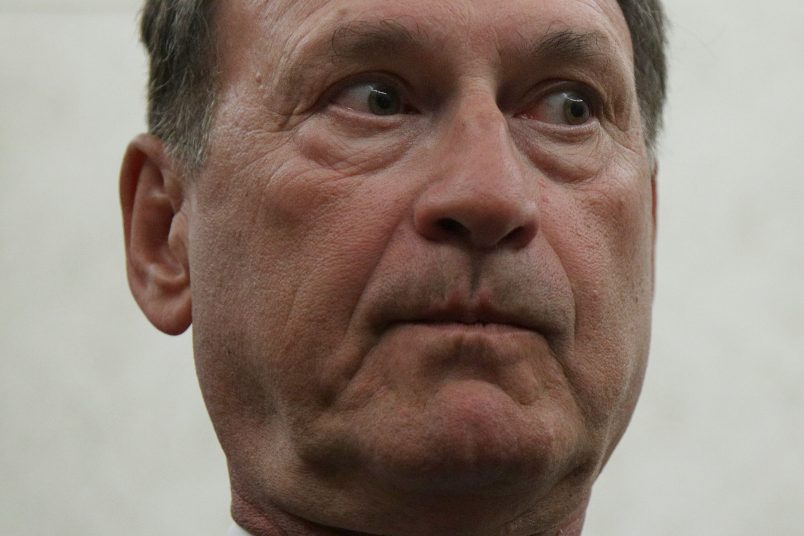
The Supreme Court was simply hamstrung, Justice Samuel Alito wrote, unable to knock down Texas’ hyper-partisan, likely racial gerrymander because the election it would govern is so close.
Said election, though, is a whopping 11 months away. Yet that near year of time — plus a March primary, which Texas could delay — counts as the “eve of an election,” Alito wrote in his concurrence, so close to voting that changing the maps risks confusing voters. He’s referring to the Purcell principle, which stems from a 2006 case that concerned a change in Arizona photo ID laws “weeks away” from the election.
This isn’t the first time the Supreme Court’s right wing has invoked Purcell to uphold Republican maps, even when they’re being litigated comically far out from the election. In 2022, the Court blocked a district court order requiring that Alabama draw new maps, even though the state had nine months to draw new ones before the general elections.
Making the invocation of Purcell even flimsier in Thursday’s case — Abbott v. League of United Latin American Citizens — Texas only produced its new maps in August, under pressure from the Trump administration to eke out a few more Republican seats. The plaintiffs challenging the maps and the district court, Justice Elena Kagan wrote in dissent, worked as quickly as they possibly could — meaning that the Court just wrote a roadmap for illegal gerrymanders. Just wait to pass them until the “eve” of the election, and no one can stop you.
“And even supposing it is now the ninth or tenth hour, whose choice was that?” she wrote. “It was of course the Texas legislature that decided to change its map six months before a March primary.”
The status quo, she added, isn’t the new maximal gerrymander Texas passed in late summer. It’s the 2021 maps that were used for the past two election cycles, were expected to govern the 2026 elections until August and will even be used for a special election in January.
Alito’s — and presumably the unsigned majority’s — interpretation of Purcell “gives every State the opportunity to hold an unlawful election,” Kagan wrote.
Such signals from the high court are all the more useful, as red states (and blue states in response) race to contort their legislative districts, the better to stack the deck for a House majority before any voter has cast a ballot.



Just so we have this right wing Nazi horseshit straight.
Gerrymandering a state’s districts on the eve of an election is fine. But appointing a Supreme Court justice a year before an election is “too close” and the voters must decide.
Folks, this bullshit is on us. At this point we’re not being bent over, we’re happily bending over for them and asking for it. When the fuck are we going to fight back. And please, please, please don’t give me the bullshit that “we can’t do anything.” That’s fucking loser talk and you may as well STFU. Did the French roll over for the Nazis during the occupation? Did the Vietnamese just let us roll all over them? No. But Jesus, if you’re looking for a limp dick, look no further than your nearest Democrat.
It looks like Moscow Mitch is now writing the Supreme Court’s decisions.
Ok, let me review the details here. So this gerrymandering occurred far enough away from the election that it was taken to court, have an appeal all the way to SCOTUS, where SCOTUS rules almost a year away from the election.
But that is too close to the election. Right.
Oh, sorry, I mean far rightttt…
This is the Roberts Court, not the Supreme Court. Corrupt and partisan, the Roberts Court is a disgrace. Make him own it.